
Playing Cowboy: Summers on Dude Ranches
Clip | 4m 45sVideo has Closed Captions
Dude ranches shaped the way generations of tenderfeet viewed the American West.
Dude ranches were popular destinations in the mid-1900s. Tourists could enjoy a watered-down version of life on the ranch, trading crowds and pollution for open spaces, fresh air, horseback riding, and fly fishing. Those who spent summers on these dude ranches left with a fondness for the West. One ranch owner shares what a formative experience he had as a young "dude" on Valley Ranch.
Problems playing video? | Closed Captioning Feedback
Problems playing video? | Closed Captioning Feedback
Made in the West is a local public television program presented by Nashville PBS
Playing Cowboy: Summers on Dude Ranches
Clip | 4m 45sVideo has Closed Captions
Dude ranches were popular destinations in the mid-1900s. Tourists could enjoy a watered-down version of life on the ranch, trading crowds and pollution for open spaces, fresh air, horseback riding, and fly fishing. Those who spent summers on these dude ranches left with a fondness for the West. One ranch owner shares what a formative experience he had as a young "dude" on Valley Ranch.
Problems playing video? | Closed Captioning Feedback
Where to Watch Made in the West
Made in the West is available to stream on pbs.org and the PBS app.
(rhythmic music) - When I was a young guy and I lived in Greenwich, Connecticut and in New York growing up, I loved the Westerns that were on the local television station.
And I would watch those, and they came on at the time when the Sun was setting.
And I would look through the windows behind the TV at the setting Sun, setting in the west, and I would see these cowboys riding, and all that sort of thing, and I thought, "You know, what's it really like?"
And had a chance to come out when I was 12 years old, which is right at that beginning when children really start to develop, and significant experiences that kids have at that age, really sticks for life, and boy, did this visit out to Valley Ranch when I was 12 in 1965, that stuck big time.
And I remember driving in to Valley the first time, and in the driveway coming into Valley, we don't have it now, but there used to be a ford, that is to say, a river crossing, a stream crossing, which I thought was quite novel, you know, in New York, if there was a river floating through the street, that was a problem, no, this was natural here.
It was a deep experience, one, which I remember today, I can close my eyes and I can see that trip, and it made a huge impression, as you can tell, - Dude ranches are, while they still exist, they're not in the heyday anymore, the heyday was sort of in the '40s, '50s, '60s, and an enormous number of Americans, Europeans, and people from all over the world, traveled to the Mountain West to experience a rustic life on the range, and to sort of play cowboy, if you will, for a week or longer.
Back in the '20s and '30s, they would come and stay for a month or the whole summer, and go on, you know, eight-week-long pack trips in the Yellowstone wilderness.
It was a lot of Easterners, it wasn't just Easterners, and many of those people, ended up buying land out here, buying ranches.
- [Barron] Valley was established in 1915, by Larry Larom and Win Brooks of Brooks Brothers, and they were New Yorkers, and their audience was the New York audience.
And that metropolitan group, had never seen the West, except through the lens of Western movies.
And so, the opportunity to come out to this country, ride a horse, live the, quote, "Rough life," and enjoy the features of a dude ranch, was an opportunity that many of those people, just simply couldn't resist.
- [Chase] They were sold a romanticized version of the West, and again, it was a fully-crafted environment.
The Western style was extended to everything from the plates you ate off to the furnishings and the curtains, and the tools in the fireplace, and this had a huge impact on people.
People again, came from all over the country, especially, during the early days of the railroads, the railroads were promoting, working hand in hand with the dude ranches to bring people to the West, and get them utilizing these new travel options, and they were helping sell this romantic vision of the West, these people would come, they would have an incredible experience with their family.
- Valley, was host up to 7,000 guests throughout its history, both as a dude ranch and as a school.
(rhythmic music) When we come here, you often hear people say, "When you come to the West and you see its magnificence, you feel small."
And that is so true.
The country is so majestic and magnificent, that when these tender feet, these guests, these dudes see the light play on the side of mountains at sunset or at sunrise, or they see the waters of the rivers and streams, or they catch a fish, or they sit by a campfire roasting marshmallows, it's an experience totally alien to what they may have had before.
So what do they learn at the end of the month?
Probably, the most important thing, that they are small, that the world and nature are magnificent, and that there is a lot more to learn in the soul, than there is simply checking in with a MasterCard.
(gentle music)
Revitalizing American Craftsmanship: A New Model
Video has Closed Captions
Master artisans share their crafts and unexpected perspectives with university students. (4m 1s)
Video has Closed Captions
A group of American artisans share what drives them and the importance of collaboration. (6m)
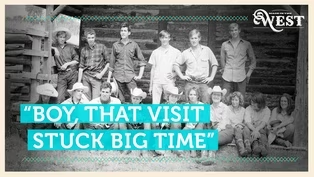 Now Playing
Playing Cowboy: Summers on Dude Ranches
Video has Closed Captions
Dude ranches shaped the way generations of tenderfeet viewed the American West. (4m 45s)
The Frank Lloyd Wright of Handmade Furniture
Video has Closed Captions
Thomas Molesworth may be the most important furniture maker you've never heard of. (5m 50s)
You Know the West Buffalo Bill Sold
Video has Closed Captions
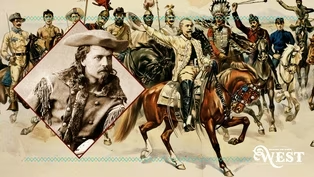
Buffalo Bill's Wild West Show impacts how the world sees the American West to this day. (5m 56s)
Providing Support for PBS.org
Learn Moreabout PBS online sponsorship
- Arts and Music

Art21 showcases today's contemporary visual artists and their groundbreaking creations.







 New Episode




Support for PBS provided by:
Made in the West is a local public television program presented by Nashville PBS