
You Know the West Buffalo Bill Sold
Clip | 5m 56sVideo has Closed Captions
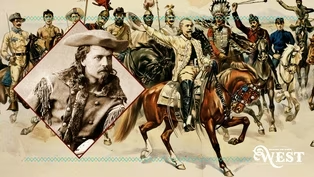
Buffalo Bill's Wild West Show impacts how the world sees the American West to this day.
Historians and art collectors tell William Frederick Cody’s (better known as Buffalo Bill) story as a buffalo hunter, Pony Express runner, showman, and marketing genius. His Wild West Show brought the West overseas and romanticized the area in a way no one had done before and few have done since. His personal style heavily influenced the aesthetic long associated with the American West.
Problems playing video? | Closed Captioning Feedback
Problems playing video? | Closed Captioning Feedback
Made in the West is a local public television program presented by Nashville PBS
You Know the West Buffalo Bill Sold
Clip | 5m 56sVideo has Closed Captions
Historians and art collectors tell William Frederick Cody’s (better known as Buffalo Bill) story as a buffalo hunter, Pony Express runner, showman, and marketing genius. His Wild West Show brought the West overseas and romanticized the area in a way no one had done before and few have done since. His personal style heavily influenced the aesthetic long associated with the American West.
Problems playing video? | Closed Captioning Feedback
Where to Watch Made in the West
Made in the West is available to stream on pbs.org and the PBS app.
- Buffalo Bill was a marketing genius.
I would say he's an influencer, much like we have influencers today.
- It is said that he, in stature, was somewhere between the Queen of England and the president of the United States.
He was one of the most famous people in the world.
- I kind of compare him to the modern day show, Yellowstone.
Buffalo Bill had that same effect back then, and he made the west accessible and romantic.
- He'd been a pony express rider.
He'd been a scout for the army.
He'd been this, that, and the other thing.
But he was an entrepreneur.
He was a promoter.
- [Rebecca] At the height of his Wild West show, he had upwards of 1200 employees.
- [Chase] He had scores of cowboys and Native Americans who he worked with, including some tribal chiefs.
He had female sharp shooters.
He was, in some ways an equal opportunity employer very early.
- Putting on one of these shows with 30 railroad cars full of animals, Native Americans, and I mean, you can imagine still the language barrier at the time, getting a couple hundred Native Americans to go to France or London for a few months or travel to the United States.
- [Chase] They would do these huge outdoor events in really large arenas.
Tens of thousands of people would see these things.
- He assembled this thing using real people in essentially real roles within the Wild West Show.
It's pretty remarkable.
He took that, he put it in a package and unwrapped it in Chicago and New York and London.
- [Chase] He himself was a great showman.
He understood marketing and branding before that was a concept.
It was just in his bones, the way he presented himself, the way he courted the press, the way he created posters that were put all over cities in advance of his group's arrival.
The graphic design of these posters stands up today.
It's incredibly well done and beautiful and exciting and gets a message across and kind of makes you want to go.
- Buffalo Bill's style really did inform what we see now as the Western aesthetic, and a couple of things that he did.
First of all, what he was wearing was really important.
When he entered the arena, he was on horseback and he was suited out in a full buck skin beaded outfit with fringe and also bead work that was done by indigenous artists.
He always wore a cowboy hat.
So he would ride in the arena, he'd take off that hat, he'd salute the crowd, and that's where the iconic Western cowboy hat came from.
He had beaded gloves on.
He had these big, tall boots.
He was sitting in a saddle that was really highly decorated and ornate that comes from the different silversmith traditions and the western saddle makers.
And then of course, he had beautiful saddle blankets that were some of the Navajo weavers and others would practice that art as well.
So he was bringing this to the arena.
And then he also had all of his performers represent more of a multicultural western style.
He had Russian cosics.
He had Spanish vaqueros, and also notably, he brought women into the mix.
He had performers like Annie Oakley, trick riders who came, where before a lot of people were concentrating on the male image of the Western cowboy.
So he brought in the female aesthetic as well.
- [Wally] They didn't always dress that way.
That was like a stage play in many respects.
But it was what people thought that West looked like as he went east and as he went to Europe, that he was creating the West in his own mind and sharing it with you.
And what an incredible thing to do at that time in that era, whether it was the saddles were the fabrics that were hand woven or the feathers or the hats or the guns.
It was all, I don't wanna say costumes, but it was all part of the Western environment.
And that's what he shared with people.
And it's sort of what been passed down through time.
We all have an interpretation of the West.
- [Chase] He was always paying attention to the impact he was making and the impact he could have.
And he was driven really, I believe, by a love of the West and a desire to share.
I mean, yes, he was trying to build something.
He was a great entrepreneur and he, you know, established a town of Cody and brought people here once he was famous.
- I don't think anybody had more of an impact than Buffalo Bill on, you know, the West and how people saw it.
But you know, it was, some of it wasn't real, but it introduced people from the cities to something that hundreds of miles away that they did not know about.
- Oh my, this is gonna sound like BS.
It was sort of a magical approach to an interpretation of the West.
Here it was in front of you portrayed by stagecoach robberies and horses running wild and roundups and all of those things.
And he put it together in this special little box that got unwrapped and what a great moment for this country and for the West and I like to believe it's still all true.
(light music)
Revitalizing American Craftsmanship: A New Model
Video has Closed Captions
Master artisans share their crafts and unexpected perspectives with university students. (4m 1s)
Video has Closed Captions
A group of American artisans share what drives them and the importance of collaboration. (6m)
Playing Cowboy: Summers on Dude Ranches
Video has Closed Captions
Dude ranches shaped the way generations of tenderfeet viewed the American West. (4m 45s)
The Frank Lloyd Wright of Handmade Furniture
Video has Closed Captions
Thomas Molesworth may be the most important furniture maker you've never heard of. (5m 50s)
 Now Playing
You Know the West Buffalo Bill Sold
Video has Closed Captions
Buffalo Bill's Wild West Show impacts how the world sees the American West to this day. (5m 56s)
Providing Support for PBS.org
Learn Moreabout PBS online sponsorship
- Arts and Music

Art21 showcases today's contemporary visual artists and their groundbreaking creations.







 New Episode


Support for PBS provided by:
Made in the West is a local public television program presented by Nashville PBS