Punctuation Power! - Jennifer Ostrega - Third Grade
5/29/2020 | 58m 18sVideo has Closed Captions
Students will learn how to demonstrate command of standard English punctuation marks.
Students will learn how to demonstrate command of standard English punctuation marks when speaking, reading, listening, and writing with interactive activities and theater scripts!
Problems playing video? | Closed Captioning Feedback
Problems playing video? | Closed Captioning Feedback
NJTV Learning Live is a local public television program presented by NJ PBS
Punctuation Power! - Jennifer Ostrega - Third Grade
5/29/2020 | 58m 18sVideo has Closed Captions
Students will learn how to demonstrate command of standard English punctuation marks when speaking, reading, listening, and writing with interactive activities and theater scripts!
Problems playing video? | Closed Captioning Feedback
Where to Watch NJTV Learning Live
NJTV Learning Live is available to stream on pbs.org and the PBS app.
Providing Support for PBS.org
Learn Moreabout PBS online sponsorshipMore from This Collection
NJTV Learning Live is a class for third graders taught by NJ public school teachers.
Writing Rocks - Nikki Silva- Third Grade
Video has Closed Captions
Students learn how to become stronger writers by varying sentences and adding details. (58m 43s)
Biodiversity in Barnegat Bay - Dunlea & Williams-Third Grade
Video has Closed Captions
We’ll see and explore all the amazing creatures that call Barnegat Bay home. (57m 31s)
PE LIVE! - Gregory Bradley - Third Grade
Video has Closed Captions
Students will do a well-rounded workout including cardio, tae bo, and yoga in this lesson. (57m 1s)
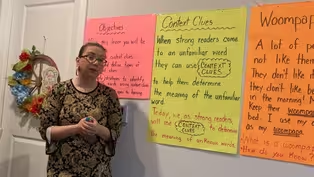
Word Detectives: Context Clues - Janice Alvarez -Third Grade
Video has Closed Captions
In this lesson, students will use context clues to determine the meaning of unknown words. (57m 36s)
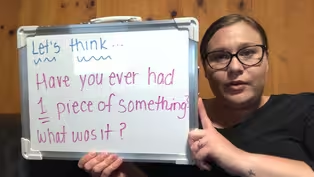
Introduction to Fractions - Krysten Paone-Hurd - Third Grade
Video has Closed Captions
Students will learn the basics of fractions when it comes to “a piece of the whole". (57m 58s)
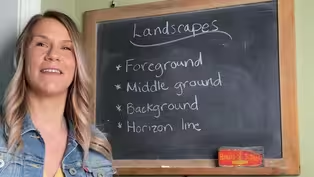
Lovely Landscapes - Natalie Steckel - Third Grade
Video has Closed Captions
In this interactive art lesson, students will learn the four parts of a landscape. (57m 51s)
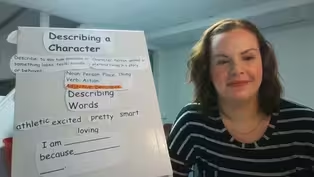
FAST Characterization - Rosemary Matar - Third Grade
Video has Closed Captions
Students will learn how to describe a character using the FAST characterization method. (57m 43s)
Area & Perimeter - Jill Turner - Third Grade
Video has Closed Captions
Students will learn about area and perimeter and apply them to real-life situations. (58m 1s)
You Guessed It!- Haritha Tottempudi - Third Grade
Video has Closed Captions
Students will learn how to infer using a fiction and nonfiction text. (57m 3s)
Sweat, Hydration, and Phys. Ed. - Kyle Muckley - Third Grade
Video has Closed Captions
Students will learn about their bodies and the benefits of physical activity. (55m 24s)
Ready, Set, Draw your Narrative - Alan Trotty - Third Grade
Video has Closed Captions
Students will draw a life event and transform it into a narrative writing piece. (58m 32s)
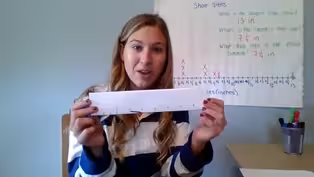
Analyzing Shoe Sizes on Line Plots-Lori Genovesi-Third Grade
Video has Closed Captions
Students will measure different shoes in their homes and analyze the data on a line plot. (58m 40s)
Providing Support for PBS.org
Learn Moreabout PBS online sponsorship- Hi, everybody.
I'm Miss Jennifer Ostrega.
And I'm from Irvington Public Schools.
I'm an English and second language teacher.
And I love what I do because I get to do everything every day in teaching with second language learners.
That means the people who are learning English as their second language.
Maybe they have another language at home, and maybe that's you.
Well, let me tell you why I love doing ESL teaching.
I chose it because my parents were teachers when I was growing up.
They took us on all kinds of trips to different places all over New York and New Jersey, and all over the country to see other languages, foods that other cultures eat and languages that weren't our own in English.
And I really enjoyed that, and they taught me to appreciate so many different cultures.
In fact, sometimes I would go and eat Chinese food or Portuguese food or all kinds of different foods.
And I really just want to tell you that if you know another language, you are awesome, because the more languages you know, the better you're gonna be in life, because you're gonna have so many tools.
Well, in English, punctuation is really important.
So today I want to talk to you about the power of punctuation marks.
And why it's so important for you to use them as you're reading, as you're speaking and in your fluency.
Fluency is how you speak.
So, when we are fluent, we are keeping the pacing, the speed of how we speak, and it's not too slow, it's not too fast.
But why do you think it's important to have punctuation?
- Mom?
- Yes, Oliver, I'm recording for the friend at home.
- No, no, I know that.
I just really needed to know what are we making for dinner?
- Okay, come in, come in, come in.
- What are you making for dinner?
- I was gonna make a beans, a cheese on a tortilla, maybe?
- Okay.
What about rice?
- Yeah, rice, rice.
Probably like beans, rice, cheese on a tortilla.
Yeah, yeah, can I finish telling this Friends at Home?
- Yeah, yeah, so we're having beans, rice and cheese on a tortilla.
- Right, right.
Sorry, it's the same thing all over again.
I know every night it's the same.
Now, did you notice how Oliver said that?
It was pretty flat.
Almost kind of like boring, right?
Like just not a lot of emotion.
So it's really important for us to use punctuation in our sentences so that we can make our expression and our voice and our face come alive.
So that we are understood better by other people.
Hey, I have an idea.
Why don't we bring Oliver back in?
Hey, Oliver!
Hey, Oliver!
- Yeah?
- Hey, can you help us out?
I wanna show the friends at home how we use the power of punctuation.
- Oh, okay.
- Okay.
So, we have a sentence... Over here, which is, "We are having beans rice and cheese on a tortilla."
Notice there's absolutely no punctuation marks in there at all.
In fact if you handed that in to your teacher, your teacher may not be very happy about it, because I don't know where that sentence ends, and I don't know what kind of expression the character in the story is experiencing.
- Wait.
So, if we want expression, we would use either an exclamation point or a question mark, right?
- Exactly.
- Question mark is when you're unsure, and exclamation point is when you're excited!
- Exactly.
So let's take that sentence again.
So why don't you say it like you're not sure if you really like that idea?
- Okay.
Beans, rice and cheese on a tortilla?
- Yeah, really?
And which one would you use for that?
- That's the question mark because I'm unsure.
- Can you point to it in English?
- Right here.
- That's the symbol.
Can you point at it in English on the other side?
- Oh, right there.
- Great, okay.
And now I want you to say it like you're really excited, like it's the best news.
- Okay.
Beans, rice and cheese on a tortilla!
- Okay, which do you think that Oliver should use?
Should he use a comma?
Point to comma.
No.
Should he use a period?
- No.
- I mean, he can end a sentence there, but it's not gonna tell him- - Right, if I'm saying it with expression.
- Yes.
- It's not gonna tell anyone how I'm feeling, so it would have to be the exclamation point.
- Ah, yes, exclaim.
To exclaim means to feel in an excited way.
To express yourself is to exclaim.
You might hear that in storybooks like, "The old man was very nervous "and he shrugged his shoulders and exclaimed, 'I don't know.'"
Okay.
So, Oliver, can you show us the exclamation mark word?
- Exclamation mark.
- There we are.
Exclamation mark.
Right.
So can you say it again with an exclamation mark?
- Beans, rice and cheese on a- - Well, start at the beginning of the sentence.
- Okay.
We are having beans, rice and cheese on a tortilla!
- Excellent.
Now, there's one thing missing that we haven't talked about yet.
It's that when you're listing things, you need to list them with commas.
Because commas are put in sentences to break apart different ideas with a pause.
- So, where would we put the comma in there?
- The commas would be right after each item we're listing.
- Oh, so beans, comma, rice, comma, and cheese.
Is there a comma after cheese?
- Nope, 'cause there's another phrase, 'on a tortilla.'
It goes right into that phrase.
- I see.
- All right, thank you so much.
- All right.
- I guess you can go back to yourself now, whatever you were doing.
I think you were reading a book.
- [Oliver] Uh, yeah.
- I don't think he was reading a book.
Probably more likely playing a video game, but- - [Oliver] Definitely true!
(laughs) - Thanks, Oliver.
And don't forget to set the table!
(Oliver groans) - So, as you can see, it's really important that we use the power of punctuation when we're learning, when we're writing and when we're reading.
Let's take a closer look at how we read punctuation.
So, period is to stop, take a breath at the end of a sentence.
A new idea is coming.
Can you say period?
Good.
Notice it's not dot.
It's not decimal point.
It's just a period.
Good.
Next we have a comma.
It's like a little curly thing like this.
And it sits below the line.
Kind of where the diver letters go.
The letters that go down into the water.
So, we pause, and there it is.
And we take a mini breath.
(inhales) Like, "I'm going to make rice, comma, beans, comma, and cheese on a tortilla."
Period.
Great.
And then we have a question mark.
Your voice usually goes up, and you stop at the end of a question mark.
It's kind of like, "Huh?"
Now I know some languages use question marks at the beginning of a sentence and the end, but we're just gonna use in English just at the end of the sentence when we're asking questions.
Next, we have exclamation point.
Exclamation point, your voice gets louder!
Really loud!
Okay, because you're going to exclaim something like, "Hey, whoever is doing construction outside, please stop banging!"
Okay, so, I'm making a video for the children at home!
But you would never wanna yell, because exclamation points are usually best used in real life when you're happy and you're excited.
And then in stories we see when the character gets mad in stories, will use an exclamation point.
Our voice gets louder and stronger, and it still stops a sentence.
Are you with me?
I think you can have the power of punctuation in your everyday life.
And you can read in your stories like that too.
Well, today we're going to look at something called a script.
A script is dialogue, or what people say.
And a script is something that people use when they're, authors use when they're writing.
Sometimes a script looks like what people use in TV shows and movie shows when they want to follow or a play in live theater.
And I was a theater major in school in New Jersey actually.
And I majored in theater and I studied theater arts.
And it really goes well with teaching because I love to teach about punctuation and expression and writing, and it's a really good mix of everything I love.
So, today we're going to look at the story 'Jack and the Beanstalk'.
And when we read a story out loud we call it Reader's Theater.
So the cast of characters are Goose, Giant, Jack, a Harp, which is a musical instrument, Mrs.
Giant, Narrator 1.
That's the person who does the speaking, who tells the story.
Money Bag, Stranger, and Narrator 2.
This story, 'Jack and the Beanstalk', is a popular American folk tale.
It is adapted from an original story, but every adaptation or interpretation can be very different, and you can see different adaptations in the way the story is told.
So, for instance, when I was growing up and I read this story and my mom read it to me, my mom, wonderful mom who's a teacher too, was a teacher.
She's now retired, which means she's not working anymore as a teacher.
She may not have had these characters in the story.
Okay.
So, I'm gonna give you a chance to see what punctuation looks like on the page.
So, Jack starts whistling.
(whistles tune) I'm not a very good whistler.
But I try.
Narrator 1.
"This is the story of Jack and the beanstalk."
Notice I just used my yellow highlighter to highlight the period there.
"Jack is on his way to town."
End of sentence, so I stop and I put a period.
Narrator 2 says, "His mother sent him to trade their cow for food."
Stop!
Trade means I give you some cars, and maybe you give me a little toy car in exchange.
Okay, so we exchange something.
"On the way, comma, he meets a stranger."
Stop.
Sentence stops.
"Hello, comma, young man."
Stop.
"Where are you going with that cow?"
Question mark.
So, you'll notice that what I did just now is I did something called a gesture.
A gesture is when we use expression not only in our voice but in our hands.
So what I'd like you to do now is think about this.
I'm going to read the story to you, and I want you to try the power of punctuation with a gesture, with your hands.
So, when you see a period, I want you to stop.
Okay.
Can everybody do that?
Period, and stop!
And how about when you see a comma?
Comma, everybody comma.
Okay.
And how about when you see an exclamation point?
Clap.
Because we're making a big expressive movement.
Clap.
And how about when you see a question mark?
Huh?
Okay, question mark.
All right, so let's try it.
And we're gonna go, and stop, period, yeah.
And comma.
And question mark.
And exclamation point.
All right, are you ready to try it now?
Great.
So I'll read the story and you can do the action.
You can grab somebody at home to do this too, like a mom or a dad or a caregiver who doesn't speak English.
If they want to listen with us, they can try it too.
Are you ready to come with me?
You're doing great.
- So, we're ready to use the power of punctuation, to read a classic folk tale called Jack and the Beanstalk.
So let's get started with the vocabulary, so that I can show you what words you'll see, and what to expect in story.
First, we will look at the title, Jack and the Beanstalk.
The summary of the story is that one day Jack's mother sends him into town to sell their beloved cow.
He ends up trading the cow for some magic beans that grow into a giant beanstalk.
When Jack climbs the beanstalk, he discovers a giant's castle.
So you're gonna read along with me and try the power of punctuation with this folktale, after we look at some words.
Beanstalk, when Jack grows a beanstalk, he discovers a giant castle.
A beanstalk, is planted from a little bean and it grows up.
In this story, since it's the folktale, it may not really be real, it's something that you're gonna see exaggerated, which means bigger than it really is.
So this bean turns into a stalk, which is gonna go really high up to the clouds.
Golden.
The giant says, "Bring me my goose that lays the golden eggs."
Golden is like a color.
And it's shiny like gold, the gem.
Grouchy.
Can you make a grouchy face?
Mrs.
Giant said, "My husband is very grouchy."
Grouchy is the opposite of happy.
Kettle.
Mrs.
Giant says to Jack, "Hide in this kettle."
A kettle is like a teapot.
Well, in this story, since it's a folktale, it's not real, Jack actually goes inside the kettle.
You can't hide in a teapot.
You don't even wanna touch it cause it's hot.
But in this story, he goes into a teapot, that's another word for teapot is kettle.
And magic.
The stranger says, "All I have are these magic beans.
I will trade the magic beans for your cow."
Magic is when the impossible happens.
When what you dream happens.
And trade.
Narrator two says: His mother sent him to trade their cow for food.
If you trade something, you give something to somebody, and they give you back something, in exchange.
So, in this story, you will be able, to listen to me, reading with appropriate rate and accuracy.
That means, I'm going to read every word carefully, and you will read along with me.
Not too fast, not too slow and not like a computer, but with expression, with the power of punctuation, you are going to read the lines, with me, with pauses.
So, you're gonna stop for periods, you're gonna, for question marks, you're gonna clap over your head for exclamation points, and you're gonna, for comma.
Intonation is really important when we speak and read.
Intonation is the rise and the falling of our voice.
We can't be boring, just talking the same time and no expression makes me wanna fall asleep at my desk.
So now that you understand, and you understand what the power of punctuation is, we're gonna practice lines that promote the fluent delivery, of the script.
So now, I'm gonna show you my screen and here we go.
Now, there are a lot of characters here.
So you'll see, you, can play all of them along with me, or you can grab someone in your household, to play the parts.
If English is a little bit hard for you, you may not wanna take the narrator part.
The narrator is the speaker who tells the story.
You may wanna take a part like Jack, or money bag because those parts are a little smaller.
Here we go.
Get ready to make your gestures.
Jack, whistles.
This is the story of Jack and the Beanstalk.
What are you gonna do?
Stop, because it's a period.
Jack is on his way to town.
Stop, it's a period.
His mother sent him to trade their cow for food.
Stop, it's a period.
On the way, pause, comma, he meets a stranger, stop.
Hello, comma, young man, period.
Where are you going with that cow?
Question mark.
My mother told me to go to town to trade the cow for food.
You're a good boy for listening to your mother.
You should give your cow to me.
I need a cow.
Do you have any food?
Are you following along with the power of punctuation?
Can you see how putting punctuation marks is so important in your story and in your writing?
Okay, I won't call out the name of the punctuation mark now, I'll just do the gesture.
So let's rehearse.
Exclamation point!
Question mark, period and comma.
Are you ready?
Let's continue.
The stranger says, "All I have are these magic beans.
I will trade you these magic beans for your cow.
Will these beans you, with these beans, you will never be hungry again."
Never be hungry?
It's a deal!
A very proud Jack can't wait to tell his mother.
His mother is very angry, she throws beans, the beans out the window and sends him to bed.
The next morning, Jack looks out the window.
Wow!
Look at the size of that beanstalk!
I think I will climb it.
So, Jack begins to climb the beanstalk.
When he reaches the top, he sees a beautiful castle.
Jack oh!
Miss Ostrega made a mistake.
Was there an exclamation point at the end of the castle?
Did he say, when he reaches the top comma, he sees a beautiful castle!
No, it was just a period, were you listening?
Did you catch that mistake?
Teachers make mistakes too.
Everyone makes mistakes.
Alright, let's get back to the story.
Narrator one, Jack goes to the door and knocks three times.
Mrs.
Giant answers the door.
Hello, young man.
Good morning?
My name is Jack.
What a brave boy.
My husband is very grouchy.
Here he comes!
Hide in this kettle.
Jack hides in the kettle.
Fee!
Fi!
Fo!
Fum!
I smell the blood of an English man!
Who got up on the wrong side of the bed this morning?
Humph!
Bring me my goose that lays the golden eggs.
Yes dear.
Mrs.
Giant brings the giant his goose.
Lay me a golden egg!
Cock, cackle, cock, cackle!
I will lay a golden egg.
If mother and I had golden eggs, we could sell them.
We will never be hungry again!
Fee!
Fi!
Fo!
Fum!
I still smell the blood of an English man!
Bring me my magic harp!
You don't have to yell.
Mrs.
Giant brought the magic harp.
Play me a lovely tune!
I am a magic harp.
Playing music keeps me sharp!
If I had a magic harp, mother could hear lovely music every day.
Does it say exclamation point?
No it doesn't, it's a period at the end of the sentence.
Let's try that again.
If I had a magic harp, comma mother could hear lovely music every day stop.
Fee!
Fi!
Fo!
Fum!
I still smell the blood of an English man!
Bring me my money bag!
You are not being nice.
Get it yourself.
The grumbling giant grabbed his money bag.
Count my money!
Money, money, money.
You have lots of money.
Quarters, dimes and nickels.
You have lots of dough.
Dough is another word for money.
And did you notice that when there's more than one item, we use that comma money, money, but then we stopped 'cause the last item was a period we were finished, and then we went to another item, quarters comma, dimes comma, and nickels period.
We notice there's a comma before the last item.
Back to the story.
If I had that money bag, the whole village would never go hungry.
As the money bag counted the money, the giant went to sleep.
Zzzz... dot, dot, dot and notice, dot, dot, dot those are not periods that stop a sentence.
If you have three dot dot dots, that means, keep going.
Of course, be careful.
You never wanna put dot, dot, dot when you're assigning something, when you're doing an assignment for your teacher, because that means you have more to say, and you are the student, you have to be the one to write or say that.
Not your teacher.
That just means the character is going to keep going.
I heard you whispering, comma Jack.
You need these things more than we do.
You should take them.
Jack hops out of the kettle.
He grabs the goose, harp and money bag and runs to the beanstalk.
The goose, harp and money bag are happy to leave the mean giant.
Hurry, hurry!
Don't be slow.
Down the beanstalk we will go!
The giant wakes up and sees Jack running away with his treasures.
Get back here!
Jack climbs down as fast as he can.
The giant climbs after him.
Jack yells to his mother.
Mother, bring me my axe!
I must chop the beanstalk down.
Jack chops as fast as he can.
The beanstalk falls with the great crash!
The giant falls and bounces back into the sky.
He's never heard from again.
And we live happily ever after.
Whew!
Are you tired from reading that story?
Well, I know you can do it.
So we're gonna give you a chance.
Yes, you and I. We are going to give you a chance, to do this all by yourself, so now you can read and try.
I'll be quiet and I will let you, find somebody in your house to do the motions when you get to the end of the sentence.
And they can use the power of punctuation.
Okay, go for it.
I'm gonna walk away, and I'll just be the page turner now.
How's it going?
Are you ready to turn the page?
If I'm going too fast for you, don't worry.
That's why you can watch this later.
It's a video and you can go back and play it again.
Let's do the other one together.
On the top of page three.
His mother is very angry.
She's throws the beans out the window and sends him to bed.
So everybody, now that you have the chance to try your voice and practice, wouldn't it be fun if we made our own story together, I'm sure where you're living you have some way of being creative with objects.
So, it's time to meet me in my kitchen.
And if you have a kitchen where you are right now, you can follow me there too.
We'll grab some objects.
Not the kind that are real, but inanimate objects.
Meaning things that don't talk, and we'll make them talk by writing a dialogue.
Okay, are you ready to follow me to the kitchen?
Okay, let's go.
- So, here we are in my kitchen, and I just grabbed some things to make for my play.
I'm gonna make a play, so I just decided I would take some beans, and I also found a sponge.
So, I'm gonna decide to personify or make these objects into people, that's called personification.
Let's clap it out.
Per son i fi ca tion.
(clapping) Now, you try it.
Per (clap) son (clap) i (clap) fi (clap) ca (clap) tion (clap), personification.
We're gonna make these characters talk.
So, the sponge and the beans, okay.
So, let's see if we can apply what we learned about the power of punctuation to our dialogue.
So, who asks a lot of questions, and who gets very excited?
So, let's take a question, okay.
And, what should Beans say to Sponge?
What should Beans say to Sponge?
"Hey, Sponge, do you wanna have a play date?"
Okay, so let's write that.
"Hey, Sponge!"
So it's, "hey, Sponge!"
And is it like, "Hey Sponge!"
or is it "Hey, Sponge."
It's like, "Hey, Sponge!"
Right, so Sponge is calling to Beans, I mean, Beans is calling to Sponge, "Hey Sponge."
And Sponge says, see these two dots?
We didn't get over what these are.
These are colons, and they indicate that the person who's speaking is going to say something.
So, Sponge says, what?
What should Sponge say?
"Hi Beans, I'm very sad."
"Hi Beans, I'm very sad."
So, what is Beans going to say to sponge?
If somebody tells you they're sad, what would you do?
I would ask a question.
I'd wanna know why.
Beans said, "Why are you so sad?"
Then Sponge says, and Sponge is starting to cry, and maybe there's water coming out of him, dripping like tears.
He's saying, "I miss my friends."
"I miss my friends."
Should I put a comma, a period, a question mark, or an exclamation point?
Is he like, "I miss my friend!"
Or, is he like, "I miss my friends?"
Or, is he like, "I miss my friends."
Probably, just a period.
And, what does Beans say?
Beans says, "Yeah, we just have to deal with this right now.
"That's just what's happening.
"A lot of people aren't seeing their friends."
"Yeah, we just have to deal with this right now.
"A lot of people aren't seeing their friends."
I'm done, I'm done with my play!
What did I forget?
I forgot two things, of the same punctuation mark, twice.
"We just, yeah, we just have to deal with this right now.
"A lot of people aren't seeing their friends."
Did I pause in between there, when I first said it?
Yes.
So, I'm gonna go, "Yeah.
"We just have to deal with this right now.
"A lot of people aren't seeing their friends."
So, you see, why it's so important, 'cause periods are like pauses.
Okay?
Now, once you have your dialogue like this, check your commas, your exclamation points.
If you can call someone, and ask them to go over it with you, and help you, or ask somebody in your house to help you, that would be great.
If you can't, then just try to check it by reading out loud.
And, it's gonna go something like this.
Okay, so you get your beans and your sponge, and then you do a little play.
"Hey Sponge!"
"Hi Bean, I'm very sad."
"Why are you so sad?"
"I miss my friend."
(cries) "Yeah.
We just have to deal with this right now. "
A lot of people aren't seeing their friend."
And there you have it, there's your dialogue.
So you can see how the punctuation power is so powerful, because you can create characters, like Beans and Sponge, right in your very own kitchen.
Yes, I could have done this with a spoon.
I could do this with a fork.
I could do this with a cup.
I can make anything talk.
I can ever make a tissue box talk.
And I have the worse allergies right now, so I could even take a tissue like this, and be like, "Hello, I'm Tissue.
"Hi, look at me."
Okay, you can do anything.
It's so much fun.
The possibilities are endless.
So, what I wanna do now, is show you one more thing.
All right, I wanna show you a play that I wrote, and there are characters that I wrote, because one day I was just having fun with my son, who you met earlier in the video.
And, I got to thinking a lot about my ESL, my English as a Second Language students.
And they have come from many, many foreign lands, where they are not so comfortable in their new home, in their new home, in their new school.
And not even just my ESL students, but whenever a new student comes to move into the school, I really think it's a student's responsibility to make them feel comfortable, to really make them just feel welcome.
So, I wrote a play called the Responsibility Challenge, and that play is about a boy who is not really making the right choices.
And that character isn't making the right choices, and so that character's classmate asks for help.
And, I'm gonna let you see this play.
So, we'll look at the punctuation, of what it actually looks like on a script when I typed it up.
And, by the way, it takes a long time to write something.
If it's not perfect the first time, don't worry, because part of the writing process is writing it again and again.
And, you might not get it right the first time, but that's what authors do.
Good authors have patience with themselves, and they try to think a lot about what they wanna write, and sometimes they change it.
That's why, it's good to have a pencil with an eraser, if you do, so you can erase it again, and try again and again.
Okay, so when you think about the play, that I'm gonna show you, the Responsibility Challenge, I want you to once again, think about who asks a lot of questions in the play, and who gets very excited?
Because, these kind of questions are going to really make a character have a lot of emotion and personality.
Okay, so let's take a little brain break 'cause you've been working so hard, and then we'll watch the Responsibility Challenge.
- Hey, everybody.
I'm ready to dance.
You guys have been doing great!
So we're gonna move and groove with me.
Ready?
(upbeat music) Okay, you wanna find a space, okay?
Any space in your place, okay so it can be, I just moved my kitchen table a little bit.
Just ask permission from a grown-up and make sure that you're not gonna bang into anything, okay?
All right.
Here we go.
No matter where you live, no matter what your house is like, you can always find a space to dance in your house.
Can you say house?
Make a house.
A house.
Bend, bend, bend, bend, bend.
Stretch your arms over and then go.
And bop, bop.
When we bop, we move up and down with your knees standing in one place.
Bop.
Bop.
Jump up.
Get ready.
Pretend you're a rocket ship.
And jump!
And jump!
Spin, spin, spin.
Twist, twist, twist, twist, twist, twist, one more.
And wiggle it out, wiggle it out.
Very, very good.
You guys did great!
Wiggle it all, wiggle, wiggle, wiggle, wiggle, wiggle, wiggle, wiggle.
Ah.
Excellent job, all right.
Fantastic.
Now you're going to get back to, just taking a deep breath, and we're ready to see our play.
- And now the responsibility challenge play, where I would like everyone at home to think about the two questions that we worked on before when we're writing dialogue.
So who asks a lot of questions?
Which character do you think is gonna ask a lot of questions?
I'll be asking that with you at the end of the puppet play and who gets very excited.
Which characters are using a lot of exclamation points.
So you're gonna listen to the voices.
I have my son here again, and we are going to get started with this puppet show.
So think about those questions, and action.
- Oh, Mary Poser.
I'm so upset.
And it's so much trouble, big time.
- Why Big Boy, what did you do?
- Why do you think I did something?
- Well, you kind of always get trouble.
- Kinda get, Oh, I do get.
Right now I feel worse.
- Oh, okay, okay.
What happened Big Boy?
- Well you know Croca?
- Oh Crocodile?
- Yeah, the new kid from Florida.
Well he's in the doctor right now 'cause I dropped my coat down the stairs on the way to my class and he tripped on it.
And well I didn't go back to get it, and I guess sort of left it there.
- Oh yeah, yesterday when the sub was there.
- Exactly, which is why I feel so bad that I was bad when sub was there.
- You're not supposed to take advantage of subs.
You know, they're teachers too and they've worked very hard for us.
- I know, well so because I didn't put my coat on the hook and go back and get it on the stairwell at the end of the day, Croca was going down the stairwell and he tripped and fell and went flying down the stairwell and he's at the doctor's and he may actually have a broken leg.
- What!
I didn't think crocodiles... Oh no.
- He tripped the coat.
And it's all my fault.
- Well, it was your responsibility to put the coat in the coat closet.
Aren't you even closet manager this week?
- Oh yeah, I am closet manager.
- This is bad, this is bad.
- Oh well, thanks a lot.
You always are Miss Goody Two Shoes.
Everything you do is so perfect.
You're always so responsible, you always know the right thing to do and... (clicking sniff sound) Hey, what smell?
- what smell?
Do you smell something yucky?
And stinky?
- You mean your hair?
- No, no, no, no.
I mean it smells a little like food, like it's coming from the backpack over there.
- It is?
Oh, it is.
- Forgot about that salami from the other day?
- See, I'm not perfect Big Boy.
No one is, but I promised my mom that I would be responsible enough to remember to empty my backpack.
See, she's working, she's away.
And my dad forgot to pack my lunch this morning.
Oh no, now I don't have a lunch.
I'm stuck with a smelly salami sandwich for me yesterday.
- Don't worry Mary Poser, I as an extra ham sandwich.
I'll ask permission for the teacher to see if I can give you half of mine.
- I think it's time.
- Time for what?
- The responsibility challenge.
- Oh that sounds fun already.
I really wanna take the responsibility challenge.
- Okay, I'm ready.
Everybody help me spell the word, ready?
Give me an R.
- R - Give me an E.
- E.
- Give me an S.
- S.
- Give me a P.
- P.
- Give me an O.
- O.
- Give me an N.
- N.
- Give me S.
- S.
- Give me I.
- I.
- Give me a B.
- B.
- I.
- L.
- L.
- I.
- T.
- T.
- Y.
- Y.
- What does that spell?
- Responsibility.
Oh, that's a long and big word.
Well, what does it mean?
- It kinda means to believe in yourself and like you can do things without someone telling you what you have to do to remember it.
It's kind of like ownership.
- An ownership.
It's a ship.
It's a ship, that doesn't sound right.
- No, my mom said, "according to this old fashion book called the dictionary, "it means the opportunity or ability to act independently and make decisions."
Okay, so listen, let's play a game, okay.
I'll tell you a situation and you tell me what the right thing to do is, okay?
- Okay, great.
Sounds like fun.
- [In Unison] ♪ We're dancing ♪ We're dancing ♪ We're dancing ♪ We're dancing and stop - Okay, give me a topic.
- That's easy, toys.
Bringing in a toy that you just got for your birthday that's really expensive.
- Not responsible, nope.
You leave toys at home.
Don't bring them to school.
- Okay, so library books.
So it's the night before library and my mom has to remind me to pack my library books for the next day.
- Exactly wrong Big Boy.
You pack your own backpack when you are responsible.
- Okay, I got one.
Taking big joke scissors and cutting things all over the house.
- No, no, no, no, no Big Boy.
That's not responsible at all.
That's for grownups.
- Okay, just kidding.
- Okay, so being responsible doesn't mean just doing stuff like chores, it also means taking responsibility for being kind to people who might need it.
- Yeah, like Croca he's sitting all alone on a bench during recess.
- You can start with hello.
- Just hello, Just hello.
- Yes.
- But I like being alone sometimes.
- Well, not everyone does.
If they are new, especially, it's your responsibility to make them feel welcome.
imagine you're in that person's shoes.
- Well, I know one thing for sure.
It would be very stinky in their shoes.
(laughing) - I know what you mean Big Boy.
But really, if you were new, how would it be if you had a responsibility for not just you, but me too.
- Well, I got this.
I'll be right back.
I mean, I'm gonna go try it out now at recess.
- I knew he'd come through.
- Hello Croca.
- Hi Big Boy.
- Hello, hi.
Are you okay?
I'm sorry about the accident.
- Yeah, I got bigger problems.
My tooth is loose.
- Oh, don't worry.
They'll really nurse at this school.
When you lose your tooth, the nurse will help you rinse out your mouth and then you get to do put the tooth in a tooth necklace and she even lets you pick out the color.
- Oh, they didn't do that at my old school.
- Yeah, well I guess I didn't realize what it was like to be in your shoes.
- Yeah, what about we something about this tooth.
- Oh, of course.
I'll show you where the nurse's office is.
Pretty loose tooth.
Let's go.
- Well, Bib Boy, my name is Croca and I'm really, really glad that you said hi to me.
- No, all I did we start with hello.
It was easy.
- Mary Poser, I get this responsibility thing.
It's actually kind of a Big Boy thing to do.
- Yes, it is Big Boy, it is a Big Boy thing to do.
- All I really did was start with hello.
That's it.
- It's that simple, start with Big Boy.
- Yay, that's a funny.
I'm Big Boy and I feel like a big boy when I do thinks that's responsible.
But seriously, Mary Poser, it was easy.
- Easy peasy and it's a kind of thing to do as well.
- Being responsible is really easy.
- Maybe it's not.
I mean, my mom says she won't get a dog until I can take responsibility for it.
Now I'm sort of getting to understand what she means.
- Yeah, responsibility.
Oh, it's tiring.
(yawning) - But, it's worth it.
I gotta go home and set the table for dinner early so that my mom can see that I'm very responsible.
- Yeah, and while you're headed, you might wanna toast that stinky salami in your backpack as well.
(chuckles) - Good idea.
Hey Big Boy, thanks.
See you tomorrow and don't forget to pack your library books.
- I won't.
- And that's the end of our little show.
So take a pad off.
Well, did you think a little bit about who asks a lot of questions?
Which character do you think used a lot of question marks?
And who gets very excited with exclamation phrase?
So let's ask or after Oliver.
- I think that someone who gets very excited is Big Boy.
He is always excited, he's using lots of exclamation marks.
If you were to just look at the script, you would see that almost every single line has an exclamation point.
So, you know, he's very excited.
- Yes.
- He use a lot lot of expression.
Who do you think he was his question?
- Well, I think that they both did, but I know, I liked when Mary Poser said, "you know what I mean Big Boy."
Like, "if you were new, "how would it be if you had a responsibility for someone else besides yourself?"
And I noticed that her voice kind of went up and then down, just like question marks too.
- Yeah.
- So, yeah.
So how long you've been doing puppet shows for?
(chuckles) - I've been doing them for a while.
- So I think you've learned a lot about the power of punctuation today.
- I definitely agree all the way from the beginning with our little lesson to now.
- And the Beans versus the Sponge.
And I think you know that even if you don't have puppets like this at home-- - You can make your own.
- You can make your own.
- Here's an example.
If you have an oven mitt, you can put it on.
- Yeah.
- And make a little character.
- Yes, we were gonna recycle this oven mitt because you can't use it safely anymore.
And instead of throwing it away, we can just make it into a character puppet.
- Hello.
- Or if you have a sock or the hole in it and you can't use it anymore, or a paper bag, anything at home really could be a puppet like we showed you.
So I just hope you have fun getting ready to do some writing, and remember what I said about writing.
You can revise, you can rewrite, you can use graphic organizers to get your ideas started.
So I just wanna say it's been so much fun with being with you and teaching you the power of punctuation today.
And I'm really looking forward to all the great work that you're gonna do and continue to do at home, where you can be so creative.
Yeah.
So thank you so much, I'm Ms.
Austrega from Irvington Public Schools, and I wanna say have a wonderful, wonderful day.
Bye bye.













Support for PBS provided by:
NJTV Learning Live is a local public television program presented by NJ PBS