
Repurposing Railroads, Farmington Historic Home and a Shire of Our Own
Season 31 Episode 13 | 27m 56sVideo has Closed Captions
Repurposing old railroad tracks, Farmington Historic Home, and how Kentucky inspired J.R.R. Tolkien.
Kentucky communities are looking to repurpose old railroad tracks in a variety of innovative and entertaining ways; Farmington Historic Home has over 200 years of history to tell; and did J.R.R. Tolkien find inspiration for the Shire in "The Hobbit" and "The Lord of the Rings" from what he heard about Kentucky?
Problems playing video? | Closed Captioning Feedback
Problems playing video? | Closed Captioning Feedback
Kentucky Life is a local public television program presented by KET
You give every Kentuckian the opportunity to explore new ideas and new worlds through KET. Visit the Kentucky Life website.
Repurposing Railroads, Farmington Historic Home and a Shire of Our Own
Season 31 Episode 13 | 27m 56sVideo has Closed Captions
Kentucky communities are looking to repurpose old railroad tracks in a variety of innovative and entertaining ways; Farmington Historic Home has over 200 years of history to tell; and did J.R.R. Tolkien find inspiration for the Shire in "The Hobbit" and "The Lord of the Rings" from what he heard about Kentucky?
Problems playing video? | Closed Captioning Feedback
How to Watch Kentucky Life
Kentucky Life is available to stream on pbs.org and the free PBS App, available on iPhone, Apple TV, Android TV, Android smartphones, Amazon Fire TV, Amazon Fire Tablet, Roku, Samsung Smart TV, LG TV, and Vizio.
Providing Support for PBS.org
Learn Moreabout PBS online sponsorshipProduction of Kentucky Life is made possible in part by the KET Millennium Fund.
This week on Kentucky Life... repurposed railroads across Kentucky are bringing new life to once-abandoned railways.
We'll explore Farmington Historic Home in Louisville and its two centuries of history in the bluegrass.
We'll explore the setting for this week's show, the Kentucky Museum in Bowling Green.
And we'll explore how our state may have been the inspiration for the Shire in the classic Tolkien novel, The Hobbit.
All that's next on Kentucky Life.
[music playing] Hey folks, and welcome to Kentucky Life.
I'm your host, Chip Polston.
It's good to see you again.
Welcome to the Kentucky Museum in one of my favorite towns in the entire state, Bowling Green.
Located at my alma mater, WKU, Go Toppers, the museum will be celebrating America's 250th birthday throughout the course of this year.
The facility brings a remarkable look at how Kentucky has evolved from our beginning to current times, and we look forward to exploring here today.
But first, the use of railroads and commerce is still vital.
In fact, in Kentucky alone, some $40 billion, that's with a B, $40 billion in goods originating here are shipped via rail every year.
But what were once prosperous rail lines 150 or so years ago, oftentimes fall into disrepair and are abandoned.
Some Kentucky communities, though, are looking to repurpose old tracks in a variety of innovative and entertaining ways.
We hit the rails to take a look.
[train honking] In the 1800s, railroads profoundly changed America.
Distances were shrunk, new towns and new industries sprang up, and mass migration to the West was enabled.
In Kentucky, trade that was once exclusive to waterways, like the Ohio River, could now thrive just about anywhere.
But the advent of the automobile meant many once-thriving railroads went under.
That led to many lines being abandoned.
In fact, research shows by the end of the 20th century, more than 100,000 miles of abandoned rail lines were littered across America.
That's where groups like the Rails to Trails Conservancy come in.
They work with community groups to convert abandoned lines into multipurpose trails.
When they first started 40 years ago, around 100 miles of reclaimed rail lines across the country were used as trails.
That number now stands at more than 26,000 miles.
I had a chance to speak with Eric Oberg from the organization's headquarters in Washington, D.C.
The railroads opened this country up.
They were a transportation renaissance.
And the legacy of those railroads are still with us.
And the railroad industry is not a dead industry.
It is a thriving industry still.
But the amount of rail corridor that was built in the heyday of the railroads, there was a lot of redundancies, which gives us the opportunity to reuse so many of these.
And because of the way rail lines were built, they lend themselves perfectly to trails that can be enjoyed by just about anyone.
The engineering that went into building a railroad was amazing, right?
It needed to be fairly flat.
So you've got a maximum 3% grades.
You are either tunneling through mountains or trestling over river valleys to create this flat grade, which makes an unbelievable surface for a trail, right?
The most accessible possible trail there is.
Anybody can use a rail trail.
Oberg says one of the more interesting rail-to-trail conversions in Kentucky is the Dawkins Line Rail Trail, which runs from Johnson County to Breathitt County.
Before it was paved, the trail was popular with horseback riders.
He says eastern Kentucky, in particular, is ripe for this kind of project.
There's really excited exploration happening in coal country in eastern Kentucky.
The National Park Service River Trails Conservation Assistance Program is working with some communities out there, not looking at abandoned rail corridor, but still some active rail corridors, and saying, “Are there opportunities to maybe co-locate rail with trail in some of these eastern Kentucky communities?” So, I mean, there's just a lot happening in Kentucky.
There's so much opportunity for more, though.
One of the highest-profile repurposing projects occurred in Louisville, where the Big Four Railroad Bridge was converted into a pedestrian bridge.
Built in the late 1800s, the bridge was a major carrier of rail freight from Kentucky across the Ohio and to all points north.
The last train crossed it in 1968.
And a few years later, the approaches in Kentucky and Indiana were removed, earning it the nickname, The Bridge to Nowhere.
It sat like this for nearly 40 years, until it was reopened as a part of Louisville's Waterfront Development Project.
The approach is a giant corkscrew that gradually brings pedestrians to the bridge that crosses the Ohio and to Indiana.
In Versailles, part of the old Louisville Southern Railroad there was decommissioned in the 1980s and was converted to use by a rail museum that takes passengers on tours.
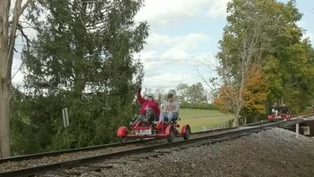
But a couple of years ago, a group called Rail Explorers started offering a different type of excursion.
Passengers ride rail bikes where they pedal on a 10-mile round trip through the heart of Versailles and Woodford County, through distilleries and horse farms.
Even though some of the bikes weigh up to 750 pounds, an electric assist motor makes the experience pretty effortless, and you can trust me on that one.
The history of this rail line that we're on right now, what can you tell me about this?
So this rail line was built in the 1800s, and this was the main line to get from Lawrenceburg all the way into the Lexington Train Depot.
I think one of the biggest things that a lot of people don't realize is how active this rail was during its prime time, because we're all so used to car culture now here in Kentucky, that now you can hop on a bus or drive with your friends to get to point A, point B. But for the longest time, if you were in Lawrenceburg in the middle of the 1800s and you needed medicine, food, fuel, whatever, if that doesn't come on a carriage, it's coming on a train.
So if we don't have these lines, a lot of people would have lost out on really the opportunity to grow as a city.
Kentucky owes a lot of its growth to the railroad.
Before the interstate system that connects all of our cities now, a lot of infrastructure and support for these communities, the only way in and out was through rail lines.
So, are a lot of these old rail lines just kind of left to rot?
Do they just sit here until nature takes them over?
Does that happen a lot?
More or less.
If somebody like the museum or us doesn't come in and offer to maintain the track or take it over from the Federal Rail Association or Federal Rail Administration, then at the end of the day, typically, the ties are all removed, and it just becomes a big gravel path through the middle of some forest.
That was the case in Park City, Kentucky, where an eight-mile rail line was constructed in 1886 to connect the small town to a world-renowned tourist attraction.
They were building the L&N Railroad from Louisville to Nashville, of course, for freight and things like that.
So they decided that they would stop here since Bell's Tavern was here, and that was where people stayed.
When they wanted to go to Mammoth Cave, they went by horseback and by stagecoach, and that's how it began.
They figured out they needed another way.
So what they did is they built a hub from the L&N tracks to go to Mammoth Cave, to the visitor center.
When the first car made the trip from Park City to Mammoth Cave in 1904, the popularity of the rail line began to falter.
It was completely abandoned in the 1920s, where it sat lifeless for more than 80 years.
In 2007, the city worked with the National Park Service to construct the Mammoth Cave Railroad Bike and Hike Trail.
It's used for a variety of activities.
We were there on a cold October morning when dozens of runners set out on a 50-kilometer race that traveled the trail.
According to Watts, who's with the Park City Tourism Commission, the investment in converting the old rail line to a trail has paid off and enhanced the livability of the town.
If you look at the old map, in 2007, it didn't say anything about, there was no lodging, no restaurants, nothing.
And we have three restaurants.
One just opened again last week.
And then, we have four B&Bs, and we have the Grand Victorian Inn.
Places that are doing better are concentrating on these quality of life amenities that make people want to live in those places.
And it doesn't matter whether it's a big city, metro area, or a small rural community.
People still want these super high-quality of life amenities, and trails are part of those.
Because no matter what you're doing on a trail, when you pass somebody, whether they are a neighbor, a friend, a family member, or a complete stranger, at the very least, you give somebody a nod.
More often than not, you say hi.
Many times, you're going to stop and have a conversation.
That's community.
Kentucky is a state known for its rich traditions and connection to our nation's history.
In fact, there's a place in Louisville with more than 200 years of history to tell.
From hosting one of the nation's most prominent presidents for three weeks, and having a central role during our nation's most divided time.
To this day, Farmington still aims to tell all the important history that happened on its grounds, both the good and the bad.
Let's take a look.
[music playing] On the outskirts of Louisville, off Bardstown Road and the Watterson Expressway, a piece of Kentucky history still stands.
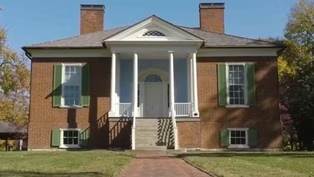
Farmington Historical Home is the oldest historical home in Louisville, with deep roots to the state and the nation.
The land was purchased by John and Lucy Speed, and they built this house.
They completed it in 1816, started work on it in 1815.
They lived in cabins for two to three years while the main house was being built.
It's a beautiful structure based on the Jeffersonian design.
John Speed had two children, two daughters, from his first marriage, and then he and Lucy had nine children together.
Nine children lived to adulthood.
The Speed family would go on to influence politics on the state and national level, as well as within the city of Louisville, with the Speed Art Museum, as well as the University of Louisville School of Engineering, being named after the family.
But those roots started right here, as a hemp plantation.
Interestingly enough, hemp was one of the only labor-intensive crops that necessitated a large labor force in Kentucky, hence Kentucky remained a slave state because of the hemp crop.
[music playing] The Speeds primarily sold their hemp to the southern cotton plantations, and they used it for rough bagging to bag up cotton as well as twine.
Most plantations in Kentucky at the time had three to five enslaved people.
Farmington had up to 70.
We know that when the Speeds arrived on this land, they had a number of enslaved people with them.
We think it's around 11 at that time.
And throughout their time here, that number grew.
As the farming and the agricultural land grew, so did the number of enslaved people.
In the years leading up to the Civil War, one man would visit Farmington and see firsthand the effects that slavery had on the nation, a young lawyer from Illinois named Abraham Lincoln.
In 1837, while running a general store in Springfield, Illinois, John and Lucy Speeds' son Joshua met and befriended Lincoln.
The story says that a young Abraham Lincoln walked into his store one day, new to town, looking for a place to stay and looking for all of the fittings for a living space.
And in typical Lincoln fashion, Lincoln tells Joshua, “I am sure this is a fair price.
However, I can't pay that.
I might be able to pay that in December if I'm successful as a lawyer.” At that point, he started talking to him and told him about this space that he lives in upstairs.
And so Joshua was like, “Well, you can live with me upstairs."
And they ended up rooming together for three years in Illinois and becoming really lifelong best friends.
After the death of his father, Joshua returned to Farmington, leaving Lincoln in Illinois during a rough patch in Lincoln's life.
He was going through a period of melancholy, as it was called at the time.
He had just ended things with Mary Todd and was really struggling with kind of the next phase of his life.
Joshua was like, “Why don't you come down to Kentucky, spend some time, take your mind off of things.
And it might be really good for you to just kind of rejuvenate yourself.” [music playing] In the summer of 1841, Lincoln stayed at Farmington for three weeks with the Speeds.
During this time, Lincoln saw firsthand the realities of plantation life.
He was troubled by that.
He wrote about how he was in downtown Louisville and saw enslaved people being shackled and put on boats to be sent further south.
He wrote how that impacted him and how it's an image he would never forget.
But his time here and his relationship with the Speeds definitely impacted his views on slavery.
Twenty years after Lincoln's visit to Farmington, his relationship with the Speeds would play a crucial role during the Civil War.
The Speeds were part of the Union.
They were very staunch Unionists.
So I think that probably helped in their friendship.
They played a key role with keeping Kentucky in the Union and kind of threading that needle, advising Lincoln on what to do at the national level and having influence in Kentucky to keep Kentucky in the Union.
So they did align in that sense of keeping Kentucky within the Union, but they did not agree when it came to slavery.
[music playing] This conflict of ideals, even amongst friends, reflected the U.S.
during its most divided time.
The Speeds were, I think, very typical of how complicated some families were and some viewpoints were during that time.
There are writings where they call themselves slave-owning emancipationists, and that just obviously does not make sense to us.
So I think they justified it as they thought of it as a business, owning enslaved people.
But yet, also spoke about how it was inherently evil at the same time.
[music playing] After the Civil War, Farmington was purchased by the Dreschers, a German immigrant family that then farmed potatoes on the land.
Then, in 1908, the land was sold to the Bischoff family, who also farmed potatoes.
When the Bischoffs sold the land in the 1940s, the house and its surroundings quickly fell into disrepair.
It was then that a group of local citizens decided to renovate and preserve the property.
There were a group of local citizens who recognized the historic significance of the house.
There was a lady named Ambrose Haldeman.
She was actually one of the foremost landscape architects in America and one of the first female architects.
So she formed an organization to preserve Farmington.
She wanted to turn Farmington into a museum where all people could visit, and we could tell the story of Lincoln.
And so she organized a group of people, and they raised money and purchased Farmington.
And it became opened up as a museum in 1959.
Farmington operated as a historical home and museum for decades, but it wasn't until the turn of the century that a concerted effort was made to tell the story of all those who lived at Farmington.
So many of those people have been forgotten.
And so it's really our mission to tell those stories of everyone who lived and labored here.
And that includes the Speeds, but it also includes those that were enslaved here.
You know, Kentucky's history is very rich and varied.
The history of Farmington was an integral part of that.
The Speed family was very active on the local, state, and federal level in politics.
Kentucky as a slave state and the divide we had during the Civil War, where Kentucky was really split on the issue.
[music playing] On this property rests more than 200 years of history that played a central part in the destiny of not only the state of Kentucky but of the United States as a whole.
[music playing] Could the rolling hills of Middle-earth have roots in the rolling hills of Kentucky?
It's a question that's sparked curiosity for years.
Whether or not J.R.R.
Tolkien found inspiration for the Shire through stories he heard from a Kentucky classmate while at Oxford University.
Let's explore evidence on both sides of the idea and why the values that define the Shire feel surprisingly familiar right here at home.
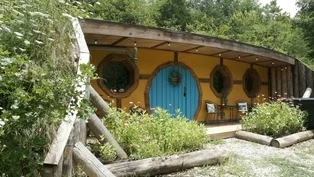
[music playing] [music playing] “In a hole in the ground, there lived a hobbit.” Those were the words J.R.R.
Tolkien wrote on a blank sheet of paper while grading exams at Oxford University in the early 1930s.
Now, at the time, he had no idea what a hobbit was, let alone the stories that would unfold from that first sentence or the immense impact they would have on the world.
Their home is called the Shire, and pre-industrial farmland as far as the eye can see, with tobacco as their main export.
Now, this may sound familiar to our own state.
But to see where Kentucky comes in, we need to learn about a man named Allen Barnett.
[music playing] Allen Barnett was from Kentucky, from Shelbyville, from a farming family, one of four brothers born in 1888.
He got to Oxford with a prestigious Rhodes Scholarship, and he started here in October of 1911, a freshman alongside Tolkien.
They become very good friends.
They're members of the same group, the hard-to-pronounce Apolausticks, which means the merrymakers.
And we still have a couple surviving photographs with him and Tolkien together.
Matter of fact, we probably wouldn't be talking about him had not Guy Davenport mentioned his name in a piece that he writes for the New York Times originally.
[music playing] So, in 1979, Guy Davenport writes an article called Hobbits in Kentucky for the New York Times.
“I was in a casual conversation on a snowy day in Shelbyville, Kentucky.
I forget how in the world we came to talk about Tolkien at all, but I was realized I was talking to a man who had been at Oxford as a classmate of Ronald Tolkien, a distinguished lawyer, Allen Barnett.” “Imagine that,” Barnett says.
“You know, he used to have the most extraordinary interest in the people here in Kentucky.
He could never get enough of my tales of Kentucky folk.
He used to make me repeat family names like Barefoot and Buffen and Baggins and good country names like that.” So there it is, the article from the New York Times that starts this whole question about, “Is Kentucky, and particularly Lexington and Shelbyville, the area around central Kentucky, a source for some, if not many, of the names that are used in the Shire by Tolkien?” Now, can this be true?
Did Tolkien really grill Allen Barnett on his Kentuckian background?
It's clear they were close.
They talked a lot.
Tolkien would have been interested in all sorts of things Kentuckian.
He was interested in place names and how people talked, how they lived.
And what's funny is Tolkien could have got them from here and then transported them back in his mind.
It's hard to say.
And there's also the problem that Tolkien said quite specifically that his Shire was inspired by the little village that he, Tolkien, had grown up in.
He says, “If we drop the ‘fiction of long ago,' the Shire is based on rural England and not any other country in the world.” So that seems to certainly be the primary influence on the Shire.
And the influence of Kentucky, I'm afraid, has to remain a question.
Tolkien wanted the Shire to embody a kind of Englishness.
He wanted his mythology to be a mythology for England.
But in truth, it's become a mythology for much of the planet.
Kentuckians, of course, probably have as much reason to identify with the Shire as anyone does, and those values of community and caring for each other, helping each other, sharing fun together.
It's easy to see why Kentuckians might feel at home in the Shire.
After all, community and the joy of being together have always been a part of life here.
And for some folks, these values have become something you can walk into.
Believe in story.
Yes.
Our goal here is to be Coffee for Imagination and Fellowship and modeled after the Inklings, which is C.S.
Lewis and J.R.R.
Tolkien's little literary society.
[music playing] They would meet and read papers to each other about literary figures, about poets, about novelists, about playwrights.
So they were a club of cultured young men who were trying to promote their own intellectual life as well as have a laugh together.
[indistinct talk in the background] They've created literature that has just stood now on close to a century and just influenced the world in so many positive ways.
And we just really wanted to model our organization to kind of replicate what they were doing over in England with a beverage and a space and with friends.
I walked into Drinklings and met Randy Hardman and said, “Hey, do you like C.S.
Lewis?” He's like, “I'm more of a Tolkien guy.” I was like, “That's fantastic.
I'm a Lewis guy.
Hey, we should do something.” And within a month and a half, we had a Lewis Society and Tolkien Society going.
And so we got together and had the first Verum Fabula Fellowship meeting on the back porch of the old Drinklings location.
And we had 20 people out there for our first gathering.
And I don't know how many books we had read thus far and conversated around, but it was something that was kind of an idea.
And six years later, it is still going strong.
We create this atmosphere.
And then, these Kentuckians, they're like, “Yes.” Like, “I could easily be Bilbo.
I could easily be Merry or Pippin.” You see yourselves in those people because they're real.
They're tangible.
And they have.
it's just part of the human experience.
I think we all, in a sense, are more Hobbiton than we are rangers from the north.
It's stories that tell us who we are.
Stories that remind us why we're here.
Stories that encourage us and inspire us.
Yes, what we do makes a difference.
So that's what myths are.
These important stories that are foundational for humanity.
[indistinct talk in the background] We actually all love.
We all want to live in the Shire because it's food, it's fellowship, it's fireworks, it's laughter.
All those things that we love about the Hobbits, we really know we're meant for.
So people in Kentucky who read the Lord of the Rings and find their own home reflected in the Shire can use that, I hope, to give them strength in whatever they have to do to maintain love and respect for nature and the world at large in their home state.
[music playing] We've had a great time here today at the Kentucky Museum on the campus of Western Kentucky University in Bowling Green.
Now, we're celebrating our country's 250th birthday all this season on our show, and the museum here has some great activities planned to mark the milestone.
Be sure to make the trip down 65 to visit this beautiful place if you haven't been before.
Now, if you liked our show, be sure to like the Kentucky Life Facebook page and subscribe to the KET YouTube channel for more of what we like to call Kentucky Life Extras, where you'll have access to lots of other great videos.
Until next time, I'll leave you with this moment.
I'm Chip Polston, cherishing this Kentucky life.
[music playing] [music playing]
Video has Closed Captions
Clip: S31 Ep13 | 8m 22s | 200 years of history at Farmington Historic Plantation in Louisville. (8m 22s)
Video has Closed Captions
Clip: S31 Ep13 | 8m 7s | Abandoned Kentucky Railroad lines finding new life. (8m 7s)
Video has Closed Captions
Clip: S31 Ep13 | 7m 59s | Was Kentucky an inspiration for Tolkien's literary works? (7m 59s)
Providing Support for PBS.org
Learn Moreabout PBS online sponsorship













Support for PBS provided by:
Kentucky Life is a local public television program presented by KET
You give every Kentuckian the opportunity to explore new ideas and new worlds through KET. Visit the Kentucky Life website.