OnQ
Set in Stone
Clip: Season 9 | 8m 3sVideo has Closed Captions
This segment showcases local archeological sites with Native American petroglyphs.
This segment of OnQ, titled 'Set in Stone', was reported by Pierina Morelli. The segment explores sites throughout the Pittsburgh region where archaeologists have identified Native American petroglyphs. Archaeologists Ken Burkett, Ed Kaufman, and Richard Ziegler discuss petroglyphs’ historical and cultural significance, as well as their own work to research and preserve these ancient carvings.
Problems playing video? | Closed Captioning Feedback
Problems playing video? | Closed Captioning Feedback
OnQ is a local public television program presented by WQED
OnQ
Set in Stone
Clip: Season 9 | 8m 3sVideo has Closed Captions
This segment of OnQ, titled 'Set in Stone', was reported by Pierina Morelli. The segment explores sites throughout the Pittsburgh region where archaeologists have identified Native American petroglyphs. Archaeologists Ken Burkett, Ed Kaufman, and Richard Ziegler discuss petroglyphs’ historical and cultural significance, as well as their own work to research and preserve these ancient carvings.
Problems playing video? | Closed Captioning Feedback
Where to Watch OnQ
OnQ is available to stream on pbs.org and the PBS app.
Providing Support for PBS.org
Learn Moreabout PBS online sponsorship[Music Plays] Petroglyphs are figure incised on the rock.
We'd like to think o by Native Americans.
They've been around her from anywhere from 900 years to 500 years.
The engraving on this site, done by the Native Americans, have been pecked with a stone and then rubbed smoot with another stone, and most of them are fairly broad.
They have a U-shaped bottom.
Some of the work that they did was used by or, you know, they put on antler dow and pounded on it, whic we would have hammered a chisel.
But this work was done crudely.
The state has 13 recorded petroglyph sites here in the what we call the Uppe Ohio Basin that runs from Parkersburg, West Virginia, up to Indian Guard Rock, which is near Franklin, PA.
There are thre different groups.
There's a group here in the upper Allegheny Valley.
There's a group on the Monongahela River and there's also a group on the lower Allegheny and als the the Ohio River proper.
[Music Plays] This is the Parker' Landing petroglyph site.
It's the first site that was ever recorded in Khan County, Pennsylvania.
[Music Plays] This is one of the few places in in western Pennsylvania where Pennsylvania period, that you can actually g and stand and say, here it is exactly as it was when the Native Americans were here.
The rocks that are exposed today haven't moved for a thousand years or more.
It probably hel some religious or educationa or tribal significance to the people that created them.
There are six panels here, and I think we have 179 prehistoric figure recorded at this site.
Panel number one is underneath the first set of ripples you see to the north of us and it consists of a human head with 4 or 5 lines radiating from the top of the head that appear to be commonly called power lines, but may represent some type of a headdress.
The otter at Parker i the biggest figure in the site.
It's about 13f long from head to tail.
It's in an outline form, and what's unique about this figure are not totally unique, but what's different is that it does have two in size lines across the body.
That's called lifelines among people that deal with pictographs and petroglyphs.
The lifelines usually help indicate that this is a spirit animal representation.
[Waves Crashing] And yo see it with the spiritual lines in all of the drawings.
Or a lot of the petroglyphs have spiritual lines in them, and the animal all had a spirit.
And and they thought highly o these animals and, and actually, you know, it's not like they worshiped them but they thought of them.
They had some good feelings about them, and they all were significant in something that they did.
The Algonquin has speaking Indians up through this area, Ohio, and up into the Midwest, have a legend of a creature called Michi, and it's an antlered underwate panther.
The Michi Peshwa lived in the rapids and in legend was noted for upsettin canoes and drowning people, and generally being wha we think of as one of the dens of the deep.
We think that the majority of them were made after 100 AD by Native Americans that were living in permanent or semi-permanent villages, practicing horticulture, raisin corn, beans and squash, living in fortified settlement on a year round basis.
[Car Driving] Rainbow rocks is a it's a it's a very big rock overhang.
It's what we cal a rock shelter.
The Native American camped underneath this shelter, and it's probably locate on a remnant of what's called the Frankston Venango Trail.
That's when you were excavatin the site here was in 1954?
54 and 55, yeah!
And you found th you found the petroglyphs when you were excavating this?
Yeah!
I just started the center over in here, close to the wall.
Dick Ziegle discovered the site, and I believe it was in the lat 1950s.
He was actually excavating in there.
And Dick's story is that he too a break from excavating and leaned up against the rock.
And I just glanced ove and I thought, well, those looked like impressions in the rock.
And then I got close and started sizing it up.
And I know a lot of people see knows maybe didn't pay any attention to them.
I thought it was maybe erosion in the rock or that, but I suddenly realize there were figures that had been carve in the rock, the head of a snake, and the body of a snak coming down through here.
There's a second snake up here with the body coming down through here, wha we call a turkey track or a bird track here and here.
There's also another one here.
And then there's.
And it's very hard to see, but there's another the head of the snake here and a body coming down here at the bottom of this turkey.
It's very difficul to see in here.
There's a human figure and there's a head right here of a human figure.
There's two arms coming up her on each side, the body and the two legs out at the bottom here.
We'll see that o some of the other sites to with the stance of a man with his arms spread very wide and his legs spread kind of in a, in an upright or a dancing position or some type of an awareness position with his arms up.
[Music Plays] I think it tells story because when I talk to Leo Milford, the game commissioner, a young fella, he said, out here there's a lot of rattlesnakes, there's copperheads.
And I thought, well, here's the copperheads, here's the rattlesnakes with the crosses on the tail, rattlesnakes.
And at that time he told me he said, a lot of game out here, a lot of turkey.
And here, these were turkey tracks.
What they see, Thompson figured.
So I think it was a hunting experience that they've had out here.
What they actually meant though, we don't know and we probably never know.
Those people were long gone and have no living descendants in this area.
[Music Plays] It's very interesting to be abl to sit here and ponder what's been put there a thousand years ago by somebody, and in your mind to try to decipher what that perso was trying to tell us.
We have no idea.
You know, we can look at them, we can make assumptions.
But to be truthful, that culture was so radically different from what we see today.
And you know what?
What are people going to think about us 1000 or 2000 years from now?
[Music Plays]
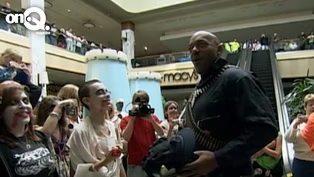
Video has Closed Captions
This segment features the annual 'Zombie Walk' at the Monroeville Mall. (6m 27s)
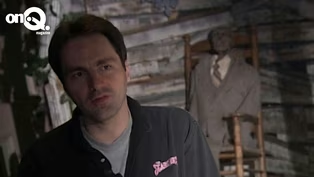
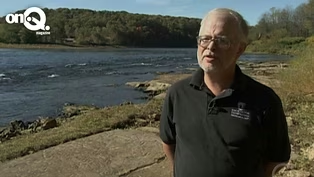 Now Playing
Video has Closed Captions
This segment showcases local archeological sites with Native American petroglyphs. (8m 3s)
Providing Support for PBS.org
Learn Moreabout PBS online sponsorship New Episode
- News and Public Affairs

Top journalists deliver compelling original analysis of the hour's headlines.

- News and Public Affairs

Today's top journalists discuss Washington's current political events and public affairs.

 New Episode
 New Episode
 New Episode
 New Episode


 New Episode


Support for PBS provided by:
OnQ is a local public television program presented by WQED