Oregon Field Guide
Underwater Robots, John Day River Geology Tour, Sage Grouse Photo Essay
Season 37 Episode 8 | 27m 36sVideo has Closed Captions
Underwater Robots, John Day River Geology Tour, Sage Grouse Photo Essay
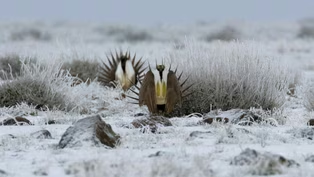
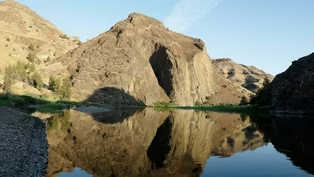
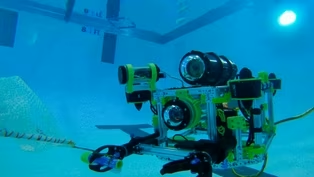
Students on the Oregon Coast build underwater robots that compete on the national level. Take an adventure back in time through some of the most stunning geology in the Northwest. The delightful dance of the greater sage grouse in the high desert in spring.
Problems playing video? | Closed Captioning Feedback
Problems playing video? | Closed Captioning Feedback
Oregon Field Guide is a local public television program presented by OPB
Oregon Field Guide
Underwater Robots, John Day River Geology Tour, Sage Grouse Photo Essay
Season 37 Episode 8 | 27m 36sVideo has Closed Captions
Students on the Oregon Coast build underwater robots that compete on the national level. Take an adventure back in time through some of the most stunning geology in the Northwest. The delightful dance of the greater sage grouse in the high desert in spring.
Problems playing video? | Closed Captioning Feedback
Where to Watch Oregon Field Guide
Oregon Field Guide is available to stream on pbs.org and the PBS app.
Providing Support for PBS.org
Learn Moreabout PBS online sponsorshipMajor support for Oregon Field Guide is provided by... [ ♪♪♪ ] WOMAN: Come on!
There he is, there he is, there he is.
[ exclaims ] Get him out of there, buddy!
Good boy!
[ laughing ] WOMAN: Whoo, high five!
Yeah!
AARON: Next on Oregon Field Guide: We take up paddles and oars to travel back in time through the geology of the John Day River.
MAN: It's a window into this really complicated landscape that most of the time we're just walking around on the surface and we never get to see the third dimension.
And we crawl into a bird blind on the high desert to film the delightful dance of the greater sage grouse.
[ popping softly ] But first: In the coastal town of Newport, the next generation of maritime technology starts in a community pool just like this one.
[ ♪♪♪ ] [ people chattering indistinctly ] NOAH: These students are competing in a regional underwater robotics competition called MATE ROV.
So it'll be net PCO2 and then next.
It takes place every spring in Newport.
Throughout the school year, they design and build remotely operated vehicles to take on other teams.
The top team earns a spot at the world championship, facing competitors from across the globe.
WOMAN: Good morning.
Good morning.
Building these robots can take months, with most of the work happening after school and on weekends.
Five teams from Warrenton are competing this year.
They're all coached by Heidi Lent.
That's everybody, so we can start whenever.
So I'm running into issues writing our theme.
I love making things and building things, and then bringing really fun things to the kids to learn.
All the coding that we do, the 3D printing, Tinkercad.
If I can teach them those skills, they will definitely be more employable than the kids that aren't in a STEM-related class or elective like this.
The goal of the program is to turn classroom lessons in math, science, and engineering into hands-on experience building underwater robots to complete real-world tasks.
The most experienced team is made up of four high schoolers and one middle schooler.
They call themselves the Rays.
This is our competition ROV.
ROV stands for remotely-operated vehicle.
This is a marine-side one, so it's meant to go in the water.
These are actually industrial claws we were able to buy from the company, Blue Robotics, that they actually use these exact claws on real-world situations such as, like, coral.
This is our AI unit.
We call it Marv.
It's kind of like our assistant going underwater.
These are our two navigation cameras.
You have to have all the different angles you want or need, and it's all streamed onto a laptop that you're controlling with an Xbox controller.
These students have some extra help: a former Boeing engineer who volunteers as a mentor.
I worked at the Boeing Company for 42 years.
I mostly worked in robotics and automation.
Essentially, I'm just a technical guy that helps out however I need to.
HEIDI: I can give them time and I can give them my passion, but what I can't do is I can't figure out all the robotics that he's had so many years of experience with.
So having him is the reason we are at the level we're at with these kids.
That level has led to a stocked trophy case just outside Heidi's classroom, an impressive accomplishment considering Warrenton is far from affluent.
CRAIG: The Warrenton School District is one of the least funded school districts, probably, in Oregon.
So when I first started here, they didn't have a lot of equipment.
They didn't have a lot of background in computing or robots.
So when the opportunity came along to help Heidi with technology, that was right up my alley.
STUDENT: There we go.
Nice.
Despite limited funding, Heidi's focused on keeping Warrenton at the top of the standings in Newport.
HEIDI: Every year, I take another team.
We started with one-- we got third place.
Went with two the next year-- we got second and third.
The next year, I took three teams.
We got first, second, and third.
I think it's because I put that lock in... I'm a competitor and I want to share that with the kids.
Where the canister is the main machine and... Each week, the team heads to Seaside for an hour of hands-on practice in an actual pool.
So right now we're shaking the machine out to clear any little bubbles you can see around here to make sure that the machine has the proper buoyancy when we send it on our mission.
Arming ROV.
Arming, okay.
All right.
In the professional world, ROVs are used for deep-sea mapping and exploration, like this one, which is helping scientists study submarine volcanoes.
It's the kind of career these students can work towards, and success in the competition helps open those doors.
[ ♪♪♪ ] So maybe float here, machine here.
Lay it out, check everything, make sure it works.
19 teams are competing this year, with students ranging from elementary through high school.
They compete across three levels.
Scout is the beginner tier, Navigator is in the middle, and Ranger is the most advanced.
The Rays are competing at the Ranger level.
BOY: So right now everyone's just going around looking at all the other teams, basically sizing up the competition is what most people are doing right now.
The Sea Bunnies are one of five teams from Warrenton.
They're competing at the Navigator level.
GIRL: The ocean is practically in our backyard, so we want to make machines to help learn about that stuff.
And so maybe when we're older we can take on one of those jobs and try and find a sustainable future for ourselves.
Are you guys using any fluid power?
Hydraulic.
Hydraulic?
OWEN: So we're one of the only public schools here.
We have the smallest team compared to that team over there.
I mean, they have probably about 15 kids total.
We have five.
We're making something better than theirs with less people, less resources.
That's why they're kind of just like-- Well, we don't know if it's better until we compete.
Every team faces the same set of underwater challenges, earning points for each task they complete.
They get two chances, and only the best score counts.
Okay, guys, five minutes starts now.
Why is that camera not running?
Oh, it's angled off.
It's offset, so it's, like, rotated right now.
Uh... Unexpected technical issues are forcing them to make a tough choice: leave some tasks unfinished and sacrifice points or risk valuable time trying to fix the problem.
So I'm going to make a change in plans.
I'm going to move the hydrophone over.
Do we get partial points for...?
It's not, you know, normal.
You're at five minutes, guys.
Okay, Owen, are we ready for photosphere or no?
Huh?
Photosphere?
No?
Two minutes.
I don't know if I can flip it.
Oh!
So it's blocked?
That's not good.
JUDGE: Didn't record that, by any chance?
What?
De-assemble.
That was so bad.
As we got down there, things just weren't going right.
We overestimated our team's ability to a point, not the machine.
And then we just had issues with memorizing certain tasks.
I'm a little bit nervous for sure.
I mean, like I said, after what we just did, it's anyone's game at that point.
Gonna run all on the photosphere the second round.
Make sure to stay confident but still remain productive.
I don't want to see anyone sitting there doing nothing.
We all have a role here, okay?
So for some reason the temperature is like right now, negative 127.
For the room temperature?
Temperature, yes, -127.
Negative 127.
RECORDED VOICE: Answer is -138.
Huh?
Uh, it doesn't hold.
It won't hold it.
It's too loose.
You got this, Jaden.
Okay, open it a little bit.
Okay, shut.
Fingers!
That water stem... [ ♪♪♪ ] All right, here we go, guys.
300 points this run.
300.
Don't quote us on that.
Really, really, really ready?
BOYS: Yes.
All right, go.
A little past that.
I've taken down the PCO2.
That appears to be fully in the square.
It is, yes.
Okay.
I'm going to attempt to remove the bottom of that... [ overlapping chattering ] What's the time?
That's time.
Uh, time?
That's time.
Done.
Done.
You guys were... really had it together.
You did a really good job.
Thank you.
So I want to start off by saying thank you all so much for joining us for the 2025 MATE Oregon Regional ROV competition.
[ all cheer, applaud ] The Sea Bunnies fell short of placing this year.
It's not about if you win or you lose.
All that really matters is that you learn from your mistakes, you get some education, and you can always try again in the future.
But the Rays scored enough points to give them a chance at first place.
For the Ranger teams, this is the one level that is able to advance to the world championship.
We're going to start with second place, though.
Our second place will be-- The winner is Valor Maritime from Valor Christian School.
[ all cheering ] It's easy to see these students as just kids at a competition, but they're the next generation of scientists, engineers, and innovators helping to shape a better world.
It really just shows you what it's like to be part of a team and how to work with other people.
It gives you an opportunity to make your imagination come to life.
--with a total of 385 points are the Rays!
[ all cheering ] All right!
And let's go all forward!
[ ♪♪♪ ] We're here on the beautiful John Day River in north central Oregon, and despite the look of things, we're not just here for the fun.
We're here for the rocks!
GILFILLAN: On this summer day in 2025, a group of self-described rock nerds has assembled on the banks of the John Day River with geologist Ian Madin.
I'm Ian.
Hi, Ian.
Oh, you're going to be our guide.
Yeah, I am.
Well, no, they're gonna be your guides.
I'm just gonna be your entertainment.
Oh!
IAN: Gosh, where to start?
This is one of the more geologically unique parts of the state, this entire region... Ian spent much of his career as chief scientist at Oregon's Department of Geology and Mineral Industries, also known as DOGAMI.
So we'll be starting out in the Columbia River basalt... But for the next four days, he's the chief tour guide on an expedition back in time.
Okay?
Let's go get wet!
[ indistinct chattering ] So we are in the canyon of the John Day River between Service Creek and Clarno, and it's a stretch of the river that cuts through a major transition in Oregon's geologic history.
So as we proceed down the river, we cut deeper and deeper into the earth and towards the older rocks that are underneath the Columbia River basalt.
If you've been almost anywhere in the Northwest, you'll recognize the massive lobe-like flows and distinctive columns of Columbia River basalt.
The story of this common rock starts about 16 million years ago.
At that time, Oregon was warmer and covered with lush plant life.
And then, for about a million years, hundreds of successive flows of volcanic basalt spread across the landscape, covering everything in its path.
Columbia River basalt is one of the three largest volcanic eruptions known in Earth history, and basalt is very fluid lava and covered virtually all of eastern Oregon and eastern Washington with thousands of feet of black lava.
And then, over time, rivers have cut through that, creating deep canyons and this layer-cake effect.
I'm fascinated by the landscapes, and it seems to me that that raises the obvious question of, "Why does it look the way it does?"
And geology answers that question or it leaves us a little confused about it, but that's half the fun is trying to figure out what the story is.
Brothers Ajay and Kiran Limaye grew up in Wisconsin but now live on opposite sides of the country.
So I'm a geologist at the University of Virginia.
I heard of Eastern Oregon from my brother 20 years ago and, you know, kind of daydreamed of one day doing a trip here, so here I am!
As a family, we were lucky to have our mom for 80 years.
We lost her, and this is a chance for us to spend time together in the natural world, and that's something she really liked.
So it's a chance for us to be together and also have an adventure.
The first day ends on a convenient beach nestled in these familiar landforms... and a chance to cool off after a hot day on the river.
[ birds chirping ] IAN: And we're off.
Another adventure!
Uh-huh.
The next morning starts off with more gorgeous landscape... a few small rapids... [ whooping ] IAN: Uh-oh, here comes a big one!
Oh, sideways!
Oh, God!
[ straining ] Oh, right down my shirt!
...and then this astonishing feature comes into view.
It's known as Byrds Point, named for early homesteader William Byrd.
IAN: Byrds Point is a large body of basalt and probably flowed down a river canyon carved into the older rocks.
Those have all eroded away and have left Byrds Point standing as a great, old cliff.
AJAY: It's really interesting to just go to a different part of the world.
And the landscapes here in Oregon, shaped so much by volcanoes, just give a whole nother world of opportunities to see new things happening.
The timeless basalt citadels stand guard along a river also teeming with bird life, including red-wing blackbirds... osprey... and bald eagles.
[ cries ] But just a few miles downstream, the landscape shows hints of a dramatic change.
IAN: If you look over on the right-hand side, you'll see layers of basalt that form a big curved arc, forming sort of a cup.
So what you're looking at here is a place where the basalt flowed down an ancient valley, mimicking the shape of that valley.
This change in the basalt's structure is the first sign that more ancient landscapes are about to be revealed.
So on the right, you can now see the transition from the white ash to the brown lava above it.
The white is volcanic ash, and that is probably 30 million years old.
So we are looking now at the older landscape just peeking out from underneath the basalt.
The rocks that make up these land forms of ancient ash are known as the John Day Formation and are the result of massive, explosive eruptions from supervolcanoes.
[ ♪♪♪ ] Places such as the Painted Hills are classic examples of features made up entirely of ash from these large-scale eruptions.
But on this part of the John Day, there was also something else going on.
At the same time, there were these small, local volcanoes, and they would produce lava flows and volcanic mud flows, and all of those would interfinger with the ash that was constantly falling from the sky that covered the entire landscape.
The results of these more local events, known as the Clarno Formation, are, in a word: A mess.
A very colorful mess, but a mess.
The Clarno is characterized by blocky lava flows and volcanic mudflows, which are a hodgepodge of mud and boulders that occurs when lava erupts onto ice and snow, and then those are also often modified by hot springs solutions, so instead of being black might be red and white.
Add to those events millennia of erosion and other land-shaping forces and you get this breathtaking, if messy, scenery.
Absolutely spectacular.
You know, that's the beautiful thing about a river trip is that you can kind of sit back and watch it unfold in front of you.
Toward the end of the day, the group has settled into what is known as "river time."
This is my first rafting trip, so I wasn't totally sure what to expect, but it really definitely develops a flow after a while.
There's just a lot of time to let things go by.
I think that the pace of the travel down the river itself, you have enough time to just go at really what feels like a natural pace.
We got some chicken stir-fry tonight for dinner.
Onions, peppers, carrots, house-made peanut sauce.
ALL [ singsong ]: Dinner!
[ all chuckle ] Oh, yes, please.
Would you like some...?
KIRAN: It's funny, like, when you go into a trip and you have that kind of city energy and you're like, "Oh, my God, what am I doing?
It's going to be kind of a long trip and who are these people?"
[ indistinct conversation, laughter ] But by the end you're like, "Oh, this is so great.
I could do several more days of it."
Just a great group of people to be with and learn what their experiences are too.
Day three starts off calmly enough.
ALL [ singing ]: ♪ Always look On the bright side of life ♪ ♪ Doo-doo, doo-doo Doo-doo-doo-doo ♪ And let's go all forward!
But it doesn't take long for the river to mix things up.
And while the river calms, the scenery continues to dazzle as well as puzzle.
WOMAN [ over radio ]: Is that a landslide coming down from the top?
No, I think it is, uh... I've been debating this, but I think that there's a fault in here.
And this material has been tilted as a result of movement on that fault.
I'm working on a story.
I need a little more data.
And so here's the deal: I may not have the right answer.
But, I mean, that's the whole point in geology is oftentimes you don't know, you can't know, and you have to try to use your observations to piece together something that is plausible and you test that hypothesis.
By the end of day three, a familiar but much more ancient basalt landform comes into view: Cathedral Rock.
I'm sure that you've all been wondering about this fabulous cliff and how it came to be.
So this is actually the throat of a volcano through which magma was rising to erupt at the surface, and everything above it has long since been eroded away.
Floating past the rock the next day affords a closer view of the magnificent columns.
This is a classic example of the columnar cooling joints that form in this basalt to make these beautiful, perfect columns.
As the tour winds down, the landscapes of the Clarno Formation grow even more wild and impressive.
These are the result of millions of years of cataclysmic forces building, carving away, and reinventing the landscape... all of which serve as potent reminders of nature's awesome and often violent power.
That is one of the great things about floating this river is that it's a window into this really complicated landscape that most of the time we're just walking around on the surface and we never get to see the third dimension, and this gives us that view.
KIRAN: Being in an experience like this that's so immersive for me reminds me of why I live here.
I thought maybe after three days it'd be, "That's enough," but there's so much more stuff I want to go back and learn about.
IAN: Two of the things that I love most in the world are floating down rivers and talking about geology.
So the opportunity to do both of those at the same time is kind of my idea of heaven.
And sometimes they don't get expressed at all because the columns... [ popping softly ] On a recent story, I filmed sage grouse in the High Desert.
It was quite the adventure.
I had to get up at 4 a.m.
and sit in freezing temperatures in a bird blind like this.
But it was worth it to get you the footage you're about to see.
[ ♪♪♪ ] [ birds chirping ] [ grouse popping softly ] [ wind rumbling ] [ ♪♪♪ ] You can now find more Oregon Field Guide stories and episodes online.
And to be part of the conversation about the outdoors and environment here in the Northwest, join us on Facebook, Instagram, and YouTube.
Major support for Oregon Field Guide is provided by... Additional support provided by... and the following... and contributing members of OPB and viewers like you.
Greater Sage Grouse on the High Desert Photo Essay
Video has Closed Captions
Clip: S37 Ep8 | 1m 44s | The strange beauty of greater sage grouse in the high desert in spring. (1m 44s)
Video has Closed Captions
Clip: S37 Ep8 | 12m 17s | Take an adventure back in time through some of the most stunning geology in the Northwest. (12m 17s)
Video has Closed Captions
Clip: S37 Ep8 | 10m 43s | Students on the Oregon Coast build underwater robots that compete on the national level. (10m 43s)
Providing Support for PBS.org
Learn Moreabout PBS online sponsorship New Episode
- News and Public Affairs

Top journalists deliver compelling original analysis of the hour's headlines.
 New Episode
 New Episode
 New Episode






 New Episode

Support for PBS provided by:
Oregon Field Guide is a local public television program presented by OPB