In the Arena
Weaponizing Midwestern Nice: Chad Udell Builds for the Future
Episode 2 | 25m 9sVideo has Closed Captions
Chad Udell shares how curiosity, technology and Midwest grit led him to build SparkLearn.
Chad Udell traces a career built on curiosity, adaptability and a willingness to keep learning. From early web design and mobile technology to co-founding SparkLearn, he shares how his team helps deskless workers access training wherever they work, why entrepreneurship never stops changing, and how “weaponizing Midwestern nice” became part of his approach to business and legacy.
Problems playing video? | Closed Captioning Feedback
Problems playing video? | Closed Captioning Feedback
In the Arena is a local public television program presented by WTVP
In the Arena
Weaponizing Midwestern Nice: Chad Udell Builds for the Future
Episode 2 | 25m 9sVideo has Closed Captions
Chad Udell traces a career built on curiosity, adaptability and a willingness to keep learning. From early web design and mobile technology to co-founding SparkLearn, he shares how his team helps deskless workers access training wherever they work, why entrepreneurship never stops changing, and how “weaponizing Midwestern nice” became part of his approach to business and legacy.
Problems playing video? | Closed Captioning Feedback
Where to Watch In the Arena
In the Arena is available to stream on pbs.org and the PBS app.
Providing Support for PBS.org
Learn Moreabout PBS online sponsorship- There's a quote from Theodore Roosevelt that I come back to often and it's why we named the show "In the Arena."
"It's not the critic who counts, not the man who points out how the strong man stumbles or where the doer of deeds could have done them better.
The credit belongs to the man who is actually in the arena."
Now I think about that a lot because we live in a world full of critics, people watching from the stands, commenting, judging, offering opinions with absolutely zero skin in the game.
And then there are the few, the ones who step in anyway, not because they have it all figured out, not because they're fearless, but because something inside them won't let them sit still.
They step into the arena knowing full well what it costs.
And so this show, it's not about polished success stories.
It's about the people who stepped in anyway.
The ones who have been marred by dust and sweat, and yes, occasionally getting punched in the face by reality.
Today's guest is one of those people, someone who didn't just build a company, but chose to build something that changes how people think, how they grow, how they learn, and how they show up in the world.
This is a story behind the startup.
This is what it looks like to be in the arena.
(energized rock music) Welcome back, everybody.
I'm honored to be sitting here with our next guest who has spent his entire career helping people learn, grow, and adapt.
So welcome to "In the Arena," Chad Udell, co-founder of SparkLearn.
Welcome, my friend.
- Thanks, it's good to be here, Doug.
- Yeah, well, we're excited to have you on "In the Arena," because from what we've talked about already, you've been in the arena for quite some time.
And the world is a completely different place than where you started.
However, you seem almost prophetic in the way that you approach things.
But before we step into the present, I'd first like to go to the past, to learn more about who Chad was before he was an entrepreneur.
We wanna to tell the story behind the startup, so I think we need to go back in time a little bit to learn more about Chad as a youngster.
Were you building things back then?
When did you kind of know that you were an entrepreneur, if you don't mind going back in time?
- Sure.
Well, I think like a lot of us in our generation we grew up, had parents maybe that worked out of the home.
And so we were left to our own devices.
- [Doug] Yes.
- No pun intended.
We'll get to more of that in the future here in just a moment.
But left to our own time, right?
Get home from school, get yourself a snack, get your homework done, figure out something to keep yourself busy so you're not getting into trouble.
Maybe some video games, maybe some time with friends.
A lot of the independent projects too.
Making things, building things, tinkering, Lego bricks, engineering projects, all those types of like STEM toys and things like that.
So a lot of time kind of left to grow and develop by yourself and come up with interesting solutions to problems that you might be possibly facing.
I think a lot of people in our generation probably come from a similar sort of background.
- [Doug] Right.
- So maybe we're all tailor-made for entrepreneurship in some way.
- Agreed, agreed.
Now walk me back to the beginning of Float Mobile.
- [Chad] Yeah.
- And for some of you out there in the audience this journey was.
iPhones were kind of new-ish at the time.
But take us back to that time.
- True.
So, yeah been working with a group of folks here in the Peoria area for a number of years.
First started working with some people at a company in 2003.
And at that time, obviously smartphones were not really a thing.
Maybe the first Blackberrys were just hitting the scene at that time.
But as soon as these touchscreen devices started hitting the market, we were enamored.
I mean, it meant a whole big change in terms of the digital products and solutions that we were building.
At the time, we were doing a lot of corporate training or like kiosks for like museum experiences and things like that.
So educational in nature, some e-learning and things like that.
But as soon as the phone kind of hit your pocket and had it always on internet connection, it was game over.
I mean, maybe actually just game start really when it comes right down to it.
It was like a whole new venue, an entire different modality, a device that has so many different affordances like GPS's and sensors, and cameras, and everything else on it.
Just a way richer canvas for putting your work and getting the right information to the right people at the right time.
So at that time, a lot of people were still trying to put long form training content or something like that on the phones.
And I don't know about you, but video gets over about two or three minutes and my hands start to get hired.
- Yeah.
- So I'm like, I'm not going to be holding that up and looking at a 50 minute e-learning content, you know?
So how do we make this more applicable and useful for the workplace, but also today's culture and the fast-paced, you know, life that we all want to live and we're subjected to every single day.
- Now this was CIRCA 2010.
- Yeah.
- When you guys kicked off.
- Yeah, 2010, 2011, like we were starting to build our, some of our first apps and gaming experiences.
And then not too shortly after that, the iPad showed up as well.
So, you know, that kind of changed things.
So it was a little bit about information retrieval, but also like provide engaging or maybe a game-like experience in some of these types of venues.
Add things like, you know, leaderboards, or gamification, or badges, or whatever it might be to like continue to increase the enthusiasm, excitement and program adoption.
But you know, we started seeing a lot of the same sorts of patterns of problems that needed to be solved.
People had legacy content, or libraries, or materials, or assets that they just couldn't get into people's pockets in any sort of effective way.
And the tooling at that time, especially how people were creating training content, it was not much more complicated than something like PowerPoint.
- Right.
- Or you'd go full tilt and then you needed like a computer scientist and a full programmer to build something truly engaging.
And neither one of those models work for many businesses because you've got simplicity that's not going to get deep enough on the subject matter area, or you need to have an entire information technology team to support.
- Right.
- All of those initiatives.
So we saw this kind of gap and decided to kind of centralize around that.
Building products and solutions that essentially turned the custom services that we had been doing into something much more packageable and purchasable.
And that's really how Float started putting its first like feet into the product-curious world, as it were.
Kind of moving from services and consulting into something a little bit more tangible and resellable.
- Right.
So now that our audience has a little bit better understanding of the start of your entrepreneurial journey, let's kind of go back in time and I always like asking these questions of, you know.
- Sure.
- What would one of your high school teachers say about you?
And, or anybody during that age?
And maybe part of that question is, as what we learn a lot is people that are building for revenue, for their livelihood, oftentimes we're building similar products just for fun as a hobby.
So were you building anything back in your high school years?
- Oh, well, you know, I mean, I've taught myself a lot of programming and things like that, kind of starting near the end of the high school career, but like I would show up at the computer labs and I didn't have classes in the computer labs.
I would just like hop on a machine that was open or free and taught myself Adobe Photoshop and Illustrator and like some of these tools for designing and things.
Got into a lot of, you know, like some of the early CD-ROM creation of some like, some friends of mine were in bands and stuff, so I would like design them covers, or do mix tapes, or posters, or T-shirts, or other types of things like that.
Made a couple websites for some record labels and it was a good time.
It all seems really quaint now.
But it was kind of the first steps into, you know, being a bit of a self-starter and you kind of got to go out there and make those connections, shake those hands, and try and get the deals that you can in order to continue to put your stuff out there.
- [Doug] Yeah.
- Yeah.
- And I think that's so cool how it was fun, but now seems so quaint.
I kind of love that reference and we'll dive into more of whatever the opposite of quaint is.
- Yes, exactly.
- The more complex bigger issues that you're tackling today.
But still staying back then.
As you started to make that transition of, "This is fun to I need to start making money."
Was Float the first thing that you really dove into?
And did you have a, or were you collecting a paycheck, I guess, before then working for somebody else?
- I got out of school and moved to Chicago and got a job working in media.
My first gig was working for Rolling Stone Magazine.
They had a web presence at that time, so we were building some games and things.
And then of course, you know, the, the dot-com bomb kind of hit and myself and basically an entire swath of the working population that we're working on these cool.com projects were suddenly said, "Eh, that's not really monetized or that's not really making us the thing that we need."
So it was a little bit of a regroup, right?
At that time, that's when I, I realized I had some skills like in computer.
So I started teaching at some local, you know, re-skilling schools and stuff, teaching products like Dreamweaver or basic HTML and CSS.
And around that time then as well, my wife and I wanted to start a family.
So we decided to move back downstate and I got a job pretty much right out of way doing some freelance game, and web design and development, but then also teaching at a local university here, Bradley University, which is my alma mater, so I was really happy and proud to go back.
- That's awesome.
- Had a lot of time, a lot of good times there working with students, many of which over the years have become either, you know, close friends or perhaps business partners.
And in the case of some, interns and even employees and teammates.
So it's been a great experience in that regard.
And it's just, you know, keep building your network and keep, you never know.
Like somebody that you met seven, 10, 12 years ago, if you made a good impression on them and you see them back around again, it could become something great.
So keep those types of relationships hot or friendly if you can.
- [Doug] Yes.
- Right?
- Yes.
That is very important, I agree.
- Yeah.
- So as you're starting to build out Float Mobile.
- [Chad] Yeah.
- You added another kind of a piece to you, to your brand.
- Yeah.
- By writing a book.
- I wrote my first book in 2012.
We had, it was called "Learning Everywhere: How Mobile Content Strategies Are Transforming Training."
It's a mouthful, I know.
But it really signified the shift, you know, in the sense that learning was not like a centralized thing that has to take place in a schoolhouse or even in a classroom.
Learning can take place no matter where you are, especially with these phones in your pocket and the ability to have internet basically wherever you want.
You have no more tortured moments.
I'm sure we probably remember like the days of going to a friend's place or something and be like, "What movie was that guy in with that other person?
The thing?"
And I mean, you can now learn that answer no matter where you are.
- Right.
- Right?
I mean to the point now, I mean, you don't even have to even look it up.
You just talk to your phone and you'll be able to get that answer or something along those lines.
So, I mean, as those types of situations began emerging, I found that I had some strong opinions on some of the ways that things were being done.
Started doing a lot of blogging and thought leadership short form content.
A couple book publishers noticed some things that I had been doing, approached me to do a book.
And it was a very rewarding experience in the sense that pre-generative AI technology meant a lot.
- You actually wrote the book, not AI.
- Yes.
It meant a lot of nights, you know, after the family had gone to bed or something like that, where this is like the side hustle.
So even as I'm doing my job, had to work on these, on this book.
And then of course, all the other material and media that comes with it, the conference presentations, and the sessions, and the white papers, and not knowing all of the marketing that goes into it and those types of things.
It's been pretty fantastic.
I mean, I went on and I did end up writing a couple more books in the same subject matter area of adult learning and workplace learning.
They've been pretty fantastic business cards in the sense that, you know, you can very clearly provide that to somebody and let them know this is, these are my thoughts on this subject matter area that we're talking about here.
I've spent some time collecting them for everybody.
This is my point of view.
It's based on my personal experience and expertise.
There's quite a bit of research and development that has gone into some of these those titles as well.
But it's never been like the way that I pay my bills.
The book is, I get a royalty check every once in a while and I joke with the family, "Hey, it's time to go for dinner."
As long as you want to go to, you know, your favorite fast food establishment and don't get too fancy with it, right?
So it's not going to be, you know, a world beating New York Times bestseller, but it does get me conversations and has had some introductions to people that I otherwise probably would not have been able to meet or been able to speak to in a way that I felt validated or able to converse with them on that type of level.
So it's been great overall.
I don't know if I'll write another one.
- But never say never.
- Three is a lot.
Three's a good, solid number, I mean.
- It is.
- But you know.
But there are a lot of ways to share your information in today's climate that don't necessarily require a 75,000 or 100,000, you know, word title.
There's a lot of short form content.
There's a lot of maker content, YouTube, channels, influencers, all the channels that are out there, obviously.
But I think that for where we were, especially getting things started, the book was a good step in the right direction.
- Yeah, and it's, you know, today, remote worker means something completely different, I think, than it did 15, 14, 12, 10 years ago, for sure.
So let's talk about SparkLearn.
- [Chad] Yeah.
- And kind of dive into that platform right now in the next, you know, minute or two to give the audience a little bit more context there.
- Yeah, absolutely.
So SparkLearn is our attempt to solve for the mobile and deskless worker.
Really a lot of folks that are in quick service restaurants, fast casual, basically, or the hospitality sector in general.
But also like field technicians, communications professionals, utility people, guys that are out there climbing the poles and making sure that your lights stay on, all those types of individuals.
They face, people that have that type of work profile face some significant challenges.
Most of them are hourly employees, so their worth and their value is determined by the employer to be, how productive were you during this shift?
So the chance or the opportunity for them to get invited to conferences, or seminars, or webinars, or take time out to do their training, that's a luxury.
And some companies with great professional development programs can't afford to do that for their team members, but by and large, most of them really are not given those types of, you know, strong armaments, as it were, for training.
Onboarding and understanding what it is that you're supposed to do in your job is one of the biggest single ways that you can determine that employee satisfaction is going to at least start high.
Warm welcome, get people up to speed so that they're competent, feeling good about themselves.
- Right.
- A good training program can make every employee your best employee if it's executed properly.
And what we saw was a massive shortcoming in the sense that if mobile devices and tablets truly are here to stay, why aren't we using them as training content?
And if we are going to be using them as training content, why would we in any way, shape or form go back to doing it the same old way that we had been doing with classrooms and rote memorizations, and test scores, and quizzes and things being the sole way that you measure whether a training program is actually effective?
There should be opportunity for the employee to understand that the training program is there when they need it as a channel of information, not just ahead of time, hope that I retain it and I can do my job when I'm on the floor or out or in the field.
So SparkLearn is our effort to create a safe repository of measurable training content that can be delivered anywhere to any employee that's highly personalized and always available.
And we continue to augment that.
We've added lots and lots of capabilities over the years.
And not only are we a great program now, but I think that the roadmap and the future that we've got charted ahead of us with all the new technologies that continue to amaze the marketplace and confound a lot of us at the same time, they're all available and we can, you know, start to employ and use those as well to continue to improve employees' day-to-day work.
- That's a big, bold, audacious endeavor that you guys are on in the SparkLearn team.
So you literally tap into hundreds of thousands of employees from global companies.
That seems a little bit stressful.
You go back and think of your first customer to where you guys are now.
What are some of the, I guess, major headwinds or hurdles, whether it be, you know, a literal or a regulatory, or maybe just in your own sort of head as you grew?
If you could share some of those hard lessons learned.
- Yeah, I mean, like any entrepreneurial journey, there's always these like days where you, the thing goes really well and you're like, "This is amazing."
And then the next day you're like, "Oh, there's a whole 176 question security verification profile interview that I have to fill out for this particular company."
Or there's a new type of insurance that you need against like, I don't know, AI data exfiltration or something.
There's always something, right?
And so those types of challenges, even after the business is established, they don't necessarily go away because they're constantly changing.
When GDPR hit, that was a big deal.
That changed a lot of things in terms of compliance and data, and record keeping, especially for companies that serve a global audience like ourselves.
- What's GDPR?
It is the privacy and regulation policy that is in place in the European Union related to, you know, your right to be forgotten.
If you leave a place, they have to delete your data and there's a number of other types of precautions.
It is really a regulatory and compliance framework for risk management with data and privacy for employees.
So those are some of the things that we face.
But then, of course, obviously everybody had the obstacles or the issues with COVID.
Figuring out what that means was a challenge.
The advent and the creation of some of these generative AI technologies and people just wanting AI everywhere, you know, that's a pressure and something that we're dealing with.
And then the shift now I think that we're underway is like the user interface and user experience that we had all grown to like understand and accept on the phone surface is being replaced by voice and video and other ways of interaction with content too.
So it's never a steady target.
It's always moving.
- Yeah, it's a very complex thing as the world evolves, your business evolves, and vice versa.
So if we're to think out beyond, let's go now go to the future now and what SparkLearn is and even you as an individual.
What is something that you hope a legacy, you know, that you're able to impact the world and those around you?
- Well, you know, I slice it in a couple different ways.
I'm about to turn 50 this year, so I'm getting a little bit more reflective on some of these types of topics.
From a work perspective, I want to continue to have an impact in the way that we have.
You know, going out and speaking and making a voice for, you know, small town companies trying to make an impact on the, the broader, larger world.
Whether that be through the weaponization of Midwestern nice.
- [Doug] Yes.
- Which is essentially my way of just saying like, you say you're going to do something, do it.
Potentially even like aggressively do it such that someone notices they did it and they did a really fine job, so we're going to ask them to do it again.
- Right.
- You know, you show up, you execute, you know, and you do what you say that you were going to do and you committed to.
That's a legacy that I hope lands instead.
You know, we stayed in it.
We stayed in the arena.
We gave our punches.
We took a couple licks as well, but we did what we could.
And then, you know, as my kids, my family has continued to grow, and now I have college students.
I think the most lasting legacy that I want to leave obviously is more of a personal one.
And I just want them to be prepared and ready to handle their own stint in the arena when and if that comes.
Whether they're entrepreneurs or it's just trying something new or trying something different that they feel like they are equipped, you know?
The entrepreneurial mantra, and I've heard you say this before of, you know, get comfortable with being uncomfortable.
Understand that uncertainty is a fact of life and just be able to deal with that.
Building resiliency and adaptability in the people that I work with, the clients and customers that I work with, but also my kids at home.
And by extension, my friends and family is something that I hope I can leave behind.
- That's great.
And I appreciate it.
I think that's a good spot for us to wrap this up because my next question, you already answered it, was what would you tell your former self, your younger self and/or your kids?
What advice would you give?
And I think you nailed it.
So thank you.
How can people get in touch with you?
- Absolutely.
You can find me and my company online at sparklearn.com.
But of course, LinkedIn, Instagram, and all that other stuff.
In my spare time, I also like to make a little bit of music.
So if you do more research on me, you may be able to find my Instagram and creation in that arena as well.
But definitely here out in the Peoria, Illinois scene hitting all of those types of places.
And of course, at our home at Distillery Labs on Adams in Peoria, you can find me there too.
- Thank you, Chad.
Really appreciate this.
- Thanks, Doug.
- There's something powerful about hearing a story like that because it reminds us that the people we look up to, the ones building companies, writing books, leading teams, they're not superheroes.
They are just people who made a decision, a decision to step forward before they felt ready.
a decision to keep going even when it would've been easier to stop.
And maybe the most important part, they stayed in the arena long enough to become someone they didn't even recognize when they started.
Because that's what this does.
It changes you, not just what you build, but who you become in the process.
And here's what I hope you take from this, is you don't need permission to step into your own arena.
You don't need the perfect idea.
You don't need the perfect timing.
You don't even need full confidence, because let's be honest, that rarely shows up when you want it to.
You just need to take the next step, and then the next one, and then the next one after that.
While everyone else is still sitting in the stands talking about what they would do, don't be that person.
Be the one who tried.
Be the one who risked it.
Be the one who walked in knowing it might not work and did it anyway.
Because at the end of the day, the only people who truly understand what it means to build something that matters are the ones who dared greatly.
Thank you for joining us.
And next time, we'll step into the arena with another founder who is daring greatly, building boldly and figuring it out in real time, just like the rest of us.
I'm Doug Cruitt, and this is "In The Arena."
(inspirational music) (soft music)
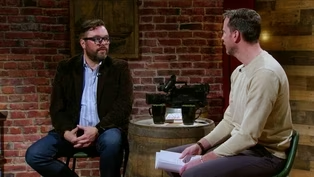
From Rolling Stone to Bradley: Chad Udell’s Career Pivot
Video has Closed Captions
Clip: Ep2 | 1m 31s | Chad Udell recalls early web work, the dot-com crash and a network that shaped his career. (1m 31s)
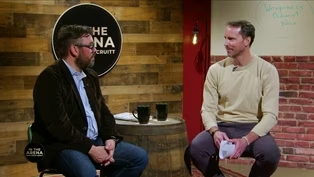
What “Weaponizing Midwestern Nice” Really Means
Video has Closed Captions
Clip: Ep2 | 1m 31s | Chad Udell explains “weaponizing Midwestern nice” and the legacy he hopes to leave behind. (1m 31s)
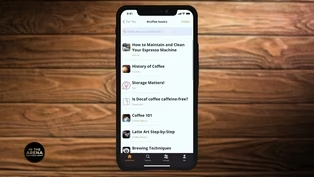
Why Most Workplace Training Fails Frontline Employees
Video has Closed Captions
Clip: Ep2 | 1m 13s | Chad Udell explains “weaponizing Midwestern nice” and the legacy he hopes to leave behind. (1m 13s)
Providing Support for PBS.org
Learn Moreabout PBS online sponsorship

- Science and Nature

Explore scientific discoveries on television's most acclaimed science documentary series.

 New Episode








Support for PBS provided by:
In the Arena is a local public television program presented by WTVP