| | | | |
 |
|

A decade-long overview of the threats, deceptions and diplomatic ploys that have shaped U.S.-North Korea relations
| 


 |
|
|
| 1989 | End of Cold War; North Korea loses Soviet patronage | |
|
In 1989, Soviet control of communist governments throughout Europe begins to weaken and the Cold War comes to a close. As the USSR's power declines, North Korea loses the security guarantees and economic support that had sustained it for 45 years. |
|
|
| 1989 | Activity at Yongbyon nuclear complex | |
|
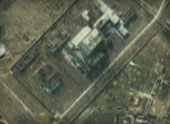
Through satellite photos, the U.S. learns of new construction at a nuclear complex near the North Korean town of Yongbyon. U.S. intelligence analysts suspect that North Korea, which had signed the Nuclear Nonproliferation Treaty (NPT) in 1985 but had not yet allowed inspections of its nuclear facilities, is in the early stages of building an atomic bomb.
In response, U.S. pursues a strategy in which North Korea's full compliance with the NPT would lead to progress on other diplomatic issues, such as the normalization of relations. |
|
|
| May 1992 | North Korea allows first inspections | |
|
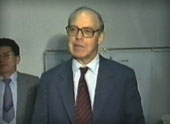
For the first time, North Korea allows a team from the International Atomic Energy Association (IAEA), then headed by Hans Blix, to visit the facility at Yongbyon. Blix and the U.S. suspect that North Korea is secretly using its five-megawatt reactor and reprocessing facility at Yongbyon to turn spent fuel into weapons-grade plutonium. Before leaving, Blix arranges for fully equipped inspection teams to follow.
The inspections do not go well. Over the next several months, the North Koreans repeatedly block inspectors from visiting two of Yongbyon's suspected nuclear waste sites and IAEA inspectors find evidence that the country is not revealing the full extent of its plutonium production. |
|
|
| March 1993 | North Korea threatens withdrawal from NPT | |
|
North Korea's announcement shocks the world. Facing heavy domestic pressure from Republicans who oppose negotiations with North Korea, President Bill Clinton appoints Robert Gallucci to start a new round of negotiations. After 89 days, North Korea announces it has suspended its withdrawal. (The NPT requires a 90-day notice before a country can withdraw.)
In December, IEAE Director-General Blix announces that the agency can no longer provide "any meaningful assurances" that North Korea is not producing nuclear weapons. |
|
|
| April 19, 1994 | North Korea raises stakes; U.S. considers military response | |
|
North Korea announces that it is going to move its stock of irradiated fuel from its five-megawatt reactor without allowing international inspectors to monitor the process. It also threatens to go one step further and reprocess the fuel from that reactor, which would give Pyongyang enough plutonium to make five or six nuclear weapons.
The Clinton administration decides that it will take every possible action to try and stop the North Korean nuclear weapons program. It considers a strike against the Yongbyon facility, but concludes that the consequences -- an estimated 100,000 casualties from a North Korean reprisal are too severe.
The administration instead decides to press for U.N. sanctions, a move that North Korea considers extremely provocative. Park Yong Su, a North Korean negotiator, warns, "If you force us to go to war, we will go at anytime." He threatens that North Korea will turn Seoul into "a sea of flames."
In South Korea, authorities call for civil defense exercises to prepare the country for an attack. Clinton asks the Pentagon for options to reinforce troop strength in South Korea. |
|
|
| June 1994 | Carter travels on peace mission to Pyongyang | |
|
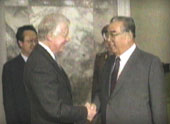
Despite opposition from some senior members of the Clinton administration, former U.S. president Jimmy Carter travels on a private trip to Pyongyang to meet with Kim Il Sung and try to broker a diplomatic solution to the crisis. While in Pyongyang, Carter makes a controversial television appearance in which he details the commitments he has extracted from Kim Il Sung. He tells CNN that Kim Il Sung "[has] given me assurance that as long as this good-faith effort is going on between the United States and North Korea, that the inspectors will stay on site and the surveillance equipment will not be interrupted." Carter also announces that Kim Il Sung has agreed to go back to the negotiating table. |
|
|
| July 1994 | Death of Kim Il Sung | |
|
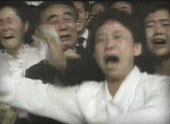
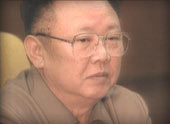
Kim Il Sung dies suddenly of a heart attack on the day that negotiations begin. Kim Il Sung is succeeded by his son Kim Jong Il, who had been linked to acts of terrorism against South Korea, including a 1983 bomb blast that killed 4 government ministers and a 1987 blast aboard a South Korean airliner that killed 115 civilians. Kim Jong Il is also tied to North Korea's nuclear ambitions -- he was the founder of the Yongbyon complex. |
|
|
| October 1994 | Agreed Framework negotiated | |
|
In October, the U.S. and North Korea complete negotiations in Geneva of what becomes known as the Agreed Framework. North Korea agrees to shut down the Yongbyon complex and cease plutonium production. In return, the U.S. promises to help with the construction of two modern light-water reactors to help solve North Korea's energy problems. The light-water reactors are modern nuclear power plants that are built, operated, and regulated in accordance with international standards of safety. The U.S. also agrees to provide 500,000 metric tons of heavy fuel oil annually until construction on the light-water reactors is complete.
When the deal is announced, many Congressional Republicans are outraged. Critics claim that the deal is "appeasement" because it rewards North Korea for bad behavior. In part because of Congressional opposition, construction of the light-water reactors falls behind schedule and delivery of the heavy fuel oil is often late.
> Read experts' analyses of the Agreed Framework. |
|
|
| December 1994 | North Korea shoots down U.S. helicopter | |
|
One U.S. soldier is killed when North Korean forces shoot down a U.S. helicopter. North Korea accuses the helicopter pilot of spying, while the U.S. maintains that the aircraft had strayed off course during a routine training mission. Pyongyang holds the pilot for 13 days and to win his release, the U.S. expresses "sincere regret" for the incident. |
|
|
| Mid- to late 1990s | North Korea faces devastating famine | |
|
A combination of long-term economic decline and devastating weather conditions lead to a famine during the mid-1990s, during which foreign aid workers estimate as many as 2 million people die of starvation. In 1995-96 floods destroy 16 percent of the country's arable land. In 1997 and again in 2000, North Korea suffers a devastating drought along its fertile west coast. According to the World Food Programme, the food deficit in North Korea has been in excess of 1 million tons per year since 1995. |
|
|
| 1998 | South Korea launches Sunshine Policy | |
|
Newly-elected South Korean President Kim Dae Jung institutes a new approach to dealing with North Korea, which becomes known as the "Sunshine Policy." It advocates openness and engagement with North Korea and assumes that Kim Jong Il wants to modernize the North Korean economy.
> Read an interview with Lim Dong Won, the architect of the "Sunshine Policy." |
|
|
| Aug. 31, 1998 | North Korea launches Taepodong missile; U.S. conducts policy review | |
|
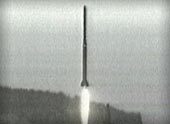
In a surprise move, North Korea launches its Taepodong missile -- a three-stage missile estimated to have a range of 3,800 to 6,000 km -- over the Sea of Japan. The missile launch proves that Pyongyang can launch an attack on Japan and is an embarrassment to President Clinton, who had backed the Sunshine Policy. Mandated by Congress to review U.S. policy toward North Korea, the president asks former Defense Secretary William Perry to conduct the review. |
|
|
| March 1999 | North Korea agrees to inspections of suspected nuclear site | |
|
After several months of negotiations, North Korea agrees to allow U.S. inspectors visit a suspected nuclear site located at Kumchangri in exchange for food aid. Inspectors twice visit the complex -- which was believed to house an underground nuclear reactor and plutonium reprocessing operation inside of a mountain -- but find no evidence of nuclear activity at the site, although some continue to speculate that the North Koreans removed evidence before allowing inspections. The incident is an embarrassment to U.S. officials. |
|
|
| May 1999 | Perry visits Pyongyang | |
|
The first U.S. presidential envoy to visit North Korea, Perry tries to convince Pyongyang to abandon its nuclear and missile development programs in exchange for improved diplomatic and economic relations with the U.S. His trip, during which he hand-carries and delivers a letter from President Clinton to Kim Jong Il, is the culmination of his policy review.
Perry delivers his final report in October, at the end of an eight-month review. The report concludes that "the urgent focus of U.S. policy toward the DPRK must be to end its nuclear weapons and long-range missile-related activities."
The Perry report suggests a two-path strategy in which the U.S. and North Korea would gradually negotiate an end to North Korea's weapons program and the normalization of relations between the two countries. |
|
|
| September 1999 | Hopeful signs | |
|
North Korea pledges to freeze all tests of its long-range missiles and President Clinton responds by easing some economic sanctions that were put in place in 1950, when North Korea invaded South Korea. |
|
|
| Summer 2000 | North-South tensions ease | |
|
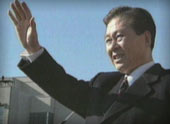
In June, South Korean leader Kim Dae Jung travels to Pyongyang for a summit with Kim Jong Il. The meeting raises hopes for a further warming of relations between the two countries.
In August, family reunions are held in Seoul and Pyongyang for families divided at the end of the Korean War. The following month, athletes from both North and South Korea march together in the opening ceremony of the Olympic games in Sydney, Australia.
In October, Kim Dae Jung receives the Nobel Peace Prize for his efforts to open a dialogue with North Korea. |
|
|
| July 2000 | North Korean anger at delays in Agreed Framework | |
|
Angry at the loss of electricity from delays in the construction of the light-water reactors promised in the Agreed Framework, Pyongyang threatens to restart its nuclear program. |
|
|
| October 8-12, 2000 | U.S. and North Korea issue joint communiqué | |
|
A high-level envoy, Vice Marshal Jo Myong Rok, visits Washington in early October. He brings an invitation for President Clinton to travel for a summit in Pyongyang and reaffirms that North Korea wants to improve relations with the U.S.
Jo's visit results in the issuance of a joint communiqué in which the two countries state their intentions to "fundamentally improve" bilateral relations. The communiqué also notes that, "As a crucial first step, the two sides stated that neither government would have hostile intent toward the other and confirmed the commitment of both governments to make every effort in the future to build a new relationship free from past enmity." |
|
|
| October 2000 | Albright visits Pyongyang | |
|
Secretary of State Madeleine Albright becomes the highest-level U.S. official to visit North Korea since the Korean War when she travels to Pyongyang to negotiate a missile deal with Kim Jong Il. The key items on Albright's agenda include continued inspection of suspected nuclear sites, an end to the North Korean long-range ballistic missile program, an end to North Korean sales of its ballistic missile technology, and improved relations with South Korea.
Another reason behind Albright's mission is to lay the groundwork for a potential visit to Pyongyang by President Clinton. At the end of the summit, Kim Jong Il reiterates an invitation for Clinton to visit North Korea. However, Clinton, who's at the end of his presidency and is consumed by the Middle East peace process, decides not to go. |
|
|
| January 2001 | George W. Bush inaugurated | |
|
At first, it appears that the Bush administration will continue the Clinton administration's policy of engagement with North Korea. Secretary of State Colin Powell tells reporters, "We do plan to engage with North Korea and pick up where President Clinton and his administration left off. Some promising elements were left on the table." |
|
|
| March 2001 | Bush signals shift in policy | |
|
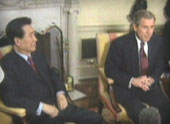
Bush holds a summit with South Korean president Kim Dae Jung in Washington. Although he publicly endorses the Sunshine Policy, privately Bush tells Kim that the U.S. will not continue talks with North Korea, setting aside the Clinton administration's policy of engagement. The South Korean president is stunned.
The administration also announces that it will conduct a review of U.S. policy towards North Korea. In remarks to reporters, President Bush voices doubt over trusting North Korea, saying, "Part of the problem in dealing with North Korea, there's not very much transparency. We're not certain as to whether or not they're keeping all terms of all agreements." |
|
|
| June 2001 | North Korea threatens to restart missile tests; Bush administration completes policy review | |
|
North Korea warns that it will consider restarting missile tests if the Bush administration refuses to resume diplomatic contacts aimed at normalizing relations between the two countries. The following month, the State Department reports that North Korea has conducted tests of its long-range Taepodong missile.
After completing its policy review, the Bush administration agrees to talk to North Korea, but insists upon a broad agenda: that talks go beyond Pyongyang's nuclear and missile programs to also include a reducation of conventional forces, and that North Korea immediately restarts cooperation with the IAEA. |
|
|
| Sept. 11, 2001 | Attacks on World Trade Center and Pentagon | |
|
The Sept. 11 attacks raise new fears in the U.S. about weapons proliferations and the possibility that a rogue nation would sell its missiles and nuclear technology to a terrorist group. |
|
|
| Jan. 29, 2002 | Bush delivers "axis of evil" speech | |
|
In his State of the Union address, Bush describes North Korea as "a regime arming with missiles and weapons of mass destruction, while starving its citizens." He warns that states seeking weapons of mass destruction are a "grave and growing danger" to U.S. security and signals that the U.S. will act preemptively to deal with such nations. In a memorable turn of phrase, Bush labels Iraq, Iran and North Korea an "axis of evil."
North Korea's official state newspaper reacts by accusing the U.S. of trying to occupy North Korea. It declares the speech is "little short of declaring war." |
|
|
| October 2002 | Pyongyang admits secret uranium enrichment program | |
|
In the summer of 2002, the CIA, working with evidence that it had been collecting since the middle of Clinton's second term, concludes that North Korea is secretly pursuing a uranium enrichment program. The uranium enrichment program is different from the plutonium-based program that Pyongyang agreed to freeze during negotiations for the 1994 Agreed Framework; however the U.S. argues that North Korea has violated the spirit, if not the letter, of the agreement.
On Oct. 3, Assistant Secretary of State James Kelly travels to Pyongyang to confront the North Koreans with the evidence. The next day, the North Koreans admit to the program but refuse to end it. Pyongyang's admission is not publicly revealed for two weeks.
In November, the U.S. Japan, and South Korea cut off all fuel oil shipments to North Korea. |
|
|
| December 2002-February 2003 | North Korea restarts plutonium program | |
|
North Korea turns off all the monitoring equipment at its nuclear facilities at Yongbyon and sends IAEA inspectors home. The following month, Pyongyang announces its withdrawal from the Nuclear Nonproliferation Treaty and insists that only bilateral talks with the U.S. can resolve the conflict. It restarts the nuclear reactor in February.
As fears that North Korea may soon begin producing nuclear weapons escalate, the Bush administration maintains that the current problems can be resolved peacefully only through a multilateral diplomatic process involving Japan, South Korea and China. |
|
|
| February 2003 | Debate within Bush administration continues | |
|
Testifying before the Senate Foreign Relations Committee, Deputy Secretary of State Richard Armitage, a Northeast Asia specialist, says, "Our suggestion is not quite that we handle these talks multilaterally, but we have a multilateral umbrella, of any sort." His remarks reportedly infuriate President Bush, who orders a ban on any public discussion of anything that might resemble one-on-one or bilateral talks with North Korea. |
|
|
| March 2003 | Tensions escalate; U.S and North Korea at impasse | |
|
After restarting its nuclear reactor at Yongbyon in late February, Pyongyang tests two short-range missiles in March. It also intercepts and harasses a U.S. spy plane flying off its coast and announces that it is pulling out of the armistice talks that have been going on since the end of the Korean War. |
|
|
| |
home : introduction : analyses : the north koreans : chronology : nuclear capabilities
interviews : readings & links : discussion : producer's chat
teacher's guide : tapes & transcripts : press reaction : credits : privacy policy
FRONTLINE : wgbh : pbsi
photograph copyright © afp/corbis
web site copyright 1995-2014
WGBH educational foundation
| |