MORE ON DR. AMINAH MCCLOUD MORE ON DR. AMINAH MCCLOUD
Even before Sept. 11, American Muslims were experiencing tension with
non-Muslims. Two years ago, controversy erupted in Palos Heights, Ill. when its
rapidly growing Muslim community proposed building a new mosque and community
center on the site of an empty church. Public hearings were held, during which
some residents who objected to the mosque proposed a recreation center in its
place. Other residents spoke up against what they called "open racism."
The Muslims ultimately agreed not to buy the church and accepted a monetary
settlement, but still they went to court charging discrimination. A federal
judge has ordered the two sides to enter into an interfaith dialogue.
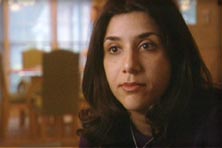
Dr. Aminah McCloud is serving as an advisor to the Muslim community in Palos
Heights while the case awaits trial. She converted to Islam in 1966. An expert
in Islamic Studies at DePaul University in Chicago, Dr. McCloud built her
career studying Muslims. "I think that judge, whoever he or she is, just ought
to be given a Nobel Prize," she says. "And even though [the judge] ordered it,
the people in this community had to think enough of their community to take up
the challenge. And they have."
There are an estimated 5-7 million Muslims in the United States. In America,
the Muslim population includes immigrants and those born here -- three-quarters
of whom are African-Americans. Muslims are not just experiencing tension with
non-Muslims; often the two groups within the Muslim population don't get
along.
Dr. McCloud discussed this situation at her house, with her family and two
friends -- one of whom was of Pakistani descent and had lost his job at a
Muslim relief organization when the federal government froze its assets after
Sept. 11.
"My parents came here, they worked," he said. "And then all of the sudden today
I'm told that without any reason, that you work for a so-called organization
and you can't do this anymore. And I still can't come to terms with it."
Dr. McCloud believes that the civil rights of innocent immigrants are being
violated and that all American Muslims should be concerned. However, her own
daughter sees it differently. She said, "I don't think that African-Americans
who've always had problems with civil rights should be sticking their neck out
for a group of people asking for trouble and a group of people who have done
nothing for us. Period."
According to Dr. McCloud, African-American conversion to Islam sometimes
results from dissatisfaction with Christianity. "In 2002, Christianity is still
about race," she says. "It's still the blond-haired white Jesus with blue eyes.
They're saying 'No, I'm not worshipping white men.'"
Other times, African-Americans convert to Islam because they're feel
dissatisfied. "For some others who were not inside of a structured religious
community, it is 'I want to be inside of a structured religious community,'"
Dr. McCloud explains.
|