
A Nebraska city built a road using 2 million plastic bags
Clip: Season 7 | 10m 19sVideo has Audio Description
South Sioux City and University of Nebraska researchers test a road made from recycled bags.
South Sioux City and University of Nebraska researchers test whether recycled plastic grocery bags can improve asphalt roads while reducing waste. The project uses nearly two million recycled plastic bags and could help reshape how future roads are built in Nebraska and beyond. In South Sioux City, Nebraska, an innovative experiment is turning plastic waste into pavement.
See all videos with Audio DescriptionADProblems playing video? | Closed Captioning Feedback
Problems playing video? | Closed Captioning Feedback
What If is a local public television program presented by Nebraska Public Media
A Nebraska city built a road using 2 million plastic bags
Clip: Season 7 | 10m 19sVideo has Audio Description
South Sioux City and University of Nebraska researchers test whether recycled plastic grocery bags can improve asphalt roads while reducing waste. The project uses nearly two million recycled plastic bags and could help reshape how future roads are built in Nebraska and beyond. In South Sioux City, Nebraska, an innovative experiment is turning plastic waste into pavement.
See all videos with Audio DescriptionADProblems playing video? | Closed Captioning Feedback
Where to Watch What If
What If is available to stream on pbs.org and the PBS app.
Providing Support for PBS.org
Learn Moreabout PBS online sponsorship[Mike] What If... plastic grocery bags could be used to make roads?
(upbeat rock music) (mellow music) Sometimes there's so much beauty in the world, but there's nothing attractive about billions of single use plastic bags that are costly to our cities, agriculture and the environment.
Few would call this an "American Beauty."
(upbeat music) The folks in South Sioux City had an idea about a way to reuse some of those plastic bags, pave a road and trails, incorporating a couple million of 'em shredded and melted into the asphalt.
(upbeat music) This half mile stretch of what used to be a gravel road is a project driven by a guy who's been around here for a while.
How long have you been city administrator?
40... 40 some years.
People don't usually last that long in those positions, -do they?
-That's right.
A lot longer than normal.
[Mike] So where'd the idea for the road project come from?
[Lance] We always try to learn from what other towns are doing, what other places are doing.
And we saw on the internet plastic roads being built in Europe, Sweden and Ghana, lots of different places and said, "This makes sense."
And it fits the council goal of being an environmental friendly city.
(mellow music) (upbeat music) [Mike] It took a couple years of work to get to this point, aided by a Nebraska Environmental Trust grant and lots of partners from the Nebraska Department of Transportation, construction, recycling and other areas.
Baylor Bestgen kept everyone connected and the project moving forward.
When they first contacted you about doing this thing, what did you think?
I'd be lying if I said I didn't have reservations.
I think civil engineer is naturally a creature of comfort.
It seems like a big lift, but once you get smart people talking to each other and they have that same frequency, it becomes really easy.
[Mike] You wouldn't know it by looking at it, but the top three inches of asphalt includes the shredded plastic.
When you first started floating this idea around, did you get any funny looks?
When people thought about a plastic road, they didn't realize what we meant.
But you know, plastic is a petroleum based unit, so it makes sense to put it into asphalt.
The key to making it all work was Jamilla Teixeira with the University of Nebraska.
She had the brains and the knowledge to make this thing happen.
(mellow music) [Mike] Jamilla Teixeira was doing research in her lab on asphalt, concrete, things roads are made from years before South Sioux City started their project.
I always think that infrastructure requires a lot of natural resource, materials to construct roadways, but if we just use a natural resource, I think it's not the ideal situation.
We have several different byproducts and ways that could be incorporated.
So waste plastic, it is just one of the potential materials that I saw that could be a good opportunity to start researching.
[Mike] Materials like plastic grocery bags, but also water bottles, large bags for ag materials, even conveyor belts.
Interesting, and this works better in concrete.
That works better in asphalt.
Each type of plastic, they have their own chemical, physical characteristics, shapes and they might be ideal for one application or for the other.
Right now we are researching this one for concrete and those for asphalt.
[Mike] We have the ingredients, time to cook.
Ready to be the "matter chef?"
I would love to be a "matter chef."
-Yes, let's do it.
-I even get a coat.
Yes, you'll get everything.
But don't forget, safety first.
Here's your safety gloves.
(upbeat music) -Gotta stir the cake.
-Yep.
It's a brownie.
It is a brownie.
(upbeat music) "Matter Chef!"
(upbeat music) So we bake the cake.
That's how we say.
And then we test to see if the cake is good enough to be placed on the roadways.
What if I apply the load here?
Is it gonna crack?
Is it gonna deform?
Because those are the major issues on a pavement.
You can see cracks, you can see potholes, deformation, water can infiltrate.
We need to verify before applying.
Right, nobody likes potholes.
No, nobody likes potholes.
[Mike] Samples are subjected to different performance tests.
One measures how likely it will crack.
And we see that the cracking tolerance index is 106.1, which is pretty much good for our mixture.
[Mike] Another mimics traffic load, a wheel going back and forth, showing resulting deformation.
You can see here, small deformation, large deformation.
Those are mixtures that we use on South Sioux City.
Those had no plastic.
This has plastic, you can clearly see.
Wow, you can really see a difference.
So the plastic held up a lot better.
For the South Sioux project, Jamilla and team tried about six different recipes before finding the right mix.
And visited plants that make road materials to learn the best way to incorporate plastics.
I would say, it took about almost two years until we said, "No, I think this recipe might work."
And I'm still not saying with a 100% assurance that this is gonna last.
We still need to see long-term performance.
I think the importance of this research is taking something that is just discarded out there and find a room, but in a proper way.
Because asphalt pavements, pavements in general, they have a great history of incorporating waste materials.
But I always say that we cannot think the pavement as a big trash can that we can just dump things underneath.
It has to help on the performance of the roadway somehow, otherwise, we're just hiding a problem.
(upbeat music) (people applauding) So today we are here to announce the first plastic recycled bag road in the state of Nebraska.
But this is a story, it's an innovation, it's something, it's done a few spots around the world.
(people cheering and clapping) [Mike] This short stretch of road is a point of pride for South Sioux City.
It's also a research project.
Can adding 2 million shredded plastic bags to the asphalt be cost efficient and make the road last longer?
(upbeat music) We were able to build the roadway that actually is gonna be subject to our harsh environmental conditions.
Low temperature, winter conditions, high temperature, summer.
We can see if the plastic helps on the addition that's gonna promote less susceptibility to moisture damage, to low temperature cracking, which is one of our issues in Nebraska.
(mellow music) Well, I think the road is gonna demonstrate, one, that it will last longer based on all the other studies we've seen.
Number two, it's more flexible.
Number three, it should cost less.
Once you set up a system of system of construction companies working on this, it should cost less.
[Mike] Foundry Road is a good place for the test because it's in a high traffic park and leads to a construction site that gets heavy truck traffic.
All involved will be watching how the road holds up for the next few years with an eye on more projects like this.
Do you think this can take off in 10 years?
I think so.
I think so.
Plastic bag roads everywhere?
Imagine, imagine.
We already use asphalt and asphalt comes from petroleum.
Plastic is also a petroleum based material.
Why not?
What does it say that it was South Sioux that did this and as the first in Nebraska?
You guys have talked to Lance, you've met Lance.
He's very innovative.
I think the big picture is, all the plastic bags that are being wasted in our country and finding a positive use of those bags, I think will generate more interest and more savings of those bags in a great way.
(mellow music)
What If Artists Only Had 20 Minutes To Paint?
Video has Audio Description
Clip: S7 | 5m 32s | Artists have 20 minutes to create a winning painting during Omaha's Art Battle at CULXR House. (5m 32s)
He Builds Guitars from Bleachers & Battleships
Video has Audio Description
Clip: S7 | 6m 19s | Meet Nebraska guitar maker Phil Whitmarsh, founder of Old Market Guitarworks. (6m 19s)
Meet the Entrepreneur Behind Pat on Tap
Video has Audio Description
Clip: S7 | 6m 30s | Abby Miller transformed vintage vehicles into Pat on Tap, a Nebraska mobile beverage caterer. (6m 30s)
How a Family Farm Became a Social Media Business
Video has Audio Description
Clip: S7 | 7m 53s | Nebraska family turned their five-acre hobby farm into a full-time social media business. (7m 53s)
 Now Playing
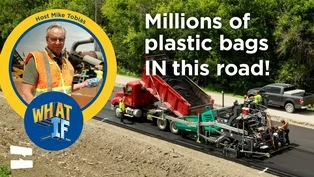
A Nebraska city built a road using 2 million plastic bags
Video has Audio Description
Clip: S7 | 10m 19s | South Sioux City and University of Nebraska researchers test a road made from recycled bags. (10m 19s)
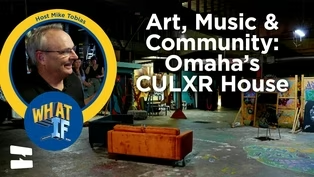
Inside CLUXR House: Where Music Art & Community Collide
Video has Audio Description
Clip: S7 | 8m 53s | A look inside CULXR House in Omaha, a creative hub for music, art, fashion, and community engagement (8m 53s)
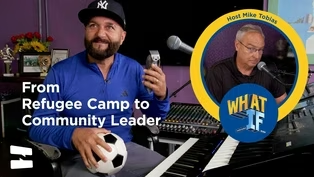
From Refugee Cam to Community Leader
Video has Audio Description
Clip: S7 | 10m 48s | Meet Hasan Khalil, a Lincoln entrepreneur and Yazidi refuge building community and uniting people; (10m 48s)
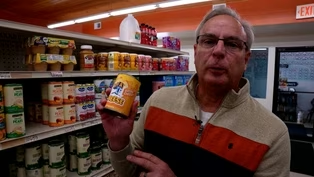
Inside a Student-Run Grocery Store in Rural Nebraska
Video has Audio Description
Clip: S7 | 10m 45s | Students in Cody, Nebraska run a real grocery store that serves their rural community. (10m 45s)
Providing Support for PBS.org
Learn Moreabout PBS online sponsorship













Support for PBS provided by:
What If is a local public television program presented by Nebraska Public Media