
Disco Balls, Sadie Price: Bowling Green's Victorian Pioneer, The Gateway to Kentucky, Transylvania University
Season 31 Episode 16 | 26m 30sVideo has Closed Captions
History of the disco ball; botanist Sarah Francis Price; Cumberland Gap; Transylvania University.
Explore the history of the disco ball and meet an artist keeping the tradition alive; Sarah Frances Price was a botanist and scientific illustrator from Bowling Green who paved the way for generations of curious minds; Chip visits the Cumberland Gap to learn about its role in Kentucky's history; and Transylvania University was key to the growth of Lexington, as well as the University of Kentucky.
Problems playing video? | Closed Captioning Feedback
Problems playing video? | Closed Captioning Feedback
Kentucky Life is a local public television program presented by KET
You give every Kentuckian the opportunity to explore new ideas and new worlds through KET. Visit the Kentucky Life website.
Disco Balls, Sadie Price: Bowling Green's Victorian Pioneer, The Gateway to Kentucky, Transylvania University
Season 31 Episode 16 | 26m 30sVideo has Closed Captions
Explore the history of the disco ball and meet an artist keeping the tradition alive; Sarah Frances Price was a botanist and scientific illustrator from Bowling Green who paved the way for generations of curious minds; Chip visits the Cumberland Gap to learn about its role in Kentucky's history; and Transylvania University was key to the growth of Lexington, as well as the University of Kentucky.
Problems playing video? | Closed Captioning Feedback
Where to Watch Kentucky Life
Kentucky Life is available to stream on pbs.org and the PBS app.
Providing Support for PBS.org
Learn Moreabout PBS online sponsorshippossible in part by the KET Millennium Fund.
Coming up on Kentucky Life, We'll look at how our state played a key role in the development and manufacturing of an iconic dance floor staple, the disco ball.
We'll meet Sarah Frances Price, a Kentucky botanist with a remarkable backstory who changed forever how we look at plants.
We'll explore the setting for this week's show, Cumberland Gap National Historic Park, and we'll learn how Transylvania University played a key role in the growth of Lexington as a city.
All that's next on Kentucky Life.
[music playing] Hey folks, and welcome to Kentucky Life.
I'm your host, Chip Polston.
It's good to see you again.
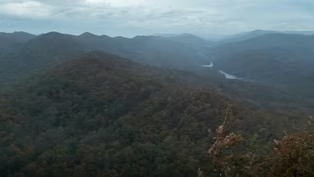
As we celebrate America's 250th birthday this year, what better place to do so than our country's first great gateway to the West, the Cumberland Gap.
Now, a national park in Kentucky, the Gap provided a path for bison, Native Americans, long hunters and pioneers.
More than 300,000 people crossed the Appalachians right here to settle America.
And a fact that has to be pointed out, most of them were on foot.
They walked through here from as far away as Pennsylvania in search of a new start.
It's a remarkable story we look forward to sharing with you a little later in our show.
But first, when you think of Kentucky, so many iconic images come to mind.
Horses, bourbon, basketball, but something that was first patented and pretty much exclusively manufactured here for decades should also be on that list, disco balls.
From the vision of a Northern Kentucky entrepreneur to the work of a quiet Louisville company, Kentucky has been the center of the disco ball universe.
Let's look at how all this came to be, and how one artist is keeping the tradition alive in some innovative ways.
[music playing] Odds are pretty solid that no one in Newport, Kentucky, in the early 1900s could have ever imagined the downbeat of a disco song.
But for Bernard Woeste, his fateful decision in February of 1917 to patent what would come to be known as the disco ball would change the dance floor for a generation.
Woeste called his creation a myriad reflector.
He described it in vivid terms.
“My invention is to produce a plurality of reflecting surfaces to be arranged in such a manner that the various several reflections shall be projected at varying angles and the device itself rotated or otherwise moved so that the reflections may produce a scintillating and spectacular effect.” An ad for the myriad reflector in a 1922 electrical merchandising bulletin read, “The newest novelty is one that will change a hall into a brilliant fairyland of flashing, changing, living colors.
A place of a million colored sparks, darting and dancing, chasing one another into every nook and corner, filling the hall with dancing fireflies of a thousand hues.” Woeste and his business partner sold their 27-inch magnificent globe covered in 1,200 small mirrors to ballrooms, dance halls, and skating rinks.
But the device wasn't a hit.
Many dance halls and the like were quiet due to the start of World War I, and the patent expired in 1934.
[music playing] But then, the 1970s happened.
Disco exploded, and the disco ball was its main character.
The center of this universe was a Louisville business called Omega Industries.
The company made mirrors and saw the opportunity to strike while the dance floor was hot.
So it makes perfect sense that they would employ a team of people.
And for a good stretch of time, they had a big staff making disco balls, reflector balls, for up until the 1970s, when it really, really took off.
The Fraser History Museum has one of the original Omega disco balls in their collection.
At one time, from this building in Louisville, Omega produced more than 100,000 disco balls a year.
They moved to a smaller location next door several years ago, where they still make disco balls.
Now, we wanted to show you how they did it, but they politely declined our invitation, saying that to this day, they still get calls weekly from media outlets all around the world who want to come into their shop, and it's just too disruptive.
Louisville celebrates its disco ball heritage in a variety of ways.
That original building where Omega cranked out all those dance floor staples?
It's now been converted into a hotel named the Myriad, after the name Bernard Woeste gave his patented device more than 100 years ago.
The hotel celebrates its heritage with disco balls throughout.
And the old dust collectors that were once used to keep the Omega assembly line free of foreign objects were repainted orange and incorporated into the hotel's swimming pool.
A popular Louisville true crime book was given the title, A Dark Room in Glitter Ball City, which spawned the popular HBO documentary series, Murder in Glitter Ball City.
But the person most keeping this tradition alive works out of a small garage behind his home in Louisville's Clifton neighborhood.
Robert Brown's interpretation of the modern disco ball has him bedazzling all sorts of creatures and objects.
Well, I had a company come by, and they were like, “We hear that you're savvy with metal and welding and glass and art.” And they're like, “We really want a life-size squirrel, which is our logo.
But we want it to be a disco ball, like for Kentucky and Louisville being the disco ball makers of the world.” And so, I sat down with him, I told him the idea, "I would make it out of metal, paper, and then the mirror squares and build it.” And they said, “Great, you do it, and we'll give you a budget.” And so I made a squirrel, and it was a lot of fun.
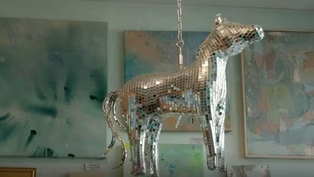
So far, he's made about 20 of the pieces, everything from rockets to horses like this one hanging in a Louisville gallery, to pigs, and even saddles, which one bride commissioned him to make for her wedding reception.
He was working on a saddle the day we visited him, and he says there's a science to placing the small half-inch mirror pieces, which he buys from Omega Industries, in just the right spot.
Like the seat is going this way, so the sides, I want them to shoot down, and then I'll do an edge around the whole thing to make it█ because, you know, you're recovering the saddle, but you also, you want to make some of the squares a little offset so it catches light and dances more.
If I made it super smooth, the shape of the saddle, it would still talk with lights pointing at it.
But if I change a little bit of the direction of the mirror squares, then it talks more.
Like many things, foreign manufacturers producing inexpensive knockoffs have flooded the disco ball market, diluting Kentucky's dominance of the dance floor.
But for a period in the 1970s, a mirrored orb made in Louisville was the center of the leisure suit scene, and you just can't help but celebrate that.
It's fun.
It's exciting.
It's kind of goofy and kitschy.
Everything about them is great.
I mean, you know, there's no.
I can't imagine anyone being sat around a disco ball.
[music playing] Affectionately known as Sadie, Sarah Frances Price hailed from Bowling Green.
She overcame significant hardships to follow her passions for science and art in the process of becoming a renowned botanist.
She blazed a trail through Victorian society that would pave the way for future generations of curious minds.
Kentucky has a beautiful natural landscape, and Sadie saw that.
And she devoted her entire life to collecting natural specimens and preserving them and preserving Kentucky's landscape as a whole.
She could be such an inspiration to scientists, and artists, and women today if we just knew her story.
Following her lifelong passion for exploring the natural wonders of Kentucky, Sarah Frances Price left a rich legacy that goes well beyond her internationally recognized contributions to the field of botany.
She was a teacher and a painter, and the quality of her work endures because of her meticulous attention to detail.
It was interesting to see just exactly how detailed she was in her sketches.
You could tell the shape of the flower, and you can tell just from her sketch with nothing in the background.
It's not climbing up anything in her sketch.
It's just the plant that it is, in fact, a vining plant.
And once again, with her book on ferns, it is so wonderfully detailed.
You can see each individual serration in the leaf.
You can see all the individual sori on the backs of the leaves.
She took a lot of time with it.
And because of that quality, it is still usable today.
Sadie Price discovered seven new plants in Kentucky, and five of them were named after her.
The most famous is the Viola priceana Pollard, which is a white violet with a purple center.
Only 3% of new land plants have been named by women.
So, for Sadie Price, a woman in the Victorian era, to have so many plants named in her honor, that is just a remarkable achievement.
An achievement made even more remarkable when you consider the hardships Sadie endured during her life.
In 1865 or 1866, she had a mysterious back ailment that left her crippled for over a decade.
And then, in the 1870s, both of her parents died and her brother.
So at that point, it was her and her sister Mary alone in the world.
But Sadie didn't let these challenges dampen her passion for nature or creativity.
In addition to creating her own work, she taught painting and nature classes during this time.
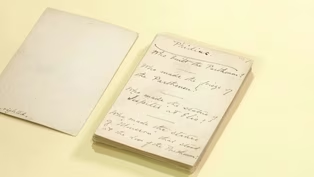
She even created teaching tools for identifying artists and plants.
And then, after being bedridden for over a decade, her fortunes took a turn for the better.
In 1880, she actually traveled to Philadelphia.
She met with Dr.
Weir Mitchell, and over the next six months, she did some mysterious treatment with him and was miraculously cured.
She came back to Bowling Green walking again and simply told everyone that she'd been patched up.
Now that Sadie was mobile, she started taking her students on field trips to study native flora and fauna.
At that time, the creation of Herbarium was at the forefront of botany, and Sadie approached this endeavor with her usual tenacity.
An Herbarium is a collection of dried plants that are scientifically classified.
So, when Sadie was going on these expeditions, she would collect samples, bring them home, and she presented her herbarium at the 1893 Chicago World's Fair.
And she actually won first prize for her herbarium out of over 100 contestants.
From the 19th to the 21st century, Sadie's work is still relevant to the study of native plants, and it can be traced back to its roots at Western Kentucky University's Green River Preserve.
My work intersects with Sadie's work quite literally.
I worked on a plant named after her, one that she discovered, Apios priceana, which is Price's potato-bean or Price's groundnut.
I was able to do a management project on that particular species.
Price's potato-bean has a big preference for certain woodlands.
It likes well-drained soils.
We find it near streams.
So, my job in this case, to protect the species named after Sadie Price, was to allow little bits of light in.
So, just getting the light that it needs to allow that species to spread and reproduce.
[music playing] It's a testament to her ambition and her skill that she became so well-renowned in the field botany.
And after her death, all of the botanical magazines and newsletters published articles about Sadie and her massive contributions.
As Price's potato-bean has helped to make a comeback along the winding bottomlands of the Green River, Sarah Frances Price's legacy of instilling a passion for nature lives on, and her dedication to success through hard work is a lesson for future generations.
We've seen a lot of really remarkable sites here in the Cumberland Gap National Historic Park today.
None more so, though, than what's behind us right here.
And I can't wait to learn more about it.
This is Lucas Wilder.
He's an education specialist with the park here.
Lucas, thanks so much for being with us.
I'm always happy to be here and to speak with you.
I love it.
So, what is this behind us now?
Tell us what this is.
This is the Iron Furnace.
This is one of the oldest man-made structures in the park that still stand in today.
It was run by an entrepreneur named John Newley, who occupied what's now the town of Cumberland Gap.
And he ran this iron furnace that would create these 150-pound ingots, and then ship them all over the area for various uses.
How important was a place like this for the development of this area?
It was a huge part of the development of this area, mainly because people are traveling on the Wilderness Road, not too far from us, just up the mountainside here.
And if they needed something along the route, he not only had iron for them, but he had a little shops down here they could get supplies as they were coming through.
So, this was a big part of Westward Settlement.
So, from a geological standpoint tell us where we are.
What's the makeup, and what is it about the gap that makes it so important?
The Cumberland Gap is formed by three factors.
The first one is a fault line, that when the mountains came together, it actually created a weak point and that allowed for an ancient river to run through it.
Then about 300 million years ago, a meteorite come barreling out of the sky and hit where Middlesboro, Kentucky sits today.
That diverted the river, and the rest is created by wind.
So, a factor of fault line, water and wind created the Cumberland Gap, and it created one of the best ways to get through the Appalachian Mountains.
And that's what everybody was going for, was trying to find the easiest way through the mountains into the frontier.
So, to that point, what's the origin story for how all this happened and the role that Dr.
Thomas Walker played in making this available for people to have that westward push?
Dr.
Thomas Walker was a phenomenal man, a surveyor, a physician and a land speculator.
And he wasn't the first person to come through here.
Native Americans came through here way before him, but he was the first one to document it and write it down.
And by him writing it down and his stories proliferating throughout the eastern United States, when everybody's wanting to move west, was a perfect timing because Dr.
Thomas Walker's writings allow people to have an idea of what could be possible on the other side of these mountains.
So, he really helped people dream about what they could potentially achieve if they could just make it through the gap and see what's on the other side.
Absolutely.
Wow.
So then, about 20 years later, Daniel Boone and a company comes through here.
What does that do for the westward expansion?
How important was that?
Daniel Boone becomes a legend in his own time.
So, his first trip through here, as you said, in 1769, is a long hunt.
He's coming through here to hunt animals and to sell the pelts.
He comes back out of Kentucky with wonderful stories about how there's so much game, there's so much plentiful land in the area that people need to come here.
He declared it a paradise.
And so, his word of mouth and stories proliferate again throughout the eastern United States and send people further west.
And why is the gap so integral to Kentucky history?
Why is it so important?
There's two ways to get into Kentucky at the time.
You can come down the Ohio River.
That's dangerous.
You're getting close to Shawnee Territory, where Ohio is today.
And then, you can come through the Cumberland Gap, a much safer route to get into Kentucky.
And so this affords not only one of the best routes, but a safer route.
It really is remarkable to look around here and to think what folks had to experience when they came through and saw this, and to be able to get through the gap.
And we look forward to exploring more here today.
Lucas Wilder, thanks so much for letting us be here today.
You're very welcome.
[music playing] The history of Lexington, Kentucky, has long been tied to being the home to two major universities.
The University of Kentucky, eventually to be known as the Wildcats, began shortly after the Civil War as the Kentucky Agricultural and Mechanical University.
Transylvania University is aptly named the Pioneers, as this was the first institution of higher learning west of the Alleghenies.
Now, this school has played a major role in the growth of Lexington, and it would also have a major role in the development of that other Lexington University.
[music playing] Transylvania University was established as Transylvania Seminary in 1780 by Virginia's General Assembly to be located in the western part of the state known as Kentucky County.
The school held its first classes in 1785 in a small cabin near Danville.
In 1792, as Kentucky separated from Virginia and became the 15th state of the United States, Lexington leaders looked to attract this institution of higher learning to the city.
Lexington's population had grown to about 2,000 people, people with great determination wanting to create a wonderful city with amenities that they had enjoyed in Virginia and the Carolinas and other places.
So, there was a great drive to build this great place for themselves and their future.
Lexington gave Transylvania Seminary a plot of land along 3rd Street in 1793.
The plot, simply named Plot 6, over the next century would become known as Gratz Park, but it would immediately serve as the College Square.
In 1799, the school became Transylvania University, establishing both a medical school and a law school.
For Lexington, these schools drew professors and professionals who would enhance the quality of its culture and improve the economy of the city.
In 1805, Henry Clay was appointed as a professor of law.
Students of this law school would go on to become U.S.
senators, governors, and federal justices, including Supreme Court Justice John Marshall Harlan.
Transylvania in that era trained many of the Western America's top lawyers and top physicians in the 19th century and really made a lasting impact on Lexington and its economy and kind of the history of education in Kentucky.
As Lexington and its economy grew, the streets surrounding the campus of Transylvania attracted many influential families, whose homes, such as the Bodley-Bullock House, still stand today.
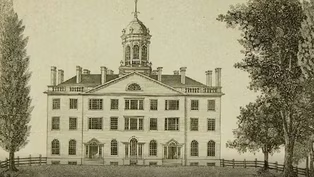
Transylvania University would build a beautiful administration building at the head of the campus.
With the addition of this level of academics, Lexington would experience advances in both art and science and earn the title The Athens of the West.
In 1818, Transylvania University recruited its third president, Horace Holley of Boston.
Under Holley's leadership, the new medical college would rival the best schools on the East Coast.
We were definitely the Western edge of European expansion through the continent, and at the time, many people believed that diseases were regional and the diseases you might get in Philadelphia were different than the diseases you might get in New Orleans, for example.
And so, we actively advertised that people in the regions should send their sons to Transylvania so that Western men could teach them about Western diseases.
In 1829, the administration building on College Square burned down.
Transylvania chose Gideon Shryock, the architect of the state capitol in Frankfort, to design a new building, Morrison Hall.
Morrison Hall was built across Third Street as the campus expanded in that direction.
When the nation entered the American Civil War, Morrison Hall served as a hospital, caring for soldiers injured at the Battle of Perryville.
[music playing] As the war ended, Transylvania University made a decision that would lead to the establishment of Lexington's second major university.
The school merged with another college, Kentucky University of Harrodsburg.
Together on Transylvania's campus, they took the name Kentucky University and added a new department, the Kentucky Agriculture and Mechanical College.
Needing more space, this department was moved to the land at Henry Clay's home, Ashland.
In 1878, Kentucky's legislature worked with the two schools, forming the Commonwealth's first land-grant college, Kentucky University Agricultural and Mechanical College at Ashland.
The agreement to use Ashland as the home for the school ran out just two years later, putting the school in the position of needing a new location.
Bowling Green, Kentucky made a strong attempt to lure the university away, but Lexington, recognizing the value of such higher learning, fought hard to keep the school.
An offer of both money and land would win the battle.
In 1880, the Kentucky University Agriculture and Mechanical College would move and immediately began building an administration building that still stands today.
In 1908, it became the administration building for State University Lexington, Kentucky, that would be renamed in 1916 to the University of Kentucky.
And in 1908, Transylvania was no longer known as Kentucky University, but once again as Transylvania University.
It remained at its original location along Third Street, with Morrison Hall overlooking Gratz Park, where it began.
And it would continue to grow as one of Lexington's and the state's prized universities.
[music playing] It's been remarkable to get to walk today in the footsteps of our ancestors here at Cumberland Gap National Historic Park.
When you think of the hundreds of thousands of people who literally walked through here in search of a better life, it's just a remarkable and fitting place to celebrate our country's 250th birthday.
Now, if you've enjoyed our show, be sure to like the Kentucky Life Facebook page and subscribe to the KET YouTube channel for more of what we like to call Kentucky Life Extras, where you'll have access to lots of other great videos.
Until next time, I'll leave you with this moment.
I'm Chip Polston, cherishing this Kentucky life.
[music playing] [music playing]
Video has Closed Captions
Clip: S31 Ep16 | 3m 50s | Chip visits the Cumberland Gap. (3m 50s)
Video has Closed Captions
Clip: S31 Ep16 | 6m 9s | Learn about the disco ball's long history in Kentucky. (6m 9s)
Sadie Price: Bowling Green’s Victorian Pioneer
Video has Closed Captions
Clip: S31 Ep16 | 5m 48s | Sadie Price blazed a trail through Victorian society. (5m 48s)
Video has Closed Captions
Clip: S31 Ep16 | 6m 9s | Learn about the historic Transylvania University. (6m 9s)
Providing Support for PBS.org
Learn Moreabout PBS online sponsorship













Support for PBS provided by:
Kentucky Life is a local public television program presented by KET
You give every Kentuckian the opportunity to explore new ideas and new worlds through KET. Visit the Kentucky Life website.