
Drafting the Declaration
Richard Henry Lee proposes a formal resolution declaring independence from Britain.
From
Drafting the Declaration
Clip: Special | 2m 58sVideo has Closed Captions
Richard Henry Lee proposes a formal resolution declaring independence from Britain.
Richard Henry Lee proposes a formal resolution declaring independence from Britain. The Committee of Five, led by Thomas Jefferson, is chosen to draft the words that would come to establish the “United States of America.”
From
Problems playing video? | Closed Captioning Feedback
Problems playing video? | Closed Captioning Feedback
Episodes presented in 4K UHD on supported devices. Corporate funding for THE AMERICAN REVOLUTION was provided by Bank of America. Major funding was provided by The Better Angels Society and...
Drafting the Declaration
Clip: Special | 2m 58sVideo has Closed Captions
Richard Henry Lee proposes a formal resolution declaring independence from Britain. The Committee of Five, led by Thomas Jefferson, is chosen to draft the words that would come to establish the “United States of America.”
From
Problems playing video? | Closed Captioning Feedback
Where to Watch The American Revolution
The American Revolution is available to stream on pbs.org and the PBS app.
Buy Now
MOMENTS: The Revolutionary War Card Game
Use your knowledge of Revolutionary-era moments to build a timeline of real historical events.Providing Support for PBS.org
Learn Moreabout PBS online sponsorship[Gavel banging] Narrator: On June 7th, Richard Henry Lee of Virginia introduced resolutions in Congress declaring that "these United Colonies are & of right "ought to be free & independent States absolved from all allegiance to the British Crown."
♪ Meanwhile, a letter to a Pennsylvania newspaper signed only "Republicus" declared that it was time for independent Americans "to call themselves by some name"-- and proposed the "United States of America."
♪ A 5-man committee was named to produce a document setting forth the reasons for making such a momentous decision.
33-year-old Thomas Jefferson of Virginia was assigned to write the first draft.
♪ He would draw from Aristotle, Cicero, John Locke, and the Virginia Declaration of Rights, written by his friend George Mason.
But his goal, he said, was to distill what he called "an expression of the American mind."
♪ He worked in a rented room on Market Street, fueled by cups of tea brought to him by his 14-year-old valet Robert Hemings-- the son of an enslaved servant, Elizabeth Hemings, and Jefferson's father-in-law.
Voice: When in the course of human events, it becomes necessary for one people to dissolve the political bands which have connected them with another, and to assume among the powers of the earth the separate and equal station to which the laws of nature and of nature's God entitle them, a decent respect to the opinions of mankind requires that they should declare the causes which impel them to the separation.
♪ We hold these truths to be self-evident: that all men are created equal; that they are endowed by their Creator with certain inalienable rights; that among these are life, liberty, and the pursuit of happiness.
[Thomas Jefferson] Wood: Everything that we believe in comes out of the Revolution.
Our ideas of liberty, equality, it's the defining event of our history.
"All men are created equal."
That is the most famous and important phrase in our history.
If we don't celebrate it, we have no reason to be a people.
And Lincoln knew that.
And that's why he says, "All honor to Jefferson."
Video has Closed Captions
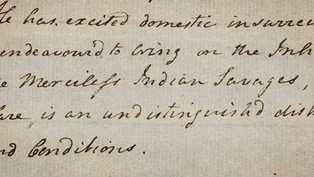
Clip: Special | 1m 24s | Jefferson uses charged language in the final grievance listed in the Declaration of Independence. (1m 24s)
Video has Closed Captions
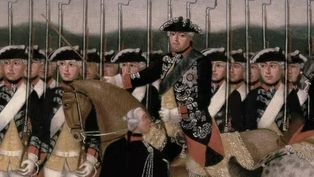
Clip: Special | 1m 57s | Colonial leaders know that France’s support is essential, but they must sever ties with Britain. (1m 57s)
Video has Closed Captions
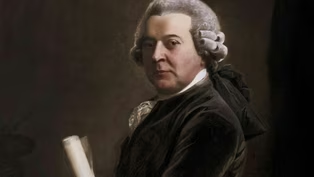
Clip: Special | 1m 47s | Revolutionary leaders realize they need popular support and begin to address everyday concerns. (1m 47s)
Video has Closed Captions
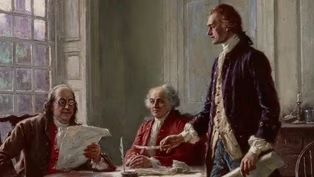
Clip: Special | 1m 44s | One purpose of the Declaration of Independence is to declare that George III is no longer sovereign. (1m 44s)
Video has Closed Captions
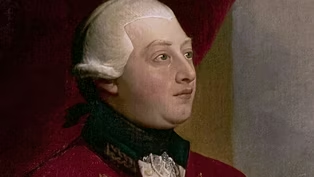
Clip: Special | 1m 17s | King George believes this American insurrection could lead to the end of the British empire. (1m 17s)
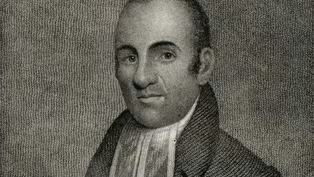
The Meaning of the Declaration to Different Groups
Video has Closed Captions
Clip: Special | 1m 28s | Different groups begin to wonder what “all men are created equal” means for them. (1m 28s)
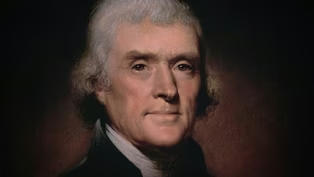
Video has Closed Captions
Clip: Special | 1m 34s | The Preamble addresses the concept of natural rights. (1m 34s)
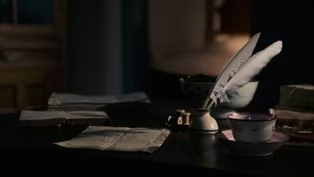
Video has Closed Captions
Clip: Special | 1m 7s | Many Loyalists and some other Americans believe Thomas Paine’s ideas go too far. (1m 7s)
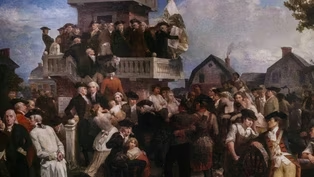
Video has Closed Captions
Clip: Special | 2m 40s | After ratification, the Declaration is publicly read across the former colonies. (2m 40s)
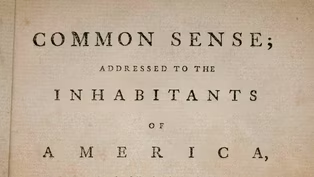
Video has Closed Captions
Clip: Special | 4m 11s | Thomas Paine publishes Common Sense, an explosive pamphlet that attacks monarchy. (4m 11s)
Providing Support for PBS.org
Learn Moreabout PBS online sponsorship







Support for PBS provided by:
Episodes presented in 4K UHD on supported devices. Corporate funding for THE AMERICAN REVOLUTION was provided by Bank of America. Major funding was provided by The Better Angels Society and...