
Thomas Paine and Common Sense
Thomas Paine publishes Common Sense, an explosive pamphlet that attacks monarchy.
From
Thomas Paine and Common Sense
Clip: Special | 4m 11sVideo has Closed Captions
Thomas Paine publishes Common Sense, an explosive pamphlet that attacks monarchy.
Thomas Paine publishes Common Sense, an explosive pamphlet that attacks monarchy, celebrates equality, and argues that independence is the only logical path.
From
Problems playing video? | Closed Captioning Feedback
Problems playing video? | Closed Captioning Feedback
Episodes presented in 4K UHD on supported devices. Corporate funding for THE AMERICAN REVOLUTION was provided by Bank of America. Major funding was provided by The Better Angels Society and...
Thomas Paine and Common Sense
Clip: Special | 4m 11sVideo has Closed Captions
Thomas Paine publishes Common Sense, an explosive pamphlet that attacks monarchy, celebrates equality, and argues that independence is the only logical path.
From
Problems playing video? | Closed Captioning Feedback
Where to Watch The American Revolution
The American Revolution is available to stream on pbs.org and the PBS app.
Buy Now
MOMENTS: The Revolutionary War Card Game
Use your knowledge of Revolutionary-era moments to build a timeline of real historical events.Providing Support for PBS.org
Learn Moreabout PBS online sponsorship♪ Narrator: On January 9th, 1776, a slender pamphlet titled "Common Sense" was published in Philadelphia-- the most important pamphlet in American history.
It was signed simply "an Englishman."
Its author, a recent newcomer to America, was 38-year-old Thomas Paine.
The son of a Quaker corset-maker and his Anglican wife, Paine had failed at his father's profession, lost his first wife and their child in childbirth, been fired from his post as tax collector, endured the collapse of a second childless marriage, and had seen his possessions auctioned off to pay his debts.
During his 8-week voyage from Britain, he'd contracted typhus, and when his ship reached Philadelphia, he had to be carried off, half-dead.
But Paine was a master with words, skillfully weaving the latest Enlightenment philosophy with biblical references that everyone knew.
And he was a violent foe of aristocracy and monarchy.
Schiff: It's a much more radical document than anything that had preceded it.
"Common Sense" takes off like an accelerant through the colonies.
[Indistinct chatter] Everyone reads it.
Narrator: Excerpts from "Common Sense" appeared in newspapers throughout the colonies.
The pamphlet would sell tens of thousands of copies.
Taylor: It is an unprecedented bestseller.
With the exception of the Bible in the colonies, no book has been read as widely as "Common Sense" is.
Bernard Bailyn: It was a wholesale attack on the entire world of Britain-- political, cultural.
And it's in slam-bang prose.
No American pamphleteer wrote that kind of really tough extreme language.
Hogeland: It just made people listen and made people think at a time when the Congress would never have thought of attacking the King personally, King George III, the "Crown of England."
They were always like, "Oh, he's not really getting it.
"It's Parliament that's our problem.
The King needs to help us."
He just called the King a "beast," in print.
He was the working-class intellectual.
His politics were radically democratic, in many ways.
And that made him different from the other famous Founders.
Voice: Hereditary succession is an insult and an imposition on posterity.
For all men being originally equals, no one by birth could have a right to set up his own family in perpetual preference to all others forever.
One of the strongest natural proofs of the folly of hereditary right in kings is that nature disapproves it, otherwise she would not so frequently turn it into ridicule by giving mankind an ass for a lion.
[Thomas Paine] Bailyn: That pamphlet did stir people's minds about the possibility of a different kind of world.
Voice: "Common Sense" struck a string which required a touch to make it vibrate.
The country was ripe for independence, and only needed somebody to tell the people so.
Private Ashbel Green.
Hogeland: Some of the Founders, and others, thought this is the moment we can start over again.
We can actually begin the world anew.
And it must have been, you know, wildly exciting at the time.
And I think it still excites us, that we are the product of a revolutionary moment where the world turned upside down.
Voice: My countrymen will come reluctantly into the idea of independency.
I find "Common Sense" is working a wonderful change in the minds of many men.
George Washington.
♪
Video has Closed Captions
Clip: Special | 2m 58s | Richard Henry Lee proposes a formal resolution declaring independence from Britain. (2m 58s)
Video has Closed Captions
Clip: Special | 1m 24s | Jefferson uses charged language in the final grievance listed in the Declaration of Independence. (1m 24s)
Video has Closed Captions
Clip: Special | 1m 57s | Colonial leaders know that France’s support is essential, but they must sever ties with Britain. (1m 57s)
Video has Closed Captions
Clip: Special | 1m 47s | Revolutionary leaders realize they need popular support and begin to address everyday concerns. (1m 47s)
Video has Closed Captions
Clip: Special | 1m 44s | One purpose of the Declaration of Independence is to declare that George III is no longer sovereign. (1m 44s)
Video has Closed Captions
Clip: Special | 1m 17s | King George believes this American insurrection could lead to the end of the British empire. (1m 17s)
The Meaning of the Declaration to Different Groups
Video has Closed Captions
Clip: Special | 1m 28s | Different groups begin to wonder what “all men are created equal” means for them. (1m 28s)
Video has Closed Captions
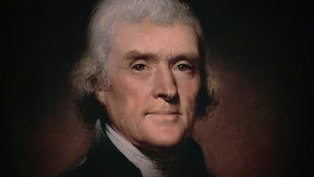
Clip: Special | 1m 34s | The Preamble addresses the concept of natural rights. (1m 34s)
Video has Closed Captions
Clip: Special | 1m 7s | Many Loyalists and some other Americans believe Thomas Paine’s ideas go too far. (1m 7s)
Video has Closed Captions
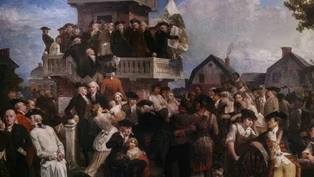
Clip: Special | 2m 40s | After ratification, the Declaration is publicly read across the former colonies. (2m 40s)
Providing Support for PBS.org
Learn Moreabout PBS online sponsorship







Support for PBS provided by:
Episodes presented in 4K UHD on supported devices. Corporate funding for THE AMERICAN REVOLUTION was provided by Bank of America. Major funding was provided by The Better Angels Society and...