Mountainthology
Episode Five: America 250 Special
7/27/2026 | 27m 45sVideo has Closed Captions
Join David Marcum as he celebrates America 250 with the crew of WVPB
Join David Marcum for this America 250-themed special edition of Mountainthology! This month we bring you stories of those who preserve history by bringing it to life, frontier cooking, and a comparison of what citizens felt at this time 50 years ago.
Problems playing video? | Closed Captioning Feedback
Problems playing video? | Closed Captioning Feedback
Mountainthology is a local public television program presented by WVPB
Mountainthology
Episode Five: America 250 Special
7/27/2026 | 27m 45sVideo has Closed Captions
Join David Marcum for this America 250-themed special edition of Mountainthology! This month we bring you stories of those who preserve history by bringing it to life, frontier cooking, and a comparison of what citizens felt at this time 50 years ago.
Problems playing video? | Closed Captioning Feedback
Where to Watch Mountainthology
Mountainthology is available to stream on pbs.org and the PBS app.
Providing Support for PBS.org
Learn Moreabout PBS online sponsorshipThis is a production of West Virginia Public Broadcasting.
Hey there, I'm David Marcum, and welcome to This America 250 special edition of Mountainthology.
It isn't uncommon for someone to describe history as a living thing.
New arguments, observations, and archeological discoveries frequently reshap our understanding of the past.
Each generation exist as a time capsule for the next, and stories of the past ignite and inspire the present.
For some, however, this is not enough.
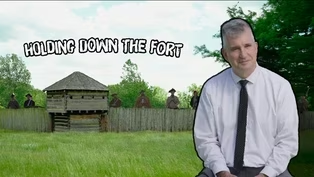
Produce Ethan Raymond interviewed Craig Hesson of Point Pleasant about living history and the importance of keeping the past alive.
There's so many things that we lose when we don't understand where we came from, understanding where we came from in our history, and the struggles that we went through make us stronge for our struggles in the future.
My name is Craig Hesson.
I work for the Mason County Board of Education, where I'm a coordinator, and in my spare time I enjoy doing living history events.
For me, reenacting living history a little bit different, living history.
We're actually taking events and trying to portray them as accurately as we can, living as what they did.
I like putting away all moder stuff and actually living in it.
Sleeping in the tents.
I've slept in a tent where it was so cold that the water frozen my canteen.
And I've been there when it's hot.
That's living history.
You're actually experiencing what they experienced.
You read something in a book and it's just words in a book.
One of the best experiences I had in the classroom when I was teaching in the classroom.
I came in and my period clothing and we had zero problems that day.
Every student was engaged and wanting to lear what the different things were.
People just they don't realize, you know, what it was like to live it and to be there.
And if we can portray what it was actually like, it makes it well.
I like to say come alive.
That's that's what it's about is making our history come along.
I've always had an interes I could go back to when I was in junior high, and For Randolph was built here in 1974.
They did a drama here.
Everything for the bicentennial.
That's probably what got me started in 19, probably 1990.
Early.
There was an event out here.
It was an encampment.
Came back a couple of years later, and I was down at battle days in Point Pleasant.
And there were guys sitting around the campfire, and I just walked up and I said, wha do I need to do to get started?
They said, pull up a chair, sit down.
This talk.
And they began to to teach me at that point not to jump into anything.
Take your time.
Research the time period that you want to do, because little things like the type of pants that you have on fly or drop front, it makes a difference in the time period.
Take a year research.
We'll be back next year.
Come and join us.
I started the following year as a part of the Allegheny Rangers a group from Roanoke, Virginia, and I've been reenacting ever since then.
Probably couldn't count the number, the number of events, the Siege of Fort Randolph, July and the fall.
We have events and Christmas.
You can multiply that by four, but I volunteered down in Roanoke, Virginia.
Many events, presentations, cricket, sport.
I've been working up there fo weddings and colonial and all.
Colonial style.
Up, up in advance.
Too many to count.
I look forward to battle days because it's a time when we have a lot of kids come through, and we get a chance to share our history.
I look forward to the siege of Fort Randolph because most people don't know what happened here in Point Pleasant.
The Fort Randolph Committe is an all volunteer committee.
It's made up of re-enactors from all over, not necessarily from Point Pleasant.
Matter of fact, most of the people on the committee are not from the media.
They all come together because they have a love for the history, and they want to see it grow and develop and to be able to continue to share and make the fort come alive.
As part of the Fort Randolph Committee for many years, chairman for many years now, just volunteer and have fun.
We're always asking for volunteers.
Come to one of the events and talk to any of the re-enactors, and we would love to welcome you in.
The new Fort Randolph was was built in 1974.
It was for the American Bicentennial.
It was all designed really to be able to have a drama.
They had a hidden wall that went across the back where they could put the horses and different things, and a stage over against one wall.
Back in the 90s, we got a grant.
There was a tavern built, a large two story structure, and the two blockhouses that now sit on the corners were built at that time.
Slowly over the years, I went from just plain stockade walls to begin to add different huts, cabins around the side walls.
Each of our cabins are named for different people or things that took place here at the fort.
They all house different displays.
They're also set up to where at different re-enactors.
Take them on and try to fix them up.
We have a carpenter shop that's set up against the wall as well.
Once you get inside the walls, we have a blacksmith shop.
We also have a powder magazine.
The two corner cabins that we have now.
One houses the gift store, the other is a kitchen mainly for re-enactors, a kitchen and restrooms for them for those who stay, and just a few amenities that they can't bring in with them.
Crews responded to Fort Randolph and Point Pleasant for a structure.
Fire dispatchers say the call came in just before midnight.
A historic fort in flames overnight, leaving people in the area heartbroken.
The chairman of the committee gave me a call.
It was about 2:00, I think, in the morning, and he told me that it was on fire.
I didn't see it, but I saw the videos of it and it was it was unbelievable.
I'll just say it was like a gut punch because it took the air out of everyone.
Hours of time that people put in building and constructing, fixing things inside, item that have been donated, hides.
It was devastating.
Everybody would gather inside and we'd play music and sing and have our meals.
So there were a lot of good memories that that went up in flames.
I haven't been i on the committee meetings, like I've been trying just t volunteer and come and help out.
I do know that the plan is to rebuild.
It'll have basically the same footing.
I have to see how tall it goes this time.
It may not be quite as tall.
And the way I understand it, it's not going to prevent us from having our events.
We will have to have the are roped off until it's taken down.
Many folks, they don't realize what we have here and the re-enactors and the reenacting community, those who help participate and help share that history.
We play a vital role in trying to educate, trying to show a love of the history of our country, of our founding, of where we come from because we came from all over.
Most of the people who settled our area were either German or Scotch-Irish immigrants.
Today, we all come from different places, but we're here for one purpose and that, and that's sharing our love fo for our history and where we've come from.
Now that you've experienced living history.
How about a taste?
Producer Katie Lemons and Connor Martin bring us to the hearth of Fort New Salem, where living historians Martha and Dick Hartley show us recipes of the frontier.
Hello.
We're Martha and Dic Hartley were volunteer docents at Fort New Salem Historic Living Museum.
We are food historians.
We are hearth cooks and we enjoy sharing with people what the pioneer life was like in the ways that the family lived, especially with the foods that they ate.
Welcome to the old kitchen at Fort New Salem.
This is typical of a pioneers curling home life on the western frontier.
During the beginning of this new country was often a struggle, a survival.
Many of their daily tasks dealt with food, clothing, and shelter.
Many families during the settlement period did not have very much cooking equipment.
We did a study of estate sales and inventories.
We found the most common equipment was a Dutch oven called a bank kettle.
Austin, the iron pot an the three legged spider skillet.
We're going to make a very simple cake.
First of all, you put cornmeal.
We'll add a little bit of salt.
I'll have some butter.
Now put in.
We have some bottom here.
We're going to mix this.
It's stirred all around.
So corn was used for many many things.
This was one of the most common to make the John kids.
We're going to put it out in the path this down.
Now we're going to put it up against the stone by the fire, and it will make off the radiant heat.
Corn was one of the foods that was commonly used by the pioneer.
Another thing that was commonly grown was pumpkin.
Pumpkins were one of the three things that our Native American neighbors gave to us.
Beans, corn, and pumpkin.
So we are going to make a pumpkin pudding.
So what I have here I've already cooked the pumpkin and it is it is settled here in the bowl bashed up.
Now I'm going to add some eggs to it.
You hope to have enough eggs from domestic poultry, but if you didn't, you would use ducks and geese eggs to.
And while that makes you want to twist up the eggs a little bit, we're going to mix that into the bowl.
We're going to store that around.
We're going to add some sugar some sweet into this in then amongst the sugar.
I have some spots.
So we're starting this up to make a pudding.
Now we're add a little milk.
Again the pioneer hope to have dairy cow or milk.
It's not used water.
Yes.
We'll have some butter down.
Some butter right here.
Thank you.
That would be another luxury.
But it was often used as a cash crop.
You could sell your butter and use that money to pay your taxes, which was very important for these when they came here to develop our country.
So now we will put in place putting dish.
He has preheated the Dutch oven back here.
The bake cattle was coals o top of it or coals underneath.
And I'm going to set it right down on the wing in the bottom.
This is how that we would be cooking this.
Another way which the common vegetable pumpkin could be used would be to use it as a casserole to stuff it.
And this was very commonly done.
What would we have today?
A pumpkin which has been the top taken off of i and the seeds taken out of it.
We're going to give it a step in.
This stuffing is going to crumble.
Maybe last night's leftover cornmeal.
We're going to add some sausage made in it.
As we said, pork was a very common me.
The sausage is seasoned with herbs which we grew rosemary and sage and tom funkin can be stuffed with whatever you had.
This is, of course, a stuffing of cornmeal.
We're going to put it inside the holiday pumpkin.
Then we will put this up to the fire.
Turning it frequently s the pumpkin cooks on all sides and the stuffing is heated through.
Now we're going to put the lid on.
Here we have one that is already finished.
We will take the lid off.
You can see that the stuffin inside the wonderful things out on our plate.
We mentioned one pot meals today.
What we have made is venison stew.
What we did.
We took the chunks of meat along with some pork fat and browned it in this ironstone pot.
Ready to serve.
A little parsley as a nice touch.
As one explores.
Pioneer time one begins to appreciate the hardships, but the determination, the hard work, and the faith that our ancestors endured for the next and futur generations of West Virginians.
Unearthing archival footag from America's 200th birthday.
Producer Tori Rankin finds West Virginia playing its part in the Great Unfinished Symphony.
Flags, county fairs, and a whole lot of unresolved tension with historian Hal Gorby.
He asks whether 250 years in, if there's been a key change.
One and one of the only one.
And we.
Decided to pain our Bicentennial flag on here.
I figure I have around 15 hours in it.
Cost of the paint was around $30 for it.
Which I figure is a pretty economical way to show your bicentennial spirit.
1976 West Virginia was very interesting to me because there are several big factors going on.
The economy.
While it's troubling elsewhere, this is actually the last sort of point when the state's blue collar economy is very strong in the mid 70s.
I'm William Howe Gorby, I'm a teaching associate professor of history here at WVU.
The chemical industry, coal mining, employment, which had dipped in the mid 20th century with mechanization, actually gets up to around 70,000.
Maybe a couple of years after this point.
So economically, it's a good time for people in West Virginia.
I mean, when they're doing these on the street interviews, you can see like every building has a business in it.
Everything seems to be bustling and moving fairly good.
It doesn't seem to be being filmed during.
If it had been filmed five years later, it probably would'v had a completely different tone because the state enters a decad The cynicism in the country at that time obviously was very palpable.
Afte this is right after Watergate.
This is right after the end of the Vietnam War.
Got 100 years looking, looking back on a couple of hundred years.
As a matter of fact, I'm looking forward to try some town.
Anything else?
I think we've we've blown the last 200 years as it is.
And I think the one gentleman who is saying we screwed up the last 200 years, that's probably kind of the general sentiment of distrust in government after Watergate, after a decade or more in Vietnam, you had a stand that was very much about we need to have God in schools, God in the celebration.
Tell us what your bicentennial booth is all about here.
Well, we feel that God should be in our bicentennial celebration.
And so we have a birthday cake for Uncle Sam.
And then we have a gift.
And then we have some correspondence courses, some Bible courses.
And then right next or near was the National Organization of Women's Booth.
What just now had to do with the bicentennial.
It just it goes to show tha women, our theme is patchwork.
And women have had to make do with what they've had down through the years, through the 200 years.
And we're just kind of emphasizing that thing.
So trying to balance this sort of top down history with this sort of bottom up history.
Mike Weber, who's in Clarksburg, kind of critiquing that storefront and talking about we need like a history of the common person.
And you know, that that does reflect, I think, what was going on within the labor movement in the state.
Well, I'd like to see people in the United States celebrate the bicentennial by going out and trying to express themselves in muc the same way as the people did durin the American Revolution, points that, like some of the murals on one of the buildings and the display case, we consider this a typical example here.
This window display of what we know, what we try to say is the boy bicentennial.
What this is, is just the consumerization of wha the bicentennial is all about.
And he ties it into kind of the fight for the eight hour day, almost making a sort of labor union sort of pitch.
Over there, across the street is a depiction of the American Revolution and the Bicentennial.
But we also find in that sign of real, scattered few people and people who have done certain heroic acts, where is the common person, the person who daily is on the streets, walking, walking around Clarksburg, or walking around any of the cities of West Virginia?
They're not just picked in any of the bicentennial displays that we've seen so far.
This is during a couple of summers in 75 and 76, when there's a large number of wildcat strikes in the coal fields of West Virginia.
We're looking today at the way we're going to be celebrating this two 50th.
I mean, there are similar tensions that we saw there in 1976 and then maybe more magnified, but also kind of like, what does this mean for the future?
A kind of economic anxiety that is different and it's extreme but is echoed there in 76 as well.
I suppose th best bicentennial thing of all would be a federal statute that requires all of us to read 20 books that are serious, half o which would be autobiographical or biographical, about by people of, you know, of greatness in American history, and the rest of which would b perhaps about American history itself, cultural aspects, different struggles.
It was interesting seeing him say that about we need to be reading mor history and autobiographies of famous people, which in one way it could be read as elitist, and probably if people would read and would then get together as for example, my wife does once a week to discuss a book that she's read with 6 or 7 other people.
That would be the best bicentennial celebration.
It's this out of stat politician who's telling people, you need to read more.
He's been here since really the mid 60s.
He was a Vista worker, member of the House o delegates, Secretary of state.
He was kind of tied into some of these grassroots organizations, among other issues.
And so I think he's also viewing it that, you know, the state is also kind of improved a lot over the decade or more that I've been here.
We need to keep this going.
We don't have anybody to compare with George Washington or Thomas Jefferson or James Madison or John Marshall, or any of the great man of revolutionary Virginia which are among the greatest men that any society ever produced at any time in history.
And we simply cannot compete with that.
And although it is part of Western Virginia's heritage, West Virginia somehow has been cut off emotionally from that.
When I had Doctor Williams says that about boosterism, that historic promotion of the 200th is jus kind of leading to boosterism.
The money that the state has to spend on history has generally turned ove to amateurs, hobbyists, boosters who want to build.
And the only thing they can think of to do is to build a tourist attraction, which may or may not attract tourists.
I think what Doctor Williams is also getting at.
It's always tied to tourism.
It's tied to economic development.
We run around trying to compete to create a Fort Randolph, to compete with the Virginia Civil War battlefields, to create an independent sought to compete with Williamsburg.
It's got to be frame in a way that it it makes money, it turns a profit.
Whereas I think he's gettin at the tension at the time that we're tying ourselves to this creation of the country, which we were part of.
But in a way we were this sort of frontier.
We really want Virginia style of history, but we're not in Virginia.
And so what are we promoting if we're promoting this more consumerist boost image of the national revolution?
The irony being that this is a celebration of 13 colonies rising up against Great Britain.
And the irony being that we basically hav our own revolution against Kenya a few generations later.
We have fewer people going to church.
We don't have those common space, we don't have bowling leagues.
You have a variety of these different spaces where people can come together in small ways, but even bigger types of ways that I do think we don't have today.
We're going to have to have a big enough event where it has enough tie in things that can draw enough peopl in, whereas as you saw in 1976, they're able to do like this wide variety of small types of music dance, church, you know, civic events.
And it doesn't need to be this elaborate production.
I mean, the first guy painting an American flag, I mean, the whole I mean, tha probably took days to do that.
That would be like a TikTok, you know, and we just see like a finished product or him like rushing through the end of the day.
People are illogical.
They they're emotional.
They do things that don't follow natural pattern or do what you think is going to happen.
And that's why it's fun to to study what they did and to not try to not to try to say what they did was wrong or right, but just to try to understand where where were they coming from?
It's very neighborly, almost a West Virginia documentary, because it's allowing people to say to get their thoughts out there, but to not critique them, not to criticize them.
Just let me let please share your opinion of this.
Almost like we're sitting on the front porch just having a conversation.
Friends, I hope you'v enjoyed the America 250 special.
As always, bonu content for the stories you saw today is available on passport and later on our YouTube channel.
Also check out our new four part docuseries, Always Free.
Mountaineers in the Revolution.
I'm David Marcum, and we'll see you next time.
This has been a production of West Virginia Public Broadcasting.
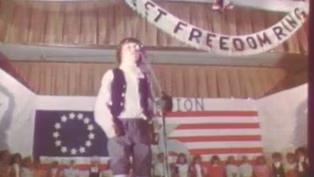
Full Length Archive Footage from 1976 - "The Late Great American Bicentennial"
Video has Closed Captions
The archive footage referenced in "The Late, Great American Bicentennial: 50 Years On" (28m 42s)
Video has Closed Captions
Producer Ethan Rayment interviewed Craig Hesson of Point Pleasant about “Living History” (8m 19s)
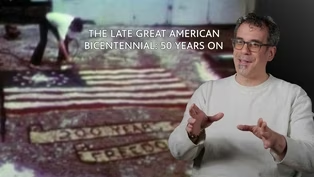
The Late, Great American Bicentennial: 50 Years On
Video has Closed Captions
Producer Troy Rankin joins historian William Hal Gorby to analyze Bicentennial footage (10m 11s)
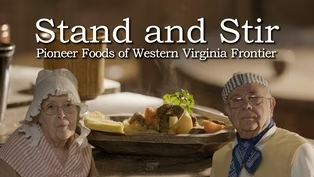
Stand and Stir: Pioneer Foods of the Western Frontier
Video has Closed Captions
Producers Kady Lemons and Conor Martin bring us to the hearth of Fort New Salem. Plus a bonus recipe (9m 21s)
Providing Support for PBS.org
Learn Moreabout PBS online sponsorship












Support for PBS provided by:
Mountainthology is a local public television program presented by WVPB