Figurative Learning - Dana Gray - Third Grade
4/7/2020 | 58m 33sVideo has Closed Captions
Students will learn how to identify figurative language in a story and how to practice it.
Learn how to identify figurative language in a story and how to practice it in this lesson. Created by NJTV in partnership with the NJEA and the NJ Department of Education, NJTV Learning Live remote learning classes are for grades 3-6, taught by NJ public school teachers. One-hour lessons include math, science, English language arts, social studies, physical education and more.
Problems playing video? | Closed Captioning Feedback
Problems playing video? | Closed Captioning Feedback
NJTV Learning Live is a local public television program presented by NJ PBS
Figurative Learning - Dana Gray - Third Grade
4/7/2020 | 58m 33sVideo has Closed Captions
Learn how to identify figurative language in a story and how to practice it in this lesson. Created by NJTV in partnership with the NJEA and the NJ Department of Education, NJTV Learning Live remote learning classes are for grades 3-6, taught by NJ public school teachers. One-hour lessons include math, science, English language arts, social studies, physical education and more.
Problems playing video? | Closed Captioning Feedback
Where to Watch NJTV Learning Live
NJTV Learning Live is available to stream on pbs.org and the PBS app.
Providing Support for PBS.org
Learn Moreabout PBS online sponsorshipMore from This Collection
NJTV Learning Live is a class for third graders taught by NJ public school teachers.
Writing Rocks - Nikki Silva- Third Grade
Video has Closed Captions
Students learn how to become stronger writers by varying sentences and adding details. (58m 43s)
Biodiversity in Barnegat Bay - Dunlea & Williams-Third Grade
Video has Closed Captions
We’ll see and explore all the amazing creatures that call Barnegat Bay home. (57m 31s)
PE LIVE! - Gregory Bradley - Third Grade
Video has Closed Captions
Students will do a well-rounded workout including cardio, tae bo, and yoga in this lesson. (57m 1s)
Word Detectives: Context Clues - Janice Alvarez -Third Grade
Video has Closed Captions
In this lesson, students will use context clues to determine the meaning of unknown words. (57m 36s)
Introduction to Fractions - Krysten Paone-Hurd - Third Grade
Video has Closed Captions
Students will learn the basics of fractions when it comes to “a piece of the whole". (57m 58s)
Lovely Landscapes - Natalie Steckel - Third Grade
Video has Closed Captions
In this interactive art lesson, students will learn the four parts of a landscape. (57m 51s)
Punctuation Power! - Jennifer Ostrega - Third Grade
Video has Closed Captions
Students will learn how to demonstrate command of standard English punctuation marks. (58m 18s)
FAST Characterization - Rosemary Matar - Third Grade
Video has Closed Captions
Students will learn how to describe a character using the FAST characterization method. (57m 43s)
Area & Perimeter - Jill Turner - Third Grade
Video has Closed Captions
Students will learn about area and perimeter and apply them to real-life situations. (58m 1s)
You Guessed It!- Haritha Tottempudi - Third Grade
Video has Closed Captions
Students will learn how to infer using a fiction and nonfiction text. (57m 3s)
Sweat, Hydration, and Phys. Ed. - Kyle Muckley - Third Grade
Video has Closed Captions
Students will learn about their bodies and the benefits of physical activity. (55m 24s)
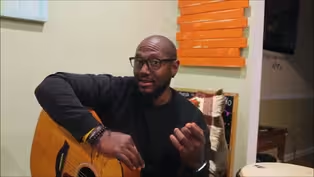
Ready, Set, Draw your Narrative - Alan Trotty - Third Grade
Video has Closed Captions
Students will draw a life event and transform it into a narrative writing piece. (58m 32s)
Providing Support for PBS.org
Learn Moreabout PBS online sponsorship>> Hi, everyone.
My name is Mrs.
Gray.
I am a third grade ELA teacher.
I've been teaching at Evergreen Avenue School for 14 years.
I spent most of my time actually teaching second grade where I taught there for 12 years.
And then recently I've been teaching ELA in third grade.
And a couple of other things about me are that I have two boys.
One is my oldest.
His name is Cameron.
He's 17 and he's a junior in high school.
So he'll be graduating next year and then my other little guy is Caden, and he's in fourth grade.
And I think the last really important thing you need to know about me is I happen to teach future superheroes.
So welcome, future superheroes.
I'm happy to be teaching you guys today.
So one of the things that I wanted to talk to you about is just how much I love books.
So like I said, I teach second grade.
I taught every subject in second.
And then I kind of got lucky with this opportunity.
My principal, Mr.
Braddock, said, "You know, next year we're gonna do something different.
You get to pick your favorite subject to teach."
And I was like, ELA.
Not really a math girl.
So I was really excited about that because I love books.
I'm so passionate about every kind of text there is, from poetry to nonfiction, fiction.
But our focus today is going to be on fiction and some of the different things that you can do with a fiction book.
So, I always tell my students, I'm going to tell you, future superheroes, that reading anything allows you to just kind of grow in so many ways.
So there's just so many different things that you can do with books.
So our main focus today is going to be on figurative language.
But as we're thinking about our figurative language, we also just want to make connections to the book that we're reading.
We want to think about just different cultures and different things that we might not experience in our everyday lives.
So to start, I want you to know that all you will need for today for the first part is just to listen and enjoy the book.
But eventually, when we do our next task, you will just need some paper and a pencil.
And then if you have some Legos or K'NEX or even coins, just something that you can use throughout your reading to help you attract figurative language, I thought we would just do it in a fun way.
And I really like to just kind of, like, touch things.
So I thought that would be a fun way to kind of keep track.
So the figurative language that we're going to talk about today is just a couple.
There's many, but I wanted to focus on a couple.
So the first one is alliteration.
One of my favorites, and alliteration is a sentence or phrase with words which start with the same letter or sound.
So the example that they give us is Morgan Mouse munched marshmallows merrily.
You can hear that M sound repeated, right?
So I'm just gonna add that to our board.
The next one I want to talk about -- this one I really, really love because I use it all the time, and that is hyperbole.
And hyperbole means that you're describing something in an extremely, extremely exaggerated way.
So the example that they give is we waited in line all day.
I feel like that's how you would say that, right?
So I know my own kids will say, we have so much homework.
We have tons and tons of homework.
A ton is a lot, right?
So that's definitely a big exaggeration.
It's a hyperbole.
The next one that we're going to think about is personification.
And if you notice, as I'm holding this close to the screen that that base word "person" is in that word, and that will help you identify any time you hear personification, which is to describe non-human things using human qualities.
So the example here says the leaves danced in the wind.
Fun one to use when you're writing.
I'll add this one here.
The next one is a simile.
You probably hear these all the time in your reading.
So a simile is just when you're comparing two things, using the words -- here are the key words -- "like" or "as."
So this one says he is as fast as a rabbit.
I happen to be slow as a turtle.
Hopefully some of you are a little faster than me and maybe you're as fast as a rabbit.
Our next one is a metaphor, and a metaphor means that you're comparing two things, so it's very similar to simile only when you're using a metaphor, the words "like" or "as" are not in the sentence.
Instead, it just says that it is or are.
So it says her slime -- Sorry.
Her smile is the sun.
I would love to be described like that, or sometimes you might say that somebody is a doll.
Oh, my gosh, she's such a sweetheart.
She is a doll.
Something like that.
The last one is probably my favorite.
It's a funny word to say, it's a fun word to spell, and I think it just really brings our stories to life and that is onomatopoeia.
Check out that word.
Onomatopoeia, and onomatopoeia is a word that sounds like the noise it makes.
So this one says the dog knocked over the vase with a crash.
And I always think of, like, superheroes when I think of onomatopoeia like that.
Pow, bang, boom.
We can use these in our stories a lot.
I love this one.
So for today, I'm going to read you a story that actually has a little bit of alliteration in its title, and that is "Too Many Tamales."
So you can hear that T sound that's being repeated.
And as I grab the book, I'm just gonna move our onomatopoeia poster up a bit so that you can see that one too because it's one of my favorites.
I have to have it showcased there.
So this is a story called "Too Many Tamales."
It's written by an author whose name is Gary Soto.
And in case you aren't familiar with tamales, they are absolutely delicious.
Probably contributes to my being slow as a turtle, but it's okay, though.
They're that good.
And they are a dish that many people have all over the world and at different times.
But this family happens to make them special for Christmas.
And the dough that they make the tamales with are called masa, so you'll hear them talk about how they're needing the masa and how something ends up going missing in the masa.
So remember that I said that our focus was going to be on figurative language, but just think about some connections that you can also make in the book.
Think about a time when maybe you felt the same way the character and the main character in the book felt, or just any kind of connection that you can make to it.
And then if you hear some figurative language, I just want you to just stop and think and we'll do a little something special with it, okay?
So this is "Too Many Tamales."
Snow drifted through the streets, and now that it was dusk, Christmas trees glittered in the windows.
Maria moved her nose off the glass and came back to the counter.
She was acting grown-up now, helping her mother make tamales.
Their hands were sticky with masa.
"That's very good," her mother said.
Maria happily kneaded the masa.
She felt grown-up, wearing mother's apron, and her mom had even let her wear lipstick and perfume.
"If only I could wear Mom's ring," she thought to herself.
Maria's mother had placed her diamond ring on the kitchen counter.
Maria loved that ring.
She loved how it sparkled like their Christmas tree lights.
Hold on a second.
I have to re-read it because I thought I heard something.
It said, "She loves how it sparkled like their Christmas tree lights."
So I'm going to stop here for a second.
Remember I said that if you have, like, Legos or K'NEX to grab them.
Here's why.
I was thinking that it would be fun to just use something to remind us of every time we heard some figurative language in the book.
So I have these jumbo Legos -- my kids happen to love Legos -- and just wrote on one side the word "simile" for this one so that anytime we heard one, we can grab it and start to make a stack, and I'll show you what we'll do with them at the end.
So I heard that simile because I heard the words "like" or "as" when she said that she loved how it sparkled like their Christmas tree lights.
So I'm grabbing a simile block.
When her mother left the kitchen to answer the telephone, Maria couldn't help herself.
She wiped her hands on her apron and looked back at the door.
So just take a minute and just make a prediction.
What do you think is going to happen?
She's been dying to wear that ring, right?
Some hyperbole there.
Mom left it on the table and she went to the door.
"I'll wear the ring for just a minute," She said to herself.
The ring sparkled on her thumb.
And even just the fact that she's wearing it on her thumb shows just how tiny she is.
It doesn't even fit on the same finger that her mother would wear it on.
Maria returned to kneading the masa.
Her hands pumping up and down.
On her thumb, the ring disappeared and reappeared in a sticky glob of dough.
Her mother returned and took the bowl from her.
"Go get your father for this part," she said.
Then the three of them began to spread masa onto corn husks.
Maria's father helped by plopping a spoonful of meat in the center and folding the husk.
He then placed them in a large pot on the stove.
They made 24 tamales as the windows grew white with delicious smelling curls of steam.
Oh, I love the way that author Gary Soto described that part.
He used tons of imagery, which is actually another kind of figurative language that we didn't talk about.
The author does a great job of that.
A few hours later, the family came over with armfuls of bright presents.
Her grandparents, her uncle and aunt, and her cousins, Dolores, Teresa, and Danny.
Maria kissed everyone hello.
Then she grabbed Dolores by the arm and took her upstairs to play with the other cousins tagging along after them.
Now, I don't know about you, but I can make tons of connections to family gatherings because we can get together very often.
In my family, my mom's from the Philippines.
So all of her family is in the Philippines.
So I've actually only met them one time in my whole life.
But my father's family is from North Carolina.
So us being from New Jersey, we didn't get to see them too often.
But these special times, Christmas and Thanksgiving, we always look forward to because that was one of the few times we could get together.
They cut out pictures from the newspaper, pictures of toys they were hoping were wrapped and sitting underneath the Christmas tree.
As Maria was snipping out a picture of a pearl necklace, a shock spread through her body.
Start thinking about what she might be thinking.
"The ring!"
she screamed.
Everyone stared at her.
"What ring?"
Dolores asked.
Without answering, Maria ran to the kitchen.
Look at that look of shock on her face.
The steaming tamales lay piled on a platter.
"The ring is inside one of the tamales," She thought to herself, "It must have come off when I was kneading the masa."
Dolores, Teresa, and Danny skidded into the kitchen behind her.
"Help me," Maria cried.
They looked at each other.
Danny piped up first.
"What do you want us to do?"
"Eat them," she said.
"If you bite something hard, tell me."
The four of them started eating.
They ripped off the husks and bit into them.
The first one was good.
The second one pretty good.
But by the third tamale, they were tired of the taste.
"Keep eating," Maria scolded.
Corn husks littered the floor.
Their stomachs were stretched till they hurt.
But the cousins kept eating until only one tamale remained on the plate.
"This must be it," she said.
"The ring must be in that one.
We'll each take a bite.
You first, Danny."
Danny was the youngest, so he didn't argue.
He took a big bite.
Nothing.
Dolores took a bite.
Nothing.
Teresa took a big bite, and still nothing.
It was Maria's turn.
She took a deep breath and slowly, gently, bit into the last mouthful of tamale.
Start making a prediction here.
Do you think it's going to be in there?
Do you think it's somewhere else?
Nothing.
"Didn't any of you bite something hard?"
Maria asked.
Danny frowned.
"I think I swallowed something hard," he said.
"Swallowed it?!"
Maria cried, her eyes big with worry.
She looked inside his mouth.
Teresa said, "I didn't bite into anything hard, but I think I'm sick."
She held her stomach with both hands.
Maria didn't dare look into Teresa's mouth.
She wanted to throw herself onto the floor and cry.
The ring was now in her cousin's throat or worse, his belly.
How in the world could she tell her mother?
"I have to," she thought.
This makes me think of tough times when maybe I had to apologize for something or admit to something that might have been a little bit hard to do.
But you just know you have to do the right thing, right?
She could feel tears pressing to get out as she -- Wait a minute.
I heard some figurative language.
She could feel tears pressing to get out.
So think about which one of our examples of figurative language might show some human-like traits.
Remember that one about personification?
I'm going to grab my block, my personification block.
Let me show you.
I can't wait to see what we build at the end.
She could feel tears pressing to get out as she walked into the living room where the grownups sat talking.
They chattered so loudly that Maria didn't know how to interrupt.
Finally, she tugged on her mother's sleeve.
"What's the matter?"
her mother asked.
She took Maria's hand.
"I did something wrong," Maria sobbed.
"What?"
her mother asked.
Maria thought about the beautiful ring that was now sitting inside Danny's belly.
She got ready to confess.
Then she gasped.
The ring was on her mother's finger bright as ever.
"The ring," Maria nearly screamed.
Maria's mother scraped up a plate of dried masa.
"You were playing with it?"
she said, smiling gently.
"I wanted to wear it."
Maria said, looking down at the rug.
Then she told them all about how they eaten all those tamales.
Her mother moved the ring a little on her finger.
It winked a silvery light.
There goes that personification again.
I'm just gonna grab one more block.
Then she told them all about how they had eaten the tamales.
Maria looked up and Aunt Rosa winked at her, too.
"Well, looks like we all have to cook up another batch of tamales," Rosa said cheerfully.
Maria held her full stomach as everyone filed into the kitchen, joking and laughing.
At first she still felt like crying as she kneaded a great big bowl of masa next to her Aunt Rosa.
As she pumped her hands up and down, a leftover tear fell from her eyelashes into the bowl and just for a second rested on her finger, sparkling like a jewel.
So I heard that key word, that word "like," so we know from our figurative language chart, that that means that we just heard a simile, right?
So this simile that I heard was that "it was sparkling like a jewel."
So here's my simile block.
I'm just gonna add it to our pile.
Then Rosa nudged her with her elbow and said, "Hey, niña, it's not so bad.
Everyone knows that the second batch of tamales always tastes better than the first one, right?"
When Dolores, Teresa, and Danny heard that from the other side of the room, they let off a groan the size of 24 tamales.
Then Maria couldn't help herself.
She laughed, and pretty soon everyone else was laughing, including her mother.
And when Maria put her hands back into the bowl of masa, the leftover tear was gone.
So that's the end of the book "Too Many Tamales."
Remember, there was some alliteration in the title.
We heard tons of different examples of similes, of personifications.
So I'm going to show you what to do with these blocks in a minute right after this.
>> Hi, guys, I am on location down in my basement.
And I thought it would be the perfect place to do a little brain break.
This is where I actually come and do some of my little workouts and some exercises and stretches just to kind of keep my body healthy, just like we all should.
So I know that you've been working hard.
You learned about a lot of different examples.
Six, to be exact.
Six different examples of figurative language.
You also were listening for them closely in our read-aloud what we read "Too Many Tamales."
So I thought that you'd be ready for a brain break.
So I'm actually going to show you one.
You might know this already.
I call it spelling aerobics.
And this is something that I normally use for my spelling wars, but since you're home, I thought this would be a good, just like a good little activity for you to learn because you can use it with any spelling word list.
And I love that it kind of gets you moving.
It ties in that body movement with the spellings of different words.
So the first thing that I'm just going to show you is just how the different movements are going to work depending on the letter in the word.
So the first thing you need to know that there are tall letters, right?
We write them all the time, but we might not think of maybe how tall or short they are, where they're kind of falling on the line.
But that's what we need to know for spelling aerobics.
So a tall letter would be like the lowercase H. That line touches all way to the top line.
So does the letter T. So does the letter L, so does the letter K. Those are all of our tall letters.
So if one of our words contains a tall letter, we're gonna touch the sky.
We're gonna reach all the way up and touch the ceiling.
If the word has a mid-line letter, which I think every single one of them does, because they all have vowels, right?
Every word has a vowel.
And all of our vowels except for Y happen to be mid-line letters.
So if your letter is a midline, you're just going to touch your hips.
So it would be like A, E, I, O, U, not Y. Y is actually a descending letter, just like J is, just like P is, just like G is.
So those are those letters that fall below the line.
So when they fall below the line, you're gonna reach down and touch your toes, okay?
So we'll start slow.
And I'm thinking that we'll start with simile.
It's a smaller word.
I think it's a good one to start with.
But I'm just going to remind you of the spelling of simile and the meaning before we aerobicize it.
So this is a simile.
Remember that it means to compare two things using the words "like" or "as," simile.
Also, you can see that all of the words start with a capital letter.
So we're just gonna do a tall letter every time we see that capital.
So for simile, we're going to do this.
We're going to put our hands all the way to the top because we have a capital S. Then I see a mid-line letter with the letter I. So we're gonna touch our hips, then another mid-line letter with the M, another mid-line with I, but then a tall lowercase L and then E. Ready to try it again?
So would be S, I, M, I, L, E. Simile.
Got it?
Alright, let's try another one.
The next one that we're going to do is alliteration.
Remember that alliteration is a sentence or phrase where each of the first words either begins with the same letter or the same sound, alliteration.
It's a little longer, but I know you can handle it.
So we're going to start with our capital A, so hands all the way up top.
so it's A, L, L, I, T, E, R, A, T, I, O, N. I did that one fast because we always do that one fast in my class because that "shun" sound is always made up of either those letters T-I-O-N, maybe S-I-O-N.
It's a tricky one because I know it sounds like you should have a S-H in there.
But that "shun" sound is either T-I-O-N like in some of your math, some of your math vocabulary, words like addition, subtraction, multiplication, or it can be an S-I-O-N like in the word division, but just always remember that T-I-O-N is making that "shun" sound, okay?
Oh, boy.
Here's our biggie, onomatopoeia.
It's a biggie, but I know you can handle it.
So remember that onomatopoeia is a word that sounds like the noise it makes.
Crash, bang, boom, pop, right?
We know them now.
Alright, for onomatopoeia, ready?
Let's go.
Capital O, N, O, M, A, T, O, P -- there's that long descending letter -- O, E, I, A, onomatopoeia.
That was a long one.
You did great on that one.
Our next word is the word metaphor.
Here I come.
So remember that metaphor means it's what you use when you're comparing two things using the words "is" or "are."
So a lot of times you might hear people say, "Ah, he is just a big teddy bear."
That's a great example of a metaphor that you've probably heard a time or two.
So, ready for metaphor?
We're going to our capital M, way up top.
Our mid-line E, our tall T, our midline A, our descending letter P, all the way back up to an H, and then O, R. That's metaphor.
Your next word is the word hyperbole.
Remember that hyperbole means that you're describing something in an extremely exaggerated way.
So sometimes when we're doing our spelling aerobics or I don't know if the class uses noodles and things like that.
Sometimes after those workout ones, the kids are like, "Oh, I'm dying for a drink."
That would be hyperbole.
They're not gonna die.
They might be super thirsty, but they're definitely not gonna die.
So, let's do hyperbole.
Ready?
Hyperbole happens to begin with the letter H. So the lowercase H is also a tall letter.
This one begins with our capital letter H, so either way, we're touching the sky, H. We're gonna go all the way down.
Oh, I like this one.
Ooh, just gonna hang here for a minute.
It feels good.
For that Y. Then we come right back with our P -- that's also another descending letter.
Then our E, mid-line R. Our tall B, mid-line O, tall L and then our E again.
Ooh, that was fun one, hyperbole.
That was a fun one to do.
I love when they kind of go back and forth like that.
And our last one for spelling aerobics is personification, another biggie.
Remember that personification is when you're describing non-human things using human qualities.
Personification.
So since we are using the capitals that we see on our poster, we're going to start by going all the way up high.
Normally if it's a lowercase P, we would touch our toes, right?
Because that normally is a descending letter when it's a lowercase.
But we're gonna start with our capitals.
Ready?
Capital P. Mid-line E, R, S, O, N -- There's that base word "person" again.
I, tall F, mid-line I again, C, A. Remember it ends with "shun."
Can we do it fast?
Ready?
T-I-O-N, "tion," personification.
Nice job, guys.
Alright, so the next thing that we're going to do is I'm going to show you -- just move you a little closer -- how we can use some of the different things that you might have around your house to kind of do the same activity that we did with our read-aloud.
So remember, I used these big blocks.
I used the big ones just because they're a little bit easier to see.
But if you're at home and you have Legos or like I said, you can even use coins or something, just every time you hear one, put one out and it will remind you of how many you heard in the story.
So I just kind of grabbed a couple of things.
Thought you guys might like these.
How many of you have these around your house, and they might be your mom's archnemesis because they're all over the floor and she needs to vacuum them.
So these are some Nerf darts.
So you could even use something like these.
If you're reading a story, just kind of have them next to your book.
And then every time you hear something like, "Oh, I heard a simile," set one aside.
"Ooh, I heard a metaphor."
Set one aside.
And then by the end, let's say you heard three in your book.
That means that you're going to try and use three when you're doing your writing or just sharing it with a friend.
Sometimes we do things like that in school.
We do a partner share, right?
This one I thought we could have a lot of fun with.
So again, you guys are home.
You might have some Jenga blocks at home.
You could take turns reading a story with somebody at home.
And then if you hear some figurative language, the first person that hears it gets to pull a Jenga block.
So I'm going to try and do this without knocking the whole stack over.
So let's say I heard "As quiet as a mouse," I heard that simile.
I might pull a block and set it aside.
Now I know that I have my simile count right here.
Okay?
So these are just a couple of different examples that you can use using things around your house.
Remember that you can also turn and use these when you're writing to kind of inspire a story.
Maybe you want to take this and build something with them.
And then whatever you build starts an inspiration for a story.
So maybe you make a house or a tower and then that becomes the setting of the story.
So have fun with some of the different things around your house.
And just remember that just because you're not at school doesn't mean you have to stop learning.
And I'm going to show you what we're going to do with our blocks for our next part.
>> So now that we have finished our book, talked a little bit about some of the different types of figurative language, look at our board.
We learned about a bunch, and that's not even all of them.
But we have a good base to start from.
So one thing that I really like to do with my students is to just kind of like get their minds really thinking in terms of similes, personification, metaphors, all that good stuff.
So one activity that I like to do with them is just kind of a blind grab.
So this is the time where you will need your paper and pencil, so if you don't have it, I'll give you a minute to get it while I just kind of review some of the different types of alliteration that we found.
So, again, in this book, specifically, there were two similes.
There was some personification.
There was alliteration with the title.
And there might have been even some others that kind of snuck in.
I think I might have even heard a hyperbole when they were talking about how full they were and different things like that.
Like they said, they were as full as 24 tamales.
I think that would be a good example of a hyperbole.
So this is how our blind grab is going to go.
If you have your paper and your pencil, I have mine.
So I have a paper.
I'm going to use a marker just so that you guys can see it a little bit better.
And I'm just going to just grab a random block and we're going to think of as many of that type of figurative language as we can in maybe a minute.
Okay?
So we'll try it.
So the first one I'm going to just grab -- I'm gonna close my eyes -- is this one.
Ooh, hyperbole.
So if you remember, hyperbole is an extreme exaggeration.
I'm going to grab the poster just so that you can see it again and see the example that they gave.
Here is hyperbole.
So remember that it says hyperbole means to describe something in an extremely exaggerated way.
And their example was "We waited in line all day."
Remember, I feel like you have to say it like that.
So I'm going to start the timer.
I'm looking at my timer with that's on my phone that's currently running.
And I'm going to give you a minute with your paper and your pencil to think of as many different examples of hyperbole as you can.
And let me just move this block to the front.
So you just have it as a reminder that that's what you're working on right now.
We're thinking of hyperbole, a really, really big exaggeration.
I'm going to do mine on my paper.
On your mark.
Get set.
Go.
What's a really big exaggeration?
I have one so far.
How's it going?
I'm working on my next one.
I have my second, I have my second, I'm trying to think of a third all of a sudden.
The time is ticking.
I'm starting to get a little panicky, but it's okay.
Let's see.
It's a big exaggeration.
Remember, their example was "we waited in line all day."
Something that's a really big exaggeration.
Ooh, I have one.
And somehow I always go back to food.
Sorry, guys, I just love to snack.
We have about 20 seconds, guys.
Let's see.
All day.
Oh, I have a good one.
10 seconds.
Ah, and it's time to stop.
You can have a couple extra seconds if you're finishing up.
Okay.
I'm going to share with you what I have.
Let me just find something to put behind my paper so that the light doesn't kind of come through it.
Okay.
So here are some of my examples of hyperbole.
So the first one says, "I found a million ants."
Let's say you're outside at a picnic.
There probably aren't a million there, but it just seems like there's so many.
The next one says, "These bags weigh 100 pounds."
This is definitely something that my kids would say if I asked them to come outside and help me with the groceries.
Suddenly, those muscles aren't working.
I thought they were superheroes too.
The next two are about food, guys.
I'm telling you, I have an issue.
But the next one says, "I ate so much that I could pop."
Am I really going to pop?
Probably not, but I've definitely come close.
The last one I wrote says, "It took forever for our food to come."
Have you ever been in a restaurant and you order and you're just like, "Lady, where is my food?"
Usually you just feel like that when you're like extremely, extremely hungry.
So that was our first one for hyperbole.
Hopefully you guys did pretty well.
And I'm excited to see.
Maybe we can share it and just see how well you did.
So the next one, let's just kind of move right down.
The next one I see is personification.
So just a reminder.
Re-reading our definition that personification again has that base word, that root word "person" in it to help you remember that it's going to have person-like traits, right?
So it says that when you're using personification, it means you're describing non-human things using human qualities.
So their example is "The leaves danced in the wind."
Sometimes these can be a little tricky, so I'm going to do my best.
I might only come up with one or two, and that's okay.
But I'm going to give you a minute, and it starts now.
So personification, we're describing something that is not real or not living with human-like qualities.
So I think I'm just gonna keep on going with my food.
My food for thought, guys.
My first one.
Okay, I have my first one.
Just a little reminder.
You're describing something that is not living with human-like qualities.
Hmm.
Ooh, I've got another one.
And also, guys, just a reminder, just do your best with spelling.
It's okay if something is not spelled perfectly.
Yikes, we only have a few seconds left, 20 seconds.
It went by quickly.
So dry that... Alright.
I came up with two.
That's okay.
I did my best.
So the first one I think I was thinking about after eating so much, I thought I could pop.
I said "The chair groaned as I sat in it."
Too many tamales for me too.
The next one says "The houseplant was so dry that it begged for water."
Can you tell that I'm looking around my house for inspiration?
I need to water these plants, guys.
So hopefully you guys did okay with personification.
Again, that one can be a little tricky.
So our next one.
We'll just stack these gently.
Is a simile, a simile.
Remember, there are key words when we're thinking of similes.
I'm just gonna slide this over.
So, with similes, we are comparing two things using the words "like" or "as."
An example that they gave again, was "He is as fast as a rabbit."
So before I start the timer, I just want to give you some tips and tricks first.
I'm actually gonna use the same paper.
I'm gonna use the bottom half since I have a lot of room there.
Maybe I'll just separate with a little squiggly.
When I was in second grade, my second grade teacher's name was Mrs.
Fleming.
She was one of my favorites.
Every time she underlined anything, she always did it with a squiggly like that because she said she had such a hard time drawing a straight line.
Don't we all?
But every single time I draw that squiggly line, I think of Mrs.
Fleming.
Miss you, Mrs.
Fleming.
So we're gonna be thinking of our similes, right?
So we're thinking of two things.
I'm just gonna show you one more time, comparing two things, using "like" or "as."
So just to give you a little tip or a hint, it might be easy to just kind of go down with how you would describe some things like if something was beautiful.
So you could say it was as beautiful as or, like, feeling things like "cold as" or "hot as."
So those are some ideas.
I'm going to get started.
I'm gonna have to start the timer for you guys in three seconds.
Three, two, one, go.
How you guys doing?
We have about 23 seconds left.
Ah, 10 seconds.
And stop.
Okay, I had a little bit of an easier time with these.
So again, remember that our similes use the keywords "like" or "as."
I kind of have a mixture of both.
So I have for my similes, under my squiggle, I just labeled it as a simile and included another squiggle.
Another shout-out to Mrs.
Fleming.
And then this time I said as beautiful as a flower.
And then as I was thinking, I was like, there's a lot of things that are really beautiful to me.
So I was thinking "as beautiful as" and I kind of branched off and said it's beautiful as a diamond, as beautiful as a gem.
The next one that I used was as hot as fire.
Could also say as hot as the sun, but I used the sun for the next one when I said it shined like the sun, so the first two, I used that keyword "as."
The next one I used "like."
And the last one, I said it was as cold as ice.
So hopefully you guys did okay with similes that time.
And I'm just wondering if you had an easier time with similes than you did with personification like I did.
That one was just a little tough for me.
So the next one that I wanted to talk about was alliteration.
Again, I said this is one of my favorites.
I love to do this with my name, have the kids do it with their names.
So just a reminder that an alliteration is a sentence or a phrase with words that start with the same letter or the same sound.
So, for example, when I say same letter, same sound, like the word Christmas begins with a C. But you could also use a K word like king or kingdom, something like that.
So it just has to have the same beginning letter or sound.
So I'm going to start the timer.
We're gonna do this again with alliteration.
We're gonna think of different letters or sounds that can be repeated.
And just a little tip for this one.
I'm thinking that this one -- Oh, I'm running out of paper.
I'm thinking that this one might be best or a tip that might be the best use with this one is just to kind of go through the alphabet.
So I'm going to start with A and and go from there.
Are you ready?
Do you have some paper?
Do you have your pencil?
Do you have a clears space on your page?
Because we're gonna need it.
I need way more than I thought.
So I'm gonna start the timer in five seconds.
Ready?
Five, four, three, two, one.
It's started.
Oh, yeah, these are fun.
And just a reminder, I'm realizing this as I'm writing mine.
Every single letter doesn't have to begin with that same repeated letter or sound.
But most should.
I'm on to B. I'm just going right down the alphabet this time, guys.
I'm on to C. Where are you?
C. And again, just remember to do your best with spelling.
[ Laughs ] This is a funny one.
Oh, about 10 seconds.
I think I'm gonna stop there.
Are you ready?
So, again, I just went right down the list.
Just a quick reminder, again -- alliteration just means that it's a sentence or phrase with the same beginning letter or sound.
So I went down the alphabet.
My first one was "Amanda ate amazing apples at --" I had a hard time thinking of what could go in the blank.
Can you guys help me out?
I was thinking at Alabama but I'm like you would normally say, in Alabama.
So if you think is something pretty good, give yourself a pat on the back.
I struggled there and I was gonna stop it at Amanda ate amazing apples, but I just really wanted to fill in that blank, so if you can help me out, I would appreciate it.
The next one I have is B and I said beautiful bears were bounding down to the beach.
So this is a good example of how that beginning sound was repeated for most of the letters, but not all of them, and that's okay.
I think it's still apparent that that the B is the predominant letter there.
The next one I said was "The castle was cleaned by the cranky king."
Don't you think he'd be cranky?
He's the king.
Usually they have people to do that, but he's cleaning the castle.
So he is awfully cranky.
So those are just some examples of some activities that you can do, just a way to practice your figurative language.
But the cool thing is, is that really what we want to do, our end goal is really to be able to use figurative language in our own writing.
So we talked about how good authors use figurative language in their writing.
You guys are great authors too.
So sometimes we just need a little reminder.
So part of the reason why I had you grab something or we grab something every time we heard one of those examples of figurative language is because it can help us remember what different things were used.
And then we can turn around and use them in our stories.
So I'm just gonna kind of make a little stack here.
Do I have one of each?
I have simile.
I have some personification.
I have hyperbole.
Metaphor on top of there.
And then just for fun, I have these little singles.
I'm gonna to put them in the middle because it kind of looks like a little tower or a little castle.
Ooh, I'm already getting excited and getting some ideas for my writing.
So the next thing that we're going to do is get ready for some writing.
So it's going to be the next little portion.
So I have my stack that's going to help me kind of keep track of the different types of figurative language that I'm gonna try to use in my story.
So you can do the same with yours, but it doesn't have to be the figurative language that was used, for example, onomatopoeia.
one of my favorite words was not in that story, and it's one of my favorites.
So I know I'm totally going to add that in.
So even though I don't have it there, I know that's something that I'm going to add in.
So if you remember onomatopoeia was one of those sound words, right?
And I just wanted to show you something cool because it is such a long word.
And it's a really tricky word to spell but I have a trick for you to help you spell it.
So here it is, onomatopoeia, a word that sounds like the noise it makes.
See that big word?
There are 1, 2, 3, 4, 5, 6, 7, 8, 9, 10, 11, 12 letters in this word.
Let's count how many syllables.
On-uh-ma-ta-pee-uh.
I count six, six syllables.
It's a tricky word to write.
Right?
I'm going to show you a trick.
Ready?
So when you're trying to write this tricky word, I want you to remember in little phases like this.
So the first part of the word is "Ono."
"Ono!"
The next part is "mato."
Once you get to that part, you just have your ending to finish it off and it's "p-o-e-i-a."
"P-o-e-i-a."
And again, those are those bangs, pows, crashes, or on a rainy day, and it'll be like a little drip, drip or maybe that thunder is booming and cracking.
Just so much fun to use onomatopoeia in our stories, right?
So remember that you can use any of the types of figurative language, not just the ones that were mentioned in our book, but we are going to kind of use that as a guide to help us with our stories, okay?
So I'm going to do that right here on the board behind me.
I'm just gonna get started on a story.
Hopefully you'll get some ideas, maybe you'll even be inspired by the one that we start to write together as you write your own.
So, I don't know about you guys, but I love to use pictures to kind of get my mind flowing or just different objects.
So if you remember, we made a castle, a figurative language castle.
I'm going to use that castle as inspiration.
So when I think of a castle, I automatically think of like a princess and a prince.
So I'm just gonna do a quick sketch and that's gonna help me get my ideas flowing.
Here's my castle.
We're just gonna add a little flag 'cause I think that'll be cute.
Maybe a little archway at the door to get in.
We can add some more details for that later.
Then here's my princess.
That's her crown.
Oh, poor girl, she has a crown but no hair.
Let's give her some hair.
And a smile.
She's the princess.
She's living a pretty good life, or so she thinks.
So, this is what I'm thinking about my princess, because I don't know about you guys, but I am a little sick of being stuck inside the house and not being able to hang out with my friends, especially my teacher friends, my students.
So I'm going to have her kind of have a similar problem.
So this is a princess, but she's trapped in her castle.
I could write, "Oh, no...
...mat-o-p-o-e-i-a."
So, she's trapped in her castle.
She wants to go outside, and I'm sure you guys do, too.
You want to go outside, you want to get back to your lives, play with your friends.
Go back to school, hopefully.
So here she is longing to go outside.
And as I'm drawing these pictures, I'm already starting to get some ideas of what I might like to write about.
So, I love to start a story with what we call in our classroom an eye-catching opening.
So usually it's something like, "It start started on a normal Sunday morning" or something like that, or it could even be something simple like, "It was a warm, sunny spring day," kind of like today, like I want to go outside and so does our princess.
So I think that's how I'm gonna start.
So you can write your story on your paper.
I'm just going to write it here.
I'll move you a little closer.
I'm just going to write it here so that we can see I'm writing a little bit better and we can do it as we go along.
So, I'm gonna start by saying, "It was a warm, sunny day."
Oh, more of a Sunday I gave it.
And we're gonna make mistakes, right?
We all make mistakes.
So we have our princess.
We need to give our princess a name, and I was thinking, I'm loving that alliteration.
Let's give her an alliterative name, so maybe Princess Penelope, Princess Priscilla.
I think I like Penelope, though.
"It was a warm, sunny day."
Notice I always go back and reread every single time before I add something new 'cause I don't want to miss anything.
Princess Penelope.
And notice that I capitalized the "P" in Princess, the "P" in Penelope.
That's a proper noun.
She's an important girl.
"Princess Penelope was trapped."
I have a really great idea.
We talked about similes.
We've created some great similes.
Now's our chance to use one.
She was trapped like what?
So I'm gonna give you a minute to think.
What is trapped or could be trapped?
What could get caught in a trap?
What is not free?
Think of it that way.
Got any ideas?
This is what I'm thinking.
Let me go back and reread.
While I'm rereading, you can do your thinking.
"It was a warm, sunny day.
Princess Penelope was trapped."
I'm going to say, "like a bird."
Like a bird in a cage.
Excuse me, magnet.
And I'm just gonna show you a little strategy that we have in my classroom.
I never, ever, ever want the students to ever get caught up or stopped by spelling.
So if you're not sure of something you can sound it out, you can tap it out if you're used to Fundations.
And I just have the kids sound it out and then circle it.
That way they know that's something that maybe they weren't sure of and they can go back to.
So when I was starting to write cage, I was like, "Ooh, that's one of those sounds."
It could be a "G," it could be a "J," wasn't sure.
So I did my best, I sounded it out, and now I'm gonna circle it.
I know it's gonna end there.
"It was a warm, sunny day.
Princess Penelope was trapped like a bird in a cage."
I like it so far.
So, I'm feeling a little trapped like a bird in a cage myself, so now I'm just kind of thinking of what she would rather be doing.
What would you rather be doing?
I'm Curious.
I would love to know.
I would really love, personally, to just go to Target, hit up that dollar section, grab me some teacher stuff before I, like, devour the rest of the store.
That was a metaphor.
Okay, ready?
"It was a warm, sunny day.
Princess Penelope was trapped like a bird in a cage.
All she wanted to do... ...was..." Excuse me, metaphor.
"...go outside and play."
I like it so far.
So we have one simile so far.
Let's think about some of the other examples of figurative language.
Oh, we also have some alliteration, right?
So we're not doing too bad.
We have used our simile.
I'm gonna put our simile block over here.
Think of some of the other examples.
We could use a metaphor.
Ooh!
No, hyperbole.
This is the greatest place to put some hyperbole.
You know why?
Think about how you're feeling.
Aren't you, like, dying to get out?
Is it just me?
Am I projecting this onto you?
I apologize if I am, but that's what I'm gonna use.
"All she wanted to do was go outside and play.
She was dying to get out of her castle.
And just like that, you can see how just adding some different examples of figurative language can really, really just level up the kind of writing that you do, right?
It just makes it more colorful.
You're writing like real authors do.
So you can see we just added three in there, and I think that we could definitely do some more.
"It was a warm, sunny day."
We could even go back and edit this a little bit.
"It was a warm, sunny day."
Watch this, I'm just gonna throw in a little carrot.
"It was a warm, sunny day," comma, "birds were chirping."
Chirp, chirp.
Right?
It brings our story to life, and you can kind of see how mine looks.
When you're doing your writing, it's going to be a little messy, guys, and that's okay.
Our first draft is always just going to be kind of like just all of our ideas kind of splashed out there, and that's exactly what we want.
So I hope that you guys got some great ideas of how you can use figurative language.
I'm hoping that as you're reading, you'll listen for a little bit more, you'll use a little bit more.
A lot of it's fun, especially that alliteration.
Do something with your name.
Think of some fun alliteration with your name.
The same first letter or first sound is going to be repeated.
Okay, guys?
I hope that you enjoyed the lesson, and I hope that you are back in school soon.
Your teachers are missing you just like you're missing them.
Alright, see ya, superheroes.














Support for PBS provided by:
NJTV Learning Live is a local public television program presented by NJ PBS