
Destination Detroit
Holocaust / Offen, Miller, Markowitz | Destination Detroit Shorts
Clip | 8m 5sVideo has Closed Captions
How Holocaust survivors found hope and a new home in Detroit.
Discover the powerful stories of Holocaust survivors who rebuilt their lives in Michigan after World War II. Through personal testimonies, learn how families found refuge in Detroit, preserved their history, and transformed unimaginable loss into a lifelong commitment to education, remembrance, and fighting hatred for future generations.
Problems playing video? | Closed Captioning Feedback
Problems playing video? | Closed Captioning Feedback
Destination Detroit is presented by your local public television station.
Destination Detroit
Holocaust / Offen, Miller, Markowitz | Destination Detroit Shorts
Clip | 8m 5sVideo has Closed Captions
Discover the powerful stories of Holocaust survivors who rebuilt their lives in Michigan after World War II. Through personal testimonies, learn how families found refuge in Detroit, preserved their history, and transformed unimaginable loss into a lifelong commitment to education, remembrance, and fighting hatred for future generations.
Problems playing video? | Closed Captioning Feedback
Where to Watch Destination Detroit
Destination Detroit is available to stream on pbs.org and the PBS app.
♪ ASPEN: Something that I really didn't know about my dad's side of the family, they were Jews that came out of Romania, there's a lot of history that wasn't written down, we don't have photographs, it was erased.
NARRATOR: Detroiters here trying to keep their history - Jewish history.
The Zekelman Holocaust Center in suburban Farmington Hills was created to do just that.
KATIE: So before the war, I mean Michigan had a very thriving Jewish community, we always have.
We were very integral, even during the Holocaust trying to send aid and help to those in Europe, and so for many people, they knew that coming to Michigan, they would have help when they came here afterwards.
GAIL: I didn't learn about the Holocaust till much later in life, probably when I was in what we now call middle school because at the time parents didn't think it was a good idea to talk to their kids about the Holocaust, it'd be too traumatic, too upsetting.
NARRATOR: Gail Offen's father Sam was a young man in Kraków when World War II started.
At the Center, descendants of Holocaust survivors talk about keeping their families' stories alive.
And here Irene Miller tells her story.
IRENE: I came to live permanently in Michigan in 1970.
I married in Israel when I just turned 18 to a man from Detroit.
NARRATOR: Then there's Max Markovitz - he came to Detroit seven decades ago.
(Max speaks English) NARRATOR: Max started life near Mukachevo, Czechoslovakia - born in 1929.
(Max speaks English) IRENE: It's a mission for me to let the world know what hate and prejudice did and what hate and prejudice can do again unless we learn from it.
My extended family was close to a hundred members.
Not a single one of them survived.
(Max speaks English) NARRATOR: Irene Miller's family was in Warsaw as Jews were being sent to Nazi death camps.
Some escaped to the Soviet Union, but Miller was taken there by force.
IRENE: Soviet soldiers kicked in the door of the cabin, and they marched us to a train station and they were shoving as many people as they could in each of those boxcars.
When the doors close they delivered us to a labor camp in the Siberian Taiga.
If you were outside, any part of your skin exposed, wouldn't take more than a few minutes it would get frostbitten.
We didn't have clothing for that kind of a climate.
They shipped us thereafter to Uzbekistan.
While in Siberia we were hungry every day.
In Uzbekistan we almost starved to death.
(Max speaks English) NARRATOR: Sam Offen?
He was taken to a Nazi concentration camp near Kraków, then to the Mauthausen- Gusen complex.
Max Markovitz found himself there too.
(Max speaks English) GAIL: It was a rock quarry, and their job was to take rocks, big rocks and break them into smaller rocks but not just standing still.
This quarry has 186 steps and I know this because I've been there and I counted the steps.
And their job was to take big heavy rocks and go run up and down these steps all day long carrying these rocks.
If you didn't run the guards would shoot at you.
(Max speaks English) (crowd cheering) ♪ NARRATOR: Markovitz made his way to a Jewish refugee house in Great Britain.
(Max speaks English) NARRATOR: Sam Offen made it to Great Britain too.
GAIL: Before the war my father remembered that his grandmother used to write letters to cousins in Detroit asking for help.
Well after the war they were in London and they thought- they're trying to think of the name, they weren't sure and they sent a letter to- and they put on it, Kirschman, that was the name they remembered, Detroit, Michigan.
KATIE: After the war about a 100,000 Holocaust survivors come to the United States and about 4,000 of them settle here in Michigan.
(Max speaks English) GAIL: The cousins that were in Detroit somehow got the letter, sent them back a letter asking for more details and- and they connected like that.
They said if you come to Detroit you'll have a family, you'll have all the food you want.
NARRATOR: As Sam Offen got older, daughter Gail said speaking about the Holocaust became his life's work.
With his electronics knowhow, Max Markovitz became an entrepreneur in Detroit, working with another Holocaust survivor for a time.
(Max speaks English) ANNOUNCER: Destination Detroit - This program was made possible in part by the Corporation for Public Broadcasting, and viewers like you.
Thank you.
To learn more about this Detroit PBS series, visit Detroit PBS dot org slash Destination Detroit.
♪ ♪ ♪
Yankee Yorkers | Destination Detroit Shorts
Video has Closed Captions
How New England settlers helped shape Detroit's early growth and industry. (2m 27s)
Mexican Americans | Destination Detroit Shorts
Video has Closed Captions
How Mexican American families helped shape Detroit's history. (8m 55s)
Karen Batchelor | Destination Detroit Shorts
Video has Closed Captions
A journey into family history, identity, and America’s past. (7m 47s)
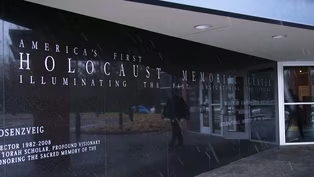 Now Playing
Holocaust / Offen, Miller, Markowitz | Destination Detroit Shorts
Video has Closed Captions
How Holocaust survivors found hope and a new home in Detroit. (8m 5s)
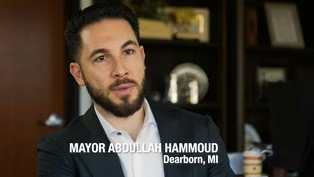
Dearborn / Mayor Hammoud | Destination Detroit Shorts
Video has Closed Captions
Discover Dearborn's rich Arab American history and growing community. (2m 8s)
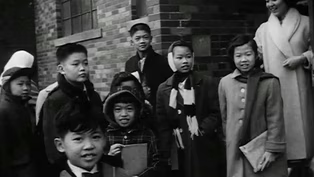
Chinatown / Sandy Fatt | Destination Detroit Shorts
Video has Closed Captions
The story of Detroit's Chinatown and its enduring legacy. (2m 27s)
Providing Support for PBS.org
Learn Moreabout PBS online sponsorship












Support for PBS provided by:
Destination Detroit is presented by your local public television station.