
Destination Detroit
Mexican Americans | Destination Detroit Shorts
Clip | 8m 55sVideo has Closed Captions
How Mexican American families helped shape Detroit's history.
Discover the story of Detroit’s Mexican American community through family histories, oral traditions, and generations of resilience. From early migration to Michigan’s farms and factories to building life in Southwest Detroit, this episode highlights how community voices are preserving a legacy that has helped shape the city for more than a century.
Problems playing video? | Closed Captioning Feedback
Problems playing video? | Closed Captioning Feedback
Destination Detroit is presented by your local public television station.
Destination Detroit
Mexican Americans | Destination Detroit Shorts
Clip | 8m 55sVideo has Closed Captions
Discover the story of Detroit’s Mexican American community through family histories, oral traditions, and generations of resilience. From early migration to Michigan’s farms and factories to building life in Southwest Detroit, this episode highlights how community voices are preserving a legacy that has helped shape the city for more than a century.
Problems playing video? | Closed Captioning Feedback
Where to Watch Destination Detroit
Destination Detroit is available to stream on pbs.org and the PBS app.
♪ KIM: So all my aunts and uncles most of them lived here in Detroit, in southwest Detroit, some though did live in Saginaw, some were in Chicago, but the majority of the family is from Detroit.
My mother's family is from Zacatecas, Mexico.
(street sounds) NARRATOR: Corktown - the original Irish enclave - not far from downtown Detroit.
It's here you'll find Michigan Central.
Lest we forget other people who'd been part of this neighborhood's history - like the Latino families who made this their destination in Detroit.
MARTINA: So we have been here for a very long time.
But yet our history has never been documented in the way that other communities have documented their history.
The African American community proudly has documented their community and that's a huge part of Detroit.
The Arab American community has documented their history.
NARRATOR: This gathering hosted by the VOCES Oral History Project.
Voces?
That's Spanish for voices.
MARTINA: The comprehensive collection of these stories has yet to be done and this committee came together to invite you here tonight because that's what we're gonna do.
(cheering and applause) MARIA: You know, this neighborhood has been revitalized many times over by new families coming in.
There are new transplants you can call them, they come in.
They don't know any of this and I think that they'd be more than interested, everyone across the board to learn about us and our stories.
OZZIE: We have to tell our own story.
That's why I'm really proud of the work that the VOCES committee is interested in doing.
NARRATOR: Filmmaker Len Radjewski Fraga used some audio recordings from the 1970s to help figure out how his family came to Michigan.
Well, the Mexican revolution was going on in 1919.
(Valeriano speaks English) (Man speaks English) (Valeriano speaks English) LEN: Back in Mexico my grandfather was a vaquero, was a basically a ranch hand, cowboy.
(Valeriano speaks English) LEN: I knew of my two uncles that had recorded my grandparents telling their own story sometimes in English sometimes in Spanish.
That changed everything.
ANNOUNCER: This is the story of two remarkable people... NARRATOR: From that came Michoacan to Michigan - a documentary first produced in 1994.
Fraga taught high school video production back then.
LEN: From the very start it's always been a family project.
NARRATOR: The Mexican state of Michoacan lies west of Mexico City.
Now there's an updated version of the film edited by Len's cousin's daughter Julie Brazen.
They're fascinated with the family lore - the Fragas made it to Texas but what really happened when they were busted flat in San Antonio waiting for a train?
DANIEL: As they were walking down the street this Mexican approached them, Mexican American.
(Valeriano speaks English) DANIEL: Dad thought he was saying Michoacan and at that point with as much suffering as they'd been through and disappointment, he was ready to go back.
MARTIN: The people there told him that Michigan you can make a lot of money there, they had been there before.
(Valeriano speaks English) NARRATOR: In Saginaw Fraga's grandfather picked sugar beets, the family barely getting by.
They moved to North Branch in Michigan's thumb for several years and had more children.
LEN: As the- their children got older, they were looking for work and the place to go was Detroit.
NARRATOR: The family - six generations now - Fraga's dive into the Mexican side of his family history has even affected how he says his name.
LEN: Since I've been using more Spanish and visits to Mexico I say frah-ga and most of the family here say fray-ga, the Americanized version and I know sometimes they look at me and they go ahh who does he think he is?
NARRATOR: Fraga's also done some research on the Polish side of his family - still working on the traditional pronunciation of that name.
LEN: Rye-yes-ki I believe.
I've got to do better about the pronunciation.
I went to Poland and found the little town where the name came from.
You know, the American culture now is- I'm half Mexican, my kids are quarter, my grandkids are an eighth, I mean unless you keep those stories and themes alive, they're easily lost.
If my uncles could do it with reel-to-reel recorders all of you should be doing- the power of these things compared to those early cameras but the first thing is, you've got to do it now.
NARRATOR: Now?
An imperative.
When people die, histories can die too.
OZZIE: We were motivated in a way to form this group VOCES because of the work of one of the musicians Cesar Peña, who said I need to make a documentary about all these fantastic musicians that came out of southwest Detroit and Delray, but unfortunately, he passed away.
NARRATOR: Back when, Cesar Peña toured with famed bluesman Albert King.
Peña died in 2022.
Meanwhile Aaron Barndollar and Ozzie Rivera had already been posting interviews on YouTube done years ago like one on musician Frank "Panchito" Lozano who'd been performing since the 1940s.
ZIGGY: This must be you here, Panchito in the background?
PANCHITO: I'm right there.
NARRATOR: Lozano, horn player, band leader and the first Mexican-American principal in Detroit Public Schools died in 2014.
Now cameras gather oral histories again... INTERVIEWEE: He knew everybody... NARRATOR: Including Barndollar's uncle.
HENRY: My grandfather had a farm, and my dad did not like working on the farm.
And he come to Detroit, and he got a job dishwashing.
And he started out as a dishwasher and worked his way up to be the head chef of the Fort Shelby Hotel.
AARON: He was the Mexican Gordon Ramsey.
He never went to culinary school, but he could do anything in the kitchen.
NARRATOR: With the oral histories coming in, Maurizio Dominguez edits an interview with Deacon Raul Feliciano of the Detroit Archdiocese and Catholic activist Beatriz Esquivel Ramos.
BEATRIZ: The people had that church built, the people built that little chapel.
NARRATOR: They're talking about the Our Lady of Guadalupe Church of southwest Detroit that dates back to the early 1920s.
MAURIZIO: Yeah, the first Mexican national parish in the Midwest, so, not just Michigan, just Midwest overall.
BEATRIZ: Those people sent for a priest in Mexico because there were no Spanish speaking priests... MAURIZIO: I think that just speaks to the core of why it's so important to do this project.
You know because stories like this that if there's no documentation available and there's no way for people to- to find out about it then how are they gonna know, right?
NARRATOR: With endeavors like this come limitations.
So many more people to talk to but there's only so much funding and people who have the time to collect these stories.
MAURIZIO: I'm only one guy, I can only record/edit so much so we're officially planning you know, what's it gonna look like to expand- to grow this team, and to bring more people into the- from the community who can help with the archiving, the recording, the interviewing, everything.
OZZIE: We're just scratching the surface.
This Latino community has been here since 1918.
LEN: We hope that what with we're doing with the Mexican-American culture is an impetus for other groups to say, hey, what about me, what about the Polish or the Germans or the ahh the Irish or whatever.
As the deeper you dive into history the more you realize all the groups that have contributed to who we are in Michigan.
Unless you tell your own story not too many people are going to tell it for you.
And that's history, you know the victors tell the story right?
ANNOUNCER: Destination Detroit - This program was made possible in part by the Corporation for Public Broadcasting, and viewers like you.
Thank you.
To learn more about this Detroit PBS series, visit Detroit PBS dot org slash Destination Detroit.
♪ ♪ ♪
Yankee Yorkers | Destination Detroit Shorts
Video has Closed Captions
How New England settlers helped shape Detroit's early growth and industry. (2m 27s)
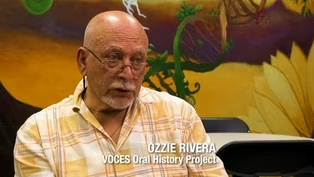 Now Playing
Mexican Americans | Destination Detroit Shorts
Video has Closed Captions
How Mexican American families helped shape Detroit's history. (8m 55s)
Karen Batchelor | Destination Detroit Shorts
Video has Closed Captions
A journey into family history, identity, and America’s past. (7m 47s)
Holocaust / Offen, Miller, Markowitz | Destination Detroit Shorts
Video has Closed Captions
How Holocaust survivors found hope and a new home in Detroit. (8m 5s)
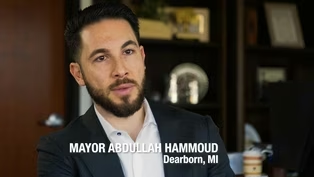
Dearborn / Mayor Hammoud | Destination Detroit Shorts
Video has Closed Captions
Discover Dearborn's rich Arab American history and growing community. (2m 8s)
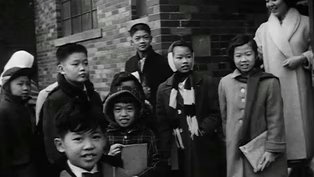
Chinatown / Sandy Fatt | Destination Detroit Shorts
Video has Closed Captions
The story of Detroit's Chinatown and its enduring legacy. (2m 27s)
Providing Support for PBS.org
Learn Moreabout PBS online sponsorship











Support for PBS provided by:
Destination Detroit is presented by your local public television station.