
Improvisation - Erich Wald - Third Grade
4/10/2020 | 57m 38sVideo has Closed Captions
Students will discover improvisation through manipulating rhythm, melody, and dynamics.
In this music lesson, students will discover improvisation through manipulating rhythm, melody, and dynamics. Created by NJTV in partnership with the NJEA and the NJ Department of Education, NJTV Learning Live remote learning classes are for grades 3-6, taught by NJ public school teachers. One-hour lessons include math, science, English language arts, social studies, physical education and more.
Problems playing video? | Closed Captioning Feedback
Problems playing video? | Closed Captioning Feedback
NJTV Learning Live is a local public television program presented by NJ PBS
Improvisation - Erich Wald - Third Grade
4/10/2020 | 57m 38sVideo has Closed Captions
In this music lesson, students will discover improvisation through manipulating rhythm, melody, and dynamics. Created by NJTV in partnership with the NJEA and the NJ Department of Education, NJTV Learning Live remote learning classes are for grades 3-6, taught by NJ public school teachers. One-hour lessons include math, science, English language arts, social studies, physical education and more.
Problems playing video? | Closed Captioning Feedback
Where to Watch NJTV Learning Live
NJTV Learning Live is available to stream on pbs.org and the PBS app.
Providing Support for PBS.org
Learn Moreabout PBS online sponsorshipMore from This Collection
NJTV Learning Live is a class for third graders taught by NJ public school teachers.
Writing Rocks - Nikki Silva- Third Grade
Video has Closed Captions
Students learn how to become stronger writers by varying sentences and adding details. (58m 43s)
Biodiversity in Barnegat Bay - Dunlea & Williams-Third Grade
Video has Closed Captions
We’ll see and explore all the amazing creatures that call Barnegat Bay home. (57m 31s)
PE LIVE! - Gregory Bradley - Third Grade
Video has Closed Captions
Students will do a well-rounded workout including cardio, tae bo, and yoga in this lesson. (57m 1s)
Word Detectives: Context Clues - Janice Alvarez -Third Grade
Video has Closed Captions
In this lesson, students will use context clues to determine the meaning of unknown words. (57m 36s)
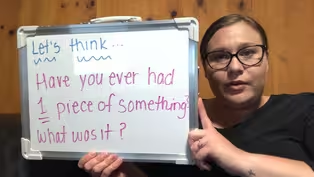
Introduction to Fractions - Krysten Paone-Hurd - Third Grade
Video has Closed Captions
Students will learn the basics of fractions when it comes to “a piece of the whole". (57m 58s)
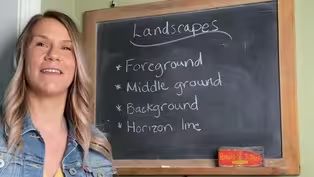
Lovely Landscapes - Natalie Steckel - Third Grade
Video has Closed Captions
In this interactive art lesson, students will learn the four parts of a landscape. (57m 51s)
Punctuation Power! - Jennifer Ostrega - Third Grade
Video has Closed Captions
Students will learn how to demonstrate command of standard English punctuation marks. (58m 18s)
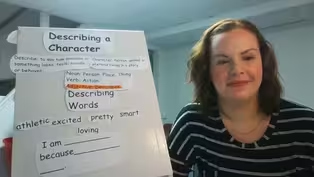
FAST Characterization - Rosemary Matar - Third Grade
Video has Closed Captions
Students will learn how to describe a character using the FAST characterization method. (57m 43s)
Area & Perimeter - Jill Turner - Third Grade
Video has Closed Captions
Students will learn about area and perimeter and apply them to real-life situations. (58m 1s)
You Guessed It!- Haritha Tottempudi - Third Grade
Video has Closed Captions
Students will learn how to infer using a fiction and nonfiction text. (57m 3s)

Sweat, Hydration, and Phys. Ed. - Kyle Muckley - Third Grade
Video has Closed Captions
Students will learn about their bodies and the benefits of physical activity. (55m 24s)
Ready, Set, Draw your Narrative - Alan Trotty - Third Grade
Video has Closed Captions
Students will draw a life event and transform it into a narrative writing piece. (58m 32s)
Providing Support for PBS.org
Learn Moreabout PBS online sponsorshipMy name is Erich Wald.
I'm the chorus teacher at the Brackman School in Barnegat.
Today, we are going to talk about improvisation.
Now, what is improvisation?
>> Musical improvisation is the creative activity of immediate -- in the moment -- musical composition.
>> But before we get to all that, let's go over a few things that you might need throughout our lesson today.
You're going to need paper, something to write with, a kitchen utensil like a spoon, a pot or a pan or a bucket.
Heck, anything you're allowed to bang on.
And yourself.
Take three minutes and grab a few of those things before we begin.
>> ♪ You can tell when I'm so sad ♪ ♪ I walk out the door in the morning ♪ ♪ Forgetting to grab my pen and my notepad ♪ ♪ Got a studio session tonight ♪ ♪ Forget what I already wrote ♪ ♪ No turning around ♪ ♪ I'm late as is ♪ ♪ Cutting it close ♪ ♪ Driving, taking mental notes ♪ ♪ Got to write a new verse while I'm at work ♪ ♪ Doing it so nobody notices ♪ ♪ My eyes are wide open and I'm on alert ♪ ♪ My boss is a jerk ♪ ♪ I'm stuck in my cubicle ♪ ♪ Trying to just act like I'm up to my usual ♪ ♪ Good thing it's a hot day ♪ ♪ 'Cause I can just act like I'm dying of thirst ♪ ♪ You don't know how much I walk to the water pit and its worth ♪ >> ♪ I can't go two days without my keyboard ♪ ♪ I can't make it one week without the beat of a drum ♪ ♪ I don't know what I would do without the music playing ♪ ♪ I couldn't make another minute without the night before ♪ ♪ I can't go two days without my keyboard ♪ ♪ I can't make it one week without the beat of a drum ♪ ♪ I don't know what I would do without the music playing ♪ ♪ I couldn't make another minute without the night before ♪ >> ♪ Now I'm trying to be nice and brief ♪ ♪ When my co-workers ask me if I want to go grab a bite to eat ♪ ♪ I say that I can't ♪ ♪ My friends are in town ♪ ♪ I got to go see them ♪ ♪ They're right up the street ♪ ♪ I told them I'd meet ♪ ♪ They're like, "Whatever, we see how it is" ♪ ♪ I smile at them all and keep minding my biz ♪ ♪ Preoccupied as a kid ♪ ♪ I get a couple of note cards before I go out in the stifling heat ♪ ♪ Slow is the bass ♪ ♪ Electric guitar screams ♪ ♪ Greg is playing piano ♪ ♪ Angela sweet as a tangerine ♪ ♪ She's the tambourine ♪ ♪ These are my friends, and we're always excited to speak ♪ >> ♪ I can't go two days without my keyboard ♪ ♪ I can't make it one week without the beat of a drum ♪ ♪ I don't know what I would do without the music playing ♪ ♪ I couldn't make another minute without the night before ♪ ♪ I can't go two days without my keyboard ♪ ♪ I can't make it one week without the beat of a drum ♪ ♪ I don't know what I would do without the music playing ♪ ♪ I couldn't make another minute without the night before ♪ ♪ I can't go another minute without it ♪ ♪ I just don't know what I'd do without this music ♪ ♪ It's all that I know ♪ ♪ It feeds to my soul ♪ ♪ I need to ♪ ♪ I can't go another minute ♪ ♪ I don't know what I would do ♪ ♪ I just don't know what I'd do without this music ♪ ♪ It's all that I know ♪ ♪ It speaks to my soul ♪ ♪ I don't know what I would do ♪ ♪ I can't go another minute without it ♪ ♪ I just don't know what I'd do without this music ♪ ♪ It's all that I know ♪ ♪ It speaks to my soul ♪ ♪ I need to ♪ ♪ I can't go another minute without it ♪ ♪ I just don't know what I'd do ♪ >> Let's get started.
♪♪ ♪♪ ♪♪ The first part of improvisation I want to talk to you guys about is rhythm.
Every time you speak, every time you move, every time you breathe, you are creating rhythm.
When we think about rhythms, we have to think about two things -- a pulse, just like your heartbeat, constant, driving -- boom, boom, boom, boom.
And if that keeps going, then you can add the rhythm on top of that.
Doh-doh, doh-doh, doh-doh.
Ga, do-do-do, go-da-do-bo, da-go-ba.
Or the pace of my feet when I'm running.
And then the rhythm goes over that.
Sa, da-da, ba, do-ba.
So the pulse is the steady part.
The rhythm is everything that happens around that steady pulse.
Boom, boom, ba-do-dok-ba, brat-ta-ta.
Rhythm is everywhere!
Right now I'm sitting on a hollow log.
It's my guess that this was one of the very first musical rhythm instruments.
Somebody was walking through the woods, stumbled upon a hollowed out log and started banging out the very first rhythms.
Alright, we're back.
Come on.
Let's take a trip to the kitchen and see if we can't create some rhythms together.
Alright.
Welcome to the kitchen.
When I start to create a rhythm, I like to start with two basic sounds.
One low sound to represent a bass drum.
[ Thumping ] And one higher pitch sound to represent a snare drum.
[ Drum thumping ] One of my favorite ways to create a bass drum sound in the kitchen is by using the fridge.
Listen to this sound.
It's a great, a great low sound.
Let's see what other sounds we could find.
I have a few things lying around.
Here's a colander, a big pot.
Little bit smaller pot.
Let's grab a few different utensils from over here.
Maybe a bucket or two from up here.
And what I want you to do is I want you to play around with all of these different instruments and hit them.
Hit them smack on with your hand.
You can smack on them with your hand.
You can use a different utensil because what you hit it with is gonna change the sound so it might be higher or lower.
Let's see how it changes from my hand to using the spoon.
Little bit different.
Let's see how all these sound.
Ooh.
Cool.
Let's see what this guy sounds like.
Here we go.
Alright, cool.
So now I think I found -- I think I found my low sound right here.
And my high sound right here So I'm gonna use this spoon for here, and I'm going to use this whisk on this pot right here, and what I'm going to do is -- hopefully you found her low sound and high sound.
Now, here's one thing.
Maybe you don't have all these things laying around.
You have body parts, so you can use your leg as your low sound.
And a clap as your high sound.
Okay?
So we're gonna try and go back and forth with some rhythms right now, okay?
So what I'm going to do is I'm going to play and you're going to play it back for me and I'm going to say it as I play.
If you needed a little help, you can say it as you play it, too.
So I'll play it.
You play it back for me.
Okay, so it's going go low, low, low, high.
You go.
Low, low, low, high.
And low, low, high.
Low, low, high.
Low, low, low, low, low, high.
Low, low, low, low, low, high.
Low, low, low, low, low, low, low, low.
Now let's try that without using these instruments, just using my body.
Are you ready?
Instead of hitting my leg, I'm going to hit my chest this time.
Here we go, so I'm gonna go... That's gonna be my bass drum sound.
And this is gonna be my snare drum sound.
So we're gonna go back and forth one more time.
This is called call and response, okay?
Here we go.
I'm going to go low, low, low, go.
Low, low, low, then we go high, high, high, high, high.
High, high, high.
We go low, high, low, high.
Low, high, low, high.
Now I'm going to replace that with bass and snare, OK?
So whatever you want to use, you can move to it.
Now, I'm going to keep hitting myself because that feels good.
Here we go.
I'm going to go low, low, low, high, low, low, low, high.
We go low, low, low, high.
Low, low, low, high.
We go low, low, low, low, high.
Low, low, low, low, high.
We go low, high, low, low, high.
Low, high, low, low, high.
Good.
Now, I'm gonna move this stuff to the side because now what we're gonna do is, if you remember what we talked about before, we talked about a pulse, and that pulse is that thing that's steady.
It never stops, okay?
It's like your heartbeat, okay?
And what we're gonna do is I'm going to keep a pulse.
And we are gonna create rhythms over this pulse.
We don't need to worry about low or high.
You can hit yourself or you can hit one of your instruments to do this exercise.
Whatever you prefer, that's what you can do, okay?
So I'm gonna keep the pulse right here.
And you are going to once again respond after me.
This time instead of hitting something, I'm going to use my mouth and I'm going to use the word "bah," okay?
You can use bah.
You can use do.
You can -- whatever sounds you want to make, you can make it.
Hit something, say something, that's fine, okay?
Here we go.
I'll do it, you do it back to me, okay?
I'll use bah.
Bah-bah, bah-bah, bah.
You go bah-bah, bah-bah, bah.
I go bah, bah, bah-bah, bah.
Bah, bah, bah-bah, bah.
Bah, bah, bah-bah-bah-bah.
Bah, bah, bah-bah-bah-bah.
Bah, bah, bah, bah.
Bah, bah, bah, bah.
Now, notice if I was to just perform with the pulse, it would always sound like this.
Bah, bah, bah, bah, bah, bah, bah, bah.
Super boring, super boring.
That's why rhythm is so cool because rhythm takes this pulse and makes this fun.
Bah, ba-da, ba-da, ba-da-do-do, bah, da-da, da-bah-bah, da-boom-bah, ba-doom-bah.
Right?
It's awesome.
You have beat boxers out there who do these amazing rhythms with only their body and their mouth.
Body percussion like I was doing before.
Okay?
You have all of these tools to make really cool rhythms just using things that are all around you every single day or just your body.
So what we're going to do right now is you get to take the lead.
I recorded myself in the kitchen using this as my bass drum and using different instruments in the kitchen to create a groove for you to improvise rhythm over.
You can make up anything you want.
It doesn't matter what it is.
The great thing about improvisation is there's no wrong.
There is no wrong.
So it's whatever you're feeling in that moment.
Spontaneous creation.
You have to be open and free to do it.
So use whatever instruments, whatever sounds that you liked making during this exercise.
Use it for the next three minutes to create rhythms over this -- over this groove that I created for you.
Let's get it started.
♪♪ ♪♪ ♪♪ ♪♪ ♪♪ ♪♪ ♪♪ ♪♪ ♪♪ ♪♪ ♪♪ ♪♪ ♪♪ Now that we understand how awesome rhythm can be, let's move on to melody.
What is melody, anyway?
>> Melody is a sequence of single notes that is musically satisfying.
>> In other words, the melody is the part of the song that you remember, the part of the song that when you're not quite paying attention, you end up humming.
A melody can be incredibly powerful, so powerful, in fact, that it can make a truck driver sing Lady Gaga.
I remember this one time I was at my wife's parents' house.
They had a horse ranch in Jackson, and I was out on the farm.
I was building a fence with my wife's father.
And all of a sudden I hear him start humming and singing this little tune.
And I looked up at him.
I said, "Rick, do you know what you're singing?"
I said, "You're singing a Lady Gaga song, aren't you?"
Now, this is a guy who's usually a country music fan, but out of nowhere, this powerful Lady Gaga melody popped into his head.
And this long-haul trucker that drives chemicals across the country is singing me Lady Gaga.
I said, "Rick, you're singing Lady Gaga."
We've never spoken of it since.
Now let's see what we can do with melody.
For this next exercise, we're gonna use a nursery rhyme that I think everybody on the planet knows.
And if you don't, you're gonna know it, I guarantee you, within the next 20 seconds.
We're gonna use the song "Mary Had a Little Lamb."
Now I know what you're thinking.
"Erich, super corny."
But wait for it.
We're gonna change it around and we're gonna make it our own.
Let me introduce you to "Mary Had a Little Lamb."
♪ Mary had a little lamb ♪ ♪ Little lamb ♪ ♪ Little lamb ♪ ♪ Mary had a little lamb whose fleece was white as snow ♪ Now, what happens if we take that song and we decide to take it in a different direction?
You see, a melody can go up.
>> ♪ Uuuuup ♪ >> And a melody can go down.
>> ♪ Oohhhhhh-uh ♪ >> So maybe in some parts of this song, we can see if instead of going down, we take the note and go up and instead of going up and in some places we decide to go down.
Alright.
Let's see how that works.
Let's take "Mary Had a Little Lamb" and let's change it up.
Usually "Mary Had a Little Lamb" goes like this.
♪ Mary had a ♪ So it goes... ♪ Mary had ♪ And once it gets to the word "had," then it starts to go back up again.
What we're going to do is instead of going back up, we're going to keep going down.
So we're gonna go... ♪ Mary had a little lamb ♪ Then we're gonna go... ♪ Little lamb ♪ ♪ Little lamb ♪ Repeat.
♪ Mary had a little lamb ♪ ♪ Whose fleece was white as snow ♪ Let's try it.
♪ Mary had a little lamb ♪ ♪ Little lamb ♪ ♪ Little lamb ♪ ♪ Mary had a little lamb whose fleece was white as snow ♪ ♪ Mary had a little lamb ♪ ♪ Little lamb ♪ ♪ Little lamb ♪ ♪ Mary had a little lamb whose fleece was white as snow ♪ And it totally changes the song.
It takes it from sounding like a childish nursery rhyme to making it sound like something that is maybe more emotional or maybe the way you heard it.
Okay, now we know how changing a melody can change a song that we already know.
Now let's start to use what we know about melody to create something completely original and improvise on our own using melody.
So I'm going to play a chord progression for you on the guitar, and we're gonna try and find some notes that work over that chord progression.
Let me play it for you.
♪♪ ♪♪ So the first thing that you want to do is you want to find some common tones, maybe notes that work over all the chords.
I'm going to sing one for you now.
♪ Oooooooooooooooh ♪ Sing it with me.
♪ Oooooooooooooooh ♪ Maybe we can do another one.
♪ Oooooooooooooooh ♪ Sing it with me.
♪ Oooooooooooooooh ♪ That's one.
Sing it with me.
♪ Oooooooooooooooh ♪ See, now we have three.
We have "ooh, ohh, ooh."
And we can use all of them.
But what I want to do first is I want to use the first one.
♪ Ooh ♪ And we're going to apply what we used in the rhythm, so I'm going to take that note and I'm gonna add rhythm, so I'm gonna go... ♪ Doo, doo, doo ♪ Sing it.
♪ Doo, doo, doo ♪ Then I can sing... ♪ Doo-doo, doo-doo ♪ ♪ Doo-doo, doo-doo ♪ See, if I have that note, and I add rhythm to it, then it starts to sound like a song.
Then if we use all three of those notes... ♪ Doo, dohh, doo ♪ If I go... ♪ Doo-doo, dooo ♪ Sing it.
♪ Doo, doo, doo ♪ ♪ Doo-doo-doo, doo ♪ Singing it.
♪ Doo-doo-doo, doo ♪ Here we go.
♪ Doo-doo-doo, doo-doo-doo ♪ ♪ Doo-doo-doo-doo-doo-doo ♪ ♪ Doo-doo-doo ♪ ♪ Doo-doo-doo, do-do-do-doo-doo, do-do-do-do-do-do ♪ See?
And then little by little, we start to make it more and more exciting by adding more notes and by adding different rhythms throughout the song that we're making up on the fly.
Okay, so we're going to do a little thing.
I'm going to do call and response, so you start to build some ideas because your ideas come from all around you, just like rhythm is all around us.
Right?
So we hear it from birds.
We hear it in the wind.
We hear music everywhere.
We listen to music, and all of those ideas and the things that we seemingly come up with out of nowhere, we've heard in other places.
We're just putting them together in our own way.
So I'm going to sing and you sing back to me, okay?
♪ Bah, bah, bah ♪ Singing it.
♪ Bah, bah-bah-bah-dup ♪ ♪ Bah-da-bah-bah-bah, bah ♪ ♪ Bah-da-da-da ♪ ♪ Ooooooooooooooh ♪ A long one.
♪ Ooooooooooooh ♪ ♪ Bah-da-da, da-da ♪ ♪ Bah-da-da, da-da ♪ ♪ Bah-da-da, da-da ♪ ♪ Bah-da-da, da-da ♪ Okay, so in this next exercise, I created a piece for you to improvise over using melody.
Don't forget -- you can go wherever you want.
You can start out with those long notes and then get more rhythmic as you go along.
Have fun.
♪♪ ♪♪ ♪♪ ♪♪ ♪♪ ♪♪ ♪♪ ♪♪ ♪♪ ♪♪ ♪♪ ♪♪ ♪♪ ♪♪ Alright, now join me for the end.
Here we go.
♪ We sing yeah, yeah, yeah ♪ ♪ Ooooh ♪ ♪ Yeah, yeah ♪ ♪ Ohhhh, ohh, ohhhh ♪ ♪ We sing yeah, yeah, yeah ♪ ♪ We sing yeah, yeah, yeah ♪ ♪ Ooh, ooh, ooh-ohh ♪ ♪ Yeahhhh ♪ Now that we've gone through rhythm and melody, I know what you're thinking.
"Alright, Erich, let's go.
Let's write a hit song.
Superstar status, here I come.
Put my YouTube channel up, 13 billion views."
But there's one more thing that we need to talk about.
And that's the human part of music.
Like, what's the human part of music?
It's that extra little thing that makes the hairs on your arm stand up.
When you hear it, you know there's something different.
It's not the melody.
It's not the rhythm.
It's the you.
It's your experiences, your unique personality, your special place in this world, your influence, your background, your upbringing and family.
The human part of music is your emotion.
Alright.
Let's talk about these emotions.
We all know the basics, the happy, the sad, the angry.
But what about everything in between and beyond?
Let me put it to you this way.
Have you ever been happy before?
And again, I'm happy right now.
I gotcha.
But let me ask you this.
Have you ever had your favorite food?
Mmm, I love tacos.
You're like, "Duh, of course.
It's tacos."
Now let me ask you this.
Have you ever had your favorite food while traveling to a place that you've always dreamed of going with your best friend in the entire world?
And every time you reach into your pockets, you pull out a fistful of hundred-dollar bills.
It's a different kind of happy, isn't it?
See what I mean?
For the next few minutes, I want you to grab a piece of paper and something to write with.
And I want you to write down some words or draw a picture or create lyrics or write down or do anything on that paper that can be associated with or go along to the music that I'm about to play for you.
Now, as I play the music, I'm going to throw some pictures on the screen and I'm going to throw some different words that might help guide you along the way.
Remember that whatever you're doing as the music changes, what you're doing can change, too.
You don't have to stick to one thing and start to move with me and discover the emotions and how the music affects what you're doing down on that paper.
You got your supplies?
I got you, I got supplies.
Let's rock.
Remember, when you're doing this next exercise, you have to constantly be asking yourself, how does it feel?
♪♪ ♪ How does it feel?
♪ ♪ Say I got to know right now ♪ ♪ How does it feel?
♪ >> Ladies and gentlemen, it's time to play the hit game show "How Does It Feel?"
♪♪ ♪♪ ♪♪ ♪♪ ♪♪ ♪♪ ♪♪ ♪♪ ♪♪ ♪♪ ♪♪ ♪♪ ♪♪ ♪♪ ♪♪ ♪♪ ♪♪ ♪♪ ♪♪ ♪♪ ♪♪ ♪♪ ♪♪ ♪♪ ♪♪ Ooh, that was heavy.
Now that we got off that emotional roller coaster, let's talk about what techniques we can use to put emotion into the music.
So when we were working with melody, we talked about finding common notes or that one note that can work over everything.
And it's important for me to tell you that even singing one note can be an emotional experience if we sing it the right way.
One of the most important or effective ways to show dynamics in music or to show emotion in music is through the use of dynamics.
Dynamics in music means volume.
So it's how we change the volume.
So I want to show you right now what it sounds like to take one note and give it a large range of dynamics.
Take a listen.
♪♪ ♪♪ ♪ Ohhhhhhhhhhhhhhh ♪ Now, that was one volume.
Watch what happens when I change that volume.
♪ Ohhhhhhhhhhhhhhhhh ♪ ♪♪ ♪ Ohhhhhhhhhhhhhhhhh ♪ ♪♪ All of these swells that -- they show a wider range of what I'm feeling.
I'm allowing people into maybe those quiet spaces.
I'm allowing myself to show people what happens in those moments when I let myself feel something.
And that's something that is so, so cool about music because it lets us show ourself.
Where we might not be able to find the words, music allows us to speak what we're feeling just from the sounds that we're making.
And dynamics is a big part of that.
So I want to practice that with you all right now.
We're going to go back to that same technique of call and response.
To do that, we're gonna do the one note.
And I want you to try and move that.
And I always tell my students, keep the smalls really small.
Make the bigs really big so we've a really big dynamic range, okay?
So let's try that.
We're gonna start as soft as we can and we're going to peak out of nowhere.
So ready?
The note's gonna be... ♪♪ So start as soft as you can.
One, two, three, four.
♪ Ohhhhhhhhhhhhhh ♪ ♪ Ohhhhhhhhhhhhhh ♪ And then what we do is we put all the things together, so let's start to add a little rhythm and a little change to the melody and use dynamics to make it have more emotion behind it, okay?
So we'll go... ♪ Bah, bah, baaaaaah ♪ ♪ Bah, bah, bah, baah ♪ Sing it with me now.
♪ Bah, bah, bah, baaaaah ♪ Now bring it down.
♪ Bah, bah, bah, bah ♪ Now one note.
♪ Ooooooooooooh ♪ Take it up.
♪ Ooooooooooooh ♪ ♪ Ooooooooooooh ♪ One more time on that.
♪ Ooooooooooooh ♪ Back to the first thing and build.
♪ Bah, bah, bah, baaaaaaah ♪ Bring it down.
♪ Bah, bah, bah, bah ♪ Okay, so then you move around and you start to play with it and you find what works best for you.
And if you can really find a way to go and feel that emotion while you're singing, it's really, really effective or it works really, really well and can be really, really powerful.
So what we're going to do next is I'm going to play something for you and we're going to try and put all of these three things together.
I want you to be as free as you possibly can.
I want you to remember what we talked about with rhythm and changing it up.
And you can stay and have these long notes and then you can break up those long notes and create something more rhythmic.
And then I want you to remember what we talked about with melody.
And you can sing that one note and then just go from one note to the next note.
It doesn't have to be something that is... ♪ Ooh, ooh, ohhh, oooh, ohhh ♪ ♪ Ohhh, yeah ♪ Doesn't have to be something crazy, okay?
You don't have to do a lot to do something that's right or to do something that is meaningful or something that is emotional or something that reflects and represents you.
Do your best.
Have fun.
♪♪ ♪♪ ♪♪ ♪♪ ♪♪ ♪♪ ♪♪ ♪♪ ♪♪ ♪♪ ♪♪ ♪♪ ♪♪ ♪♪ ♪♪ ♪♪ ♪♪ ♪♪ ♪♪ ♪♪ I know that for some of you, this might be a little bit out of your comfort zone.
We're so used to teachers telling us exactly what's right and exactly what's wrong and how to solve this problem and the steps that we need to take to get the answer right.
But improvisation is really different than that.
Improvisation is all about finding out what your right and what your wrong is.
Let's see if I can clarify that a little bit.
Your right and my right are allowed to be two different things.
That's why different genres exist.
For example, that's why Billie Eilish can be extremely huge and popular at the same time as Billy Ray Cyrus.
That's why I can wake up in the morning and go for my run and I really want to rock out to some Jay-Z, but at night, I'm hanging out in the house and I want to fall asleep to Otis Redding.
Creativity is the great equalizer.
It's what makes everybody the same.
Because it only cares if you're willing to jump in with two feet at the same time.
We all have a musical compass.
Think about it.
Every time you hear a sound or a note, you almost instantly know whether you like it or not.
That's your musical compass.
Let me demonstrate.
If I play something like this and I sing over it and I go... ♪ Baaaaaaah ♪ Terrible, right?
It's horrible.
You knew it almost instantly when I started to sing that that was not something you wanted to hear again, okay?
But let's try this one.
♪ Ooooh, oooh-ooooooh ♪ Different.
See, you already have the tools.
You just need to trust them.
We're not always going to make the right musical choices.
In fact, sometimes we got to hit a lot of bad notes to get to the good ones.
Think about it.
Think about a baby.
When a baby's a baby and it's growing up and it's learning how to walk and it walks down the hallway, it takes a step and it falls down right away.
We don't go over to the baby and go, "Sit down, baby.
You don't know how to walk."
No, we go over to the baby, we pick it up, we cheer it on, and we urge it to take another step, even though we know it's probably going to fall again.
Think about that baby again.
When the baby is learning how to speak, they make all these nonsensical words.
They make absolutely no sense.
They're just making noises at is and faces.
Sometimes they're blowing bubbles at the same time.
We don't go up to the baby and say... "Nobody even knows what you're saying.
Can you just quit it?"
No.
In fact, we look at that baby and we make those same crazy sounds back at it.
See, that's the way we need to be with ourselves and our musical ideas.
When we hit those bad notes, we just got to get over them and realize that it's just our path to get to those good notes and all those great ideas that are living inside of us.
I hope you guys had fun improvising with me today.
I love music and honestly couldn't go a day without it as part of my life.
Remember, music is all around you.
If you want to be inspired, seek out a piece of music that really touches you.
Everybody can find a song that you feel that that song was written about you.
Take that song, start to improvise over it, whether it's with a rhythm instrument, whether it's with your voice, whether you're sitting down and painting a picture or sketching to that piece of music.
Music really is a powerful tool that we can use to change ourselves and our own ideas and the people around us.
It is such a huge influence on everything that we do.
I want to leave you guys today with a special piece of music that means a lot to me.
I teach songwriting just about every day in my classes and in my school.
And half of the music that my students perform in our concerts is written by the students for the students.
And you didn't know it.
But the last track that you improvised to was a song that students at the Russell O. Brackman Middle School wrote.
And I want to leave you guys today with this song.
It's called "Roses."
And it's about finding comfort or searching for comfort in a lonely space, and I want you to listen to the words, and these are words that come from students' minds and from students' mouths, and the melodies that you hear are melodies that these students improvised in our class.
And if they can do it, I know that you can.
Keep reaching for it.
Keep being creative, and have an awesome day, guys.
Keep rocking.
♪ I wanna be alone ♪ ♪ I don't wanna be alone here ♪ ♪ Feelin' so low, solo ♪ ♪ Swallowin' the fear, so hard to breathe ♪ ♪ Maybe I don't know how I should love ♪ ♪ And it's messin' with me, messin' with my mind ♪ ♪ Nothing ever seems to be enough ♪ ♪ It's got me cryin' ♪ ♪ Oh, oh, oh ♪ ♪ So low ♪ ♪ So ♪ ♪ I wanna go to a place, close my eyes, feel the safety ♪ ♪ Wish I could run away ♪ ♪ Try to let go ♪ ♪ But it's hard ♪ ♪ 'Cause every time I go there ♪ ♪ Every time I go there ♪ ♪ I feel like I belong ♪ ♪ I feel like I belong ♪ ♪ I thought I found the truth there ♪ ♪ I thought I found the truth there ♪ ♪ It was lyin' all along ♪ ♪ It's got me cryin' ♪ ♪ Oh, no ♪ ♪ Walkin' through roses ♪ ♪ I hear through the leaves ♪ ♪ The colors I feel take over me ♪ ♪ I swim through the ocean ♪ ♪ Through the depths of the sea ♪ ♪ The pressure I feel wash over me ♪ ♪ Walkin' through roses ♪ ♪ I hear through the leaves ♪ ♪ The colors I feel take over me ♪ ♪ I swim through the ocean ♪ ♪ Through the depths of the sea ♪ ♪ The pressure I feel wash over me ♪ ♪ It's all for nothin' or nothin' at all ♪ ♪ Let go of these feelings that keep me down ♪ ♪ Does anybody hear me?
♪ ♪ Can anybody out there see it my way?
♪ ♪ Yeah, I've been thinkin' ♪ ♪ My dreams the only place I'm really freeee ♪ ♪ Free, yeah ♪ ♪ Walkin' through roses ♪ ♪ I hear through the leaves ♪ ♪ The colors I feel take over me ♪ ♪ I swim through the ocean ♪ ♪ Through the depths of the sea ♪ ♪ The pressure I feel wash over me ♪ ♪ Walkin' through roses ♪ ♪ I hear through the leaves ♪ ♪ The colors I feel take over me ♪ ♪ I swim through the ocean ♪ ♪ Through the depths of the sea ♪ ♪ The pressure I feel wash over me ♪ ♪ Walkin' through roses ♪ ♪ I hear through the leaves ♪ ♪ The colors I feel take over me ♪















Support for PBS provided by:
NJTV Learning Live is a local public television program presented by NJ PBS