
Polar Seas
Episode 2 | 54m 25sVideo has Closed Captions
As polar oceans warm and sea ice disappears, is the balance of our entire planet at risk?
The polar seas are one of Earth’s great superpowers, helping regulate our entire planet. But as they warm and sea ice disappears, explore why their health is inseparable from our survival.
Problems playing video? | Closed Captioning Feedback
Problems playing video? | Closed Captioning Feedback
Polar Seas
Episode 2 | 54m 25sVideo has Closed Captions
The polar seas are one of Earth’s great superpowers, helping regulate our entire planet. But as they warm and sea ice disappears, explore why their health is inseparable from our survival.
Problems playing video? | Closed Captioning Feedback
Where to Watch Ages of Ice
Ages of Ice is available to stream on pbs.org and the PBS app.
Share Inspiring Moments From The Film
Explore the PBS Giphy collection for Ages of Ice.Providing Support for PBS.org
Learn Moreabout PBS online sponsorship[foghorn blasting] GERAINT TARLING: This ship is really moving.
Even though it's a huge ship, it's still getting tossed around by the amount of swell we're getting.
There's spray coming over here, so be careful!
[waves crashing] MALE NARRATOR: The Southern Ocean offers no mercy for those without sea legs.
The 15,000-ton research vessel RRS Sir David Attenborough punches deep into waters that help hold the balance of our world.
What they discover could reveal the changing course of our planet.
[tense music] NARRATOR: The flagship of Britain's polar research fleet was built for seas like this!
It's a bit of a perfect storm, if you will, of conditions to get the biggest seas in the world.
NARRATOR: For a salt-soaked oceanographer like Geraint Tarling, the Drake Passage isn't just about hanging on for dear life - it's about what's going on under all of that the thrashing water.
TARLING: This is an incredibly stormy part of the Southern Ocean.
This is where the Antarctic Circumpolar Current comes into this narrow choke point and there you have huge amounts of energy as you can see around us now.
This is where the waters that are coming in from all parts of the globe overturn.
They go really deep, and other waters come up.
It's this storminess, this activity, all this energy is just driving everything else that the oceans are doing.
It really is magnificent to see the power of this ocean around us.
NARRATOR: For all its fury, this system is finely balanced.
And that balance is starting to shift.
Over the next eight weeks, the ship will explore the waters around Antarctica.
Onboard, 70 scientists and ship's crew gather crucial data on how our polar seas are changing, and what that means for life on Earth.
Before long, Antarctic's icy presence announces itself.
Lots of icebergs today actually, and the winds starting to pick up as well, so that makes things interesting.
This is an ice-capable vessel.
So it can break sea ice, frozen seawater.
Glacial ice, which is land-derived ice like big icebergs, that's very, very hard ice.
Ships can't win in a battle against glacial ice.
If you hit an iceberg, you will do massive damage to the vessel.
Radars can pick up most of them, but they don't pick up all the icebergs so you have to rely on spotting them visually.
NARRATOR: As autumn settles in, the Southern Ocean teeters on a transformation.
Ice begins to form a frozen crust that will nearly double the reach of Antarctica, as the continent extends its icy grip over the ocean.
Sea ice is one of Earth's great superpowers, helping to shield the planet, reflecting more than 80% of the sun's radiation back into space.
It controls how oceans breathe, mix, and cool.
Each winter, sea ice pulses to life.
Then naturally retreats with the changing seasons.
In recent summers, Antarctic sea ice has fallen to nearly 30% below the long-term average as ocean temperatures rise.
At the polar opposite end of the world, the change is even more dramatic.
Here, summer sea ice has declined more than 40% since satellite records began.
Understanding exactly how this is happening is now critical.
And the search for answers has been set in motion.
Over the skies of Greenland, US aircraft are on a mission.
But this is not a military operation.
Onboard are teams of scientists trying to decode the forces behind vanishing sea ice.
[indistinct radio chatter] Yeah, we are ready.
PILOT: 426474, we see we're 8,000 above you.
Copy.
NARRATOR: The aircraft function as flying laboratories, designed to help forecast the future of the Arctic.
SEBASTIAN SCHMIDT: The old Arctic, in the center, it was just permanently frozen.
The ice cover shrank in the summer, but it never went away completely.
But that is now changing.
We may be heading into a time where the permanent sea ice is going away, and that's what we call the new Arctic.
[radio chatter] [wheels screech] NARRATOR: The US space base, Pituffik, lies just 900 miles from the North Pole.
Built at the dawn of the Cold War for Arctic surveillance and missile warning, it now serves a new mission: helping NASA scientists understand the disappearance of Arctic sea ice.
Clouds and the sea ice are closely tied together.
And that has been understudied because clouds are so difficult to observe.
DR.
PATRICK TAYLOR: The primary way that NASA observes planet Earth is using our satellites.
It turns out not all science questions can be addressed from space.
Getting observations directly inside of clouds, it really provides a much deeper understanding.
We want to use the data to better predict how our Arctic climate system is changing and how that is impacting our global climate system.
NARRATOR: In high summer, almost constant daylight allows for long flight missions to take place.
But in the Arctic, the weather can turn without warning.
MAN #1: So 8 knots.
MAN #2: 8 knots?
They were saying 20 yesterday.
NARRATOR: The team gathers at 4:00 AM to determine if the weather will be on their side today.
TAYLOR: Flight planning up here in the Arctic is really tricky business.
Some of the instruments on the aircraft need more than a three-hour warmup time in order to be ready to fly.
Even for an 8:00 AM take-off, we have to start that process at 4:00 AM to decide.
If we can stay in this region, I think that's the best chance.
NARRATOR: With the weather looking stable, the decision is made to launch.
The hunt for clouds is on!
NARRATOR: Today's mission involves the coordination of three aircraft, each with a different job to do.
[radio chatter] SCHMIDT: The high-flying aircraft, the G-III, that's a jet.
They have two remote sensors.
One is a lidar that profiles through the atmosphere, gets us water vapor, aerosols, various different cloud properties.
The Learjet is specifically intended to just profile the clouds, and it has a little radar on it as well to detect precipitation.
And the third one, The Princess, the P-3, it has the science team and most of the instruments for this whole research.
This aircraft, we use pretty much for everything.
Once we get to where we're going today, we're going to do a spiral down and we'll spend most of the rest of the flight down low until we go back home, okay?
We will go real low at times.
Just so you know that.
Don't freak out.
Questions?
Alright, let's take it up.
Let's go!
[dramatic music] PILOT: Airspeeds alive.
80 knots.
TAYLOR: Clouds don't come to you.
You have to go to them.
So that's why we chase them.
PILOT: Copy, we are going to level off at 3,474 km.
NARRATOR: The plan is to fly across Baffin Bay and up into the remote reaches of the Canadian Arctic.
Once there, the three aircraft will fly at different altitudes to analyze the same clouds.
Are you seeing them on the tracker back there, 520?
PILOT: Yeah, yes.
I see them.
They're on us right now.
We're going in cloud again.
It's all liquid in this cloud.
SCHMIDT: What we've been focusing on is to go to these clouds, target them, fly through them.
And that's precisely what the satellites cannot do.
Ready to go down to 300 then?
NARRATOR: To understand how clouds affect sea ice, scientists must take samples from every part of the cloud, even if that means flying dangerously low.
Coming down low.
Inching it down slowly.
Slow end of the line.
GREG: You know, the ceiling for us here in this is 300 feet, which is pretty close to 200 feet.
I got it, I got it.
GREG: The difference between 200 ft and hitting the water and 300 ft and hitting the water is about a millisecond.
You may need that millisecond.
I think the surface is at -1.
We're not going to go down and find out.
No, no.
I know.
NARRATOR: The pilots aren't just risking their lives, they're carrying millions of dollars of irreplaceable scientific equipment in the belly of the plane.
VANESSA SELIMOVIC: This is Maverik, the laser cannon.
He's designed to measure the chemical composition of an individual single aerosol particle.
So we are talking one single particle at a time.
So not only are we trying to hit particle that is 20 to 40 times smaller than a human hair, it's traveling at over 200 miles an hour as it's going through this instrument.
So we have to get all three lasers synchronized at the same time in order to blast it so that we can chemically characterize it.
I think that's almost a miracle in and of itself, you know?
WOMAN: We are back in cloud.
We are out of it at 1701.
Yeah, we're in and out of it.
Yeah, boy.
NARRATOR: The team are finding that the Arctic's ghost-thin clouds have a surprising impact.
SCHMIDT: People think about clouds as essentially cooling, and that is true.
But here in the Arctic, these thin clouds over bright surfaces, they actually warm the surface.
If you don't see them in the satellites, and if your models don't catch them, then you're making a wrong prediction!
NARRATOR: Just as they grasp the crucial influence of these near-invisible clouds, the real-time observations stop the team in their tracks.
SCHMIDT: About a week ago, all of a sudden, on the northeastern corner of Greenland, we got this huge opening.
So this is sea ice concentrations, and we were seeing over here that there is this wedge that started opening up.
And right now, there is this, what we call this "wedge" that keeps opening up all the way to the North Pole.
You can see that all of the sea ice over here is gone all the way to the crown of Greenland.
So even where we flew a few days ago and still saw ice, it has disappeared.
I did not expect that to happen.
No.
Of course, I get concerned thinking, "Well, if this is happening here, it's kind of foreboding for the rest of the globe.
NARRATOR: This dark wedge of open water, advancing towards the pole, is a clear sign: The ice is weakening.
Thinner ice is easier to move, easier to melt, and far more vulnerable to break apart with wind and storms.
SCHMIDT: It is kind of an early glimpse into what we call that "new Arctic."
We might head into this seasonally ice-free Arctic Ocean as soon as potentially 2035... maybe even sooner.
[dramatic swell] NARRATOR: The Arctic has long been defined by thick, multi-year sea ice.
Ice that survives summer after summer.
That defining feature is now disappearing.
In its place is fragile ice - formed in a single winter, and gone just as quickly.
As the ice thins and the ocean is laid bare, heat takes hold.
Polar seas are now warming at more than double the global average.
And that changes how these waters move, mix, and steady our climate.
[waves crashing] NARRATOR: In the Southern Ocean, scientists and crew from the British Antarctic Survey study the shift underway.
[dramatic music] [indistinct voices] TARLING: 90% of the heat that's been generated from fossil fuels is actually being absorbed into the deeper parts of the ocean.
It's in the Southern Ocean where a lot of that excess heat in the atmosphere is being soaked up.
[indistinct voices] NARRATOR: Warming in the deeper layers could slow down the ocean's circulation.
A circulation that not only draws heat down, but brings life-giving nutrients to the surface.
Ready?
One, two, three, heave!
Weight coming on!
TARLING: Without an overturning circulation, the oceans would be a very different place.
It will all come to a standstill and we'll have a very different planet.
NARRATOR: Nowhere is the power of these nutrient-rich waters more dramatically revealed than on the island of South Georgia.
[majestic music] NARRATOR: Cast adrift in the icy reach between Antarctica and the tip of South America, the island of South Georgia is often referred to as the "Serengeti of the Southern Ocean."
A place where life gathers on an almost unimaginable scale.
[chirping] [grunting] [bellowing] NARRATOR: Thousands of elephant seals, and fur seals jostle for space on the fringes of the world's largest king penguin colony.
[grunts] [collective honking] NARRATOR: 400,000 of them cohabit an area that's the size of New York's Central Park.
Now that's a sight to behold.
Every inch of the bay brims with purpose.
From hatchlings begging for food to adults commuting home.
This metropolis of hungry mouths traces back to a single species hiding below the waves.
[whimsical music] NARRATOR: Antarctic krill may be no bigger than a paperclip, But combined, they can outweigh the entire human population of our planet.
Antarctic krill survive beneath the shelter of sea ice, grazing on the algae that grows there.
As they feed on blooms of phytoplankton, they quietly draw carbon from the atmosphere into the deep.
[deep moan] NARRATOR: But there is one creature that depends on krill more than seals and penguins.
[deep moan] NARRATOR: Blue whales are drawn to shimmering rivers of these tiny crustaceans, as the largest life ever to exist converges on the smallest.
[deep moan] NARRATOR: Diving down to 1,300 feet, the whale drives each massive mouthful towards the surface.
[ominous music] NARRATOR: When humpback whales come to join the feast, they coordinate their ambush, herding the krill into a tight ball, creating a huge net of bubbles.
[thrilling music swelling] [music ends] NARRATOR: Geraint and his colleagues have front row seats to this feast of giants.
It's been like whale soup.
It's just... There's just whales everywhere.
You just see blows everywhere you look.
There is a connection when we see them so close.
If you stop the ship and they come to you, you know it's their choice, it kind of feels like a gift.
[whistles] NARRATOR: The presence of so many whales suggests there is plenty of krill around.
But to assess the health of the population, scientists need to find a swarm large enough to sample.
[whale vocalizes] NARRATOR: Nightfall offers their best chance, as krill rise from the deep to feed under the cover of darkness.
And so, the waiting game begins.
[slow dramatic music] Have you seen anything?
No, nothing yet.
Thank you.
NARRATOR: Geraint and his colleague Dr.
Sophie Fielding are using a specially calibrated sonar to search for signs of swarms.
TARLING: We are pinging sound into the ocean and the krill will bounce sound back to us really strongly if they're in massive swarms.
NARRATOR: But finding Antarctic krill around South Georgia is never guaranteed.
Scientists can spend days at sea, nights of watchful waiting, and not detect a single swarm in a whole season of searching.
SOPHIE FIELDING: You basically have to stay permanently on tenterhooks ready to do something, and actually, that can be really, really tiring.
NARRATOR: The Antarctic krill population is declining.
Each season's data could confirm a trend, or signal something more sudden, and that uncertainty keeps scientists on edge.
TARLING: We know that the stocks go up and down and we can see that through our past records over the past 20 years.
We need to keep coming here to understand how they change.
- This could be something.
- Oh, yeah.
NARRATOR: Finally, the sonar reveals a krill super swarm.
[tense music] The ship's maneuvers are now calculated to stay on the swarm's shifting tail.
On the deck, the net is readied.
FIELDING: We've seen a brilliant super swarm.
It's at least a kilometer long.
We're going to deploy the net and hopefully catch ourselves maybe a kilo of krill.
NARRATOR: The ship must deploy the net carefully.
It's like dipping a teaspoon into a 700-ton mountain of moving jelly.
A living mass that can slip through the water and vanish in an instant.
[wind blowing] NARRATOR: By 3:00 AM, a blizzard has moved in, but the tense pursuit is paying off.
Wow, look, yeah, so we can just see on our-- We've got a camera on this net and we can just see these krill coming past us really clearly.
We can see them as they're coming through into the tens or hundreds, they tried to tail flip out of the way and as they're doing, there's bioluminescence.
They've got all these photophores on them.
They're phosphorescing as well.
FIELDING: The largest krill swarm that I've seen was around seven kilometers long.
- It's incredible, isn't it?
- Look at that.
- Wow, this is really... - It looks like a snowstorm.
It is a snowstorm.
That's really thick now.
It's blowing my mind just watching this.
FIELDING: Let's go down.
TARLING: You get good years and we know you definitely get bad years for krill.
It's great to be in a year where there's lots of krill around.
FIELDING: Okay, guys, keep going, grab the red line.
Okay.
Okay, try bringing those in now, Graeme.
Well done!
Heave.
Heave.
Heave!
TARLING: And then there's, like, the hope, the hope that it's gonna work, because it's been such an effort to get it in.
And then the real great moment is when that net arrives on deck and we see the krill that we need, and we know that is a great sample on which we can do science.
That's the best feeling in the world.
NARRATOR: The krill are taken to the lab to determine their species, size, and health.
TARLING: That's really interesting.
Look at the size of that.
It's amazing.
I know.
It's phenomenal, isn't it?
They're absolutely humongous, aren't they?
TARLING: I don't think I've ever seen a catch so full of these large females.
They're just incredible.
Well, now look at this one, you see how soft it is.
FIELDING: I have, yeah.
TARLING: So that means it's just lost its exoskeleton.
It's an incredible process.
Very few crustaceans molt on a regular basis.
So this one just molted How often do they molt?
About every two weeks.
- Oh, wow.
- It's like, yeah.
And you think about the biomass of krill, how large it is.
I mean, the biomass of krill is equal to the biomass of humans.
And if they're always losing their exoskeletons every two weeks, you just imagine the amount of carbon that's actually exporting to the deep ocean.
NARRATOR: Krill feed on tiny ocean plants that draw carbon dioxide from the air.
As trillions of tiny mouths feed, they effectively lighten the atmosphere's load, converting carbon into biomass.
TARLING: The fact that they form swarms really accelerates this process because they actually are creating huge areas where there's carbon raining into the deep ocean.
That's a really important process globally that we really need to understand.
[dramatic music] NARRATOR: Discoveries like this reveal the true superpowers of the polar oceans in regulating our planet, in ways we're only beginning to understand.
But krill survival depends on the sea ice, for both shelter and sustenance.
Lose the ice, and we risk losing these tiny carbon couriers along with the balance they help hold in place.
NARRATOR: Sea ice does more than nourish life.
It is the architect of this world, shaping the seascape, and the behavior of every animal that lives within it, in both the Antarctic and the Arctic.
DR.
MELANIE LANCASTER: It's so calm at the moment, we can see the sky in the ocean.
We've got beautiful reflections happening.
It almost looks actually, in the distance, like the sea ice is cloud.
The Arctic's warming three times faster than the rest of the planet.
The ocean here is changing very, very fast.
Ice forms later in autumn, and melts earlier in spring, so we've got open water seasons for longer.
NARRATOR: As the ice retreats, the rules that govern life here begin to change.
LANCASTER: Ah, we've got a seal!
This is a gorgeous bearded seal.
These are actually some of my favorites.
[chuckles] The bearded seal looks like an old man.
He actually has a big long mustache, and I don't know why it's called a bearded seal.
I think it should be called a mustache seal.
They're so charismatic.
Most of the time, they're solitary, and they use sea ice to rest on between foraging trips.
They just have the most beautiful, strange, otherworldly songs when they're trying to attract females.
NARRATOR: Okay, this seal isn't singing today, but it's hard to resist sharing their song... because it sounds like an alien landing!
[trilling] [Lancaster whistling] It sounds a little bit like that.
It probably looks like I'm fishing right now.
I'm fishing for sound.
NARRATOR: An underwater microphone can unlock a hidden world, revealing who's here, and what they're up to.
LANCASTER: The Arctic Ocean is so quiet and has been so quiet because of the sea ice.
It's a very, very quiet environment that all marine animals have evolved to live with and to take advantage of.
Until recently, the Arctic Ocean has been almost devoid of human-made noise.
And that's because the sea ice that has covered the oceans has been a natural barrier to ships getting in and to other industrial activities happening.
NARRATOR: Marine mammals use sound to hunt, navigate, communicate, and to detect danger in the dark.
[low-pitched animal calls] NARRATOR: And at the peak of spring breeding, hotspots in the Arctic Ocean can sound like a haunted house.
[low-pitched animal calls] NARRATOR: Scientists call this chorus of underwater voices "the biophony."
Sea ice forms the perfect soundproofing keeping animal sounds in... and human sounds out, which means declining sea ice will profoundly affect polar wildlife.
[dramatic music] LANCASTER: The Arctic, when we think about it, seems like a very far away, frozen place, but we know that that's changing quite a lot.
The whole region is becoming more accessible to people.
There are future shipping routes that have been identified in the Arctic and across the Arctic, including right over the top of the world.
[deep moan] NARRATOR: Whale song that once dominated this loneliest part of our planet... [deep moan] ...now competes with the roar of passing ships.
[deep moaning] NARRATOR: The trans-Arctic corridor hasn't opened yet, but shrinking sea ice means a direct route over the north pole may be possible within a decade, creating a new frontier, and a strategic prize for global markets.
In just a decade, traffic has surged by almost 40% and the distance ships push into the ice has doubled.
LANCASTER: Because we have such quiet baseline conditions here naturally, even the addition of a few ships in an area can really just double or quadruple the amount of noise pressure that is in the water.
Okay, let's see how curious we can become for them.
Listening to sound through hydrophones actually gives incredible information and insights into the animals that are in an area.
Understanding the baseline soundscape, what animals are used to hearing, and then using that information to try and get an understanding of how much industrial noise is coming into different parts of the Arctic Ocean and what that actually means for animals.
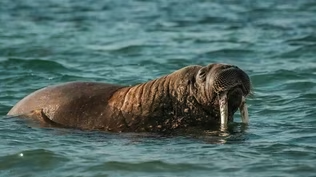
[grunts] NARRATOR: Like a slow-cooked pile of sausages, walrus lie flipper to flipper, a mass of bodies stewing in each other's heat.
With all the grace of a wet bean bag, the lumbering tonnage of several walrus take to the water.
[grunting] Oh, look how beautiful.
[chuckles] This one now looks very elegant.
Must be also itching with all the sand.
I have heard, when going in the water, it's also quite a relief for them.
[clicking] NARRATOR: Beneath the surface, the walrus sounds like it's drumming on a submarine with a teaspoon.
[clicking] NARRATOR: With a burst of air into his balloon-like throat sacs, and suddenly, he has a whole new vocabulary.
LANCASTER: Here in the Arctic, we've got such a diversity of sound.
[trilling] [croak] LANCASTER: And it's not just the animals.
[dripping] LANCASTER: We hear lots of natural sounds as these air bubbles pop and crackle from the glacial ice.
[soft popping] [rumbling] [deep crackling] LANCASTER: When we put the hydrophone in the water and we listen, we feel actually like we're completely surrounded.
[crack] NARRATOR: As ocean temperatures rise and sea ice retreats, warmer water erodes the base of glaciers, speeding their collapse.
[rumbling] There's a lot of rumbling.
Here it comes.
Look, look, look, look!
[crashing] LANCASTER: Oh, my God, that's amazing.
FABI: It's massive!
Wow.
I feel very small right now.
[crashing] FABI: And now look at the wave.
LANCASTER: I'm just filled with awe... sitting in front of this piece of history on our planet.
[somber music] LANCASTER: Even with bold action by all the world's governments, the Arctic will still continue to experience climate change, and so, we really have to understand how Arctic nature functions in order to be able to conserve it.
NARRATOR: The good news is we know how to quiet the Arctic Ocean.
By slowing ships, steering them clear of migratory corridors and breeding grounds, even designing quieter propellers.
It makes me hopeful when I sit in these big international meetings and I hear countries being concerned about underwater noise and how that affects migrating whales.
And I hear members of the shipping industry saying, "We wanna help, what can we do to help?
We wanna make our ships quieter."
So we need that kind of an attitude and that kind of initiative.
NARRATOR: What happens in these remote frozen worlds touches every one of us, reminding us that on a planet as connected as ours, there is no such thing as far away.
[light upbeat music] NARRATOR: In the Canadian territory of Nunavut, the coastal village of Cambridge Bay is surrounded by a sea of ice.
PAMELA NAKASHOOK: You need to grab your tractor.
- Tractor.
- Oh, no.
NARRATOR: Pamela Nakashook has lived here throughout her young life.
PAMELA NAKASHOOK: Living in such a remote area is peaceful and it's a beautiful life, It's cold and frozen here.
We're on latitude 69, so it's way up north.
But my heart belongs to Cambridge Bay.
I love it.
I'm Inuk.
I'm Inuit.
We rely on hunting for the food we eat and for our living.
We depend on our sea ice to cross from Victoria Island to the mainland.
Our freeze up used to be in October.
Now it's in December.
It's later and later every year.
And seems to be getting thinner and thinner.
It can be so dangerous too.
NARRATOR: From a distance, it seems Pamela is heading for the edge of the world, but she's following a frozen highway across the sea ice to meet scientists testing an idea as radical as the landscape around them -- one that might just help preserve the ice beneath their feet.
[whirring] [exciting music] NARRATOR: Flooding water onto the surface, using electric powered pumps.
It's a simple but labor-intensive process that encourages the natural formation of ice.
CIAN SHERWIN: It's extremely tough to work in the Arctic, particularly for equipment and people.
Anything electronic fails really quickly.
Thankfully, it's quite physical what we're doing, in a sense, because it keeps us warm.
But again, it is it can be quite literally backbreaking work.
NARRATOR: From December till February, the team from Real Ice will repeatedly pump water across the surface of one square kilometer.
installing pumps in the morning and then as each day ends, returning to retrieve them, so the pumps don't freeze over and buckle in the ice.
SHERWIN: Alright, let's go to the next one, yeah?
NARRATOR: Inch by inch, the sea ice should grow thicker.
The same cold that makes this possible also makes everything more perilous.
Three, two, one.
Lift again.
Three, two, one.
[grunts] It's tough, but it's good.
There's nothing quite like the Arctic to humble you, right?
[chuckles] I realize that humans aren't as indestructible as we think we are.
[deep sigh] - One more - SIMON: Put it down first.
SHERWIN: Right, use the momentum, right?
Three, two, one.
[all grunt] This is something that I feel is in grasp of finding some knowledge to just be clear, to determine whether this is viable or not.
You know, humankind is incredibly innovative and I find the furthering of knowledge and research incredibly exciting.
- [all grunt] - SHERWIN: That's it!
[grunts] [wind blowing] NARRATOR: As one of the Inuit guides for the team since their first field season, Pamela Nakashook is keen to see how the Real Ice experiment is progressing.
After weeks of flooding, and the ice building layer by layer, the results should now be visible.
How much ice did you measure so far with the thickness?
We've measured ice today that's got up to 130 cm.
That's crazy.
How is it taking them out?
Do they freeze?
- That's pretty tough.
Yeah.
- Oh.
That's why we were drilling two holes with the auger, to try to give us more space to pull them out.
NAKASHOOK: Is it easier?
A little bit.
[chuckles] NAKASHOOK: Darn.
SHERWIN: Let's see if it will start.
There we go.
[hopeful music] NAKASHOOK: I do have hope.
I think it will work.
I think it will help a lot with climate change, with our sea ice.
I think that it could solve a lot of our problems.
If this method can strengthen our sea ice, that would help our caribou population.
NARRATOR: Caribou have long been at the center of Inuit life as an essential resource for survival.
Each winter, as the ocean freezes over, caribou begin their migration.
Ice offers them a passage over an otherwise impassable sea to reach winter feeding grounds.
[snorts] NARRATOR: As the ice thins, the risk beneath each step grows.
Herds must take long detours to avoid open water, and endurance is put to the test.
[whirring] NARRATOR: Now at the coldest point of the year, the wind chill plunges temperatures to perilous depths.
The team pushes through, flooding the ice in brutal conditions with no guarantees it will grow.
SHERWIN: We're getting into the -45 realm.
The winds are a bit stronger than what we experienced yesterday.
Drop her down.
Every time you close your eyes or blink, and any of the moisture from your eyes then are going onto your eyelashes and they're freezing instantly.
You see the hoarfrost on my beard and the mustache, that's just from breathing.
Visibility's starting to get a little worse, but we're going to plow on ahead as best we can.
It should be fully frozen at these temperatures by tomorrow morning.
Very exciting to see the snow being flooded.
It's cool to see how it actually works.
It's colder than yesterday for sure.
The humidity, it really gets to you.
NARRATOR: After three hours of sea water being pumped onto the surface, the team uses GPS to track how much new ice has formed.
SIMON: Three hours of pumping.
It's not bad.
Because we know how much water we pump per minute, we can tell how much water we put onto this area.
Exactly.
SIMON: And then equate that to the ice, and then figure out how much energy we have to put into the system to create that much ice.
- SHERWIN: Yep.
- SIMON: Amazing.
SHERWIN: You can see the way the boundary forms.
Just like lava.
NARRATOR: This cold, icy layer doesn't just build on the surface.
Stripped of its snowy insulation, the underside of the sea ice freezes faster and thicker.
SHERWIN: We've covered about 160,000 meters squared so it all comes down now to the measurements, then we'll have a good indication as to how successful each technique is.
NARRATOR: On average, flooded areas are almost 20 inches thicker than the rest of the ice.
For the team, it's just the result they were hoping for.
That's very cool.
It's quite emotional to see it for the first time.
[laughs] It's great to be out on the ice.
NARRATOR: To expand this experiment across vast stretches of Arctic sea ice would demand an extraordinary logistical effort, on a scale never before attempted in polar engineering.
But even modest gains in nearshore sea ice could help those living on this frozen frontier.
[pensive music] SHERWIN: I'm extremely passionate about what I do, I love it.
Right, into the sled.
I just wanted to be involved in a project which is trying to restore an ecosystem for Arctic wildlife and people here.
Our team has put everything into this, trying to keep the ice here for as long as possible whilst we reduce emissions and transition away from fossil fuels.
We're taking action rather than sit around and hope for the best.
We're taking this to the Arctic to demonstrate that it could be possible.
[hopeful music] NARRATOR: In this place, where sea ice has long sustained Inuit culture and Arctic life, these first steps offer some hope to a disappearing ecosystem.
Because protecting polar seas is not about the ice alone; it is about securing the future ahead for all of us.
FEMALE VO: Ages of Ice is available with PBS Passport and on Amazon Prime Video.
Video has Closed Captions
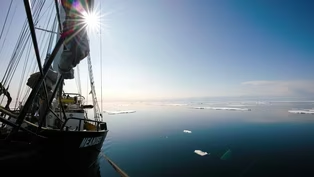
Clip: Ep2 | 2m 18s | Dr. Melanie Lancaster is a marine mammal specialist and advocate for quiet Arctic oceans. (2m 18s)
Video has Closed Captions
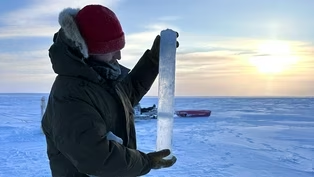
Clip: Ep2 | 3m 58s | Pumping seawater onto frozen ocean, Real Ice and Inuit guides test whether sea ice can grow thicker. (3m 58s)
Providing Support for PBS.org
Learn Moreabout PBS online sponsorship New Episode
- Science and Nature

Explore scientific discoveries on television's most acclaimed science documentary series.





 New Season



 New Season


Support for PBS provided by: