
The Fight to Protect the Mojave
Clip | 7m 58sVideo has Closed Captions
The researchers dedicated to protecting the Mojave Desert’s biodiversity.
Far from a wasteland, the Mojave Desert is a fragile ecosystem that teems with rare plant and animal life. The Mojave Desert Land Trust is working to study and protect the biodiversity of the desert’s vast expanses from development and climate change.
Problems playing video? | Closed Captioning Feedback
Problems playing video? | Closed Captioning Feedback
Earth Focus is a local public television program presented by PBS SoCal
The Fight to Protect the Mojave
Clip | 7m 58sVideo has Closed Captions
Far from a wasteland, the Mojave Desert is a fragile ecosystem that teems with rare plant and animal life. The Mojave Desert Land Trust is working to study and protect the biodiversity of the desert’s vast expanses from development and climate change.
Problems playing video? | Closed Captioning Feedback
Where to Watch Earth Focus
Earth Focus is available to stream on pbs.org and the PBS app.
Providing Support for PBS.org
Learn Moreabout PBS online sponsorship[theme music] -We've got our bags ready and start collecting, yeah?
-Great.
Yeah, let's do it.
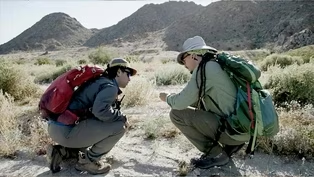
We are at the northern end of the Sheep Hole Mountains in the Mojave Trails National Preserve.
We've recently acquired this.
We're conserving it for long-term preservation of this intact ecosystem and also using it as a resource for our seed conservation and restoration efforts.
-These are all flowers that have now turned into seed pods.
This species has seed pods that are dehiscent, meaning they open out and let the seeds explode out of them.
-Today, we're collecting seeds to go into the Mojave Desert Seed Bank.
If we get a large enough collection, we'll store some of them for long-term conservation, just in case there's a need for reintroduction.
If we get a large enough collection, we'll have some for restoration work.
-When we collect seed, we don't collect more than 10% of the population because we want to ensure that there's enough for critters that rely on the seed and also that there's enough seed that goes back into the soil seed bank for the years that follow.
-Why collect only 10% again?
-Because we want to ensure that we're not taking away from the seed bank that's in the soil.
These plants will make seed.
They're going to fall onto the ground, and we call that the soil seed bank, so that in future years, that's what comes up.
10% is a scientifically determined amount that will not have any negative impacts on the environment in this way.
-I wish people knew how much life there is in the desert.
I think a lot of us have grown up with, maybe it's from cartoons or different TV shows that we watched as kids, but you have this idea of the Wild West and these open deserts where there's nothing but a couple of tumbleweeds rolling by, but there's tons of life out here.
There's tons of diversity, whether it's the plants that we work together directly in my position to conserve, or it's the bugs or the reptiles that are supported by these plants.
There's an incredible diversity of life out here.
You just have to look for it a little bit harder and take the time.
-I'm going to call that a glabra.
-There's probably a couple hundred species of plants that you see right within here.
We have foothills and then the bare bedrock of the mountain, so we get a really good diversity of plants that are protected here, as well as the wildlife.
We have tortoises here.
There's bighorn sheep in these mountains and all of the common desert rodents that live out here.
-I'm Corina.
I'm the collections manager here.
What I do is I oversee the seed collections themselves, which are stored here in our fridges.
Our three fridges are what we call our seed vaults.
Within this fridge, what you're looking at is close to millions of seeds.
What that means is the potential for millions of plants.
These seeds can go back into the land, and we're just helping facilitate their intermediary time, just keeping them safe and alive because they are alive.
We're just keeping them until they're needed.
-The Mojave Desert Land Trust is a nonprofit land conservancy based in Joshua Tree, California.
We do a lot of things to protect the California desert region, which is a quarter of the state of California.
We do everything we can to maintain a living, thriving, interconnected landscape across the desert.
The desert holds some of the highest biodiversity of anywhere on the planet.
There's more than 2,500 species of flowering plants here, for example, hundreds of species of mammals and birds, thousands and thousands of species of insects.
A lot of the life here, I think it's about a third of the species here, live in the desert and nowhere else, and are so adapted to that hot, dry ecosystem that we have here.
They can't live anywhere else.
-What does this machine do again?
-It separates the large chaff, not seed material, that's larger than the seed.
It separates out the small chaff material that's smaller than the seed, and then it uses this blower to separate out the heavier seed, which falls down below, from the lighter seed that blows out top.
This is fairly clean seed, and what we're seeing is a fairly high proportion of what we collected is probably seed material.
This is thousands of seeds there, and we've got many times that, so we really get that full genetic diversity that's captured in this large collection.
-Making sure no seeds are left on here.
-The end point is getting them back on the landscape in a way that fulfills their ecological value.
We're not a museum.
We're not trying to take these collections from the land and just store them indefinitely.
Really, what we're trying to do is take these collections from the land, care for them under our artificial conditions for a certain amount of time, making sure that they retain their viability, they're still strong living organisms, and then get them back on the landscape, either through seed-based restoration, which is just broad casting seeds on the landscape, or growing plants and transplanting those out into the landscape.
-The most existential threat of all, of course, is climate change.
The Mojave Desert region has already warmed by 3 degrees Fahrenheit over the last 100 years.
We're seeing real threats to our Joshua trees here.
By the end of this century, we're predicting that more than 90% of Western Joshua trees suitable habitat will be lost due to the shifting climate.
-That's the hard part, because I still don't really know how to tell those two.
Each one is really distinct.
-What's the satisfaction for you personally?
-Oh my God.
Wow.
That's a great question.
To me, I feel very satisfied to be able to do work that I feel makes a difference, that makes the world a little bit of a better place.
Of a better place than it was when I came here, and that will preserve these lands, which are lands that I love a lot and that we all love, that we share together, that I get to have a little part in preserving them for the next generation.
It's just really rewarding.
It's really fulfilling to me.
-The Mojave Desert Land Trust is really working to think about what does this place need in 500 years?
What are the pieces we can put in place right now that will have a lasting effect on this place?
Because we know we're all just here for this tiny little piece of history, right?
It's an interesting business to be protecting something in perpetuity.
You can't even comprehend that, right?
It's something we're really thinking about is how do we ensure that both this desert ecosystem, all the plants and animals, and the people who live here are all thriving for that 500-year view into the future?
-If you enjoy stories like this, you can support them by liking, subscribing, or checking out the donate link below.
Thanks, and stick around for the next one.
I think you're going to love it.
Why California is Betting on Giant Floating Wind Turbines
Video has Closed Captions
Clip | 8m 10s | California looks to wind energy, on land and offshore, to power its clean energy future. (8m 10s)
Why Power Lines Are Going Underground
Video has Closed Captions
Clip | 5m 52s | Could underground power lines help reduce wildfire risks in California? (5m 52s)
Why Fast Fashion Is Fueling a Growing Waste Crisis
Video has Closed Captions
Clip | 3m 48s | More clothes, lower quality and mounting environmental costs. (3m 48s)
The ‘Impossible Dream’ to Restore the LA River
Video has Closed Captions
Clip | 3m 14s | Exploring the history, ecology, and future of the Los Angeles River. (3m 14s)
The Fight to Protect Los Padres National Forest
Video has Closed Captions
Clip | 7m 46s | Will the Trump Administration’s rollback of public lands protections jeopardize Los Padres National (7m 46s)
 Now Playing
The Fight to Protect the Mojave
Video has Closed Captions
Clip | 7m 58s | The researchers dedicated to protecting the Mojave Desert’s biodiversity. (7m 58s)
Conservationists and Communities Fight to Protect the Kern River
Video has Closed Captions
Clip | 8m 27s | The California River that’s loved, drained and overrun and the people fighting to defend it (8m 27s)
Preserving Ocean Life on the California Coast
Video has Closed Captions
Clip | 7m 13s | Setting sail to learn about efforts to protect marine ecosystems in the Santa Barbara Channel. (7m 13s)
Beach Access and a Threatened Track
Video has Closed Captions
Clip | 7m 13s | As the coastline erodes, what can be done to save the seaside rail link between LA and San Diego? (7m 13s)
A Visit to Carlsbad's Fix-It Clinic
Video has Closed Captions
Clip | 6m 47s | The people who find joy and purpose in repairing the broken items in our lives. (6m 47s)
Sun, Sand and Climate Change: The Fight to Save California’s Coast
Video has Closed Captions
Clip | 6m 53s | What’s being done to save Southern California’s beaches from being washed away for good? (6m 53s)
How to Create a Sustainable, Zero Waste Meal Plan
Clip | 7m 11s | A climate change activist tells us how to create a more sustainable kitchen. (7m 11s)
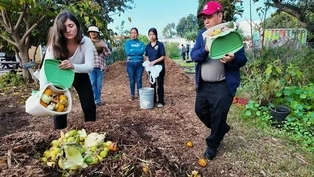
The Community That Transforms Food Scraps Together, Stays Together
Video has Closed Captions
Clip | 5m 50s | L.A.’s garden activists create a composting movement. (5m 50s)
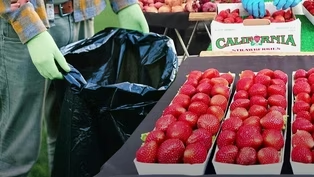
Meet the People Rescuing Food, Feeding Neighbors & Helping the Climate
Video has Closed Captions
Clip | 6m 32s | Saving perfectly good food from dumpsters (6m 32s)
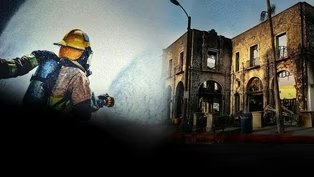
Video has Closed Captions
Clip | 6m 27s | We explore why enough water couldn’t be pumped through fire hydrants to protect homes from burning. (6m 27s)
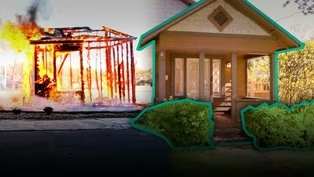
Goodbye Plants, Hello Fire Safety
Video has Closed Captions
Clip | 7m 53s | Controversial proposal to protect homes from wildfires by forcing homeowners to remove vegetation. (7m 53s)
Can You Build a Fire-Proof Home?
Video has Closed Captions
Clip | 7m 46s | How to rebuild after L.A.’s devastating wildfires. (7m 46s)
Earth Focus Environmental Film Festival 2023 (Preview)
Preview | 30s | The fifth annual Earth Focus Environmental Film Festival features five days of screenings. (30s)
Clip | 8m 17s | Taylor Yard is now an undeveloped and still-contaminated site adjacent to the L.A. River. (8m 17s)
Earth Focus Environmental Film Festival
Preview | 1m 18s | Earth Focus Environmental Film Festival (1m 18s)
Cold Rush? The Changing Arctic
Clip | 14m 41s | "Earth Focus" looks at the changing face of the Arctic today. (14m 41s)
Fukushima: Can it Happen in the US?
Clip | 7m 21s | Fukushima was not a Japanese nuclear disaster. (7m 21s)
Cambodia: Fight for Areng Valley
Clip | 10m 47s | The Chong people are fighting to protect their forests. (10m 47s)
Inside Illicit Ivory and Rhino Horn Trade
Clip | 6m 41s | Inside Illicit Ivory and Rhino Horn Trade (6m 41s)
Unacceptable Risk: Firefighters on the Frontline
Clip | 12m 52s | Fires are becoming more frequent, larger and more devastating than ever. (12m 52s)
China: Religion and Environment
Clip | 13m 37s | Filmmakers Gary Marcuse and Shi Lihong capture a surprising trend in China. (13m 37s)
Hope for Rhinos? New Approaches to Save Endangered Species
Clip | 14m 31s | Rhino horn is more expensive than gold or platinum. (14m 31s)
Making Coastal Communities More Resilient to Extreme Weather
Clip | 5m 48s | Joshua Saks looks at how America's communities can be protected. (5m 48s)
Paying for Climate Change: A Reinsurance Industry View
Clip | 6m 32s | Climate change is anticipated to have a big impact on the insurance industries. (6m 32s)
Encroaching Tides: What's at Stake for the US
Clip | 6m 32s | The eastern coast of the United States has one of the highest rates of sea level rise. (6m 32s)
Sacred Economics: A Post Money World?
Clip | 11m 55s | Charles Eisenstein speaks to Earth Focus about his new book Sacred Economics. (11m 55s)
Neonics: Toxic Until Fully Tested
Clip | 8m 58s | Scott Hoffman Black speaks about the impact of neonicotinoid pesticides. (8m 58s)
Neonics: Driving Declines in Biodiversity
Clip | 8m 26s | Dr. David Goulson speaks about the impact of neonicotinoid pesticides. (8m 26s)
Clip | 5m 43s | Earl Blumenauer talks about why protecting pollinators in the US is the national interest. (5m 43s)
Clip | 11m 29s | Shrimp farmers tell us to reject contaminated shrimp from Bangladesh. (11m 29s)
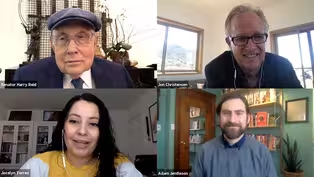
Killing the Senate Filibuster Could Inspire Bipartisanship
Clip: Special | 27m 36s | Jon Christensen moderates a conversation with former Nevada Sen. Harry Reid. (27m 36s)
Sen. Cortez Masto: Pursuing a Green Economy
Video has Closed Captions
Clip: Special | 1m 9s | Cortez Masto has a goal to grow a clean energy economy that includes jobs for the future. (1m 9s)

Sen. Cortez Masto: Protecting the Outdoors is Nonpartisan
Video has Closed Captions
Clip: Special | 37s | Protecting the environment should not be considered a partisan issue, Cortez Masto says. (37s)
Sen. Cortez Masto: On Reid’s Environmental Legacy
Video has Closed Captions
Clip: Special | 54s | Sen. Harry Reid struck a balance when crafting inclusive environmental policy, she says. (54s)

Sen. Cortez Masto: On Growing Up in Rural Las Vegas
Video has Closed Captions
Clip: Special | 40s | Cortez Masto grew up in a rural Las Vegas with cowboys and ranches. (40s)
Sen. Cortez Masto: ‘A Microcosm of America’
Video has Closed Captions
Clip: Special | 1m 17s | Sen. Catherine Cortez Masto describes her state’s role in national politics. (1m 17s)
The New West and the Politics of the Environment (Preview)
Video has Closed Captions
Preview: Special | 1m | A quiet, little-known revolution is taking place in American environmental politics. (1m)
Moapa Solar Plant Addressed Injustice, Economy and Energy
Video has Closed Captions
Clip: Special | 5m 7s | Behind-the-scenes negotiations helped establish the Moapa transition from coal to solar. (5m 7s)
How SNPLMA Wove Urban Las Vegas Back Into the Environment
Video has Closed Captions
Clip: Special | 2m 17s | The legislation helped balance urban growth in Las Vegas with environmental conservation. (2m 17s)
Black Rock-High Rock: The Negotiation Behind Conservation
Video has Closed Captions
Clip: Special | 8m 2s | A proposal to protect Nevada’s Black Rock Desert-High Rock Canyon received much criticism. (8m 2s)
Providing Support for PBS.org
Learn Moreabout PBS online sponsorship New Episode
 New Episode
- Drama

Lesley Manville and Tim McMullan return in the final installment of the Susan Ryeland mysteries.

 New Episode
 New Episode
 New Episode



 New Season

Support for PBS provided by:
Earth Focus is a local public television program presented by PBS SoCal