
Why Fast Fashion Is Fueling a Growing Waste Crisis
Clip | 3m 48sVideo has Closed Captions
More clothes, lower quality and mounting environmental costs.
Americans now buy about four times as much clothing as they did four decades ago, fueling a global fast fashion industry with major environmental impacts. From textile waste and chemical pollution to microfibers and disposable trends, experts explain how the industry grew and why its footprint keeps expanding.
Problems playing video? | Closed Captioning Feedback
Problems playing video? | Closed Captioning Feedback
Earth Focus is a local public television program presented by PBS SoCal
Why Fast Fashion Is Fueling a Growing Waste Crisis
Clip | 3m 48sVideo has Closed Captions
Americans now buy about four times as much clothing as they did four decades ago, fueling a global fast fashion industry with major environmental impacts. From textile waste and chemical pollution to microfibers and disposable trends, experts explain how the industry grew and why its footprint keeps expanding.
Problems playing video? | Closed Captioning Feedback
Where to Watch Earth Focus
Earth Focus is available to stream on pbs.org and the PBS app.
Providing Support for PBS.org
Learn Moreabout PBS online sponsorshipNarrator: Today, American consumers purchase roughly 4 times as much clothing as they did over 4 decades ago.
In Los Angeles alone, there are over 70 tons of textiles discarded annually.
Woman: 100 million pieces of garment are pushed out every single year.
And that doubles what it was in 2000, roughly.
Man: Fashion as an environmental problem is fairly recent.
It's gotten a lot of heat for waste that shows up in open dumps in the Atacama Desert in Chile, in West Africa.
If we do those lifecycle assessments of apparel and we get very consistent findings, the environmental hotspots are always material production, followed by what we call the use phase, which for apparel is basically washing and drying.
Man 2: The big issue is when we scale things up to the magnitude that we need for clothing our world population, that's where we get into some big problems.
There are many processes within the making of fabric, and there's also the question of new colors, new finishes.
All that requires having chemicals to be able to produce that.
You have to treat the fibers, adding chemicals, and then there's washing steps in between where those chemicals are synthetic or natural.
That has a significant impact on the environment.
There's a number of steps that modify the fiber surface so that you can actually have the dyes attach to the material.
As the fabric is being used and worn or even processed, they begin to shed these, these smaller particles.
So, these are materials that are being slowly released into the environment.
Narrator: To know how we got to fast fashion, we have to go back in time.
Prior to World War II, clothing production was still small-scale, happening in workshops and mostly in people's homes.
But the war created rations on fabric that made mass-produced fashion acceptable to the middle class, and clothing companies exploded across the country, churning out standardized items that we now take for granted.
Lin: I think fast fashion started with Zara.
That term came from a "New York Times" article that talked about at the time, you know, that brand basically able to include a collection in 15 days, which is unheard of.
So, normally in the traditional fashion world, it's like you have two collections a year.
But it did so well, they sold so fast, and that model worked so that you had tons of copycats, like small copycats to humongous, right, corporate copycats out there.
Narrator: Shopping malls dominated while reducing costs.
Going abroad and hiring local cheap labor were the norm.
Then came the internet.
With each passing decade, the amount of garments increased, but their quality, longevity, and labor costs decreased.
This dynamic reached its zenith with fast fashion in the early 2000s, when online shopping began to replace malls, and companies produced clothing at an unprecedented pace.
Lin: Right now, the average American owns about 110 pieces of clothing.
Now you can buy 6 seasons in a year.
So, I think that model of selling more cheaper clothing, more collections, more trends, all kind of fed on itself.
Why California is Betting on Giant Floating Wind Turbines
Video has Closed Captions
Clip | 8m 10s | California looks to wind energy, on land and offshore, to power its clean energy future. (8m 10s)
Why Power Lines Are Going Underground
Video has Closed Captions
Clip | 5m 52s | Could underground power lines help reduce wildfire risks in California? (5m 52s)
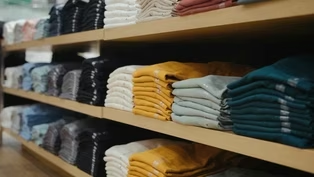 Now Playing
Why Fast Fashion Is Fueling a Growing Waste Crisis
Video has Closed Captions
Clip | 3m 48s | More clothes, lower quality and mounting environmental costs. (3m 48s)
The ‘Impossible Dream’ to Restore the LA River
Video has Closed Captions
Clip | 3m 14s | Exploring the history, ecology, and future of the Los Angeles River. (3m 14s)
The Fight to Protect Los Padres National Forest
Video has Closed Captions
Clip | 7m 46s | Will the Trump Administration’s rollback of public lands protections jeopardize Los Padres National (7m 46s)
The Fight to Protect the Mojave
Video has Closed Captions
Clip | 7m 58s | The researchers dedicated to protecting the Mojave Desert’s biodiversity. (7m 58s)
Conservationists and Communities Fight to Protect the Kern River
Video has Closed Captions
Clip | 8m 27s | The California River that’s loved, drained and overrun and the people fighting to defend it (8m 27s)
Preserving Ocean Life on the California Coast
Video has Closed Captions
Clip | 7m 13s | Setting sail to learn about efforts to protect marine ecosystems in the Santa Barbara Channel. (7m 13s)
Beach Access and a Threatened Track
Video has Closed Captions
Clip | 7m 13s | As the coastline erodes, what can be done to save the seaside rail link between LA and San Diego? (7m 13s)
A Visit to Carlsbad's Fix-It Clinic
Video has Closed Captions
Clip | 6m 47s | The people who find joy and purpose in repairing the broken items in our lives. (6m 47s)
Sun, Sand and Climate Change: The Fight to Save California’s Coast
Video has Closed Captions
Clip | 6m 53s | What’s being done to save Southern California’s beaches from being washed away for good? (6m 53s)
How to Create a Sustainable, Zero Waste Meal Plan
Clip | 7m 11s | A climate change activist tells us how to create a more sustainable kitchen. (7m 11s)
The Community That Transforms Food Scraps Together, Stays Together
Video has Closed Captions
Clip | 5m 50s | L.A.’s garden activists create a composting movement. (5m 50s)
Meet the People Rescuing Food, Feeding Neighbors & Helping the Climate
Video has Closed Captions
Clip | 6m 32s | Saving perfectly good food from dumpsters (6m 32s)

Video has Closed Captions
Clip | 6m 27s | We explore why enough water couldn’t be pumped through fire hydrants to protect homes from burning. (6m 27s)
Goodbye Plants, Hello Fire Safety
Video has Closed Captions
Clip | 7m 53s | Controversial proposal to protect homes from wildfires by forcing homeowners to remove vegetation. (7m 53s)
Can You Build a Fire-Proof Home?
Video has Closed Captions
Clip | 7m 46s | How to rebuild after L.A.’s devastating wildfires. (7m 46s)
Earth Focus Environmental Film Festival 2023 (Preview)
Preview | 30s | The fifth annual Earth Focus Environmental Film Festival features five days of screenings. (30s)
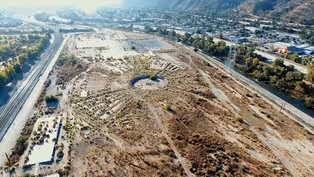
Clip | 8m 17s | Taylor Yard is now an undeveloped and still-contaminated site adjacent to the L.A. River. (8m 17s)
Earth Focus Environmental Film Festival
Preview | 1m 18s | Earth Focus Environmental Film Festival (1m 18s)
Cold Rush? The Changing Arctic
Clip | 14m 41s | "Earth Focus" looks at the changing face of the Arctic today. (14m 41s)
Fukushima: Can it Happen in the US?
Clip | 7m 21s | Fukushima was not a Japanese nuclear disaster. (7m 21s)
Cambodia: Fight for Areng Valley
Clip | 10m 47s | The Chong people are fighting to protect their forests. (10m 47s)
Inside Illicit Ivory and Rhino Horn Trade
Clip | 6m 41s | Inside Illicit Ivory and Rhino Horn Trade (6m 41s)
Unacceptable Risk: Firefighters on the Frontline
Clip | 12m 52s | Fires are becoming more frequent, larger and more devastating than ever. (12m 52s)
China: Religion and Environment
Clip | 13m 37s | Filmmakers Gary Marcuse and Shi Lihong capture a surprising trend in China. (13m 37s)
Hope for Rhinos? New Approaches to Save Endangered Species
Clip | 14m 31s | Rhino horn is more expensive than gold or platinum. (14m 31s)
Making Coastal Communities More Resilient to Extreme Weather
Clip | 5m 48s | Joshua Saks looks at how America's communities can be protected. (5m 48s)
Paying for Climate Change: A Reinsurance Industry View
Clip | 6m 32s | Climate change is anticipated to have a big impact on the insurance industries. (6m 32s)
Encroaching Tides: What's at Stake for the US
Clip | 6m 32s | The eastern coast of the United States has one of the highest rates of sea level rise. (6m 32s)
Sacred Economics: A Post Money World?
Clip | 11m 55s | Charles Eisenstein speaks to Earth Focus about his new book Sacred Economics. (11m 55s)

Neonics: Toxic Until Fully Tested
Clip | 8m 58s | Scott Hoffman Black speaks about the impact of neonicotinoid pesticides. (8m 58s)
Neonics: Driving Declines in Biodiversity
Clip | 8m 26s | Dr. David Goulson speaks about the impact of neonicotinoid pesticides. (8m 26s)
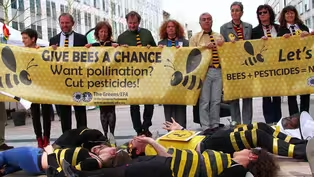
Clip | 5m 43s | Earl Blumenauer talks about why protecting pollinators in the US is the national interest. (5m 43s)
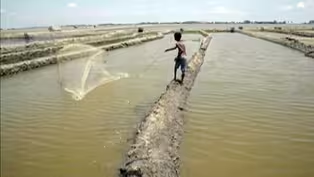
Clip | 11m 29s | Shrimp farmers tell us to reject contaminated shrimp from Bangladesh. (11m 29s)
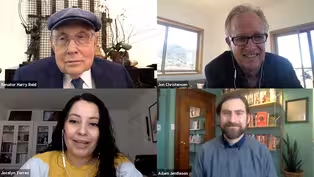
Killing the Senate Filibuster Could Inspire Bipartisanship
Clip: Special | 27m 36s | Jon Christensen moderates a conversation with former Nevada Sen. Harry Reid. (27m 36s)
Sen. Cortez Masto: Pursuing a Green Economy
Video has Closed Captions
Clip: Special | 1m 9s | Cortez Masto has a goal to grow a clean energy economy that includes jobs for the future. (1m 9s)
Sen. Cortez Masto: Protecting the Outdoors is Nonpartisan
Video has Closed Captions
Clip: Special | 37s | Protecting the environment should not be considered a partisan issue, Cortez Masto says. (37s)
Sen. Cortez Masto: On Reid’s Environmental Legacy
Video has Closed Captions
Clip: Special | 54s | Sen. Harry Reid struck a balance when crafting inclusive environmental policy, she says. (54s)
Sen. Cortez Masto: On Growing Up in Rural Las Vegas
Video has Closed Captions
Clip: Special | 40s | Cortez Masto grew up in a rural Las Vegas with cowboys and ranches. (40s)
Sen. Cortez Masto: ‘A Microcosm of America’
Video has Closed Captions
Clip: Special | 1m 17s | Sen. Catherine Cortez Masto describes her state’s role in national politics. (1m 17s)
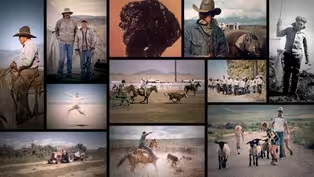
The New West and the Politics of the Environment (Preview)
Video has Closed Captions
Preview: Special | 1m | A quiet, little-known revolution is taking place in American environmental politics. (1m)
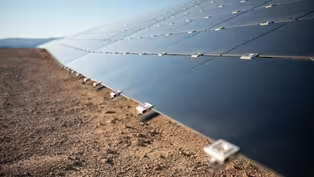
Moapa Solar Plant Addressed Injustice, Economy and Energy
Video has Closed Captions
Clip: Special | 5m 7s | Behind-the-scenes negotiations helped establish the Moapa transition from coal to solar. (5m 7s)
How SNPLMA Wove Urban Las Vegas Back Into the Environment
Video has Closed Captions
Clip: Special | 2m 17s | The legislation helped balance urban growth in Las Vegas with environmental conservation. (2m 17s)
Black Rock-High Rock: The Negotiation Behind Conservation
Video has Closed Captions
Clip: Special | 8m 2s | A proposal to protect Nevada’s Black Rock Desert-High Rock Canyon received much criticism. (8m 2s)
Providing Support for PBS.org
Learn Moreabout PBS online sponsorship New Episode
 New Episode
- Drama

Lesley Manville and Tim McMullan return in the final installment of the Susan Ryeland mysteries.

 New Episode
 New Episode
 New Episode



 New Season

Support for PBS provided by:
Earth Focus is a local public television program presented by PBS SoCal