
The Incubator of Life
Episode 3 | 54m 22sVideo has Closed Captions
Journey beneath the ice to discover hidden worlds and clues to life beyond Earth.
Journey beneath the ice to discover hidden worlds where life flourishes against the odds. As scientists explore glaciers, oceans, and frozen frontiers, they uncover remarkable clues that may one day help us find life beyond Earth.
Problems playing video? | Closed Captioning Feedback
Problems playing video? | Closed Captioning Feedback
The Incubator of Life
Episode 3 | 54m 22sVideo has Closed Captions
Journey beneath the ice to discover hidden worlds where life flourishes against the odds. As scientists explore glaciers, oceans, and frozen frontiers, they uncover remarkable clues that may one day help us find life beyond Earth.
Problems playing video? | Closed Captioning Feedback
Where to Watch Ages of Ice
Ages of Ice is available to stream on pbs.org and the PBS app.
Share Inspiring Moments From The Film
Explore the PBS Giphy collection for Ages of Ice.Providing Support for PBS.org
Learn Moreabout PBS online sponsorship[wind blowing] MALE NARRATOR: The polar environment is a landscape so cold... so hostile... that nothing should survive here.
And yet... it does.
[dramatic swell] [bleats] [bellows] NARRATOR: The frozen ends of the Earth are teeming with life.
- [elephant seal bellowing] - [penguins honking] NARRATOR: Some stories play out on an epic scale.
Others reveal just how curious and delightful our living planet really is.
Beneath the polar ice, scientists are discovering lifeforms that are rewriting the rules of biology.
DR.
RY HOLLAND: We are trying to find the limits of life.
Sampling the earth, the air, and the ice.
NARRATOR: And are beginning to perceive its power to shape our planet.
ALUN HUBBARD: It's not a frigid sterile environment, it's very much alive.
NARRATOR: As scientists venture deeper into Earth's frozen realm, the search for life on other planets suddenly feels a lot less like science fiction.
VICKIE SIEGEL: How can we explore here on Earth and learn more about extreme biology and distant worlds?
[soft rippling] NARRATOR: At its most beautiful, Antarctica can feel almost impossible.
A rare corner of our world.
It reawakens our idea of what a wild planet should be.
[squawking] DR.
SUSANNE LOCKHART: When people think of Antarctica, I think the first thing that comes to mind is penguins, icebergs, seals, and whales.
[grunts] LOCKHART: I was never going to be a penguin scientist.
[squawks] LOCKHART: Don't get me wrong; I do love penguins.
But there are so many other organisms that are just as important to the health of the environment.
NARRATOR: For three decades, Dr.
Susanne Lockhart has been uncovering how Antarctica's hidden ecosystems are connected to help protect some of the most vulnerable life on Earth.
LOCKHART: Antarctica just feels like home.
And I don't know exactly why that is but I've just always been really connected to this place.
NARRATOR: Every living thing here depends on the sea.
All 10,000 known species.
But most of those species are hidden deep beneath the surface, in a world still poorly understood and rarely glimpsed.
Unless you can find yourself a machine that can withstand crushing depths and subzero temperatures.
[mechanical whirring] Fortunately, we've found one!
[dramatic music] NARRATOR: Every summer, Susanne commutes to work in a tiny submersible.
Her annual survey helps to identify fragile ecosystems before they disappear.
LOCKHART: Hoping to see a built-up community, diverse, 3D complexity, so that we can get it analyzed and protected.
Let's close the hatch and get down there!
[hatch locks] Top side!
Top side, 713.
MAN ON RADIO: 713, topside, go ahead.
My hatch is closed, locked and secured.
My equalizing valve is closed.
My oxygen is on.
My CO scrubber is on, my air conditioning is on.
Both air monitors are on and in the green.
Ready to set timer on your mark.
NARRATOR: Next stop, the sea floor.
CASSIE SLEEPER: My name is Cassie Sleeper and I'm a submersible pilot.
It's such an inhospitable world that you're going down to see.
Crazy pressure on this sub.
NARRATOR: But fear not!
The sub is built to endure more than a ton of force pressing on every square inch, which is reassuring, because we're about to test that theory.
Going down nice and gentle at about 16 meters a minute and everything's looking good.
LOCKHART: I've never been in a space capsule, but I can imagine that being in the submersible is very similar.
It's a little claustrophobic.
There's not a lot of room.
You're very aware that you're completely reliant on the technology around you to keep you alive.
SLEEPER: So right now, we're at 73 meters and just before we get to the bottom, we're gonna slow down and go nice and gentle.
Everything looks good.
I can see the bottom.
Yes, I see bottom.
SLEEPER: There it is.
Okay, here we go.
Let's go look for some things.
NARRATOR: At first, nothing.
Just a pale expanse of silt stretching into the distance.
It's kind of spooky.
And then... life.
LOCKHART: These trenches here are very much full of glass sponges.
Oh, a gorgeous delicate bryozoan there, I love those ones.
See the little fat boy there?
- Nudibranch.
- SLEEPER: Nudibranch!
They get really big down here.
There's lots of little fish finding refuge here as well, and that's always important.
I'm collecting evidence to make a case for areas to be protected.
NARRATOR: In most places on Earth, color fades with depth.
Here, in the perpetual twilight, it explodes.
LOCKHART: Under the ice, Antarctica becomes super colorful and super diverse.
NARRATOR: Soft corals unfurl in sherbet pinks and burnt oranges.
Brittle stars appear like constellations.
Feather stars lift their arms, caught mid-dance.
This is the benthos - where life slows down and grows strange.
SLEEPER: I think the benthic life is pretty cool.
They withstand such crushing pressure and this cold temperature.
It is very alien.
LOCKHART: I guess there is a kinship with astrobiology for sure.
It does feel like an alien world.
I see a sea mouse, an aphrodite polychaete scale worm.
SLEEPER: Oh, yeah.
They stumped me in my early years, for sure, because the scales will come off.
And then you'll be like, "What is this organism?"
And it's really opalescent.
Octopus, octopus, octopus right there, right here.
LOCKHART: Oh, yeah.
SLEEPER: There's a lot of feather stars.
Oh, my goodness.
[gasps] I've never... in all my years.
- Oh, my God.
- [both laugh] LOCKHART: That's insane.
Oh, my God!
SLEEPER: He's got to be, like, a meter.
That is amazing.
I've never seen a skate before.
This is really cool.
- LOCKHART: So good.
- Nice.
NARRATOR: The appearance of larger, rarely sighted marine creatures is a sign that this hidden world beneath the ice is not barren, but is rich with life.
There are so many new things we find down here all the time.
SLEEPER: There's a lot of glass sponges here.
LOCKHART: There really are.
Sun star.
Whereas you guys like to call them death stars.
Oh, gorgeous octopus.
- Another one.
[gasps] -A big one.
A big one.
SLEEPER: He's right there, That's awesome.
- Aww!
- He's so big.
There's certainly a lot of 3D complex structure.
Lots of organisms are using the larger organisms for shelter and as a way to feed and that is really what we're looking at and the kind of areas that we would like to get protected.
I see some more corals here, they've got some gorgeous color, orange and yellow.
People are very surprised to hear that there are corals in Antarctica in such a cold environment.
They are very, very old, they're very, very slow growing, and that's what makes them super fragile.
NARRATOR: The cold allows life to endure for extraordinary spans of time.
Some sponges may have been alive for more than a thousand years.
But a single disturbance to an ecosystem can take generations to heal.
Concentrated around the Antarctic peninsula, the krill fishing fleet sweeps through these wild southern waters.
These industrial factory ships harvest krill around the clock.
LOCKHART: They don't want their nets dragging along the bottom, but unfortunately, they do.
It just makes this area so very vulnerable and we're at the threat of losing it.
NARRATOR: For Susanne, the goal is to ensure these vulnerable ecosystems are protected by steering human activity away from the sea floor.
Yeah, this is nice.
And there's an anemone over here.
A big anemone.
NARRATOR: They may appear strange... even slimy.
But these hidden worlds play a vital role in supporting the entire Southern Ocean.
LOCKHART: They help bring carbon down out of the water column and put it back into the sediment.
It's such an important part of the whole cycle in the Southern Ocean.
NARRATOR: And Susanne is here to make sure the smallest species are not forgotten.
SLEEPER: We are going to have to go up.
LOCKHART: It's always too short unless a whale comes swimming by now.
I kind of feel like we might get that lucky after that dive.
It's a great dive.
Great dive.
It really is an amazing place to spend time.
I am very lucky.
Back to Earth!
Yes, I can see it getting nice and turquoise up there.
SLEEPER: There we go.
NARRATOR: After an hour in the deep, next stop: fresh air.
LOCKHART: It's so important to protect these hidden worlds.
I'd like to think that there's still time to safeguard them.
I think that there's still a lot of hope, and I feel the responsibility to protect it.
NARRATOR: Thanks to Susanne's work, more than 200 square miles of Antarctic seafloor are now permanently off limits to commercial trawling, protected under an international agreement to safeguard Antarctica's fragile marine ecosystems.
It goes to show, some of the most important pieces of our living system are also its smallest... and most easily overlooked.
[ethereal music] NARRATOR: In Antarctica's interior, new research has uncovered a rich and complex ecosystem.
But... it's at a scale invisible to human eyes.
And it doesn't follow the playbook of conventional life.
HOLLAND: Once you are in this interior region, it's a microbially dominated world.
They're the only organisms that are adapted to live in a place like this.
I really like microbes because a lot of the time, they just don't make any sense.
They just live in the most extreme places that you think "Nothing can live here."
Feels kind of like being an astronaut when you're in the suit.
So we dress like this to reduce contaminations.
There's actually more microbial cells than human cells in your body.
The human cells are just bigger.
Worse, we've been wearing these clothes for about 10 days in a row.
So there's a lot of potential contamination especially from your mouth as you breathe and speak.
NARRATOR: This is microbial CSI - a high-precision hunt for life too small to see.
HOLLAND: These are essentially the world's most expensive fans.
We stick a filter on the front to capture any bacteria... Click!
And the fans will pull air through for four hours -- they're on a timer- and after that, we'll extract DNA from the filters.
NARRATOR: But here's where things get weird.
These microbes don't eat soil or harvest sunlight.
They survive on thin air, literally.
Snacking on molecules in the atmosphere is a strange trick known as "aerotrophy."
A survival strategy so extraordinary, it's forcing scientists to rewrite the rules of how life works.
HOLLAND: So what I'm doing here is measuring how quickly these bacteria in the soils can consume the trace atmospheric gases; hydrogen, methane, and carbon monoxide.
So we can see these bacteria in the soils actually consuming those gases, which is really cool that it happens even at the freezing cold Antarctic temperatures.
So we think that aerotrophs are actually forming the base of the food chain here.
I think it's very interesting to see how an ecosystem forms.
They're alive, but they're alive in such a completely different dimension to the way that humans are alive.
NARRATOR: As we discover more about Antarctica's strange microscopic life forms, the more the cosmos begins to feel alive with possibility.
HOLLAND: There's definitely a lot of interesting analogs to extraterrestrial life in Antarctica.
Like Europa, the moon of Jupiter, which has the ice-encrusted surface.
Yeah, Antarctica is a very interesting place to study astrobiology: what life might be like on other planets.
NARRATOR: When astrobiologists imagine life beyond Earth, they're not picturing something waving back at us.
They're looking for the quiet survivors thriving in hidden places... just like this one.
[dripping] NARRATOR: High in the Tyrolean Alps lies a secret world.
[dramatic music builds] Discovered by accident in 2007, when a mountaineer peered into a small crack in the glacier and found a labyrinth of frozen chambers buried within its glittering heart.
A palace of ice, with vaulted halls, dripping with frozen chandeliers, like the ruins of some lost Arctic Versailles.
BIRGIT SATTLER: The ice is like a massive treasure box.
It tells us a lot about the climate, but it's also a treasure box of a whole lot of biodiversity.
So it harbors life in all different kinds.
NARRATOR: For ecologist Birgit Sattler, this frozen underworld reveals a hidden menagerie of ice creatures most of us never knew existed.
SATTLER: Ice is never sterile.
Nobody would have thought that little tiny animals and organisms, they can live inside the ice.
But here we are!
There are bacteria, there are algae, there are fungi.
There are also some metazoans, like tardigrades or the glacial flea.
We just see ice now as a solid block, but it's just a mingling of ice crystals.
And inside these tiny channels, they can move around.
Ice is also not just like distilled water.
They also have nutrients and salts.
NARRATOR: Inside the ice, the mini-ecosystem is surprisingly busy -- eating, reproducing, and quietly shaping the chemistry of the snow.
The type of microorganisms living in this ice have existed for millions of years.
Like nature's closest thing to an unbreakable toy, tardigrades are able to live for decades without food or water, tolerate temperatures hotter than a kitchen oven, and even survive the frozen vacuum of space!
With creatures like this living in the ice, it's easy to see why scientists believe our icy worlds are a window into space.
Life in ice is like a holy grail, also, when you think about astrobiology.
How could it be on other exoplanets, which are ice covered?
I would be quite positive that if there is life, that it would be in ice.
NARRATOR: These tiny ecosystems may appear trivial, but as ice melts the microbial biomass gets carried downstream into rivers and soils, seeding entire ecosystems, feeding aquatic life, and fertilizing landscapes far below, rippling all the way down the mountain- through streams, forests, and beyond.
[birds chirping] NARRATOR: Recognizing how important these hidden ecosystems are, Birgit spends the year tracking the tiny lifeforms within the snow and ice.
SATTLER: Snow and ice is an ecosystem itself, and a healthy glacier has a healthy microbial ecosystem so that's the base of any ecosystem.
NARRATOR: But the environment here is going through dramatic change.
SATTLER: Many glaciers in this Austrian area, they will be lost within -- the small ones within some years even, and we have even witnessed some glaciers vanish.
NARRATOR: In an effort to preserve Alpine glaciers, each spring, miles of fabric is rolled out across swathes of snow.
It's a striking and somewhat surreal scene, known as "blanket tucking" -- as glaciers are put to bed for the summer.
So the best sunscreen for a glacier would be a perfect white snow cover.
But this will go away, so they have to do it in a technical way.
They lay out fleeces.
It's a lot of work.
It takes them weeks.
NARRATOR: The idea is simple: wrap it in a giant reflective blanket to deflect the summer sun.
And it appears to work.
What once seemed like a quirky experiment has been adopted across the European Alps -- from Austria and Switzerland, to Italy and France -- buying some glaciers years of extra life.
But how far are we willing to go to hold onto ice?
The blankets that they're using, it's made of polypropylene, and that's an emission source of microplastics, and we can't have it in such a sensitive ecosystem as high-altitude regions.
This here looks pretty clean.
NARRATOR: Birgit is investigating a new eco-friendly material being trialed here at Hintertux.
SATTLER: This is made of cellulose.
It's a pure natural fiber.
It is made of wood, and cellulose has more or less the same performance as the plastic fleece.
KLEMENS: -0.4.
- Maybe from the surface.
- Yeah.
SATTLER: Every two weeks, we go to our test fields.
We look for the biodiversity inside of snow and ice.
Is there a change?
Is there a shift?
And at the end, we hope that we can give green light for these samples.
NARRATOR: Blanket tucking won't stop climate change.
But on a small scale, it will buy time for some of the Alps' most iconic glaciers.
And for the delicate ecosystems that have evolved here.
SATTLER: Ice has taught me a lot to be humble in my own existence, in my own awareness of nature.
It's really a privilege to work here.
That's why we cry out that it must be protected.
NARRATOR: The secret life inside snow and ice may be impossible for our eyes to see, but it is crucial to the health of these mountain environments.
And like any ecosystem, when the balance is disturbed, it will change the world around it.
[dramatic swell] TINA: Oskar Uniform, can you open a 7-nautical-mile working area around my position and next corner later than 01345?
NARRATOR: For the past few years, Professor Alun Hubbard has been investigating a strange phenomenon, as something living wakes within the Greenland ice sheet.
ALUN HUBBARD: The ice sheet is meant to be white.
But this part of the Greenland ice sheet, it's gone really, really dark.
And we call it the dark zone.
It does sound a bit Star Wars-y.
And we used to just think it was dust or black carbon coming in from wildfires from North America, but it turns out it's its own unique ecosystem.
The Greenland ice sheet, it's not a frigid sterile environment, it's very much alive with this weird ecosystem of cryoconite.
It's like ground coffee grains.
It's really weird stuff.
It's organic, it's algae, there's some fungi in there as well.
And they're basically living off dust on ice.
I mean, how crazy is that?
NARRATOR: Bathed in summer's 24-hour sunlight, algae produce dark pigments to shield themselves.
But that same pigment sets off a chain reaction.
Viewers with trypophobia may wish to look away now.
HUBBARD: It's literally drilling holes into the ice sheet because dark surfaces absorb a hell of a lot more radiation than bright white surfaces.
NARRATOR: And every year, the living dark zone creeps further.
HUBBARD: What's for sure is there's a lot of it, certainly on this western margin of the ice sheet.
It's a vast area, 1,000 kilometers in length, 60, 100 kilometers wide, and it's having a huge impact on the melt rates here.
NARRATOR: In just one summer, it's estimated algae melted an extra four to six gigatons of ice, about ten percent of all the melt in the region.
HUBBARD: It's expanding because the ice that's melting carries this mineral dust from the last Ice Age.
We have a nutrient source, we have 24-hour sunlight, and we have water, and it's like a nutty hydroponic experiment.
NARRATOR: At the height of summer, thousands of meltwater lakes materialize across Greenland's ice sheet.
If we land on this eastern shore of it, Tina, that would be fantastic.
So, kind of just below us.
TINA: Okay.
This is what we call a supraglacial lake.
It's basically a surface melt lake.
There's some really, really big black patches of cryoconite, algae crud, it's really accumulated in the bottom of this lake.
I want to see if it's decomposing and letting off any methane.
So we're going to be running the sensor and taking some real-time measurements as we go.
What could go wrong, eh?
NARRATOR: Well, actually, this entire lake could suddenly collapse and drain into the ice below.
HUBBARD: Literally a huge fracture opens up and the water gets swallowed in.
And that is very dramatic.
and lakes five, six kilometers across disappear down this hole.
NARRATOR: So Alun is keeping a fairly close eye on things, just in case the lake decides to disappear.
HUBBARD: Iceberg-ahoy!
Oh, it's gorgeous.
From a certain aspect, you'd think it's like the Caribbean.
But it's cold.
I'm not going to last very long in there.
That water is about one degree or less.
NARRATOR: Bubbles trapped under the ice give Alun the first clue... that something is feeding on the dead.
HUBBARD: We've got a really funky natural experiment here.
My suspicion is those bubbles will have quite a high concentration of methane in them.
So that's what I'm gonna have a look, see, and do.
Try and deploy this instrument scientifically.
You never know unless you make the measurement.
NARRATOR: As algae dies beneath the ice, microbes move in to consume the rotting remains and exhale methane into the atmosphere.
HUBBARD: Methane is a very, very potent greenhouse gas.
It's 20, 30 times more potent a greenhouse gas than CO2, carbon dioxide.
It's the kind of untold story of climate change.
There are satellites now that are detecting methane across the planet and the indication is there are parts of Greenland where there's a lot of methane being released.
We just don't know where it's coming from and whether it's a specific source or whether it's, like, the whole ice sheet.
NARRATOR: Holding enough water to raise global sea level by 23 feet, the ice sheet faces a feedback loop in overdrive.
More melt means more algae, leading to more methane, accelerating the warming of the atmosphere.
Ambient methane levels, they're about one to two parts per million.
I was getting a reading of up to 500 parts per million.
NARRATOR: These extraordinary readings suggest that parts of the ice sheet may now be acting like a giant bioreactor.
HUBBARD: The point about being here is that you see these new processes emerging.
And I think that's quite important if we're to try and predict its future and figure out what's going to happen to this ice sheet over the next 50, 100, 200 years.
NARRATOR: But this story doesn't end here in Greenland.
Not so long ago, this Alaskan swamp land was ice too.
When the ice retreated, it left behind a frozen legacy: permafrost, ground that has stayed frozen for thousands of years.
And now, as the planet warms, lakes form, not on the ice this time, but where the earth begins to thaw and collapse.
KEVIN ROZMIAREK: You'd think of Arctic field work as cold, but now it's the hottest summer on record in Alaska, in the same year where we have the hottest sea surface temperatures and the most melt in Greenland.
I've been coming here for about four years now, on and off.
If a bear shows up, my gear isn't worth my life.
NARRATOR: In grizzly country, every strange noise tends to get your attention.
[squeaking] NARRATOR: Particularly when you're not at the top of the food chain.
[squeaking] NARRATOR: The porcupine has solved the predator problem with a rather prickly survival suit.
But it's not the only thing making a living here.
Under the squelching mud, a hidden biology stirs to life.
Microbes feed and belch, turning long-frozen landscapes into sources of gas.
ROZMIAREK: Big Trail Lake is iconic because it is the highest known emitter of natural methane we've yet found on this planet.
And it's like a hot tub: the equivalent of nature farting in a bath.
Nature is much less embarrassed about this one, and as you'll see, this lake pursues it freely.
[gurgling] ROZMIAREK: Big Trail Lake is a laboratory of the Arctic.
It's a projection of what the Arctic could look like in the future.
It may be a worst-case scenario, but we need to know what it looks like because these types of abrupt permafrost thaw areas are starting to emerge elsewhere.
NARRATOR: For the past four years, Kevin has been trying to answer a critical question: How are these gases escaping?
And how much is being released?
ROZMIAREK: All around this lake in the water are plants that have developed an interesting strategy in order to get oxygen and other gases down to its roots and back.
They've created these little straw-like structures that go from the outside all the way down to the soil.
The plant didn't intend this, but it's inadvertently created a superhighway for the gases that are produced in the roots to come back up.
And what that does is it releases those gaseous products -- carbon dioxide and methane -- out from all of the plants that are encircling Big Trail Lake.
NARRATOR: Despite the lake's lush appearance, the vegetation growing here simply can't keep pace with the speed and volume of the emissions being released.
To find out just how much is escaping into the atmosphere, Kevin samples the invisible gas using telescopic tubes.
The evidence is then carried back for analysis.
The flasks have had about 35 minutes to move into this instrument.
And the results are interesting and match our expectations.
There are some that are elevated something that's slightly above what I would call ambient or something that what methane would look like maybe in our backyards.
But in the places closer to the lake where we've taken samples, it's massively elevated.
Many times higher than ambient.
[dramatic music] ROZMIAREK: I'm used to just grabbing air and knowing that I have a machine that'll measure it, but I can't see the change.
And now, when I look out across this environment, I can see change quite clearly in front of me.
The way that these trees are generally described is "a drunken forest."
Trees that are leaning over as a consequence of thaw that's happening to the permafrost underneath the soil below us.
As a scientist, it's often really hard to observe small changes when the scale is tipping, it's really difficult.
But when I'm walking through these environments and I'm looking out on these ecosystems and landscapes, the scale isn't tipping, it's screaming at me.
The effects of the changing environment are very tangible.
Every one of these trees represents an incremental step towards a future that could represent a shifting climate that will affect all of us uniquely, but in general, much warmer.
NARRATOR: Across our world, wherever ice has shaped the landscape, change is underway.
From space, Earth hangs as a fragile blue marble.
[dramatic music] NARRATOR: We now see life, in all its resilience and strangeness, is not confined to warm, sunlit places.
Sometimes, life begins in the cold stillness of ice, which raises an extraordinary possibility.
If ice can incubate life here on Earth, could it do the same elsewhere in the cosmos?
[indistinct radio chatter] FLIGHT DIRECTOR: And here we go.
Ten, nine, eight, seven, six, five, four, three, two, one, ignition!
And lift off!
Lift off, the falcon heavy with Europa Clipper.
Unveiling the mysteries of an enormous ocean lurking beneath the icy crust of Jupiter's moon, Europa.
CREW: Engine pressures are nominal.
[applause] [emotional music] NARRATOR: Across the solar system, wherever we search for life, we search for ice.
CREW: Europa Clipper, separation confirmed.
NARRATOR: Ice exists in the shadows of distant moons, at the poles of Mars, and forms the frozen shell of Jupiter's moon, Europa.
Because ice holds more than water, it holds chemistry, possibility.
In 2024, NASA's Europa Clipper began a five-and-a-half-year journey across the solar system to the ice moon of Europa.
The mission: the search for life!
Beneath Europa's frozen crust, an immense liquid ocean may exist, providing one of the most promising places in our solar system for life beyond Earth.
If we want to explore alien ice worlds, we first have to engineer for them.
[crashing] NARRATOR: Which is why scientists are turning to our own polar regions where we can begin testing the technologies, and the ideas that may one day take us to new frontiers.
The huge floe lies north, north east.
We follow the open lead lies alongside this big flow, almost to the end to the north and then we will go to the east.
NARRATOR: It's early spring, and the icebreaker, Le Commandant Charcot, navigates through sea ice as it pushes towards the coastal fjords of Greenland.
Onboard are both passengers and scientists.
SIEGEL: We are heading to Ittoqqortoormiit.
And I'm really curious to see the place.
The sound has been frozen over all winter.
It's covered with ice.
So it's an environment that's been sealed off and isolated.
Because this ship has the capability of a really powerful icebreaker, we are able to get into areas where other scientists can't and certainly not at this time of year.
So we're able to conduct investigations that other folks generally aren't able to do.
NARRATOR: Reversing toward the shore, the icebreaker uses the thrust of its propellers to carve a narrow lead through the frozen surface.
PATRICK MARCHESSEAU: It's important, then, you know, the limits of your vessel.
The most dangerous part when we sail into this area is to be trapped in the ice.
As the Inuit say, only the weather and the ice will decide.
[chuckles] [gulls squawking] NARRATOR: Clinging to the edge of East Greenland, Ittoqqortoormiit is one of the most isolated settlements on Earth, accessible by ship only for a few short months each year.
Coming into this village in this way has been a really unique experience for me.
I've never experienced Greenland or any other polar region from the sea.
NARRATOR: Robotics designer Vickie Siegel builds autonomous vehicles that dive beneath sea ice, exploring oceans like those that may exist on icy worlds beyond Earth.
It's so much wetter from this morning.
Okay, it's safe.
SIEGEL: So I've been working with a robotics team that's developing systems to someday explore the moons of Jupiter and Saturn.
Now of course, when we're talking about ice on other worlds, off of Earth, largely, we have to kind of speculate.
But we can give our best guess by investigating as many different under-ice environments here on Earth as we can possibly reach.
The local Greenlandic people go ice fishing here all the time.
But there hasn't been a lot of scientific work just kind of looking at the ice-water interface in this area.
I think it'll be a great place to send the ROV down for a dive.
You feel comfortable?
Ah, yeah, that's better.
NARRATOR: Vickie is fitted with a survival suit and tethered to a safety line, just in case she slips into the subzero sea.
Okay.
Pull on it to see.
I really do not want to fall into this water.
[chuckles] This is really cold!
We will not break you in pieces.
[laughs] It's good.
This little robot is a lot simpler than what I'm used to working with, but I think it's a really good tool to just kind of do some first look science under the ice here.
The more times we can look under the ice, and see what the underside looks like, see what the environment is like, the better we understand the constraints that we have to engineer towards.
[mysterious music] [beep] SIEGEL: So the nice thing about the VR goggles is if I look to the right, it makes the robot turn to the right, and if I look left, it looks left.
If I look up, then I can see the underside of the ice right now.
And if I look down, I see the briny deep.
Ice is ever changing.
It's an amazing medium to make a robot navigate through, navigate in.
Are we safe on the current point of view?
It's not too strong.
No, I think it's alright.
I think I'm close underneath the open channel, but there's a jellyfish, so I'm taking a moment to check him out.
Oh, it's beautiful.
Oh, that's interesting, okay.
The sediment in the ice is a challenge when you're looking at drilling through long, long stretches of ice.
It does have interesting implications for robotics, actually.
Being under the ice takes me off of this planet.
It makes me think about how we might explore other worlds with oceans and what that might look like.
[ethereal music] SIEGEL: As Europa Clipper is doing these flybys of Europa, there's a lot to think about.
NARRATOR: The orbiting spacecraft won't land.
It will skim the surface, mapping the icy crust.
So that one day, we know exactly where to touch down.
SIEGEL: There are several robotic challenges that we have to tackle to conduct an exploration mission.
First is that we have to be able to drill through somewhere between 14 and 40 kilometers of ice.
Kilometers of ice!
That's a lot.
And then once you've broken through the ice into the ocean, well, you've got an entire ocean to explore.
That's something that we're still working on on this planet.
NARRATOR: Polar landscapes are not just helping us imagine other worlds.
They are changing how we see our own, revealing just how precious, complex, and vulnerable life on Earth really is.
SIEGEL: There is still so much that we don't know.
And just by going out and being in these environments and looking with a little bit of a different perspective, we learn more about climate change, we learn more about extreme biology here on Earth.
But that all begins on the edges of human exploration.
NARRATOR: The more we learn about Earth's polar extremes, the more it becomes clear: they hold the key to our future and shape the world we live in.
CIAN SHERWIN: The ice here is something that really needs to be treated like the Amazon rainforest or any of these really important ecosystems that are lifeblood for the planet.
ROZMIAREK: There's this feeling that we need to be doing better, faster, and sooner.
It's our collective responsibility.
LOCKHART: We are all responsible for Antarctica and the Southern Ocean because it's owned by no one.
I see how fragile it is but I also see how connected it is.
It's just super important for the balance of the natural world.
NARRATOR: Moved by what these places give us, a determined effort is taking shape to keep something irreplaceable from slipping away.
DR.
MELANIE LANCASTER: Here in the Arctic, we've got an opportunity to get it right, to have it remain as it is and not have it become an industrialized place.
We can do it!
ULYANA PEÑA: This is what's at stake.
This needs to exist on this planet.
NARRATOR: Understanding the extraordinary role ice plays in shaping our planet is the first step toward protecting it.
SIEGEL: We're laying the groundwork for incredible research that will continue beyond our lifetimes.
FEMALE VO: Ages of Ice is available with PBS Passport and on Amazon Prime Video.
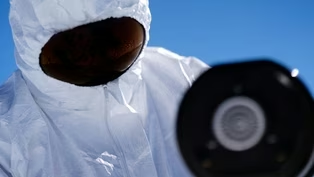
Antarctica's Air-Eating Microbes
Video has Closed Captions
Clip: Ep3 | 3m 54s | No sunlight, no soil to eat. In Antarctica, Dr. Ry Holland finds microbes surviving on thin air. (3m 54s)
Video has Closed Captions
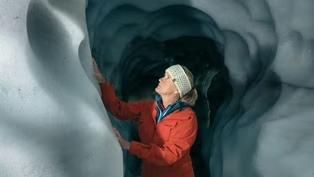
Clip: Ep3 | 3m 39s | Could life beyond Earth hide in ice? Dr. Birgit Sattler finds tardigrades thriving inside a glacier. (3m 39s)
Providing Support for PBS.org
Learn Moreabout PBS online sponsorship New Episode
- Science and Nature

Explore scientific discoveries on television's most acclaimed science documentary series.

 From My Station
 New Season
 New Season






Support for PBS provided by: