
excerpts from FRONTLINE's interviews with
john hillen | lawrence korb | chuck spinney | ralph peters | andrew f. krepinevich

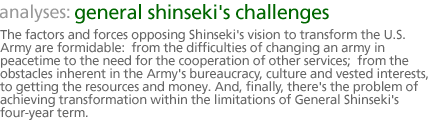
General Shinseki's got two challenges. He's trying to change an army in
peacetime. A peacetime army is, for the most part, nothing more than a large
complex bureaucracy that is heavily engaged every day in very martial tasks.
But it is a bureaucracy. The most popular book in the army right now is
the reissue of an old novel called Once an Eagle by Anton Myrer. The
protagonist is the bold warrior who is operating in wartime and has the virtues
of warfare. He's innovative; he's bold; he's audacious. The antagonist is the
classic manipulative bureaucrat. And their story is the story of the struggle
for the soul of the army. It's the innovative, bold wartime army versus the
bureaucratic peacetime army, which is static, defensive, protecting its turf,
and doing none of the things that allow people to succeed on the battlefield.
So that's one challenge--managing bold innovative change in a peacetime
environment.
Another challenge is trying to have a transformation with the same set of
corporate leadership that is essentially non-transformative. You almost never
get radical transformation in a corporate leadership model in which all those
leaders rose to the top doing business the old way. . . . I have a hard time
seeing how the army can change in the context of its current leadership and
their cultural values.

...The real challenge for General Shinseki is, will there be enough money now
for him to do what he wants to do? Because it's going to mean buying different
type of weapons systems, and spending more on investment than seems to be in
the army budget.
The estimates are $40 billion to $70 billion. Is that money well
spent?
That's money well spent. But I would say to him is, "You've got to make some
trade-offs. I'll let you make the army lighter, but it's got to be smaller. I
want you to cut a couple of divisions. I want you to use the money you save
from that to modernize. I want you to make some hard choices about your
weapons systems. Do you really need all these Crusaders? Do you really need
the Comanches? Do you need the Wolverine and all these other systems that you
were building?"
...
How would you rate General Shinseki's chances of success?
I think he has more than a chance of succeeding. But I have been very
disheartened by the reaction within the army so far to his changes.
What you have is, basically, by making the army lighter, you're going to take
on some of the barons in the army--the people who control the branches, the
artillery and the armor--who like a lot of the systems he is trying to make
smaller or get rid of.
And you see that basically as resistance to the change? . . .
Very definitely. There's always resistance to change, especially when you're
changing the essence of the service. If you want it to happen, you can't have
the chief of the service out there by himself. He's going to need allies
within the office of the secretary of the army and the office of the secretary
of defense who are willing to take on these vested interests. And I haven't
seen anybody really charge up the hill with General Shinseki so far.

What are the major barriers to really changing the army?
By its very nature, the army is extremely tradition-bound. Militaries have to
be tradition-bound in order to stay together in conditions of stress. People
have to have a common outlook, a common sense of values. These traditions in
the army reach back a very, very long time. When you try to reorient yourself
to these changes, you have to go into fundamental belief systems. That makes
it difficult in any bureaucracy. So that's the first problem.
A second problem is that you can't distinguish the need to change from the need
to get budget bucks inside the Beltway in Washington. Part of this is being
driven by the fact that the army feels under siege by the air force and the
navy, and it needs to protect itself in what is a changing world as far as
national security budgets are concerned.
There is a growing proclivity in the United States toward a foreign policy of
what I call "drive-by shootings," where we go bomb somebody and don't even
deploy ground forces. And of course, by its very nature, the army has a hard
time playing in that very game. So the people in the army are afraid that if
they don't do something dramatic, their budget share is going to shrink even
further.
A third factor that is peculiar to the institution of the army is its whole
personnel policy. That is a big impediment to change. The way they manage
people is a big impediment to change. They essentially operate by what is
called an "individual replacement policy." It assumes that people are
indistinguishable cogs in a machine that can be moved around at will. They
manage their forces according to a personnel system that moves individual
people around, rather than organizing units and moving units around. That
makes it very difficult to build up skills and cohesion, and it makes the
individuals in the military more dependent on standard operating procedures and
rote processes. Those rote processes, of course, and the kind of checklist
mentality that goes along with it make it much more difficult to adapt a
change.
If we managed our forces according to units, where we kept units as cohesive
entities, and moved them around, it would be harder for the personnel system.
But then as people learn to work together, and learned each other's strengths
and weaknesses and became a team, just like any other kind of team, they can
then explore more things. They can anticipate how their partners will react,
and it gives them more fluidity.
Do you think that the army as perhaps being more resistant to change than
other services?
No, I think the most resistance to change is the air force.

General Shinseki sent a book, America's First Battles, up to Congress
to try to say you need to prepare--we have had a terrible history of preparing
for the first battle. Is the problem that he's trying to change a peacetime
army?
Desert Storm was one of the worst things that ever happened to the U.S. Army.
It was the last great twentieth-century war. The army performed superbly and
convinced itself that it had all the answers. So we're still dealing with the
legacy of success in Desert Storm, as well as the Cold War. Certainly in
America's first battles, we traditionally have done rather poorly. Sometimes
there were excuses, like starved armies. Today that's not an excuse We have
huge military budgets, in historical terms. So if we fail in a first battle,
you can blame the generals and admirals who failed to call it right and call it
honestly. And you can blame Congress, because ultimately Congress determines
the shape of the force. So I think General Shinseki is absolutely trying to do
the right thing.
The other problem we face is that it's not only the first battle of the next
war. We are in an age of conflict after conflict, intervention after
intervention. And they're not going to stop. If you study the history of the
nineteenth-century army fighting the Indians of the Southwest and the
Northwest, read the War Department records in Washington. And every one of
those was the last one. In other words, there would be no more Bosnias, no
more Kosovos. They're all the last one.
The bad news is we are in for a nearly endless stream of these. The world is
broken and desperate trying to right itself, to find a new balance after the
dissolution of great bloc systems, great empires and dictatorships. It's going
to be decades or longer before these conflicts all play out. So while
preparing for the first battle of the big war, we've got to be able to do a
wider variety than ever of lesser, but often dangerous, and sometimes bloody
things as well. We are not only are not fully prepared for the next big one;
we're not well prepared for many of the little ones.
Some people say the army is too top-heavy.
I'm not convinced by the argument that we have too many generals. I'm
certainly easily convinced by the argument that we have mediocre generals and
admirals. I'm familiar with the pundits and demigods who hold up the
Wehrmacht, the German Army of World War II, and say, "Well, you had a sergeant
leading 30 or 40 men. You didn't need these officers. They didn't have this
many generals."
First of all, the German Army in World War II lost the war. Secondly, the
nature of things has changed. The military force of today, like it or not, is
infinitely more complex than the primitive armies of World War II. We have a
much more sophisticated force technology, more complex in other respects as
well from communications to intelligence. You do need a much greater tail.
The other argument you'll hear is the logistics tail is too great, so let's
just cut the tail. That's foolish. That's an armchair general's argument.
The way you reduce the tail is by changing the combat force. If you
arbitrarily cut tail, it means you can't support the combat force you've
built.
So you've got to take an over-arching view of things. Could you do with fewer
generals? Yes, probably somewhat fewer, if they were better. But these little
arguments about how many angels can dance on the head of a pin just miss the
boat. We need a quality, thinking army that can do pushups and shove in the
bayonet as well. What we have, sadly, is a mediocre Department of Defense
overall--from Secretary Cohen on down.
Can the transformation take place without really restructuring the army? . .
.
There are always plenty of people in Washington and defense pundits willing to
say you can't do this, you can't do that, you must buy this. If people are in
love with the division, the way to deal with it is the way General Shinseki's
dealing with it. Keep the division name, change the brigades. Change the army
that way and let the brigade drive the division into its dotage.
Oftentimes people become so enamored of the name or the flag or the rank. But
as long as let you let them keep the title, you can change the substance.
And I think that's what General Shinseki is doing brilliantly. Is the current
division the structure for the future? Of course it's not. But why wage a
quixotic tilt against windmills, a fight against division, when you can let the
old boys have their division. Change its substance, change its guts. And make
it go away more effectively that way.
...
Why do you think Shinseki will be successful in what he's trying to do?
I'm not convinced General Shinseki will be successful. I hope he will be
successful. But the institutional resistance within the army, the contractors,
the partisans on Capitol Hill who speak patriotism but are worried about PAC
money, they're all stacked against him. He's fighting a courageous fight in
the true American grain. I hope he wins. But at best I'd give him even odds.
And I'd only give him even odds because the future is pressing us toward the
vision and the reality General Shinseki has articulated.
|
| |

The army confronts several problems. One is a resource problem. The army is
already strapped in terms of its budget, so any new initiative has to come out
of its hide. And there's no one right now willing to give the army the slack
it needs, for example, in terms of maintaining forces for the two-war posture
or in terms of its rotations of forces to various peacekeeping operations. So
that's problem number one--getting the resources to do it.
Problem number two is that, to some extent, addressing these problems requires
the cooperation of the other services. For example, if you're looking at
avoiding putting your forces at risk by funneling them through hostile airbases
or major ports, then you've got to talk to the air force about different kinds
of airlifts. You've got to talk to the navy about different kinds of sealifts.
Perhaps a sealift that can deploy forces over beaches, for example, as opposed
to going through ports. And of course, these services are also strapped for
resources right now. What that means is you need leadership from the top. You
need someone--a senior defense official, the secretary of defense--to say,
"Look. What I want you to do is place greater emphasis on preparing for these
kinds of future challenges. And yes, I'm willing to take a little bit of risk
in terms of our ability to wage two wars in the near term. I want to free up
the funds that it's going to take to experiment with new kinds of equipment and
new kinds of operations."
And perhaps, finally, the challenge the army faces is an internal challenge.
What you're talking about here is an emphasis on different kinds of forces.
Typically the forces or the dominant cultures within the army over the last 40
or 50 years have been the heavy mechanized forces, the armor, the mechanized
infantry, and the tube artillery. And what you're saying here is, "You folks
are not going to be unimportant. But you're going to be relatively less
important as we conduct these kinds of operations."
And that's a tough thing to hear when you have a legacy of racing across Europe
as Patton's Third Army, staring down the Soviets during the Cold War, and
winning the smashing victory in Desert Storm. To somehow be told that, "Well,
that was a fabulous job, but in the future you may be less relevant." That's
some pretty bitter medicine to have to swallow.
How much will General Shinseki be able to achieve?
General Shinseki's term is limited to four years. And I think there's a strong
belief on his part that somehow he has to lock down this transformation before
he leaves, lest the forces that oppose change begin to reverse the work that
he's done. Unfortunately, when you look historically at a transformation, a
large-scale change in military organizations, it typically takes at least a
decade, often more, to bring about this kind of change. So in a sense,
Shinseki is caught between a rock and a hard spot. If he doesn't lock it down
quickly enough, he risks his work being undone. If he focuses on the
longer-term challenges, for example the challenge of deploying in the absence
of forward bases, and keeps the process of transformation going, he runs the
risk that his successor won't see the value of that kind of transformation.
How do you assess his chances?
Right now the, the army is focused overwhelmingly on resolving the Task Force
Hawk problem. When you hear the army talk about the interim brigade formation,
the phrase you keep hearing is, "We're going to deploy that brigade 96 hours
after wheels up." To a certain extent, if you look at the growing risks to
forward bases, that's almost akin to the army saying, "We're going to get to
the twenty-first century ambush point more quickly." It's like
Custer saying, "I want to get into the valley faster."
If you don't think through the long-term consequences of the near-term
transformation, what you can end up with is essentially transforming yourself
down a blind alley--ending up with a false or a dead end transformation. You
could get a force in 2010 that solves the 1999 Kosovo problem very well. But
that force isn't really prepared to deal with the challenges of 2010 and 2015.
...
You said that all the military services have walked up to the abyss and
looked down and seen what's required to remake the military, and then stepped
back from the brink. What is scaring them?
This military revolution is presenting new kinds of challenges to the American
military, and that's inducing a rather high level of discomfort. The service
chiefs look at this issue of forward basing access . . . in their own war
games. This would be the abyss. They see how difficult it is. They see how it
challenges some of the dominant service cultures.
For example, the air force is engaged in modernizing its short-range tactical
aircraft. These aircraft have to move through forward bases. They are chained
to those forward bases; they are stuck in those canyons. For the air force to
say, "We need to change. We need to think about other options in addition to
this," is to challenge the dominant culture of the air force today, which is
the fighter pilot culture.
The navy's new attack aircraft that are replacing the ones we're facing now
actually have a shorter range, not longer range. "If we, the navy, want to
help the army and the air force win the battle ashore, we're going to have to
belly those carriers up to the coast, or at least as close as we can get. That
gives us less warning time against anti-ship Cruise missiles or against a
submarine attack." That's challenges the dominant culture of the navy.
It's similar for the army. "Perhaps we can't get those heavy mechanized forces
in there quickly, and perhaps even if we can, we can't support them
logistically the way we'd like to." Again, that challenges the dominant
culture. . . . Perhaps in the future, the army forces will screen the deep
strike assets. In fact, these formations will emphasize long-range
aviation--rocket artillery as opposed to tube artillery, and light infantry in
small formations, as opposed to mechanized infantry. Those are all difficult
operational problems to deal with. But they are also difficult cultural
problems for the services to deal with as well. ...
You say that ultimately, the biggest barrier to change isn't strategic, but
intellectual.
The biggest barrier to change or transformation within the army is not fiscal.
I think it is intellectual. To be sure, the army has resource problems; it has
funding shortages. But the real challenge is in enunciating a vision that
says, "This is where we need to go. This is why we need to transform. These
are the consequences if we don't. There is a penalty that we will incur if we
stay the way we are, if we stay on the course that we presently have set for
ourselves."
There's an absence of that kind of intellectual or strategic breakthrough that
says, "This is the future in which we have to operate. These are the
challenges and opportunities we face in that future that are very different
from today. This is a future that we're not moving towards right now. We're
not on a path to get to this future and operate effectively as an army. So we
need to transform. We need to set up on a different path that's going to
require us to move resources. It's going to require us to create winners and
losers, in terms of systems, in terms of force structure, in terms of army
culture."
It's going to require a Herculean effort to bring our sister services on board.
But if you don't have a clear, compelling, persuasive message, you cannot hope
to persuade a secretary of defense. You cannot certainly hope to persuade
other services, and you cannot hope to persuade the Congress that it ought to
fund you to do this at the expense of other competing priorities.
home ·
experts' analyses ·
interviews ·
army chronology ·
quiz ·
discussion
gore & bush's military agenda ·
readings ·
synopsis
credits ·
tapes & transcripts ·
pbs online ·
frontline
web site copyright 1995-2014
WGBH educational foundation
|





 He is a former Army captain and a former staff member of the Commission on
National Security, a Congressionally appointed independent committee set up to
examine national security issues in the 21st century. He has been a
defense policy adviser to the Bush 2000 campaign.
He is a former Army captain and a former staff member of the Commission on
National Security, a Congressionally appointed independent committee set up to
examine national security issues in the 21st century. He has been a
defense policy adviser to the Bush 2000 campaign. He is vice president of the Council on Foreign Relations and former
assistant Secretary of Defense in the Reagan administration, 1981-1985.
He is vice president of the Council on Foreign Relations and former
assistant Secretary of Defense in the Reagan administration, 1981-1985. An analyst in the Pentagon's Office of Program Analysis and Evaluation, he's
been an outspoken critic of military spending issues dating back to the early
years of the Reagan administration. He authors an email column that is widely
disseminated within and outside the Pentagon.
An analyst in the Pentagon's Office of Program Analysis and Evaluation, he's
been an outspoken critic of military spending issues dating back to the early
years of the Reagan administration. He authors an email column that is widely
disseminated within and outside the Pentagon. A former Army Lt. Colonel and author of several books on the military, he
initially was a skeptic of General Shinseki's efforts to change the Army. He
is the author of Fighting for the Future: Will America Triumph?.
A former Army Lt. Colonel and author of several books on the military, he
initially was a skeptic of General Shinseki's efforts to change the Army. He
is the author of Fighting for the Future: Will America Triumph?. He is executive director of the non-profit Center for Strategic and Budgetary
Assessments and also served as a member of the National Defense Panel. The
Panel was set up in 1997 by the Secretary of Defense to re-evaluate changing
military needs in the new post-Cold War environment..
He is executive director of the non-profit Center for Strategic and Budgetary
Assessments and also served as a member of the National Defense Panel. The
Panel was set up in 1997 by the Secretary of Defense to re-evaluate changing
military needs in the new post-Cold War environment..