
Shenandoah
Monarch Butterfly
Clip | 4m 34sVideo has Closed Captions
The Monarch is the only butterfly on Earth to make a two-way migration across North America.
The Monarch is the only butterfly on Earth to make a two-way migration across North America, but it’s a journey no single individual can finish alone. This 6,000-mile odyssey requires multiple generations to complete. A crucial pitstop on this voyage is Big Meadows in Shenandoah—an open landscape first cleared by Indigenous hunter-gatherers nearly 9,000 years ago.
Problems playing video? | Closed Captioning Feedback
Problems playing video? | Closed Captioning Feedback
Shenandoah is presented by your local public television station.
Shenandoah
Monarch Butterfly
Clip | 4m 34sVideo has Closed Captions
The Monarch is the only butterfly on Earth to make a two-way migration across North America, but it’s a journey no single individual can finish alone. This 6,000-mile odyssey requires multiple generations to complete. A crucial pitstop on this voyage is Big Meadows in Shenandoah—an open landscape first cleared by Indigenous hunter-gatherers nearly 9,000 years ago.
Problems playing video? | Closed Captioning Feedback
Where to Watch Shenandoah
Shenandoah is available to stream on pbs.org and the PBS app.
Providing Support for PBS.org
Learn Moreabout PBS online sponsorship(gentle string music) >>The monarch butterfly.
The only butterfly in the world that makes a two-way migration across North America.
But, unlike birds, this journey takes several generations to complete.
(wings flapping) Starting in spring, monarchs migrating northward from Mexico simply don't live long enough to make the whopping 6,000-mile journey as far north as Canada and all the way back again.
To make the transgenerational journey, this monarch makes a crucial stop, here in Shenandoah.
(gentle music) Like the other monarchs, she can't just stop anywhere to lay her eggs, she needs milkweed.
And luckily for her, Big Meadows is bursting with them.
(gentle music) She can thank indigenous hunter-gatherers for this sanctuary.
Starting around 9,000 years ago, they cleared this area, turning it into a hunting ground.
(grass rustling) From this land, once home to the Monacan, Manahoac, and Massawomeck, endures in a name whose origins remain a mystery, Shenandoah.
Some translate as, "beautiful daughter of the stars."
(pleasant music) (insects buzzing) Today, urban development and pesticides contribute to the sharp decline of monarchs.
(wings flapping) But beautiful havens like these help ensure its survival.
Federally protected from encroachment, the rich soil and wide open space provide the perfect growing conditions for milkweed and the monarchs.
Though the plants are poisonous to most creatures, this butterfly lays hundreds of eggs on them before she dies.
(wings flapping) Milkweed's toxicity doesn't just defend her eggs from predators, it also kickstarts a powerful defense strategy.
When the caterpillars hatch, they begin feeding on the plant.
Most animals couldn't stomach it, but monarchs have evolved this adaptation for a reason.
By absorbing the toxins, they become poisonous themselves.
Their black, yellow, and white stripes send a clear message to potential predators, stay away.
(lively tempo music) (chrysalis crunching) This chemical armor remains with them through their metamorphosis into adult butterflies.
(lively tempo music) (birds chirping) From here, the monarch's journey continues, led by the next generation.
(wings flapping) (gentle music) But how these torch bearers know to navigate these specific flight paths, and when, requires an extraordinary sixth sense, a kind of biological compass that uses the sun's position and their own circadian clock to guide them on their epic transgenerational voyage.
(gentle music) (wind howling) (gentle music)
Video has Closed Captions
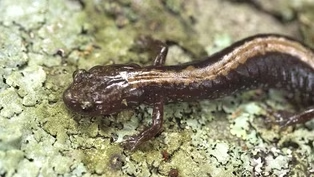
This ancient resident is one of the most geographically restricted vertebrates on the planet. (2m 42s)
 Now Playing
Video has Closed Captions
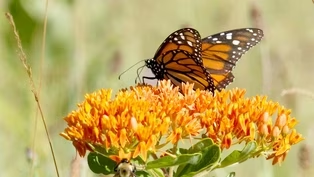
The Monarch is the only butterfly on Earth to make a two-way migration across North America. (4m 34s)
Video has Closed Captions
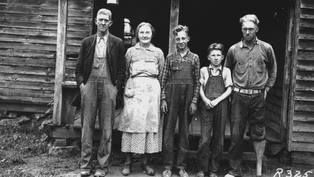
Shenandoah National Park is celebrated as a protected wilderness, but its creation came at a cost. (5m 52s)
Video has Closed Captions
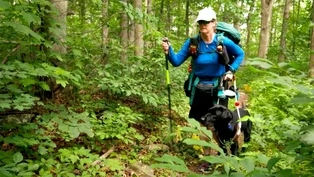
Mary Wilson is on a quest to become the first blind woman to complete the Appalachian Trail. (3m 11s)
Video has Closed Captions
Beneath the forest floor lies a subterranean backbone that nourishes and regenerates life. (2m 40s)
Video has Closed Captions
In the lengthening days of spring, Shenandoah's bucks undergo a rapid transformation. (2m 44s)
Video has Closed Captions
American Eels begin their lives as microscopic larvae drifting across the Atlantic. (3m 35s)
Video has Closed Captions
The Eastern Hemlock is a giant of the forest, living for centuries & serving as a keystone species. (4m 25s)
Video has Closed Captions
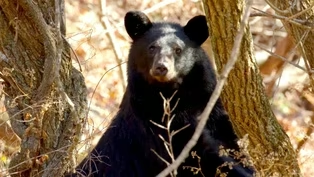
This iconic keystone species nearly vanished when the park was founded in 1935. (3m 54s)
Video has Closed Captions
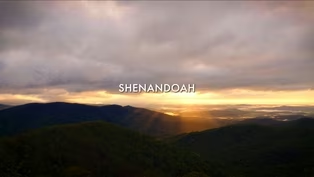
Discover the majesty of Shenandoah, an ancient wilderness alive with constant change. (1m 15s)
Providing Support for PBS.org
Learn Moreabout PBS online sponsorship New Episode
- Science and Nature

Explore scientific discoveries on television's most acclaimed science documentary series.
 New Episode
- Science and Nature

Capturing the splendor of the natural world, from the African plains to the Antarctic ice.

 New Episode







Support for PBS provided by:
Shenandoah is presented by your local public television station.