
Shenandoah
The Hemlock Wooly Adelgid
Clip | 4m 25sVideo has Closed Captions
The Eastern Hemlock is a giant of the forest, living for centuries & serving as a keystone species.
The Eastern Hemlock is a giant of the forest, living for centuries and serving as a keystone species throughout Shenandoah's ecosystem. But today, these ancient trees are under siege by an invader almost too small to see: the Hemlock Woolly Adelgid. These tiny, invasive insects have wiped out a staggering 95% of the park’s hemlocks, leaving skeletal remains across the hillsides.
Problems playing video? | Closed Captioning Feedback
Problems playing video? | Closed Captioning Feedback
Shenandoah is presented by your local public television station.
Shenandoah
The Hemlock Wooly Adelgid
Clip | 4m 25sVideo has Closed Captions
The Eastern Hemlock is a giant of the forest, living for centuries and serving as a keystone species throughout Shenandoah's ecosystem. But today, these ancient trees are under siege by an invader almost too small to see: the Hemlock Woolly Adelgid. These tiny, invasive insects have wiped out a staggering 95% of the park’s hemlocks, leaving skeletal remains across the hillsides.
Problems playing video? | Closed Captioning Feedback
Where to Watch Shenandoah
Shenandoah is available to stream on pbs.org and the PBS app.
Providing Support for PBS.org
Learn Moreabout PBS online sponsorship(gentle music) >>The towering eastern hemlock lives for centuries and can grow up to 160 feet.
At these heights, they shade river streams, shelter creatures, and shape the park's entire ecosystem.
But even giants can fall, and sometimes all it takes is something almost too small to see.
(gentle music continues) Here, a tiny invasive insect is laying siege, transforming the ecosystem in its path, the hemlock woolly adelgid.
Spreading quickly, the microscopic insects hatch from woolly masses.
Clinging to hemlock branches, they feed on the trees' internal food sources, and drain the trees of life.
(gentle music continues) Accidentally introduced from Japan via global trade, these tiny invaders have infested the entire span of the Appalachian trail and beyond, leaving skeletal remains scattered across the hillsides.
(gentle music continues) Lacking natural predators, the adelgid has spread unchecked, wiping out a staggering 95% of Shenandoah's hemlock trees.
(gentle music continues) To counter this, the National Park Services' biological technicians are introducing natural predators, species that have evolved alongside the pest in its native range, like the Laricobius beetle, a tiny but powerful ally in the fight to save hemlocks.
>>It's always a little scary to introduce a non-native to control a non-native, but these beetles are very specific.
They feed entirely on the adelgids.
And here at our park, we waited a long time just to make sure it was safe.
Without some kind of control, we feel like we're gonna lose all our hemlocks.
They are so important to our ecosystem.
They're classified as a keystone species.
If you take the keystone out of an arch, the whole arch falls apart.
(gentle music continues) Our middle school group came out and we were emphasizing how important the hemlocks are.
If we lose our hemlocks right here, it's going to change the nature of this little ecosystem.
And so one of the students spoke up and said, "Yeah, we need a lot of duct tape to put it back together or keep it together."
And another student spoke up and said, "Yeah, the Lari beetles are the duct tape for the hemlock ecosystem," which I thought was very insightful and a good way to put it.
If we don't do something, we're gonna lose our hemlocks and things are gonna really change in our forest.
(gentle music continues) The hemlock woolly adelgid, they'll be here, I think, forever, but we hope eventually there will be that balance established where we'll have enough natural controls to keep them in check.
(gentle music continues) We do see some regeneration.
I see little seedlings coming along.
We feel like with ongoing efforts that a percentage of our forest will be hemlocks in years to come.
(gentle music continues) (wind swishing) (wind swishing continues) (gentle music)
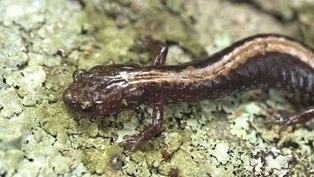
Video has Closed Captions
This ancient resident is one of the most geographically restricted vertebrates on the planet. (2m 42s)
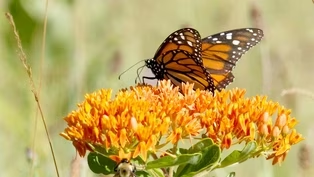
Video has Closed Captions
The Monarch is the only butterfly on Earth to make a two-way migration across North America. (4m 34s)
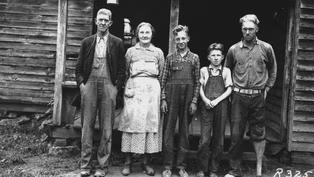
Video has Closed Captions
Shenandoah National Park is celebrated as a protected wilderness, but its creation came at a cost. (5m 52s)
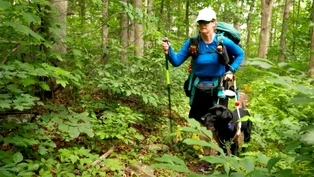
Video has Closed Captions
Mary Wilson is on a quest to become the first blind woman to complete the Appalachian Trail. (3m 11s)
Video has Closed Captions
Beneath the forest floor lies a subterranean backbone that nourishes and regenerates life. (2m 40s)
Video has Closed Captions
In the lengthening days of spring, Shenandoah's bucks undergo a rapid transformation. (2m 44s)
Video has Closed Captions
American Eels begin their lives as microscopic larvae drifting across the Atlantic. (3m 35s)
 Now Playing
Video has Closed Captions
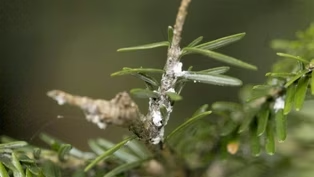
The Eastern Hemlock is a giant of the forest, living for centuries & serving as a keystone species. (4m 25s)
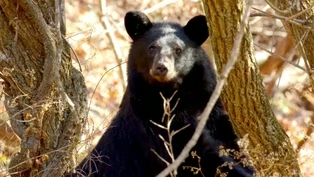
Video has Closed Captions
This iconic keystone species nearly vanished when the park was founded in 1935. (3m 54s)
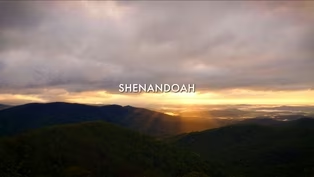
Video has Closed Captions
Discover the majesty of Shenandoah, an ancient wilderness alive with constant change. (1m 15s)
Providing Support for PBS.org
Learn Moreabout PBS online sponsorship New Episode
- Science and Nature

Explore scientific discoveries on television's most acclaimed science documentary series.
 New Episode
- Science and Nature

Capturing the splendor of the natural world, from the African plains to the Antarctic ice.


 New Episode







Support for PBS provided by:
Shenandoah is presented by your local public television station.