
Outdoor Elements
Native Plants for Gardens at Wellfield Botanic Gardens
Clip | 27m 58sVideo has Closed Captions
Native plants are thriving at Wellfield Botanic Gardens!
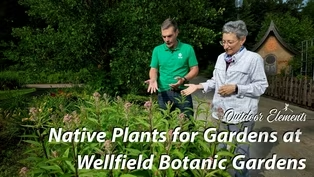
Native plants are thriving at Wellfield Botanic Gardens! Discover how these plants support birds, butterflies, bees, and other wildlife as Kyle Strain shares why they're an important part of the garden's landscape. Evie explores the gardens to learn how native plants can make a difference in your own backyard.
Problems playing video? | Closed Captioning Feedback
Problems playing video? | Closed Captioning Feedback
Outdoor Elements is a local public television program presented by PBS Michiana
Outdoor Elements
Native Plants for Gardens at Wellfield Botanic Gardens
Clip | 27m 58sVideo has Closed Captions
Native plants are thriving at Wellfield Botanic Gardens! Discover how these plants support birds, butterflies, bees, and other wildlife as Kyle Strain shares why they're an important part of the garden's landscape. Evie explores the gardens to learn how native plants can make a difference in your own backyard.
Problems playing video? | Closed Captioning Feedback
Where to Watch Outdoor Elements
Outdoor Elements is available to stream on pbs.org and the PBS app.
Providing Support for PBS.org
Learn Moreabout PBS online sponsorshipI'm at Wellfield Botanic Gardens in Elkhart County, Indiana, and it's a beautiful 36-acre gem here in Elkart.
And we're going to talk about native plants for gardens right here.
And in just a minute, I am going to catch up with Kyle Strain, who is the manager of public horticulture here, and we're gonna see how they've incorporated native plants into this botanic garden.
So now we are at the start of the children's garden and I'm now with Kyle and first Kyle, tell us what you do here at Wellfield Botanic Gardens.
Hi, I'm the horticulture manager here at Wellfield Botanic Gardens, and along with our amazing horticultural staff, we maintain our living plant collections and the garden spaces that we see around us.
And we also maintain our plant collections database, which is important as well, and maintain the health of the plants.
I bet that keeps you busy.
It is.
Yes, I'm very busy.
I love my job, but yes, I am.
Never a dull moment.
Even in winter, I know.
Everybody's busy here.
So we're going to talk a lot about native plants, native plants incorporated into gardens, landscaping, et cetera, which I know you're a big fan of.
But there's lots of different kinds of collections here.
Some are ornamental, some that you've done a lot of native work.
So let's first start out with what is a native plant.
A native plant is a plant that occurs naturally in a region or climate that was not introduced by humans.
It's been there for quite some time.
Okay, all right.
And I think it's really interesting that Wellfield has incorporated many native plants and I think that's over time been increasing.
It seems to be that there's more and more.
So we're at the start of a very, what I would call, natural looking garden.
So maybe we can take a look.
Tell me what's here behind us.
So right here at the entrance to our children's garden this is our native prairie and so yes we have an eclectic collection of plants throughout the gardens but we have some areas dedicated solely to native species and this is one of them.
Okay, well how about if we walk along and we can talk about some of the plants.
If folks have like a larger area that they wanna fill with native plants, this is one way to do it, right?
Definitely.
Okay, let's take a look.
So as we come into our prairie here, you see off to the left is a beautiful, native flowering plant, Sambucus canadensis, which is our native elderberry.
It's in full bloom right now.
We have several of these throughout the gardens, especially along our shoreline areas.
And those also produce berries that are a really valuable food source for birds.
For birds, which is a good point about native plants, right?
They provide a role, a service, to birds and insects.
I think sometimes we have to rethink our garden plants.
We don't maybe get nervous if insects are eating them.
If something's not eating some of your plants, then it's not part of the ecosystem.
And sometimes I think we forget that plants aren't just intended to look pretty, they also are a food source and a shelter source for insects and wildlife.
Excellent.
Okay.
And that one's a good example.
Yeah.
All right.
So there's some really large plants in here, some of which may be okay for people's home gardens.
Yeah, some maybe not.
Some maybe not, it depends on your space.
If you're planting a flower bed really close to the house, up by the house you may not want this really cool plant, which this is prairie dock.
It has these, the leaves can get two feet.
They're so cool.
They're so cool, though, they're really.
They are massive and then it's starting to send up its stems, which will bloom next month.
But these stems can reach heights of 10 feet.
And so this is something you may want in the backdrop of a garden or if you're designing and you want a meadow space or a prairie space, this is a good one.
It really doesn't require much work on your part.
It sends down really deep tap roots and we don't, we don't have to water this much at all.
Which is true for a lot of natives, right?
It is true.
Yeah, yep.
That's great, okay.
Oh, I like this little purple one over here.
This is cute.
This is spiderwort, or Ohio spiderwort sometimes called.
It's Tratiscanthia ohiensis.
That's another beautiful one that we have throughout the garden spaces.
And as I recall, they open in the morning.
Up later.
Yeah, so pretty.
Really nice.
Super nice.
Ah, okay.
Here's a nice cheery yellow one, right?
Yes, so this one is the one many people will know.
This is Rutebeckia or Black-Eyed Susan.
This is rutebechia hurta, which we haven't discussed cultivars, but there are many popular landscape cultivars that are bred from this species.
It's just a cultivated variety that's often been bred for ornamental values and characteristics.
But this is the native species.
Nice, so the true species, the straight species.
Yeah, that's really pretty.
So cheerful, right?
And also good for birds, right, like later in the season when it goes to seed.
Yes so our prairie, so when we walk around the gardens you may see some more manicured spaces that we keep a bit tidier and that's important for some of our spaces but then for our natural spaces for instance we don't cut this back in the winter time.
We let it kind of be until later into the spring.
We want those seed heads to be available for birds.
And it can be a shelter source for insects and wildlife, too.
Yeah, a lot of insects overwinter in the stems of plants, standing plants, so it's this giant one over here.
This one is, so it's related to prairie dock that we just talked about.
It's in the same genus.
It's, this is silphium lacinatum or compass plant.
It has got this really cool deeply lobed leaves.
It's very sandpapery and they kind of look like a sunflower which they're in the same family.
And they're kind of facing the morning sun this morning, which is nice.
That's great.
These are one that's great to have back in the prairie a bit, too.
And then the surrounding plants also help support them.
Although these stems are really strong and they tend they may bend a bit but they stand to stay pretty upright.
Pretty upright.
Yeah, and I think that's a good point too.
There's a new term to me called chaos gardening, where it's just like, you know, you just put everything in there and let it grow.
Yeah.
And I think this is kind of a good example.
Everything's really tight, everything's supporting each other structurally.
Yes.
And, I think, that's good thing to remember, especially with some of these taller native plants.
Definitely.
All right, let's see what else we got here.
Oh, wait, already?
Look at this.
It's June, and there's golden rat.
Yes.
Yes, this is early goldenrod, hence the name, so that's starting to bloom now.
That's Solidago juncea and that's a great, goldenrods are what's known as a keystone species which means they have a very high impact ecological value.
So they provide food and shelter to many different species.
Very nice excellent and colorful.
I mean, it's just so colorful.
Yeah Great.
Oh Now this is striking So this, some people may recognize this.
There's a common landscape plant called false indigo, which a lot of people like to plant.
This is a different species.
This is our native species, Baptisia lactea, and it naturally grows in prairies and it requires very few resources maintained.
Like once these are established, they really don't require much water.
They have a beautiful flower, as you can see there.
It is real.
It is really pretty with these really like almost purple stems yes right and i like the foliage is really pretty delicate really nice that's great so much fun stuff really nice oh this is one of my My favorite.
Mine too.
Yeah.
Culver's root.
Yes.
This is Culver's Root, Veronicastrum virginicum.
This is one of my favorite natives as well.
It's just got really beautiful spiky blooms.
Really nice.
We have some of this in some of our more traditional gardens as well.
Okay.
Yeah.
So it's kind of at home or looks at home in both kinds of gardens.
It can, yeah.
I think it has very high ornamental appeal.
Yeah, it does, right?
It's just really nice.
Oh, and right here next to the drinking fountain, look at this beautiful milkweed.
Okay, this is one of my most favorite fragrances.
It is, it smells really nice.
That's common milkweed, and people may know that one pretty well because it's the main host plant for the monarch butterfly.
That's great.
I'm going to snip it.
That's just like the best smell.
And I know all kinds of other pollinators.
That's true.
Yes, absolutely.
Oh, is this dogbane?
Yes it is.
So dogbane was actually planted on our shorelines and it's it's not necessarily intended to be in the prairie.
Here it is!
This is one of our slightly more aggressive native species so if you have like an area you want to keep a little tidier and you don't necessarily have the need for a competitive plant you may not want to plant this but it's this is also in the milkweed family.
Can I pinch off a little piece, right?
So I should get some milky sap there, right, let's see.
Oh yeah, look at that.
Just like milkweed.
And that sap is toxic to a lot of animals, and that's what helps monarchs get their defense mechanisms.
So they consume that, and then they become toxic to predators.
Themselves, the predators, yeah.
That's great.
It's kind of pretty.
It is pretty, yes.
It just grows.
It's got those red stems and a nice blue, yeah.
But it'll fill your space.
Yeah, we will All right.
So... Peeking out down here.
Yeah, so this is uh, it's funny to see it so down low, right?
But this is orange milkweed or butterfly milkweed, right, another kind of milkweed.
Another kind of milkweed and that can also be used as the host plant for monarchs.
That's a really pretty one, that's my favorite I think.
And that's one I see in more traditional formalized gondolas.
Often you do.
Because it... Yes.
Can be a little more contained, a little bit more behaved.
Yes, more behaved in a... Yeah.
In a traditional landscape.
So this is a, this area is a great example of if you have a large space or you're comfortable with tall sun loving plants, right?
But you've got lots of other types of gardens here.
And I thought maybe we could stroll around and take a look.
Yeah, that sounds great.
And maybe even talk about, you know, are they easy to care for, or are there some that need a little bit more care?
We have some of both.
Yeah, I bet you do.
All right, let's take a walk.
All right.
Kyle, are native plants easier to grow than ornamental non-native plants?
Often they are.
However, even though these plants are native to our region and they've adapted to our soil characteristics and our climate, it's still important to match the plant to the site conditions.
For instance, this is Eutrochium maculatum or a spotted Joe pieweed.
It's a great native.
It's often well-behaved.
It spreads slowly by self seeding, but it stays in nice clumps and it's a beautiful plant.
However, you don't necessarily want to plant this on a sandy hill in full sun.
It's gonna wilt, you're gonna have to water it a lot, the leaves may scorch.
This does best when the soil stays fairly moist around it.
It's great when you're planting it near water sources or in low areas, like a rain garden.
And if it's not getting all day sun too.
So this plant's native to our county, but it's still important to match it the proper condition.
To the right spot.
Yes.
Okay.
All right.
Beautiful pink flowers, right?
Just getting ready to fully open.
Yep.
So exciting.
I mean, I just love it.
And then it gets fluffy seeds.
It does.
Yeah.
It does, yeah.
The seeds are honestly almost as attractive as the flowers.
Okay, all right, well let's keep walking.
All right.
Hey Kyle, I think lots of times we think of incorporating native plants that are perennials, but shrubs are very important for structure.
Absolutely.
So this is a big one, but what is this?
This is Spicebush or Lindera benzoin.
It's one of my favorites.
If you rub the leaves, it's got a great kind of spicy scent to it, hence the name.
This produces really beautiful yellow flowers in the early spring, and then it produces berries later in the season.
It's starting to form fruit now.
Starting to form the fruit, which birds love.
Birds love this, is also the main host plant for Spicebush Swallowtail butterfly.
It's a good reminder that, again, native plants play a role in supporting our insects.
I like to think of this as a good substitute for forsythia.
It is.
Yes.
Because it gets those little yellow flowers.
Not quite as showy as Percipia, but.
I think it also has beautiful bark and structure too, as well.
Nice contrast.
This is kind of a fully mature... This is a big one.
Yes.
We have some smaller ones throughout the rest of the gardens, but yeah.
It's really nice.
We do keep a fence around it because beaver like this plant a lot too.
No kidding that's why.
That's why this fence is here.
Yes.
I didn't know that.
Yep.
Wow.
They'd cart it off It's great Lots of times people ask about, is there a native vine that I can grow?
This is one of them.
This is one of them.
All right.
Alright, so what is this?
This is our native clematis, clematus virginiana.
And this, many people don't realize we have a native species of clematas, like you said.
And it's a great alternative to clematos turniflora or sweet, it's also known as sweet autumn clemates, which is an invasive species.
Invasive, right?
Yes, so this one is a lot better to plant.
However, it does require a little bit of maintenance to keep up.
It's great if you have an arbor or something for it to climb.
You do have to do a little bit of pruning to keep it in check or in bounds, but it has beautiful white flowers in the late summer and they're also really fragrant, same as the invasive species.
Yeah so good good so have some good support yeah at the end of the season or before winter then do you do something to this vine?
We actually cut it all the way back.
Sometimes we'll leave about a foot of growth at the bottom, but it's not really necessary.
You can cut this all the back once a season and it'll regrow in the spring.
You know, sometimes I see people buying sweet autumn clannotus thinking that it's native.
The native variety has these jagged leaves.
Yes, the leaves are serrated like that, so the invasive species has smooth margins on the leaves, so that's a good way to tell them apart.
Well, let's keep strolling.
Kyle, we've talked a little bit about shrubs, but small trees are something that often people are looking for to incorporate in their yards.
And there's some great native choices.
This is one of them.
Yes this is Circis canadensis many people know this one this is flowering redbud and they have beautiful structure.
We do prune these so we're in our Japanese garden right now and so everything is esthetically pruned in this garden but it really they have a natural structure that we really just try to emphasize and bring out but they're a great ornamental native.
Flowers in this beautiful profusion of pink in the spring.
Yes, it does.
And then this is another one that flowers in the spring.
What's this one?
This is one of my favorite native trees.
This is prunus americana, or wild plum.
And it blooms profusely in the spring.
White blooms, they're very fragrant and sweet smelling.
It's got beautiful bark on it.
It's kind of that smooth cherry bark that you often see.
And it does grow a lot in a season, but it stays relatively small.
It's more of a lower growing tree, a small ornamental, and then great in a landscape.
Good choice for somebody who has a smaller yard, but still not some kind of a tree.
And then here in the Japanese garden, there's like lots of, I see lots of ground cover.
So way over here, I what looks like some sedges, right?
Yeah.
That's our native Pennsylvania sedge.
OK.
And this is a great spot for it, this slope faces north.
And so it gets a decent amount of shade and it grows really well here.
This is a grass alternative also.
If you have a real shady spot where grass isn't gonna grow and you just wanna get rid of some turf.
Some lawn.
Some lawn, exactly.
Exactly.
Which really doesn't do much for our wildlife.
No.
So you can plant it and it'll fill in between each other, right?
Yes.
It's got that nice, flowy, like, kind of long grass feel and... It's really pretty.
We actually mow this once a year, it requires really little maintenance but we set the mower blades really high on a push mower and we mow it down in early spring and then the new growth flushes out and you get this.
Nice.
And then kind of up on the hillside, there's another native wahoo.
Yes, Eastern Wahoo is our native euonymus.
When people hear euonymous, they think burning bush.
Yes, same genus, but this one is native, not invasive.
You also get the beautiful fall color on these leaves.
And I think the best ornamental appeal for this one is the fruit.
In the late summer to fall, it gets really showy, pinkish red fruit.
And it's also a valuable food source for birds.
Great now you have one other space here that is also kind of natural right?
That's mostly woodland Yes, so how about if we walk through that yeah?
Let's do that, okay?
You know, sometimes natives can give us food as well.
Earlier, you mentioned the elderberry, which gets those nice purple berries for jam and stuff.
But this is another one, right?
Yes.
So what is this?
This is our native pawpaw tree, and it's starting to produce fruit right now.
It has kind of some stinky, not nondescript flowers in the spring, but then it produces this really tasty fruit, and it matures into September.
And I think it's a combination of like a mango and a banana texture.
Yeah, it's real custardy when it's ripe.
It's real custody.
They're quite delicious.
So these will get larger.
These dropped off, probably because we've had so much rain lately, but almost like dark purpley blotches on them when they're really ripe.
But that's kind of what the fruit looks like.
The leaves also have that really unique fragrance when you crush them.
Sometimes kids tell me green pepper or asphalt.
Yeah, asphalt, yeah.
So anyway, a fun one to have if you've got the space and you're looking for a tasty edible that's a native plant.
All right, let's make our way to the woodland spot.
Kyle, this space looks really different from, for example, the Japanese garden that we just came from that's much more formal.
This looks much more natural.
What is this space?
This is our Woodland Conservation Garden, and our main goal here is to have predominantly regionally native species and let natural ecosystem processes play out.
So we keep this very natural on purpose.
We let fallen trees decay on the ground.
We let the leaf cover stay.
The main work we do in here is removing invasive species to help our natives thrive.
But yes, it's a lot different upkeep than a formal garden like our Japanese garden Why does Wellfield feel like this is an important style of landscaping to maintain or to even have here at a Botanic Garden?
Well, for one, conservation is very, very important to us.
So we have our children's prairie, we have this space.
We have in our master plan, our wetland conservation garden that's yet to be built.
So this has always been an important thing to us, we wanna be good stewards to our 36 acres.
And we wanna have a beneficial impact on the surrounding environment as well.
But we also like to use some of these spaces.
They're great at being interpretive experiences and educational tools as well.
And I think native plants definitely play an important aspect in it.
Yeah, good, good good.
So for example, if you do have in your yard like a really shady spot with some big trees, this is the kind of space that you could have that would be really beneficial to insects and birds and wildlife.
Yes, absolutely, yeah.
So as we're walking, maybe you can tell me a little bit about why gardeners should think about what plants are native to their own county.
Yeah.
So it's important for a couple reasons.
Native plants that are native to your county, your region, they've evolved here for thousands of years and they've co-evolved alongside our area's wildlife.
And so many of our native insects and birds have adapted to need these and rely on these plants as hosts or food sources and shelter sources.
And so for instance, Parts of Asia share a hardiness zone with our area, but when we interchangeably plant species from other parts of the world, our native wildlife may not recognize that as a food source.
As a food source or a place to lay eggs, or propagate more insects, right?
So, much more limited.
The other reason I think is, like we kind of talked about before, plants that are native to our region have adapted to our climate and our soil conditions and land forms and so they're quite resilient to our area and often require fewer resources.
So easier to grow in many cases, right?
Just easy, well adapted to our climate and our soil.
So, oh, look, I love this grass.
This is bottle brush.
Lottal breast.
So it's like the most perfect name for this plant, right?
You could scrub a bottle with this.
Nice native grass, super pretty.
Comes up like wherever the seeds land.
Yep, we have a few of them scattered throughout the woodland.
So pretty.
All right, well, let's keep strolling.
You talked a little bit about thinking about county-specific natives.
And for a gardener who's interested in putting native plants in their yard or their landscape, you've given us lots of ideas, things to think about.
But there's a new, relatively new resource that you are a big part of that I think can help people select plants, think about what might work in their garden.
Yes, so there's a new book that's been done through the Wild Ones South Bend chapter.
Wellfield was the sponsor of that as well, but this is a unique resource because it's hyper specific to just our surrounding counties, the Michiana area, which it's a valuable resource for selecting plants and what to put where in your yard.
So let's, I think we've got a copy, I know you sell it here in the gift shop, but we've got an extra copy up here by the building, so let's go take a look at that.
Alright.
We're in the gift shop right now, which is where, here at Wellfield Botanic Gardens, this book is sold.
Native Plants for Michiana, Planting with Nature and Beauty in Mind.
Great resource.
The committee that created this book was all local, including you, which is great.
And you said Wellfield was a sponsor, which is terrific.
What do you think is valuable about this for gardeners?
We've broken it down into forbs, grasses, trees, and shrubs for people to take a look at depending on what they want for their space.
It goes in depth into 180 different species are in the book and we talk about the best kind of site conditions, how large these plants get, how well they kind of cooperate with other plants.
And we also have a map.
That shows which counties they're native to.
So it's a great resource.
It also tells you the light conditions and which kind of insects it attracts and pollinators.
So it a really great resource for a homeowner or someone even in the landscape industry when selecting plants for a certain location.
That's great, and in addition to this photo information, as you mentioned, with the range maps for the counties and the growing conditions, there's also articles.
We talked a lot today about insects, and again, all written by folks like you and others in the region who are knowledgeable about how to plant in containers or how to put soft landings under your trees for insects or how attract birds, so.
A great resource.
It is.
If folks are not near Wellfield Botanic Gardens, Wild Ones South Bend has a website where the sale locations are listed and that is southbend.wildones.org and that has kept up to date with all of the various locations, but if you're close by to Elkhart and you want a lovely walk and you wanna come here and purchase the book, it's available here as well.
And come see some of the plants in the book out in the garden.
Out in the gardens.
Well, this has been a lovely exploration of Wellfield Botanic Gardens.
Kyle, thank you so much for spending some time.
I know you're super busy and now you need to go back out to the gardens and do some work, but I appreciate you sharing all this information with us.
Yes, thank you, Abby.
It's been fun.
Thanks.
Remember you can find your own outdoor elements when you visit area parks and natural areas.
We'll see you soon.
A Fungus that Looks like Fido's Nose
Video has Closed Captions
Clip | 4m 49s | A Fungus that Looks like Fido's Nose (4m 49s)
Video has Closed Captions
Clip | 9m 22s | It’s time for a little late summer cleaning! Evie cleans out her birdhouses and takes a (9m 22s)
Clip | 2m 58s | Evie takes a closer look at the Veiled Amanita and discovers the unique feature that gives (2m 58s)
 Now Playing
Native Plants for Gardens at Wellfield Botanic Gardens
Video has Closed Captions
Clip | 27m 58s | Native plants are thriving at Wellfield Botanic Gardens! (27m 58s)
Video has Closed Captions
Clip | 3m 15s | Spiny and Pink: Musk Thistle (3m 15s)
Primed for Pollinators - Corson Riverwoods County Park
Video has Closed Captions
Clip | 12m 22s | No description (12m 22s)
Video has Closed Captions
Clip | 2m 42s | Evie takes a closer look at some unusual fungus. (2m 42s)
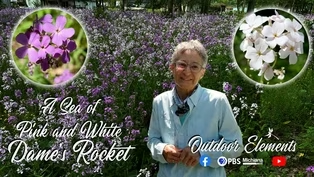
A Sea of Pink and White-Dame's Rocket
Video has Closed Captions
Clip | 4m 34s | Evie takes a closer look at Dame's Rocket, a non-native plant that can crowd out native wi (4m 34s)
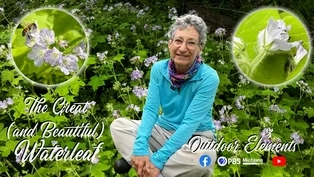
The Great (and Beautiful) Waterleaf
Video has Closed Captions
Clip | 4m 28s | The Great (and Beautiful) Waterleaf is putting on quite a show! (4m 28s)
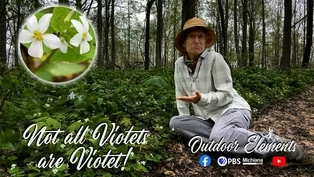
Video has Closed Captions
Clip | 3m 27s | 🌸🤔 Are all violets actually violet? Not quite! (3m 27s)
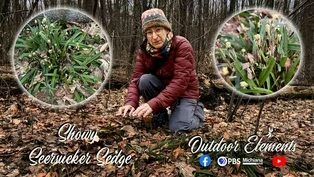
The Sedge with Edges: Discovering the Seersucker Sedge 🌿
Video has Closed Captions
Clip | 3m 10s | Even in late winter and early spring, some plants really stand out along the trail! Evie c (3m 10s)
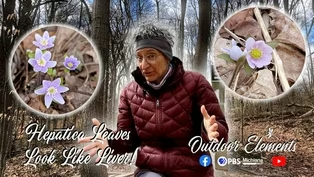
Why This Flower is Named After a Human Organ
Video has Closed Captions
Clip | 3m 3s | Early spring hikes are full of hidden gems! While out on the trail, Evie discovered some S (3m 3s)
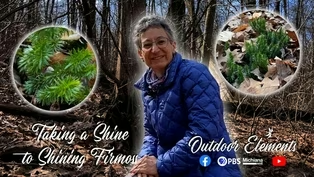
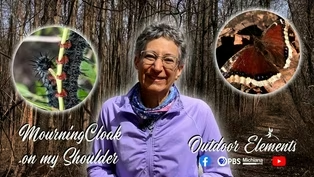
Video has Closed Captions
Clip | 4m 42s | Looking for a tiny sign that winter is on its way out? Evie hit the snow-covered trails in (4m 42s)

Video has Closed Captions
Clip | 6m 54s | 🦆❄️ When winter tightens its grip, the waterways tell a different story. (6m 54s)
Video has Closed Captions
Clip | 3m 2s | Take a winter walk with us at Fernwood Botanical Garden! (3m 2s)
Video has Closed Captions
Clip | 4m 20s | 🦉🌲 WHOO was here? While walking along a wooded path, Evie came across a mysterious p (4m 20s)
Barking Up the Right Tree: Norway Maple
Video has Closed Captions
Clip | 4m 30s | No description (4m 30s)
Don't Toss Those Holiday Lights! | OE
Video has Closed Captions
Clip | 8m 25s | 🎄✨ Got holiday lights that no longer sparkle? Don’t toss them! ♻️ In this ep (8m 25s)
Video has Closed Captions
Clip | 3m 38s | 🍂✨ Out on a fall walk in the woods, Evie stumbled upon a sweet seasonal surprise — (3m 38s)

Urban Transformation at Milkweed Gardens
Video has Closed Captions
Clip | 17m 11s | No description (17m 11s)
Video has Closed Captions
Clip | 11m 50s | 🌿🖊️ It’s time to slow down and connect with nature! In this episode of Outdoor E (11m 50s)
Video has Closed Captions
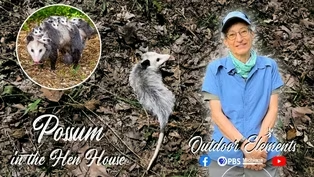
Clip | 3m 20s | 🐔👀 There’s a possum in the hen house! 🐾 On this episode of Outdoor Elements, E (3m 20s)
Video has Closed Captions
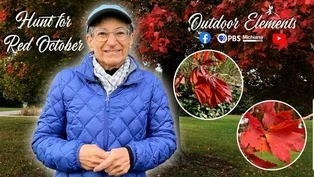
Clip | 2m 57s | 🍁 It’s that time of year when nature puts on its most colorful show! 🌳 In this epi (2m 57s)
Video has Closed Captions
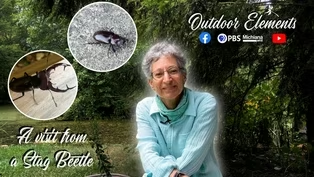
Clip | 3m 36s | 🌿🪲One of our awesome viewers spotted a beetle making its way across the driveway and (3m 36s)


Video has Closed Captions
Clip | 3m 24s | A viewer shared a fascinating video of a Paintedhand Mudbug, and Evie dives into the detai (3m 24s)
Pretty in Pink for Pollinators
Video has Closed Captions
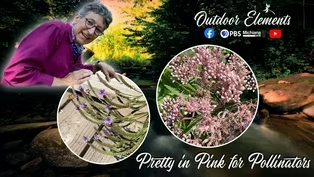
Clip | 5m 3s | At Lydick Bog Nature Preserve, Evie spots a burst of pink in a wetland. She explores these (5m 3s)
Another Milkweed Specialist: Milkweed Tussock Moth
Video has Closed Captions
Clip | 4m 36s | No description (4m 36s)
Video has Closed Captions
Clip | 3m 43s | Evie spotted Pointed-leaf Tick-Trefoil and shares how to identify this plant. (3m 43s)
The Unique Flowers of Buttonbush
Video has Closed Captions
Clip | 3m 58s | Evie finds Buttonbush at Spicer Lake Nature Preserve (3m 58s)
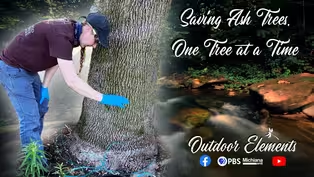
Saving Ash Trees, One Tree at a Time
Video has Closed Captions
Clip | 11m 16s | No description (11m 16s)
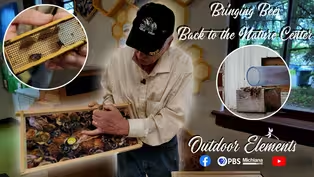
Bringing Bees Back to the Nature Center
Video has Closed Captions
Clip | 6m 10s | No description (6m 10s)
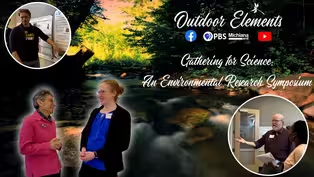
Gathering for Science: An Environmental Research Symposium
Clip | 10m 27s | Evie stops by the St. Joseph County Public Library during their Earth Day celebration to c (10m 27s)
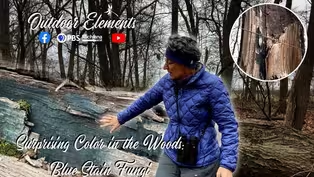
Surprising Color in the Woods: Blue Stain Fungi
Video has Closed Captions
Clip | 3m 48s | No description (3m 48s)
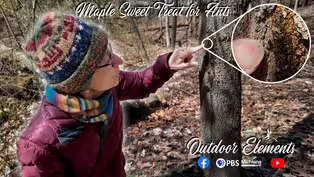
Maple Sweet Treat for Ants | Outdoor Elements
Video has Closed Captions
Clip | 1m 34s | A sweet surprise in the woods! (1m 34s)
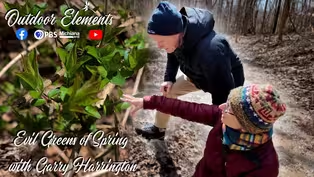
Evil Greens of Spring with Garry Harrington
Video has Closed Captions
Clip | 12m 56s | Things are greening up in the spring woods, but it’s not necessarily a welcome sight. (12m 56s)
Providing Support for PBS.org
Learn Moreabout PBS online sponsorship New Episode
- News and Public Affairs

Top journalists deliver compelling original analysis of the hour's headlines.


 New Episode


 New Season




Support for PBS provided by:
Outdoor Elements is a local public television program presented by PBS Michiana