
Outdoor Elements
What is Amowesh? With Cusi Ballow
Clip | 6m 26sVideo has Closed Captions
No description
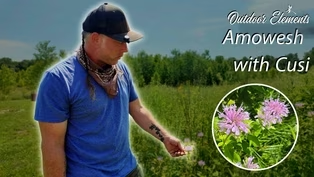
Bee Balm has a name with a story! Cusi Ballew shares the Potawatomi name for Bee Balm, Amowesh, and explains how the plant’s name connects to the Potawatomi language and his own uses for this versatile plant.
Problems playing video? | Closed Captioning Feedback
Problems playing video? | Closed Captioning Feedback
Outdoor Elements is a local public television program presented by PBS Michiana
Outdoor Elements
What is Amowesh? With Cusi Ballow
Clip | 6m 26sVideo has Closed Captions
Bee Balm has a name with a story! Cusi Ballew shares the Potawatomi name for Bee Balm, Amowesh, and explains how the plant’s name connects to the Potawatomi language and his own uses for this versatile plant.
Problems playing video? | Closed Captioning Feedback
Where to Watch Outdoor Elements
Outdoor Elements is available to stream on pbs.org and the PBS app.
Providing Support for PBS.org
Learn Moreabout PBS online sponsorshipThis one here is, you know, common name is bee balm, and it's Latin name is monarda fistulosa, I believe.
And in our language, we would call it ze sabuk, talking about that spicy leaf.
Or a more direct translation of bee balm would also be amawish, like bee plant, bee balm.
And the bees do love it for its nectar.
And.
I'm no botanist, but if you look at the flowers, they have this section that sprays out the top and has the pistil and the stamens, and then it has this lower lip, but to me it always looks like one of those hats people sometimes wear, those foam hats with a bunch of stuff coming out of the top, you might see them at sports.
Thing or something like that, but it all sprays out like a fountain out of the top of the flower.
And it's this kind of light purple that almost looks faded, like a faded lavender.
Both the leaves and the flowers of this plant, and also, well, you can see here that it's got opposite leaves, opposite alternating leaves, so they go down, and then they switch direction, switch direction, but they come out the stem opposite of each other.
And ... The leaves and the flowers, when I'm harvesting, I'll harvest some leaves and some flowers.
And I often use it for tea, but fresh, these leaves can be also used, you know, on meats.
It's a lot like oregano, in a sense.
If you've ever had fresh oregano it kind of burns.
Zissa book here being called spicy leaf You know if you chew this leaf fresh You know it burns for a second, and it's and it got a really savory almost minty minty feel, but a savory flavor and It is a native plant to our meadows here.
And it is, I want to say, and I believe it is the most antibacterial plant that we have growing here in Michigan, or possibly in the Great Lakes region.
They did a study one time where They took garlic, known to be pretty antimicrobial.
Microbial, antimicrobial, and antibacterial.
And they put it in a petri dish, and then they put this in another petri dish, and they put some bacterias in there.
And the zisabuk had a larger ring of no bacteria than the garlic did.
The bacteria were able to get closer to the garlic.
Um, and, uh, and... It makes a delicious addition to any tea.
I like it as a hot tea or an iced tea.
And a lot of times, when you find it, it will be abundant, but not always.
And it's always important to remember when you're harvesting.
Um, to... In whatever way you see fit, to say thank you to the plant.
When I harvest, I always try to let the plant know why I'm harvesting.
You know, what I hope to do with what I harvest.
You know, and sometimes, like I said, that's just to keep on hand for people who might need an antibacterial or antimicrobial addition to their tea or just for flavor in teas.
But it's important that when you do harvest, you harvest in places where you find abundance and that you leave a lot more than you take, right?
So if there are five plants, don't harvest.
If there are 50 plants, don't harvests more than five or 10.
You know especially knowing that someone else may come and harvest.
And each time, that number grows smaller.
So always look for the most abundant place where you can find a plant to harvest.
I wouldn't say that Amoish is at risk, but the more abundance, the better.
It's a great plant, both for native bees and honeybees and various other beetles and mosquitoes.
I know people don't like to think about mosquitoes, but mosquitoes are one of the early pollinators, male mosquitoes.
It's an important food source for them.
A Fungus that Looks like Fido's Nose
Video has Closed Captions
Clip | 4m 49s | A Fungus that Looks like Fido's Nose (4m 49s)
 Now Playing
What is Amowesh? With Cusi Ballow
Video has Closed Captions
Clip | 6m 26s | No description (6m 26s)
Video has Closed Captions
Clip | 9m 22s | It’s time for a little late summer cleaning! Evie cleans out her birdhouses and takes a (9m 22s)
Clip | 2m 58s | Evie takes a closer look at the Veiled Amanita and discovers the unique feature that gives (2m 58s)
Native Plants for Gardens at Wellfield Botanic Gardens
Video has Closed Captions
Clip | 27m 58s | Native plants are thriving at Wellfield Botanic Gardens! (27m 58s)
Video has Closed Captions
Clip | 3m 15s | Spiny and Pink: Musk Thistle (3m 15s)
Primed for Pollinators - Corson Riverwoods County Park
Video has Closed Captions
Clip | 12m 22s | No description (12m 22s)
Video has Closed Captions
Clip | 2m 42s | Evie takes a closer look at some unusual fungus. (2m 42s)
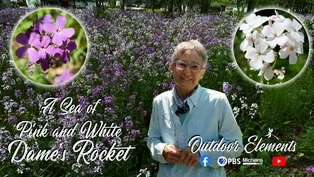
A Sea of Pink and White-Dame's Rocket
Video has Closed Captions
Clip | 4m 34s | Evie takes a closer look at Dame's Rocket, a non-native plant that can crowd out native wi (4m 34s)
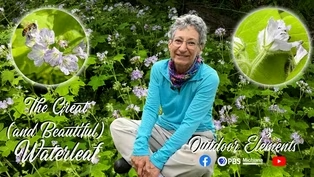
The Great (and Beautiful) Waterleaf
Video has Closed Captions
Clip | 4m 28s | The Great (and Beautiful) Waterleaf is putting on quite a show! (4m 28s)
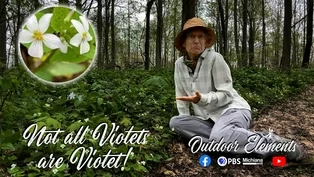
Video has Closed Captions
Clip | 3m 27s | 🌸🤔 Are all violets actually violet? Not quite! (3m 27s)
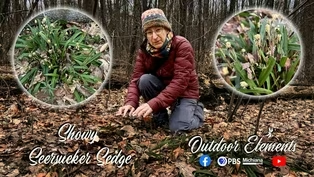
The Sedge with Edges: Discovering the Seersucker Sedge 🌿
Video has Closed Captions
Clip | 3m 10s | Even in late winter and early spring, some plants really stand out along the trail! Evie c (3m 10s)
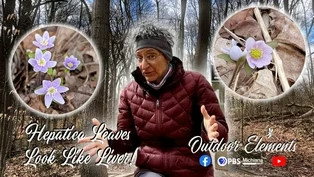
Why This Flower is Named After a Human Organ
Video has Closed Captions
Clip | 3m 3s | Early spring hikes are full of hidden gems! While out on the trail, Evie discovered some S (3m 3s)
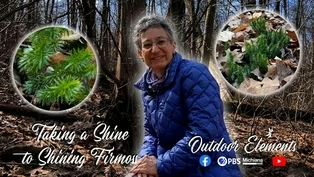
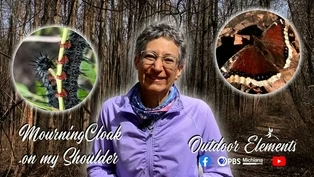
Video has Closed Captions
Clip | 4m 42s | Looking for a tiny sign that winter is on its way out? Evie hit the snow-covered trails in (4m 42s)

Video has Closed Captions
Clip | 6m 54s | 🦆❄️ When winter tightens its grip, the waterways tell a different story. (6m 54s)
Video has Closed Captions
Clip | 3m 2s | Take a winter walk with us at Fernwood Botanical Garden! (3m 2s)
Video has Closed Captions
Clip | 4m 20s | 🦉🌲 WHOO was here? While walking along a wooded path, Evie came across a mysterious p (4m 20s)
Barking Up the Right Tree: Norway Maple
Video has Closed Captions
Clip | 4m 30s | No description (4m 30s)
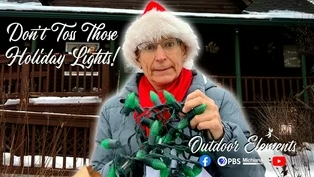
Don't Toss Those Holiday Lights! | OE
Video has Closed Captions
Clip | 8m 25s | 🎄✨ Got holiday lights that no longer sparkle? Don’t toss them! ♻️ In this ep (8m 25s)
Video has Closed Captions
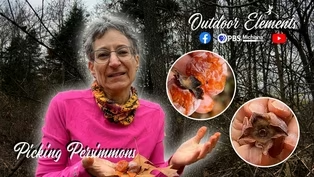
Clip | 3m 38s | 🍂✨ Out on a fall walk in the woods, Evie stumbled upon a sweet seasonal surprise — (3m 38s)

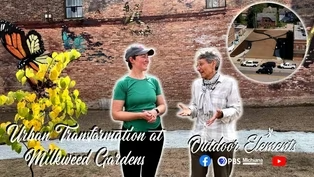
Urban Transformation at Milkweed Gardens
Video has Closed Captions
Clip | 17m 11s | No description (17m 11s)
Video has Closed Captions
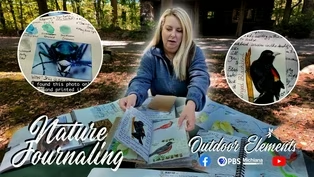
Clip | 11m 50s | 🌿🖊️ It’s time to slow down and connect with nature! In this episode of Outdoor E (11m 50s)
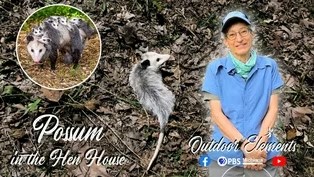
Video has Closed Captions
Clip | 3m 20s | 🐔👀 There’s a possum in the hen house! 🐾 On this episode of Outdoor Elements, E (3m 20s)
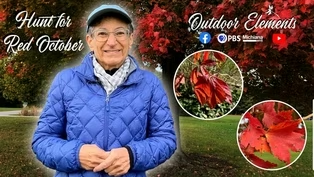
Video has Closed Captions
Clip | 2m 57s | 🍁 It’s that time of year when nature puts on its most colorful show! 🌳 In this epi (2m 57s)
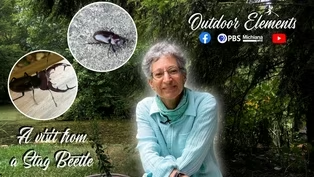
Video has Closed Captions
Clip | 3m 36s | 🌿🪲One of our awesome viewers spotted a beetle making its way across the driveway and (3m 36s)


Video has Closed Captions
Clip | 3m 24s | A viewer shared a fascinating video of a Paintedhand Mudbug, and Evie dives into the detai (3m 24s)
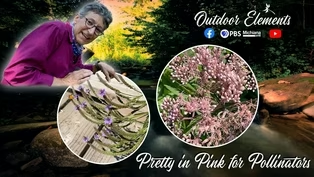
Pretty in Pink for Pollinators
Video has Closed Captions
Clip | 5m 3s | At Lydick Bog Nature Preserve, Evie spots a burst of pink in a wetland. She explores these (5m 3s)
Another Milkweed Specialist: Milkweed Tussock Moth
Video has Closed Captions
Clip | 4m 36s | No description (4m 36s)
Video has Closed Captions
Clip | 3m 43s | Evie spotted Pointed-leaf Tick-Trefoil and shares how to identify this plant. (3m 43s)
The Unique Flowers of Buttonbush
Video has Closed Captions
Clip | 3m 58s | Evie finds Buttonbush at Spicer Lake Nature Preserve (3m 58s)
Saving Ash Trees, One Tree at a Time
Video has Closed Captions
Clip | 11m 16s | No description (11m 16s)
Bringing Bees Back to the Nature Center
Video has Closed Captions
Clip | 6m 10s | No description (6m 10s)
Gathering for Science: An Environmental Research Symposium
Clip | 10m 27s | Evie stops by the St. Joseph County Public Library during their Earth Day celebration to c (10m 27s)
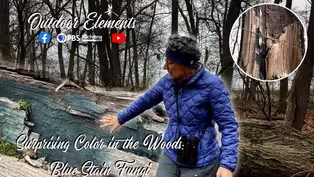
Surprising Color in the Woods: Blue Stain Fungi
Video has Closed Captions
Clip | 3m 48s | No description (3m 48s)
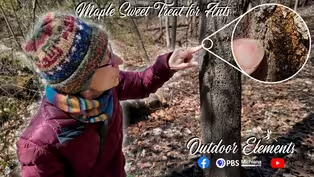
Maple Sweet Treat for Ants | Outdoor Elements
Video has Closed Captions
Clip | 1m 34s | A sweet surprise in the woods! (1m 34s)
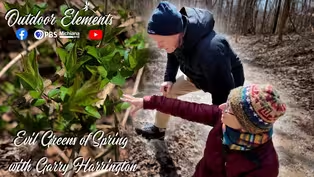
Evil Greens of Spring with Garry Harrington
Video has Closed Captions
Clip | 12m 56s | Things are greening up in the spring woods, but it’s not necessarily a welcome sight. (12m 56s)
Providing Support for PBS.org
Learn Moreabout PBS online sponsorship New Season
- Drama

Hugh Bonneville stars in a crime drama inspired by one of the largest robberies in British history.
 New Episode
- News and Public Affairs

Top journalists deliver compelling original analysis of the hour's headlines.


 New Season
 New Episode





 New Episode
Support for PBS provided by:
Outdoor Elements is a local public television program presented by PBS Michiana