
Why Scientists Brave the Poles
Preview: Season 2026 | 3m 59sVideo has Closed Captions
At -40°, your eyelashes freeze with every blink. So why do these scientists keep coming back?
Temperatures plunge below -40°C. Eyelashes freeze. Equipment fails. Every day tests the limits of human endurance. Yet for the scientists of “Ages of Ice,” these frozen frontiers are places of wonder and profound connection, where hardship, curiosity, and camaraderie combine in the pursuit of knowledge.
Problems playing video? | Closed Captioning Feedback
Problems playing video? | Closed Captioning Feedback
Why Scientists Brave the Poles
Preview: Season 2026 | 3m 59sVideo has Closed Captions
Temperatures plunge below -40°C. Eyelashes freeze. Equipment fails. Every day tests the limits of human endurance. Yet for the scientists of “Ages of Ice,” these frozen frontiers are places of wonder and profound connection, where hardship, curiosity, and camaraderie combine in the pursuit of knowledge.
Problems playing video? | Closed Captioning Feedback
Where to Watch Ages of Ice
Ages of Ice is available to stream on pbs.org and the PBS app.
Share Inspiring Moments From The Film
Explore the PBS Giphy collection for Ages of Ice.Providing Support for PBS.org
Learn Moreabout PBS online sponsorship♪ Once someone has spent a bunch of time in these kinds of environments and in the poles, it changes you.
And if you like it, if you love it, then you just want to keep finding ways to come back.
It's about -20, 25 today and days like today I just wish I'd done tropical reefs.
Not glaciers.
You good?
I'm cold.
I've been working here for almost 30 years now.
I just love the place.
Sometimes I wish it was a bit warmer.
I love the thought that we have to survive and thrive as a scientist in these far flung, remote environments.
You do need to like to suffer a little bit.
Or at least be prepared to suffer because you will suffer.
You'll get cold toes and feet.
You'll get hungry, you'll get thirsty.
You might be, you know, inherently cold all the time.
And you need to have something just pulling you through that that's driving you to gather information and do your work beyond the harshness of the environment that you place yourself in.
Absolutely my favorite part is getting to go out in the field and kind of push the boundaries of where humans have been, where humans have looked, where humans have explored.
It's an incredible privilege, and there is still so much that we don't know.
We look all around us and it's just an endless horizon of ice.
It plays with your perspective.
It plays with your senses.
It is comforting, you know that the world is so much larger than I imagine.
And coming to this environment, it makes you realize how amazing this planet is.
It definitely makes me feel small.
I mean, I feel that way on mountains and I feel that way in polar regions.
You realize you're just really this tiny, tiny little speck.
It really makes you realize nature is so much bigger.
Nature is powerful.
Nature is still boss.
There's nothing quite like the Arctic to humble you, right?
I realized that humans aren't as indestructible as we think we are.
Every time you close your eyes or blink, any of the moisture from your eyes then are going on to your eyelashes and freezing instantly.
Your nose hair starts to freeze.
And as soon as you take that first breath of air -40, your lungs feel it as well.
The coldest temperatures thus far, with windchill, we're probably in the minus 40s minus 50s.
I have written in my diary numerous times.
What am I doing here?
Fortunately, I'm surrounded by a great team who acknowledge that we are here.
Yes to hopefully cross the ice sheet, but more importantly, to gather useful scientific data so they know what our mission is.
Part of the bonding experience with with collaborators in the field, part of what makes it so special is that it is not easy.
All good?
Yeah, sure.
Not to be dramatic, but you really are trusting these other people.
That's the kind of experience that you can't have back home.
It's something that only happens out in these extreme places.
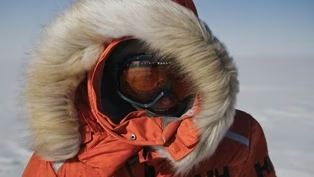 Now Playing
Why Scientists Brave the Poles
Video has Closed Captions
Preview: S2026 | 3m 59s | At -40°, your eyelashes freeze with every blink. So why do these scientists keep coming back? (3m 59s)
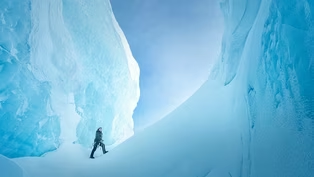
Video has Closed Captions
Preview: S2026 | 30s | Discover epic science in the most extreme places on Earth. (30s)
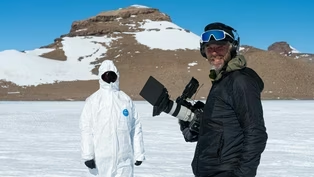
Video has Closed Captions
Preview: S2026 | 4m 54s | Go behind the scenes of the epic three-year journey to film “Ages of Ice.” (4m 54s)
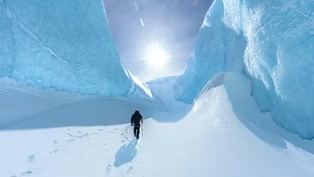
Video has Closed Captions
Preview: S2026 | 1m 27s | Discover epic science in the most extreme places on Earth. (1m 27s)
Video has Closed Captions
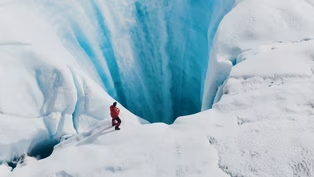
Clip: S2026 | 2m 22s | Glaciologist Alun Hubbard stands at the edge of a perilous moulin on the Greenland ice sheet. (2m 22s)
Video has Closed Captions
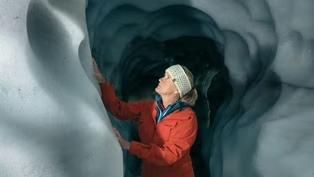
Clip: Ep3 | 3m 39s | Could life beyond Earth hide in ice? Dr. Birgit Sattler finds tardigrades thriving inside a glacier. (3m 39s)
Antarctica's Air-Eating Microbes
Video has Closed Captions
Clip: Ep3 | 3m 54s | No sunlight, no soil to eat. In Antarctica, Dr. Ry Holland finds microbes surviving on thin air. (3m 54s)
Video has Closed Captions
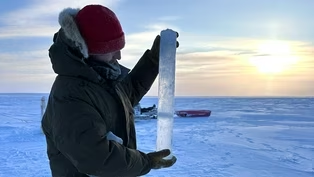
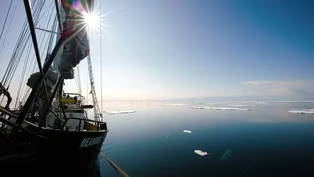
Clip: Ep2 | 3m 58s | Pumping seawater onto frozen ocean, Real Ice and Inuit guides test whether sea ice can grow thicker. (3m 58s)
Video has Closed Captions
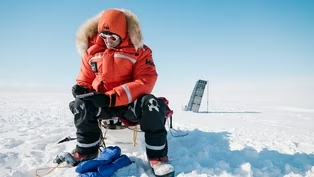
Clip: Ep2 | 2m 18s | Dr. Melanie Lancaster is a marine mammal specialist and advocate for quiet Arctic oceans. (2m 18s)
Video has Closed Captions
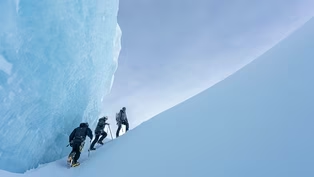
Clip: Ep1 | 4m 48s | Five strangers, 220-pound sleds, 30 days on Greenland's ice, all to map what lies beneath. (4m 48s)
Video has Closed Captions
Clip: Ep1 | 4m 58s | Is Greenland's ice leaking methane? Glaciologist Alun Hubbard descends into a moulin to find out. (4m 58s)
Providing Support for PBS.org
Learn Moreabout PBS online sponsorship New Episode
- Science and Nature

Explore scientific discoveries on television's most acclaimed science documentary series.





 New Season



 New Season


Support for PBS provided by: