MARKED! - The Series
The Soldier Who Arrested A Governor
Clip | 13m 31sVideo has Closed Captions
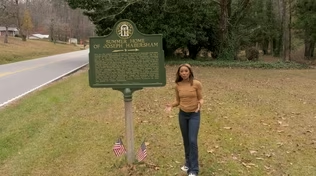
An early Georgia leader who was key to Patriot resistance and the early days of the postal service.
Joseph Habersham spent summers in North Georgia at a home in the county that now bears his name. His backstory is one of leadership, as an early figure in the formation of the Georgia political infrastructure, on the battlefield as a Revolutionary war hero, a member of the Continental Congress and even as postmaster general of the United States.
Problems playing video? | Closed Captioning Feedback
Problems playing video? | Closed Captioning Feedback
MARKED! - The Series is a local public television program presented by GPB
MARKED! - The Series
The Soldier Who Arrested A Governor
Clip | 13m 31sVideo has Closed Captions
Joseph Habersham spent summers in North Georgia at a home in the county that now bears his name. His backstory is one of leadership, as an early figure in the formation of the Georgia political infrastructure, on the battlefield as a Revolutionary war hero, a member of the Continental Congress and even as postmaster general of the United States.
Problems playing video? | Closed Captioning Feedback
Where to Watch MARKED! - The Series
MARKED! - The Series is available to stream on pbs.org and the PBS app.
Providing Support for PBS.org
Learn Moreabout PBS online sponsorshipDuring the revolutionary period, his last name was synonymous with Georgia politics.
He was a military leader and a shrewd operator, not afraid to challenge the king, and in early America, president George Washington even put him in charge of the mail.
This is marked a series that zooms in on Georgia and it's backstory, one historical marker at a time.
I'm Maiya May and I'm here at Georgia Historical Marker 068 dash seven to tell you the story of this really cool spot up here in North Georgia and about the man who called it home on during the revolutionary period.
Most of the action was down south in Savannah and up here in north Georgia.
It was kind of quiet.
This was like the mountainous frontier.
And for part of the year, this was home to one of the most influential people during Georgia's revolutionary period.
And that man is Joseph Habersham.
Joe Habersham is among that younger generation, the sons of Georgia's original founders, you know the men who led early Georgia in the 1750s and sixties.
Now by the 1770s, the sons are ready to exert themselves onto the scene, and he is at the forefront of that.
His daddy was James Habersham Senior, a very wealthy merchant, and he came to Georgia in 1738.
All right, so before we get too far into Joe's story, we have to break down the Habersham family.
So first of all, they are from England, and then there's James Habersham.
He's the father, he is the patriarch.
James is a loyalist, the term, not necessarily kind of at the forefront back then as it is now.
He was a member of the King's government.
He was a member of the colonial government at a high ranking level.
James Habersham Sr.
Was totally pro monarchy.
He was a temporary governor for about two years while James Wright was gone.
So he was loyal to the Crown.
And then there's his three sons, James Junior, our guy Joseph, and then the third brother John.
His three sons became Patriots were revolutionaries, right?
The revolution split families, it split communities, it split families.
I guess the most famous family to split was Benjamin Franklin.
It's not an uncommon dynamic in civil wars throughout history, fathers are typically more conservative, the son's more eager to challenge societal norms.
If You go to the Colonial cemetery where the daddy is buried, he's buried, and then there's a little marker there.
But right beside him is a big shrine where Joseph is, and I think some of the other hahas there.
The wealth generated by James Haber's plantations and his mercantile stores allowed him to send his boys to get an education like the Sons of many.
Well-to-do Southerners, especially planters and merchants.
Joe Habersham is sent north.
They would send their sons either to Princeton, sometimes Harvard, or to England to get educated.
Joe Habersham is sent to England to further his education.
Like many Southern boys, they return eager to play a part in what's happening.
Joe is no different 1771 when he arrives back to Savannah.
We've just had the Boston Tea Party.
Things are accelerating.
- Savannah is where Joe really starts rolling up his sleeves, getting to work on what's happening in Georgia.
Joe Habersham joins the Liberty Boys, which is George's version of the Sons of Liberty, founded by Sam Adams in Massachusetts during the Stamp Act crisis.
It is comprised of all groups of society, all white males.
They are wreaking havoc throughout Savannah, disrupting all phases of colonial government.
Liberty Boys tarred and feathered somebody in the summer of 1775 because he went into a tavern down there and gave a toast and said damnation to the Patriots.
So they were creating havoc and keeping it all stirred up.
The Liberty Boys nicknamed by George's Royal Governor, sir James Wright as the Sons of Licentiousness, because of the trouble they caused him.
A lot of these men who are young and wielding influence with property and or money run in the same circles, Button Gwinnett, George Walton, A lot of these names you hear in Georgia's history were part of the same crew in some form or another.
Joe Habersham is one of the most active and energetic liberty boys.
He is able to secure leadership positions in the militia.
He's able to secure political positions of influence, most notably his position on the Council of Safety, which is a very determined, motivated force for patriotism in Georgia.
But throughout the colonies, there are councils of safety everywhere, and they operate under the idea of you are with us or you are against us.
And they were able to successfully convince many loyalists with leanings to eschew those beliefs and join the rebel cause.
And in May of 1775, Joe Habersham gets a crew together to really start some trouble.
In the spring of 1775, Joe Habersham bleeds a cadre of young revolutionaries to steal the king's gunpowder.
They stormed the King's magazine in Savannah.
That was in May of 1775.
And these were all young.
One of them was Noble Wimberly Jones, who was the son of a great loyal crown supporter, just like James Habersham senior.
And this is his son.
That's a revolutionary as well.
So he was there.
Edward Telfair was another one.
They then send that gunpowder to Boston to be used against the king's men in the deadly fighting on Bunker Hill.
They stole the gunpowder.
Some say they dispersed the gunpowder, sent it up to the Northern colonies, you know, to help the Patriots up there.
But that was just the beginning of it.
In July, they took a British ship.
It was called the Philippi.
The Provincial Congress in Georgia had become aware that that ship was off of Tybee Island.
And the decision was made by Samuel Elbert and Joseph Habersham and Oliver Boeing to go and take the ship.
The Philippi was coming and it had ammunition on it.
It had powder shot muskets, but it was for the Indian trade.
And the provincial Congress gave them a school which they outfitted with a pivot gun, and they christened it, the Liberty.
And they went down to the Savannah River and got out there with the Philippi right off the coast of Tybee.
The Philippi was big and the Liberty was able to maneuver around it, and they captured the ship, all of the weapons and the powder that was stored on it.
And so Joseph Habersham was in involved in that.
He stole weapons from the Crown to then turn around and use against them.
That's that's pretty bold.
But a few months later, Joe gets even bolder.
On January 16th, 1776, Joe Habersham volunteers to lead a group of rebels to arrest Governor James Wright and his council members at the Government House, which is the official governor's residence in Colonial Georgia.
And so as James Wright is meeting with his council members at dinner at the government house underneath a portrait of King George II Wright is discussing this ever-growing mobocracy that's kind of taking over.
In past the guards rush Joe Habersham and Company.
Council members flee out the windows and through the door, and Habersham walks up to James Wright and gently places his arm on James Wright's shoulder and says, Sir James, you are my prisoner.
And that's how they arrested him.
He was put under house arrest.
That was in January of 1776, so he was under house arrest.
He couldn't go anywhere.
Now, Habersham was friends with James Wright.
James Wright was his father's best friend.
We don't know exactly why Joe Habersham volunteered for this duty.
It may have been because he wanted to show his father's best friend that a new generation was taking over.
It may have been because he wanted to make sure that James Wright was treated well in the process.
Joseph Habersham spent seven years in the military in the thick of the Revolutionary War, and he worked his way up.
He started in the Georgia militia, and by the time the war was over, he was Colonel in the Continental Army.
It's a job he actually inherits from Lachlan McIntosh, one half of the McIntosh Gwinnett Feud.
But politics, that's Habersham's thing.
He serves twice as the speaker of the Georgia General Assembly.
That was the most powerful job in the state government.
The governor wasn't after the American Revolution.
The speaker of the House was the one that truly had the power.
Joe Habersham, Princeton educated, English educated, understands the importance of an educated populace.
Georgia was coming out of the American Revolution, and that revolution did much damage to Georgia's civic organization.
It was very important for Georgia to get some kind of foundation on education.
Habersham and a guy by the name of Abraham Baldwin convinced the legislature, they lobby for a college in Georgia, which would be the first college in Georgia history, come to be known as the University of Georgia.
All right, so the next time you tailgate in Athens, remember that the person who lived here was one of the guys who helped make that possible.
And while UGA begins in 1785, 2 years later, it's time for the Constitution to be ratified.
And once again, Joe Habersham is in the mix Following the Constitutional convention in Philadelphia in the summer of 1787, the Constitution is finally ratified in Philadelphia, but that doesn't mean that it's anything official yet it is sent to the individual 13 states.
They hold their own ratifying conventions and Joe Habersham is a part of that ratifying convention in Georgia By just about every measure.
This is the date in Georgia's history that matters.
Official statehood the fourth state across the line of independence, and Joe Habersham isn't done.
Joseph Habersham is the mayor of Savannah from 1792 to 1793.
So it was a perilous time.
It's perilous because Georgia is still trying to figure things out.
It's taking its first wobbly steps as a state, and as if he hasn't done enough, Joe finally gets tapped to serve in the federal government.
Joseph Habersham is put in charge of the mail.
George Washington saw him as someone incredibly capable and trustworthy.
Washington taps Joe Habersham to be us Postmaster And postmaster General is a really important job, especially during this time period.
Habersham understood the importance of an operating mail system that largely is sending newspapers and pamphlets across the country, which is incredibly important for a young democratic republic.
For people in places that are further away from the Capitol in Philadelphia and New York to know what's going on.
That was no trivial position.
The only way people could communicate was through writing and through the mails.
It made the country function.
He saw it as so important that anyone that impeded such delivery was un-American, if not treasonous, because the mail was so vital to a democratic republic.
He's also postmaster under John Adams.
But when Jefferson becomes president, then that's the other party.
Jefferson offers him a cabinet position, but he didn't want it.
Thomas Jefferson asked him to be Secretary of the Treasury, an incredibly important job, especially as the nation changed from federalist policies to Democratic Republican policies.
I'm suspecting that he was a Federalist because he supported many of the policies of Alexander Hamilton, which includes the Bank of the United States.
Joseph Habersham also served as president of the US Bank in Georgia until his death in 1815.
At the age of 64.
Joe Habersham was one of early Georgia's most important founding fathers.
He led Georgia's revolutionary movement.
He led Georgia's early statehood government.
He was a national figure admired by Washington and Jefferson.
He helped found the University of Georgia, who two and a half centuries later is world renowned.
Go dawgs.
- When we've been digging into these stories, there's often a similar thing, right?
There's an interesting person that does an interesting thing that has some real influence over Georgia, but Joseph Habersham is a little different.
This is a guy who did all kinds of interesting things that had a ripple effect all over early America, and it should make us wonder for a guy that's so busy, when did he get a chance to spend summers here in North Georgia?
Regardless, the people here in aptly titled Habersham County are often reminded of what he did for Georgia, early America and its people.
I'm Maiya May, and we'll see you at our next stop.
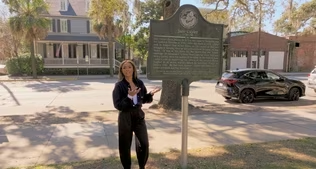
Video has Closed Captions
The story of an early Georgia woman who stepped in to help the resistance and outrun King George. (10m 35s)
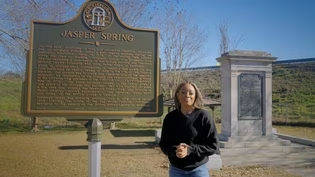
Video has Closed Captions
The story of a soldier who rallied an army and-according to legend-saved patriot prisoners of war. (10m 57s)
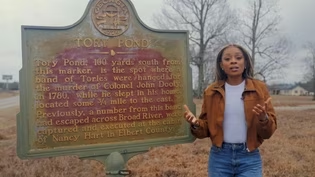
Video has Closed Captions
The story of a Georgia frontier leader, the legend of his death and the vengeance that came after. (13m)
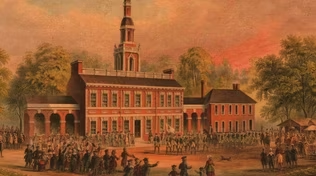
Video has Closed Captions
The Georgians who signed the Declaration of Independence and their influence on the early republic. (12m 52s)
Video has Closed Captions
The story of an international coalition and the attempt to recapture Colonial Georgia's most importa (14m 6s)
Georgia's Fight Goes To The Water
Video has Closed Captions
The story of a small Georgia fleet that stands tall in the face of the powerful British Navy. (12m 8s)
Video has Closed Captions
The trials, tribulations and resilience of one of Georgia's earliest settlements. (13m 38s)
Video has Closed Captions
A Liberty County landmark that once protected the people and resources of Coastal Georgia. (12m 49s)
The First President Heads South
Video has Closed Captions
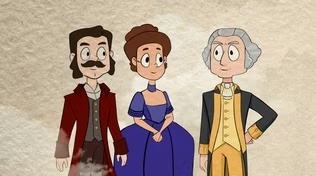
The story of George Washington's first and only visit to Georgia. (13m 32s)
 Now Playing
The Soldier Who Arrested A Governor
Video has Closed Captions
An early Georgia leader who was key to Patriot resistance and the early days of the postal service. (13m 31s)
The Frontier's Fierce Protector
Video has Closed Captions
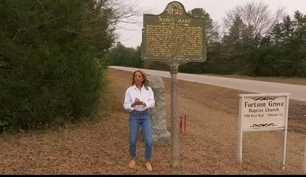
The story of a Colonial Georgia woman who was a fierce protector of home, family and liberty. (14m 9s)
Video has Closed Captions
The story of a founding father, his influence on early Georgia, and the duel that ended his life. (14m 18s)
Providing Support for PBS.org
Learn Moreabout PBS online sponsorship











Support for PBS provided by:
MARKED! - The Series is a local public television program presented by GPB