MARKED! - The Series
The First President Heads South
Clip | 13m 32sVideo has Closed Captions
The story of George Washington's first and only visit to Georgia.
When America's first president made his first and only trip to the deep south in 1791, it was an opportunity to spread goodwill and unify a country still learning to stand on its own. What he found was a region ready to embrace their new president, and the new democratic republic he led.
Problems playing video? | Closed Captioning Feedback
Problems playing video? | Closed Captioning Feedback
MARKED! - The Series is a local public television program presented by GPB
MARKED! - The Series
The First President Heads South
Clip | 13m 32sVideo has Closed Captions
When America's first president made his first and only trip to the deep south in 1791, it was an opportunity to spread goodwill and unify a country still learning to stand on its own. What he found was a region ready to embrace their new president, and the new democratic republic he led.
Problems playing video? | Closed Captioning Feedback
Where to Watch MARKED! - The Series
MARKED! - The Series is available to stream on pbs.org and the PBS app.
Providing Support for PBS.org
Learn Moreabout PBS online sponsorship- He was America's very first CEO.
He packed its bags for a road trip to the deep south.
It was a gesture of unity and of leadership, and it also sent a clear message that the United States of America wasn't just ready to stand on its own, but that the office of the President reports to the people.
This is Marked!, a series that zooms in on Georgia and its backstory, one historical marker at a time.
I'm Maiya May and I'm here in Savannah, Georgia to tell you the story of America's very first president and his only visit to the deep south.
When you're in Savannah, you can't go five feet without running into something old, with a story to tell.
In the late 18th century, almost everything was routed through this town in 1791.
It's also the southern most city of the original 13th colonies, and that's just one of the reasons that in the same year, President George Washington, who spends most of his time up north, decided to head south.
If you're in Savannah talking George Washington or anything historical, that means talking to one person, Stan Deaton, senior historian with the Georgia Historical Society.
What was the importance of him doing this tour?
Why was it important for him to go and meet Americans out in the field, in the wild, on the ground?
Well, the American Revolution had been over for about 10 years by that point, and he sort of embodied for a lot of people, the American nation.
He thought it was time for him to get out and come down to the southern states where, believe it or not, even though he was a Virginian, he had never been south of Virginia.
So he decided to come out and see North Carolina, South Carolina, and here in Georgia, South of Virginia, and the further south you go from Pennsylvania, even there are less and less and less citizens.
A lot of people, half of them are more depending upon where you're living and what exact date are enslaved or free blacks whose opinions don't matter in the grand scheme of early American politics.
But George Washington understands that it is important to connect north and south, especially Charleston and Savannah because those are two cities that are very important to America's export game.
And because the South doesn't have a lot in terms of population, it's kind of the wild country.
Traveling in the 18th century was probably worse than we even imagined it to be.
Sitting on a horse hour after hour after hour, 20, 30 miles a day, day after day after day with very few roads, even fewer roads that resemble anything like finished roads, rain or snow, throws everything into confusion.
A tour like Washington's requires a great deal of logistical machinations and logistical organizing just to get everyone from point A to point B. During his trip, he was able to stay in what they considered close contact with the Vice President John Adams.
President Washington also isn't doing this trip solo.
There's a whole group.
There's staff, including his secretary and right hand, Major William Jackson, a few horses, a couple of carriages.
So wanting to avoid a deep south summer, the trip south from Philadelphia starts around 11:00 AM on March 21st, 1791.
He had an entourage of about 10 people.
We know how presidents travel today with the security they have and the administrative staff that they have.
He really didn't have any of that.
He also traveled with one of his dogs, which he enjoyed.
Washington is an observer of everything around him, and as you traveled by horseback hundreds and hundreds of miles, he sees a society that in some ways certainly resembles the cavalier nature of his home in Virginia.
He observes what we come to know as southern gentility.
All along the way, he's being toasted and showered with dinner parties, meeting with local politicians and their wives.
Everyone is getting an up and close look at the first president.
This is a big deal.
And by April, he's winding his way through Virginia into North Carolina and down into Charleston.
He was really taken aback by how well he was treated by southern elites, but also the more common folk that he encountered on his journey.
He has to stay at various locations on the road, sometimes actual ends by the side of the road and sometimes people's houses.
So after getting through Virginia, the tobacco fields of North Carolina and into the Port of Charleston, President Washington and his team arrive here in Savannah on May 12th, 1791, almost two months after leaving Philadelphia.
Savannah hasn't seen a celebration like this since the arrival of the final royal governor in 1760.
And so for George Washington, great fanfare, parades, parties, cannon firing their salute to him announcing his arrival.
He would be escorted by the town leaders, and so George's finest noble Wimberly Jones, great patriot leader, rebel during the Revolutionary War, and Joseph (Joe) Habersham, they brought him into Savannah.
So he came down the river and then he came up the bluff onto, of course what is now River Street and then up to Bay Street.
And they had all the pomp and circumstance that you would imagine and think that they would do.
There were guns and cannons and fireworks and banners.
It was a moment never to be forgotten.
So he already had this mythic status as a leader.
He was in many ways a magnificent physical specimen.
He was about six foot two.
He looked great on horseback.
He was a natural horseman.
So even though he traveled by carriage when he got outside town, he always stopped and got on his horse so that he came into town and he really sort of cut this majestic figure.
He looked the part, he had this aura about him.
Like any VIP visitor, the president was wined and dined too.
And some of that took place right behind me, which was once the site of a place called Brown's Coffee House, a Savannah stable in those days, that was later torn down in 1889.
The city's elite spent time with him.
Nearly 24/7 it seemed, dancing, at feasts.
And George Washington has always been known to love dancing with the finer sort.
General Nathanael Greene's wife, Caty, who lived in Georgia after the war, was a favorite of his.
He loved dancing with her and he loved flirting with women.
From Abigail Adams all the way down to Eliza Hamilton to Caty Littlefield Greene, He saw the city.
He acted as a tourist.
He had a big dinner at a city tavern with some of the muckety mucks that you would expect.
Washington loved to mingle, especially with the ladies.
Everywhere he went, his journals record that he danced the night away, he drank punch, he met veterans of the revolution, veterans of his army like Lachlan McIntosh, who gave him a personal tour of the battlefield.
As part of his tour of Savannah general, Lachlan McIntosh wanted to show Washington the ground that the siege of Savannah in October, 1779 was fought on.
Specifically the Spring Hill redoubt.
Washington as a general certainly was accustomed to viewing the scene and figuring out, you know, what land is best chosen for a battle.
McIntosh and Georgians wanted to know what he thought about the lay of the land in Savannah.
He was very diplomatic.
George Washington actually wrote in his journal, "To form an opinion of the attack at this distance of time, and the change which has taken place in the appearance of the ground by the cutting away of the woods, is hardly to be done with justice to the subject."
He knew how important the battle of Savannah had been.
The siege of Savannah, the failed attempt to retake the city from their British is one of the great American losses.
I think he felt that innately, you know, as a military man.
The astonishing thing to me is that he was here for four days.
Presidents still come to Savannah, important people come to Savannah for an hour or two.
By the 15th of May, a Sunday, George Washington was about to leave town, but Sunday also meant that President Washington was going to church.
Going to church meant going here.
Christ Church of Savannah, it's one of the oldest churches in Georgia, and that's why it's got the nickname the Mother Church.
Now, the actual church that George Washington attended burned down in the Savannah Fire of 1796, which also burned two thirds of the city.
As he leaves Savannah, he stops at the rather famous plantation called Mulberry Grove, which was a gift to General Nathanael Greene after the revolution ended for his services in liberating Georgia.
There are a lot of people who feel like if George Washington at any point in the revolution had gone down, if he had been shot, if he had been killed, Nathanael Greene probably would've taken over and would have finished the job.
Greene dies shortly after the war, we believe of heat stroke on the plantation.
Washington had a long and close relationship with Greene's widow, and so he made sure before he headed back north that he stopped to see her at Mulberry Grove to express pleasantries and condolences because that was the first time he would see her.
After his hand chosen leader's death.
Savannah rolled out the red carpet for the president and his traveling party, hospitality that only a city like Savannah can provide, but it was time for them to make the turn and head back north.
So he traveled north out of Savannah to Waynesboro first, which was named for Mad Anthony Wayne, one of his lieutenants during the revolution.
And then he went on to Augusta, which at that time was Georgia's Capital.
I was reading some analysis from his journals and he commented on how interesting Augusta was laid out and how interesting some of the south was laid out from a mapping standpoint.
Well, Washington from his youth had been a surveyor, and he had traveled into the back country or Virginia all the way to the forks of the Ohio.
So he was an outdoorsman.
He loved being outside.
And of course, as a military person, he had studied terrain and topography, and so he was always interested in where cities were positioned and particularly how they might develop.
That was another thing that happened on this tour.
He was actually able to sort of see the country and understand better how it was going to expand in the coming years, which of course it did.
By May 21st, 1791, George Washington's southern tour was just about over.
And as he's heading out of Augusta, he's now officially visited all 13 colonies.
He celebrated and embraced, but his visit to Georgia wasn't just about pomp and circumstance and showing him a good time.
It's also important for a couple different reasons, Getting a view of him for Georgians must have been beyond electrifying, beyond gratifying.
I don't think we could actually imagine what that must have felt like to Georgians because he is bringing to them not only his celebrity status and someone that we don't just recognize as being important.
We know that he is at the core, this honest guy who believes in republicanism, meaning representative government, which is new.
It is new and it's scary.
But for the middling and lower classes, he had to have come across as of a godsend.
Someone that is not just accepting of us as being part of this nation, but is willing to grant us or to embrace us as part of the body politic.
And that's the first time, certainly in American history, really world history.
This is not something that is common and he is at the head of it.
He didn't have to leave Philadelphia or New York.
He could have been very comfortable.
He put himself on those bad roads and in those taverns where the food was bad and the beds had fleas because he understood if this country was going to survive, people had to see it and feel that it was a real thing.
I would argue that that visit did more to solidify the idea of the United States and the minds of the people at that time, probably than any other presidential visit.
It may have only happened once, but the first president's visit to Georgia, a really big deal is still kind of in the air around here.
There's the aptly named Washington Square.
There's the plaque just across the way on what's now a law office that commemorates one of the balls he attended in that very spot.
And of course, there's this marker here in Johnson Square that people stop and read every day because in Savannah history just kind of hangs out.
I'm Maiya May, and we'll see you at our next stop.
Video has Closed Captions
The story of an early Georgia woman who stepped in to help the resistance and outrun King George. (10m 35s)
Video has Closed Captions
The story of a soldier who rallied an army and-according to legend-saved patriot prisoners of war. (10m 57s)
Video has Closed Captions
The story of a Georgia frontier leader, the legend of his death and the vengeance that came after. (13m)
Video has Closed Captions
The Georgians who signed the Declaration of Independence and their influence on the early republic. (12m 52s)
Video has Closed Captions
The story of an international coalition and the attempt to recapture Colonial Georgia's most importa (14m 6s)
Georgia's Fight Goes To The Water
Video has Closed Captions
The story of a small Georgia fleet that stands tall in the face of the powerful British Navy. (12m 8s)
Video has Closed Captions
The trials, tribulations and resilience of one of Georgia's earliest settlements. (13m 38s)
Video has Closed Captions
A Liberty County landmark that once protected the people and resources of Coastal Georgia. (12m 49s)
 Now Playing
The First President Heads South
Video has Closed Captions
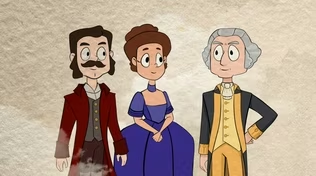
The story of George Washington's first and only visit to Georgia. (13m 32s)
The Soldier Who Arrested A Governor
Video has Closed Captions
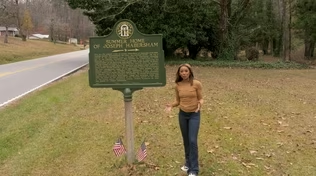
An early Georgia leader who was key to Patriot resistance and the early days of the postal service. (13m 31s)
The Frontier's Fierce Protector
Video has Closed Captions
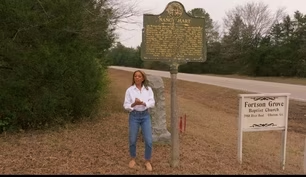
The story of a Colonial Georgia woman who was a fierce protector of home, family and liberty. (14m 9s)
Video has Closed Captions
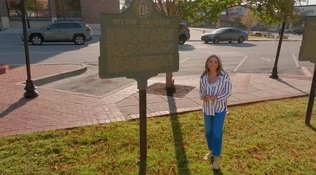
The story of a founding father, his influence on early Georgia, and the duel that ended his life. (14m 18s)
Providing Support for PBS.org
Learn Moreabout PBS online sponsorship











Support for PBS provided by:
MARKED! - The Series is a local public television program presented by GPB