
Why California is Betting on Giant Floating Wind Turbines
Clip | 8m 10sVideo has Closed Captions
California looks to wind energy, on land and offshore, to power its clean energy future.
California has ambitions to super-size the amount of clean electricity it gets from wind energy. The key to that plan is to place hundreds of wind turbines offshore, but the cost and engineering challenges are huge.
Problems playing video? | Closed Captioning Feedback
Problems playing video? | Closed Captioning Feedback
Earth Focus is a local public television program presented by PBS SoCal
Why California is Betting on Giant Floating Wind Turbines
Clip | 8m 10sVideo has Closed Captions
California has ambitions to super-size the amount of clean electricity it gets from wind energy. The key to that plan is to place hundreds of wind turbines offshore, but the cost and engineering challenges are huge.
Problems playing video? | Closed Captioning Feedback
Where to Watch Earth Focus
Earth Focus is available to stream on pbs.org and the PBS app.
Providing Support for PBS.org
Learn Moreabout PBS online sponsorship[music] -These are all big modern machines.
These all are fully robotic devices.
You look up on the back, you will actually see a stalk that extends upward on the back of the nacelle.
That's its weather station.
It's measuring the wind speed and the wind direction 24/7.
The robotic controller is taking action and turning the entire nacelle, the head up there, and turning it to face into the wind.
These machines are pretty funny to watch on a low wind day because you can actually see it trying to find the wind.
It will continuously change the direction it's facing, waiting for the winds to exceed 7 miles an hour, which is what it takes to actually get started.
We are in the San Gorgonio Pass.
This is near the city of Palm Springs.
Here in the pass, we have a fair amount of wind that's normally set up by the cold ocean climate to the west and the hotter desert climate to the east.
That just creates a pressure difference that tends to pull the air through the mountain pass.
It makes it a great place for a wind farm.
We're only about 10% of the wind energy, but we can power, on average, about 750,000 homes when the wind is blowing, 250,000 homes when it's averaged over the course of a year.
That's a third of Riverside County.
We make more power than the needs of Palm Springs by a factor of 10 every year, and in fact, this entire Coachella Valley, by a factor of 3.
-I think nothing else has quite the potential that wind energy has, and that's really because wind is an already established, a long-established, renewable energy technology.
We know how to build it.
It's really quite straightforward.
It's hard to imagine California reaching its clean energy goals without really investing in building out wind power going forward.
[music] -In general, wind energy, I think, has a lot of problems compared to many other sources of energy.
If you put even land-based wind against photovoltaic energy, photovoltaic energy wins easily.
The solar is remarkable, the way it's expanded in the last 10 years.
That's going to change the economics of wind energy.
We talk frequently about how conventional energy, natural gas-generated electricity, is getting beaten by solar.
Well, so is wind.
You have to look at it in a comparative way.
-One of the most important things when we think about transitioning the electric grid to clean electricity is actually just having a diversity of resources.
One of the things that wind can do that solar can't do is generate electricity when the sun isn't shining, which seems like an obvious thing to say.
There are periods where solar production is quite low, when it's cloudy outside for potentially days at a time, and during those periods of time, wind energy can keep cranking, can keep producing electricity.
For California specifically, right now, wind is actually a relatively small but pretty important part of California's clean energy mix.
In all of the planning to reach the state's clean energy goals, wind energy would roughly triple to get to those goals.
Tripling from now to 2045, the amount of wind energy we have, is a pretty daunting task, but it'll be an important part of transitioning the state to clean electricity.
-Offshore, the wind conditions are significantly stronger.
Very strong winds offshore, very consistent winds offshore.
The challenge in California is going to be, how are you going to build these wind farms when you have deep water channels off our coast?
These turbines are going to be floating.
You're going to have to bring that power onshore, which means you have a floating substation.
This is all beyond my pay grade, but it is a challenge that the industry is facing today.
The state of California is planning offshore wind by 2045.
It is part of the state's plan.
[music] [background conversations] -Here in the city of Long Beach, we believe in offshore wind.
We are not turning back.
We are going to play our part to make sure it becomes a reality here in California, and we believe in it.
-The Port of Long Beach is one of the busiest ports in the nation.
We want to support the state's development of floating offshore wind by being an assembly hub for those turbines.
For floating offshore wind, you need to assemble those turbines at a port before they're towed out to the wind farms.
It is very difficult to find suitable sites on the west coast for that assembly operation.
The Port of Long Beach has unique qualities that can meet that need.
We are proposing to build out a new purpose-built facility for the assembly of those turbines.
The facility is called PURE WIND.
It's specifically designed for the assembly of floating offshore wind turbines.
-There are two main spots where offshore wind is being considered in California.
The first is along the central coast of California, and there's also another spot on the north coast of California near Humboldt Bay where offshore wind is being considered.
One of the challenges with building out offshore wind at a big scale in California is actually building up that infrastructure on land, building up the ports and all of that infrastructure that would enable the offshore wind industry to install those turbines out in the water.
I'd say the biggest obstacle is probably the uncertainty that's been cast over the industry by the current administration's attacks on offshore wind.
-We're clear-eyed about the current federal environment, but PURE WIND is being built for California's long-term energy future, not for a single lease or a single year.
This type of infrastructure takes a long time to build.
We're moving forward with the things that we control.
Our job is to ensure that California has that capability ready when it's needed.
-They want to put them 20 miles offshore.
20 miles offshore in California is 4,000 feet of water.
A 12-megawatt turbine is going to stand from the waterline to the tip of the rotor in a vertical position at least 800 to 1,000 feet.
That's an Eiffel Tower.
Are you really seriously considering putting 2,000 floating towers in the ocean that are almost 1,000 feet high each, and you're going to tether each of them to water that's 4,000 feet deep?
There's a lot of things that could go wrong if you do that, and the cost is just ridiculous.
It would be about $180 billion just to procure and install them.
It'd be another $12 billion to upgrade the port infrastructure.
Another $36 billion to upgrade the transmission lines.
It's the most expensive way to produce electricity in the world.
-There are some unknowns with floating offshore wind, but the nice thing is it leverages technology from oil and gas.
We know a lot about these floating platforms and the anchor systems.
We know how that functions out in the open ocean.
It's less about, "Hey, we don't think this technology is going to work," or there's a question around whether it's going to work.
It's about how do we make it commercial scale?
-This place has been here going on 50 years.
If I come back in 50 years, is there still energy being generated by wind turbines here?
-[chuckles] I think there's going to be wind energy being generated in this mountain pass for a very, very long time.
We have seen some repowering happen recently.
Repowering is the process of taking those old windmills out and replacing them with new ones.
We still have a lot of room out here to take the old ones out and put big new ones up.
Let's get as much electricity from wind as we can.
[music]
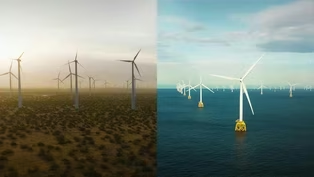 Now Playing
Why California is Betting on Giant Floating Wind Turbines
Video has Closed Captions
Clip | 8m 10s | California looks to wind energy, on land and offshore, to power its clean energy future. (8m 10s)
Why Power Lines Are Going Underground
Video has Closed Captions
Clip | 5m 52s | Could underground power lines help reduce wildfire risks in California? (5m 52s)
Why Fast Fashion Is Fueling a Growing Waste Crisis
Video has Closed Captions
Clip | 3m 48s | More clothes, lower quality and mounting environmental costs. (3m 48s)
The ‘Impossible Dream’ to Restore the LA River
Video has Closed Captions
Clip | 3m 14s | Exploring the history, ecology, and future of the Los Angeles River. (3m 14s)
The Fight to Protect Los Padres National Forest
Video has Closed Captions
Clip | 7m 46s | Will the Trump Administration’s rollback of public lands protections jeopardize Los Padres National (7m 46s)
The Fight to Protect the Mojave
Video has Closed Captions
Clip | 7m 58s | The researchers dedicated to protecting the Mojave Desert’s biodiversity. (7m 58s)
Conservationists and Communities Fight to Protect the Kern River
Video has Closed Captions
Clip | 8m 27s | The California River that’s loved, drained and overrun and the people fighting to defend it (8m 27s)
Preserving Ocean Life on the California Coast
Video has Closed Captions
Clip | 7m 13s | Setting sail to learn about efforts to protect marine ecosystems in the Santa Barbara Channel. (7m 13s)
Beach Access and a Threatened Track
Video has Closed Captions
Clip | 7m 13s | As the coastline erodes, what can be done to save the seaside rail link between LA and San Diego? (7m 13s)
A Visit to Carlsbad's Fix-It Clinic
Video has Closed Captions
Clip | 6m 47s | The people who find joy and purpose in repairing the broken items in our lives. (6m 47s)
Sun, Sand and Climate Change: The Fight to Save California’s Coast
Video has Closed Captions
Clip | 6m 53s | What’s being done to save Southern California’s beaches from being washed away for good? (6m 53s)
How to Create a Sustainable, Zero Waste Meal Plan
Clip | 7m 11s | A climate change activist tells us how to create a more sustainable kitchen. (7m 11s)
The Community That Transforms Food Scraps Together, Stays Together
Video has Closed Captions
Clip | 5m 50s | L.A.’s garden activists create a composting movement. (5m 50s)
Meet the People Rescuing Food, Feeding Neighbors & Helping the Climate
Video has Closed Captions
Clip | 6m 32s | Saving perfectly good food from dumpsters (6m 32s)
Video has Closed Captions
Clip | 6m 27s | We explore why enough water couldn’t be pumped through fire hydrants to protect homes from burning. (6m 27s)
Goodbye Plants, Hello Fire Safety
Video has Closed Captions
Clip | 7m 53s | Controversial proposal to protect homes from wildfires by forcing homeowners to remove vegetation. (7m 53s)
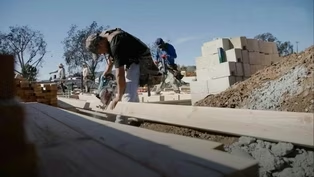
Can You Build a Fire-Proof Home?
Video has Closed Captions
Clip | 7m 46s | How to rebuild after L.A.’s devastating wildfires. (7m 46s)
Earth Focus Environmental Film Festival 2023 (Preview)
Preview | 30s | The fifth annual Earth Focus Environmental Film Festival features five days of screenings. (30s)
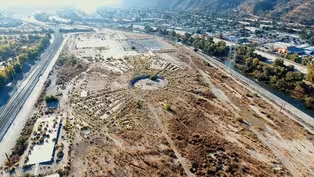
Clip | 8m 17s | Taylor Yard is now an undeveloped and still-contaminated site adjacent to the L.A. River. (8m 17s)
Earth Focus Environmental Film Festival
Preview | 1m 18s | Earth Focus Environmental Film Festival (1m 18s)
Cold Rush? The Changing Arctic
Clip | 14m 41s | "Earth Focus" looks at the changing face of the Arctic today. (14m 41s)
Fukushima: Can it Happen in the US?
Clip | 7m 21s | Fukushima was not a Japanese nuclear disaster. (7m 21s)
Cambodia: Fight for Areng Valley
Clip | 10m 47s | The Chong people are fighting to protect their forests. (10m 47s)
Inside Illicit Ivory and Rhino Horn Trade
Clip | 6m 41s | Inside Illicit Ivory and Rhino Horn Trade (6m 41s)
Unacceptable Risk: Firefighters on the Frontline
Clip | 12m 52s | Fires are becoming more frequent, larger and more devastating than ever. (12m 52s)
China: Religion and Environment
Clip | 13m 37s | Filmmakers Gary Marcuse and Shi Lihong capture a surprising trend in China. (13m 37s)
Hope for Rhinos? New Approaches to Save Endangered Species
Clip | 14m 31s | Rhino horn is more expensive than gold or platinum. (14m 31s)
Making Coastal Communities More Resilient to Extreme Weather
Clip | 5m 48s | Joshua Saks looks at how America's communities can be protected. (5m 48s)
Paying for Climate Change: A Reinsurance Industry View
Clip | 6m 32s | Climate change is anticipated to have a big impact on the insurance industries. (6m 32s)
Encroaching Tides: What's at Stake for the US
Clip | 6m 32s | The eastern coast of the United States has one of the highest rates of sea level rise. (6m 32s)
Sacred Economics: A Post Money World?
Clip | 11m 55s | Charles Eisenstein speaks to Earth Focus about his new book Sacred Economics. (11m 55s)
Neonics: Toxic Until Fully Tested
Clip | 8m 58s | Scott Hoffman Black speaks about the impact of neonicotinoid pesticides. (8m 58s)

Neonics: Driving Declines in Biodiversity
Clip | 8m 26s | Dr. David Goulson speaks about the impact of neonicotinoid pesticides. (8m 26s)
Clip | 5m 43s | Earl Blumenauer talks about why protecting pollinators in the US is the national interest. (5m 43s)
Clip | 11m 29s | Shrimp farmers tell us to reject contaminated shrimp from Bangladesh. (11m 29s)
Killing the Senate Filibuster Could Inspire Bipartisanship
Clip: Special | 27m 36s | Jon Christensen moderates a conversation with former Nevada Sen. Harry Reid. (27m 36s)
Sen. Cortez Masto: Pursuing a Green Economy
Video has Closed Captions
Clip: Special | 1m 9s | Cortez Masto has a goal to grow a clean energy economy that includes jobs for the future. (1m 9s)
Sen. Cortez Masto: Protecting the Outdoors is Nonpartisan
Video has Closed Captions
Clip: Special | 37s | Protecting the environment should not be considered a partisan issue, Cortez Masto says. (37s)
Sen. Cortez Masto: On Reid’s Environmental Legacy
Video has Closed Captions
Clip: Special | 54s | Sen. Harry Reid struck a balance when crafting inclusive environmental policy, she says. (54s)
Sen. Cortez Masto: On Growing Up in Rural Las Vegas
Video has Closed Captions
Clip: Special | 40s | Cortez Masto grew up in a rural Las Vegas with cowboys and ranches. (40s)
Sen. Cortez Masto: ‘A Microcosm of America’
Video has Closed Captions
Clip: Special | 1m 17s | Sen. Catherine Cortez Masto describes her state’s role in national politics. (1m 17s)
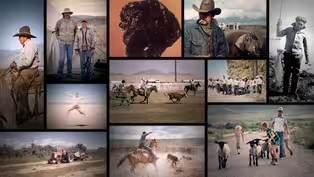
The New West and the Politics of the Environment (Preview)
Video has Closed Captions
Preview: Special | 1m | A quiet, little-known revolution is taking place in American environmental politics. (1m)
Moapa Solar Plant Addressed Injustice, Economy and Energy
Video has Closed Captions
Clip: Special | 5m 7s | Behind-the-scenes negotiations helped establish the Moapa transition from coal to solar. (5m 7s)
How SNPLMA Wove Urban Las Vegas Back Into the Environment
Video has Closed Captions
Clip: Special | 2m 17s | The legislation helped balance urban growth in Las Vegas with environmental conservation. (2m 17s)
Black Rock-High Rock: The Negotiation Behind Conservation
Video has Closed Captions
Clip: Special | 8m 2s | A proposal to protect Nevada’s Black Rock Desert-High Rock Canyon received much criticism. (8m 2s)
Providing Support for PBS.org
Learn Moreabout PBS online sponsorship New Episode
 New Episode
- Drama

Lesley Manville and Tim McMullan return in the final installment of the Susan Ryeland mysteries.

 New Episode
 New Episode
 New Episode



 New Season

Support for PBS provided by:
Earth Focus is a local public television program presented by PBS SoCal