Previous Episode
episode
Next Episode
episode
Season 20
Special: Mansion Masterpieces (2016)
History meets fantasy with treasures fit for a period costume drama!
Learn how the antiques market has evolved since 2001!
APPRAISER: If TV had smell-o-vision, you could tell this thing has been stored away forever and ever.
APPRAISER: Put one violin in a room with two experts, and you're gonna get three opinions.
GUEST: I don't think for that amount of money I should be using it for soup.
MARK WALBERG: Back in 2000, Roadshow found items from all over in the hub of the universe: Boston, Massachusetts. Have the values for this mystery violin and other wicked awesome antiques changed over time? Find out in our fresh look at Boston.
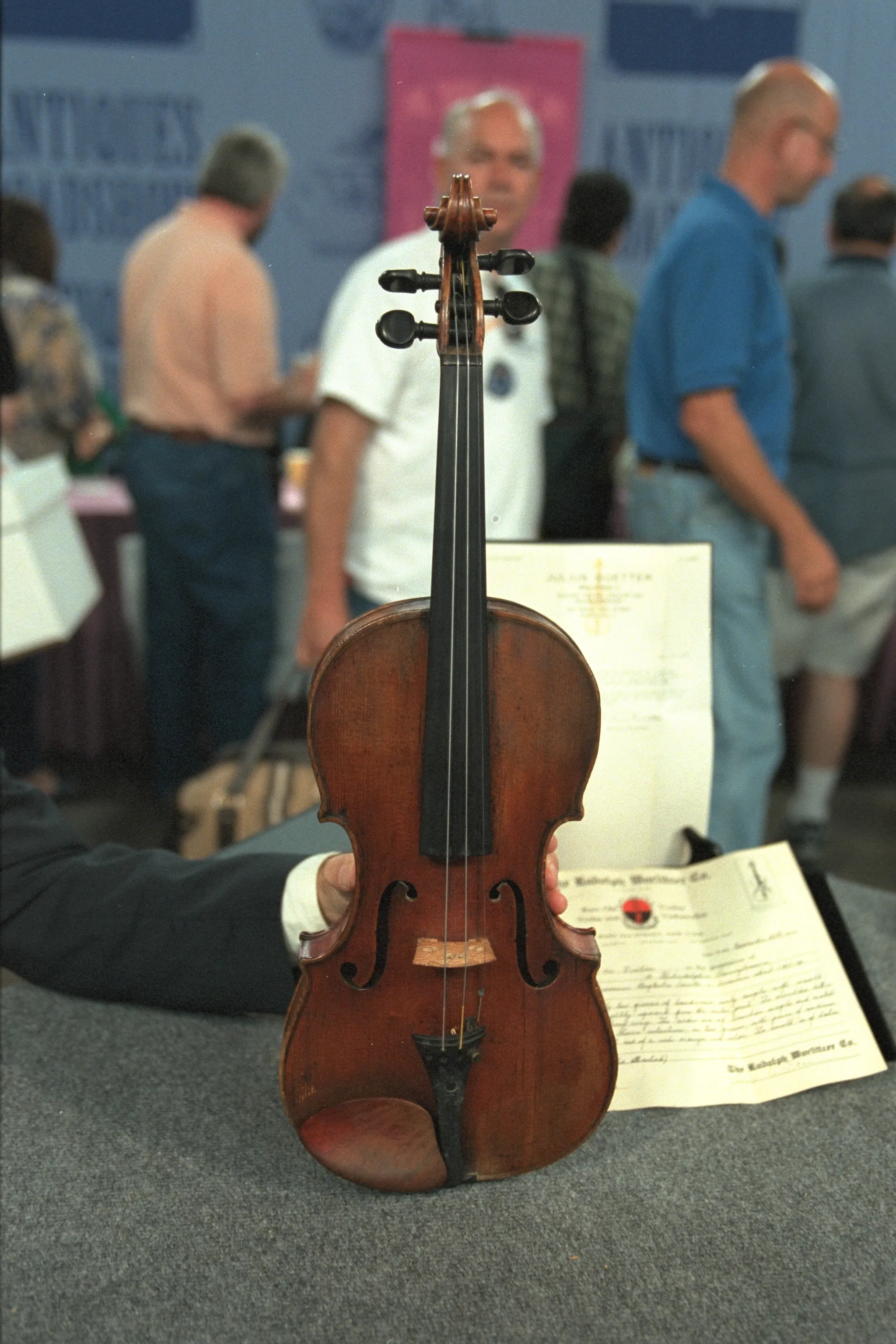
GUEST: This belonged to my grandmother, who played the violin. She went to Europe with her family on the grand tour. It would probably be in the late 1800s. She was a young woman then. And one of the things they bought was this violin when they were in Italy.
APPRAISER: Well, it's interesting... part of the story-- she's purchased this or her family has purchased this instrument in Italy and then brought it back to the United States, where the next part of this story starts. And this is the attribution of this instrument. Back here in America, they then tried to find out where this violin was made and who it was made by. It's a saying I always sort of spurt out that "Put one violin in a room with two experts and you're going to get three opinions" because the violin has to speak for itself at some point.
GUEST: Right, right, right.
APPRAISER: We've got two very interesting ones here, one from 1942 by a Julius Guetter, who was a maker and restorer in Philadelphia, where your family was from. He put this instrument as a Joseph Guarneri as it's labeled. Yet a year later, it's shown to one of the better dealers in the United States, Rudolph Wurlitzer, who then ascribes it to Johannes Baptiste Ceruti-- a much later maker, after Guarneri. And now you'll hear my opinion, yet a third.
GUEST: Oh, great, I can't wait.
APPRAISER: The instrument is most certainly Italian work and for a lot of reasons. We're going to look at the workmanship here. One of the most wonderful things about this instrument is the scroll and how wonderfully it's carved. It's a very short, compact scroll very much in the style of Guarneri. And if I had to venture, I'd say it's from the maker of the Guarneri family. Yet the body tells us something different. Why is it Italian work? We're going to look first here at the f-holes and how wonderfully the wings are cut and finished off. When we look at the thicknesses of the f-hole, we're noticing that it starts off very even through in this area and then gets thick again up at the wings. That technique repeats itself on the back of the violin with the corners, both on the top and back. You'll notice a very even edgework around the outer bouts and as it approaches the corners it actually scoops out-- typical Italian style, without a doubt. The varnish doesn't say 18th century; the varnish-- this sort of thinly applied varnish-- says 19th century. I'm going to say 1810, 1820, in that period. Having an attribution of Ceruti with this instrument in this condition, I'd give it an estimate of between $18,000 and I'd probably say $26,000, somewhere in that range, at auction.
GUEST: Wow, wow, wow, wow, wonderful.
APPRAISER: It's a wonderful, classic piece. Always difficult to attribute pieces. You know, there's 10,000 names in this book, and we only know a small portion of all their work.
GUEST: And there's no signature or little carving...
APPRAISER: No, no, right. But a great example.
GUEST: Would you recommend getting it refinished or doing anything to get it playable, or...?
APPRAISER: Well, "refinishing" is a dangerous word. You want to keep this varnish as original as possible because it's really quite wonderful a varnish on here. Yes, certainly a little restoration work-- gluing the seams, getting it set up, certainly making it playable if there's someone in the family who wants to play it. I think it would serve a musician very well.
GUEST: What do you know?
GUEST: I bought it at an auction. It was an estate auction. The woman had quite a number of Oriental items. I guessed that it was probably from Japan, or...
APPRAISER: You say an estate auction-- where?
GUEST: In Winchester, Virginia.
APRAISER: And what'd you pay for it then?
GUEST: I paid $60.
APPRAISER: $60 at an estate auction.
GUEST: There wasn't much interest in it.
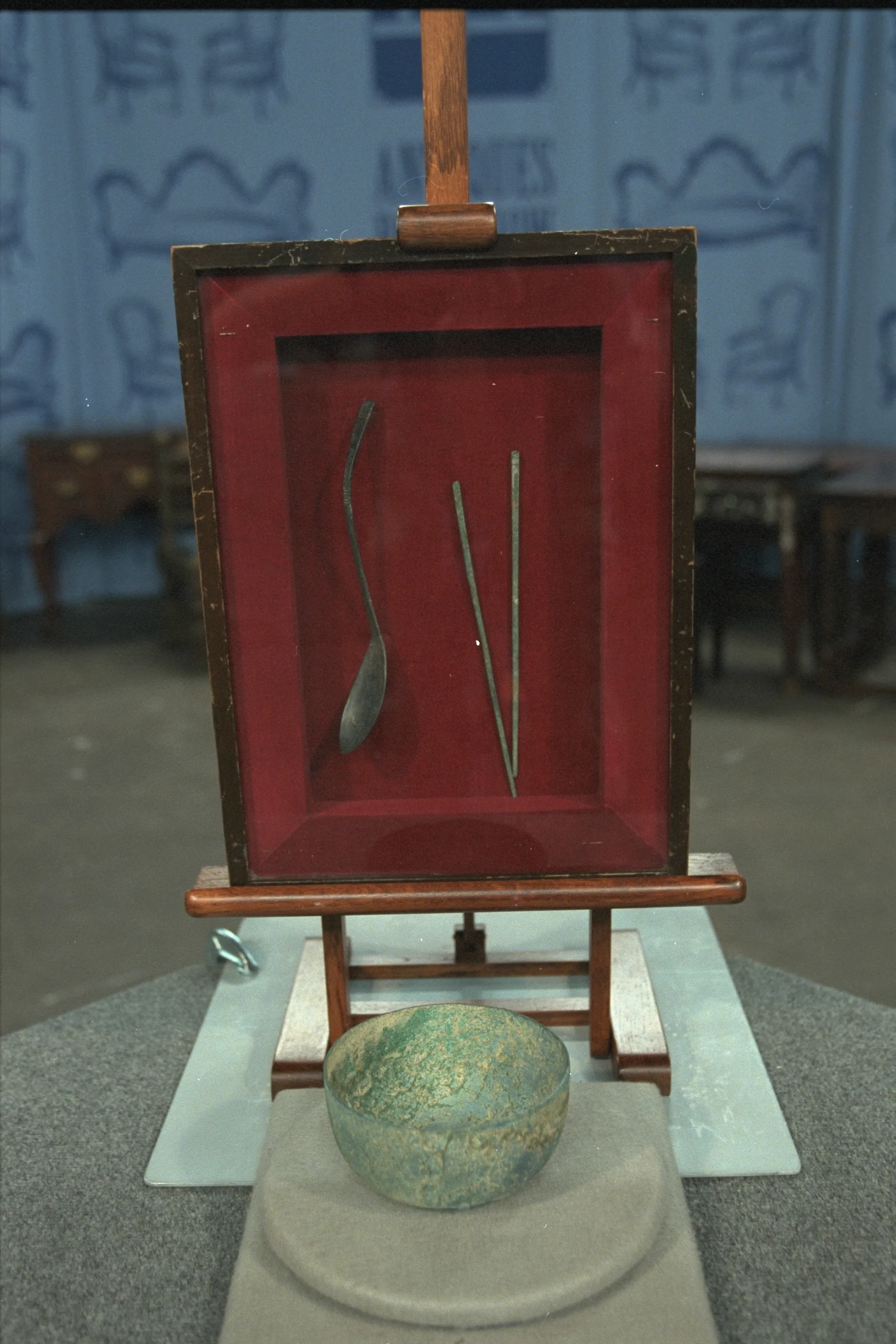
APPRAISER: In the middle of Virginia, okay. Let me tell you why I thought this—why this is interesting. During the ninth, tenth, 11th century in China there was a great flowering of scientific knowledge, cultural inspiration; it was equivalent to what we call our Renaissance. This knowledge and this inspiration for the arts was disseminated from China to the other Asian cultures. So what you have here, basically, are Chinese designs, but they're Korean.
GUEST: Oh.
APPRAISER: Dating from the 11th, 12th century, a period called the Koryo Dynasty.
GUEST: Oh, my God.
APPRAISER: Can you believe it?
GUEST: Wow! I thought they were old. The auctioneer at the time had mentioned that he thought they were buried-- that they buried objects with them...
APPRAISER: Absolutely were buried.
GUEST: And I assumed that's why there was a crack in it.
APPRAISER: They were food offerings for life in the next world, and this was intended to go with the person to the next world so they could eat. Now, they're made of bronze. They look very similar to the ones you get in China. The difference is with this bowl, the very steep-sided, rounded shape is much more typical of Korean material from that period, from the Koryo period. This patination, this green color you see here, that's an indication of authenticity and age because that only results from the action of minerals with water and acids in the soil that create this sort of natural patina that includes other minerals-- malachite and other minerals-- that would form on the surface, transforming the bronze. Probably dug up in Korea and discovered sometime, I would think, back in the 1920s. And the value for the entire group has got to be somewhere between about $1,500 and $2,000.
GUEST: Oh, that's great.
APPRAISER: So that's a pretty good find, too.
GUEST: Yeah, that is good, very good.
APPRAISER: The Popeye, well, last one of these I heard selling at auction-- this is the very rare, overhead punching bag-- $3,500.
GUEST: You're kidding!
APPRAISER: I am not kidding.
GUEST: Oh, my God! For Popeye? (laughing)
GUEST: It was in our home when I was growing up, and just this year, my mother gave it to us to have in our home.
APPRAISER: It's signed down here, "Th. Welch" which stands for Thaddeus Welch. He was a Marin County painter, and he often painted Mount Tamalpais. This is probably worth around $8,000 to $12,000.
GUEST: Mm-hmm. All right, thank you.
GUEST: It belonged to my great-grandmother.
APPRAISER: Well, it's a wonderful example of American Edwardian jewelry, probably made here in Boston, with hand-made elements around the milligraining. Worth about $4,000 to $5,000.
GUEST: Oh, we had always heard it was costume jewelry.
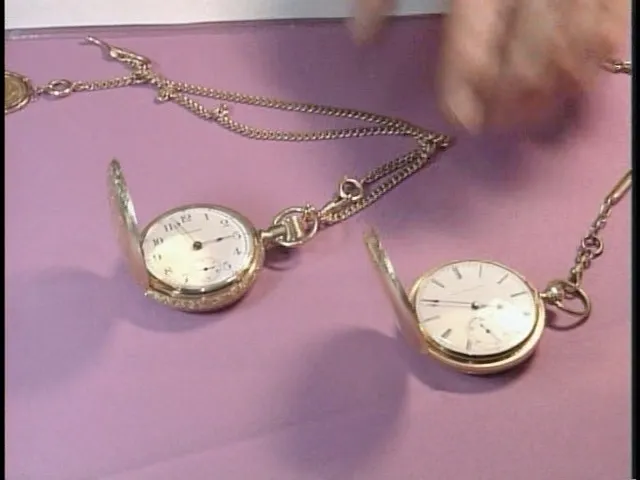
APPRAISER: We're here in Boston, and what is so fascinating is the fact that Boston was a major, major manufacturing city for watches. And before factories were set up in Waltham, it was very difficult to get a watch. And one of the founding members of the American watch industry was a man named Edward Howard, who also had his factory in Boston. And together, we've turned up both an Edward Howard watch and a Waltham. Waltham was to watches as General Motors or Ford was to automobiles. They basically were the company that put watches in everybody's pocket. Howard, on the other hand, was more of a boutique industry, and Howard watches are interesting to collectors because they look like no other watches that were made before or since. And if you open up the back of a Howard, it is this wonderful mechanism, and they're highly prized. Walthams in this condition, which are very common, would be worth $1,500 to $2,000 simply because of its condition. The Howard, on the other hand, although it's not in as nice condition, is worth maybe $1,500, $2,500 as well.
GUEST: That's pretty good.
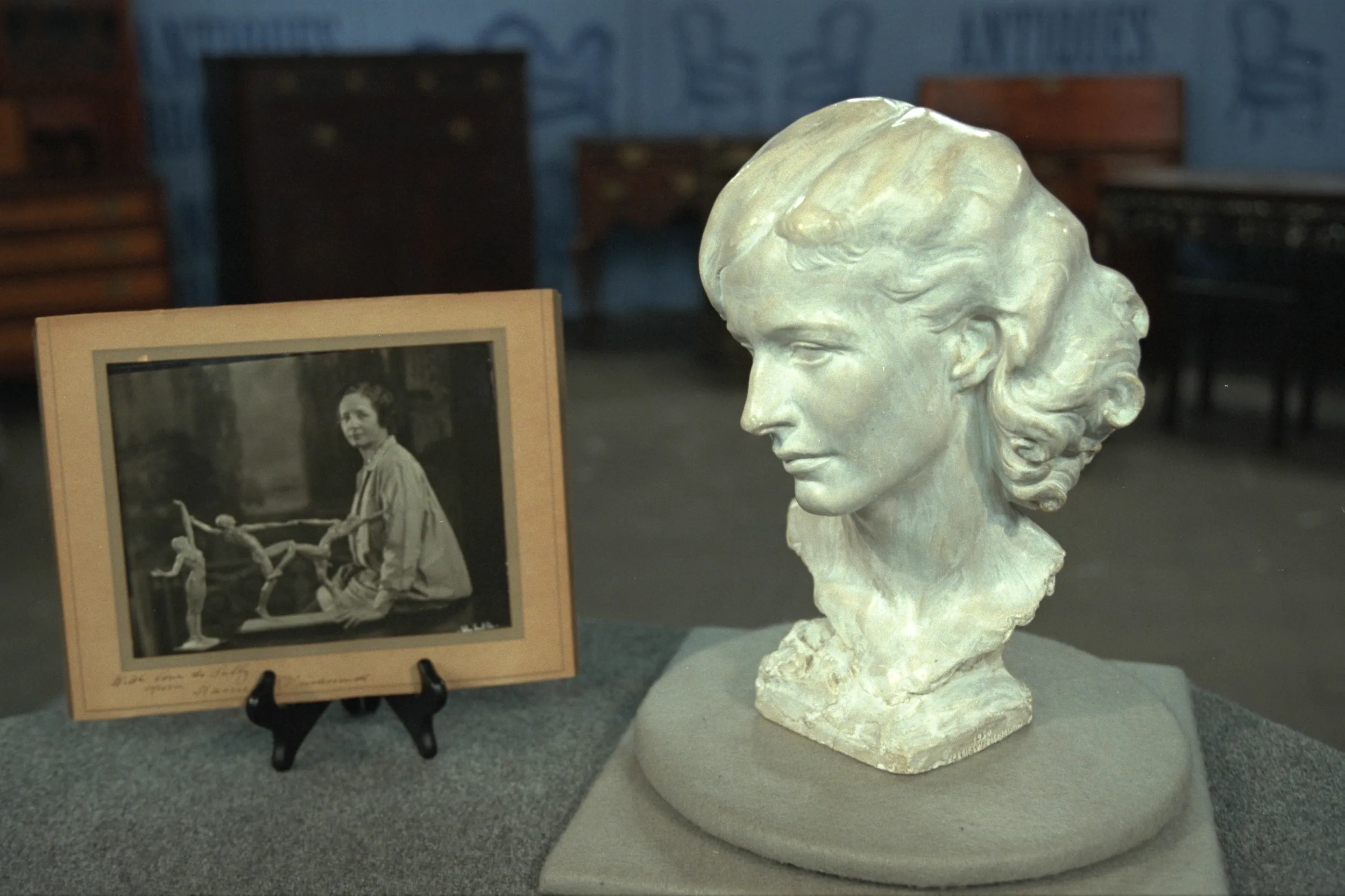
GUEST: Well, my great-great-aunt was a friend of Harriet Frishmuth, and she'd given her this back in the '30s, I believe. And my great-great-aunt, having died childless, left everything to my grandmother...
APPRAISER: Mm-hmm.
GUEST: And I'd always admired it, and I helped my grandmother clean out her house one year, and she said I could have anything I wanted for doing that, so I chose this.
APPRAISER: Good choice. Harriet Frishmuth, as you may or may not know, was born in Philadelphia in 1880, and her family went to Europe early on. And I've always thought this was very interesting: the only class open in Paris to women was taught by Rodin. She later moved to New York, studied at the Art Students' League, and is really thought of as a New York artist. Her sculptures are tremendous and very, very valuable. We have the piece signed, and also a lovely portrait of her which is also autographed and dedicated by the sculptor. What I also find interesting about this particular piece is that it's her favorite model, Desha, and I think that sort of intimacy and sensitivity really plays into it. It is a plaster cast, which is valued differently than a bronze. In some ways, while it's unique, it's much more fragile. A terrific piece, a great family treasure by one of the seminal sculptors of the 20th century. Harriet Frishmuth, the best. In terms of its value, I would put it between $15,000 and $25,000.
GUEST: Oh, wow!
APPRAISER: (laughing) So, keep her someplace safe.
GUEST: Yes. When my mother finds out how much this is worth, she's going to want it back. (chuckles)
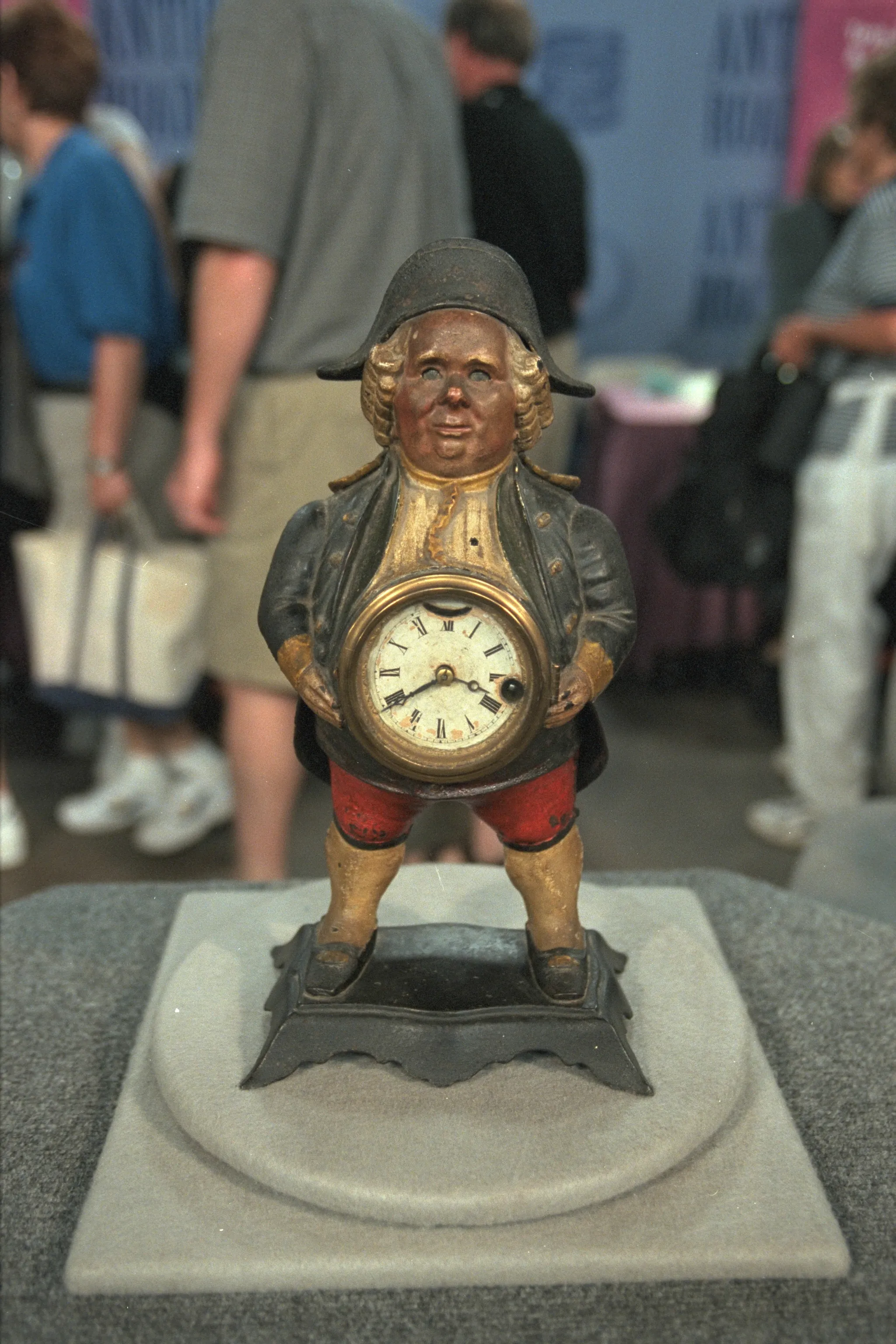
GUEST: It was given to my uncle Bill, who worked in a local grocery store, and the gentleman who owned the store was very elderly at the time and eventually decided to retire, and he gave it to my uncle as a parting gift.
APPRAISER: Was your uncle an antique collector, per se?
GUEST: No, not at all.
APPRASER: So, what... one can wonder why he thought your uncle would like this. It's a curious object. (laughing)
GUEST: I have no idea why he picked that to give to him as a gift.
APPRAISER: And then ultimately, it was left to you? Is that the idea?
GUEST: Yes. He knew that I liked it as a little girl, and he told his sister, my aunt Marjorie, "When she gets old enough, I want her to have it."
APPRAISER: Great.
GUEST: He passed away, and she kept it and when I became an adult, she gave it to me.
APPRAISER: When I was a teenager, I collected clocks. I think that's how I got started in all of this. And I remember in some of the early reference books seeing these clocks illustrated, and I was quite fascinated with them and wondered whether I'd ever get to see one for real. Well, over the years I've seen a few of them. These so-called "blinking-eye" clocks have been collectible since the early part of the 20th century, believe it or not. The thing that impresses me about this particular clock, it's in remarkable condition. Many of these clocks have been repainted over the years because people think, "Oh, the paint's dull. I think I'll dress it up little bit." I don't think I've ever seen one that worked. And in this case, we know it's working, and it's telling good time.
GUEST: He certainly does.
APPRAISER: The movements on these clocks were made by Waterbury, a clock company in Waterbury, Connecticut. They're responsible only for the movement. But the case itself was made by Bradley & Hubbard Manufacturing in Connecticut, and they were a remarkably innovative firm making a lot of decorative objects out of both cast iron and brass. If we turn the clock over, you can see that it was patented in the late 1850s. And there's Bradley & Hubbard's logo. This clock has a wonderful profile. Okay, it was called at the time the "Continental" model, and there were a number of these clocks made in a variety of forms, this being, I think, one of the most desirable forms. Great condition-- it's working. It's the best.
GUEST: Thank you.
APPRAISER: So I was thrilled when you brought it in, and I think as far as value is concerned, it would be probably between, well, $4,000 and $4,500. So it's a treasure.
GUEST: Thank you very much.
APPRAISER: All right, and now, you ready?
GUEST: Well, it was a photo that was in our home. It's from my husband's grandfather, and he worked on maps and he helped work on a map that was in the book 90 Degrees South, and this photograph was in that book.
APPRAISER: This is a carbon print or a pigment print of a ship called the Terra Nova. The title of the photograph is "The 'Terra Nova' Icebound." The photographer, his signature is on the lower right here, Herbert G. Ponting, "H.G. Ponting." And the byline reads: "Scott's Last Expedition." Ponting was something of a colorful figure. He started out as a journalist. He photographed during the Boxer Rebellion in China, went to the Philippines, and in 1910, was designated photographer of the official British expedition to Antarctica. He worked with Commander Robert Falcon Scott on the ship the Terra Nova, which left New Zealand in 1910 for the South Pole. On the ship-- and we can see some of the figures here-- were crew members, Siberian ponies, dogs, and motorized vehicles. Ponting was photographing all along: onboard the ship, as the crewmen left the ship. The expedition reached the South Pole in January 1912. Scott and his officers died and were designated heroes, having, of course, reached the South Pole. These photographs are extremely desirable today as fine art images-- you can see the beauty of this photograph-- as historical documents that chronicled the expedition. Do you have any idea of the value of something like this?
GUEST: No, we just have... we've had it hanging on the wall in our green room.
APPRAISER: In the auction market, I would estimate this carbon print at $7,000 to $10,000.
GUEST: No way. I didn't realize it was anything like that.
GUEST: I picked the piece up at a moving sale for just a couple of dollars.
APPRAISER: The glass that was mated with Venini was really... They were virtuoso techniques. You can see it would have been very, very difficult, creating all of these patchworks. The value would be probably $4,000 to $6,000.
GUEST: $4,000 to $6,000? You're kidding!
APPRAISER: What you have is a great collection of pillow shams. In the war, you could send these to people that you loved. So you have probably close to $1,000 worth of pillow shams here.
APPRAISER: But these are Steiff, and for every hundred animals we see that are Steiff, we see one doll. The little girl today is between $800 and $1,000, and he is $2,500 to $3,000. He'd be more if he were clean.
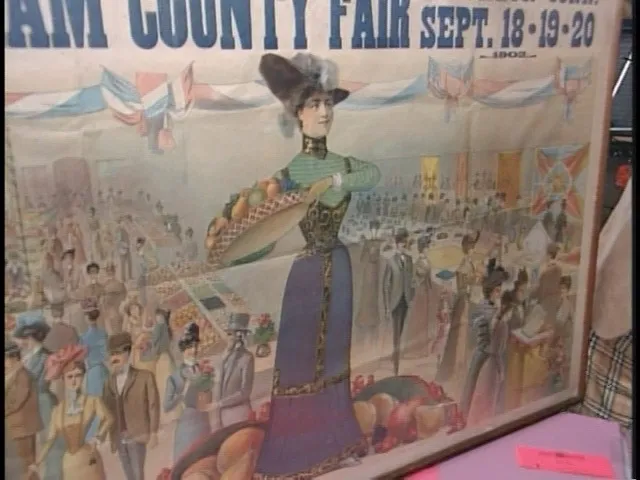
APPRAISER: This poster represents, obviously, a county fair from 1902. It's a stone lithograph, and the detail is extraordinary. I mean, here you have all of the baked goods that were prepared by ladies of the town. There, you have all the local produce.
GUEST: Plus, it's sentimental because my brother gave it to us. It was a nice gift.
APPRAISER: Do you realize what a nice gift that was?
GUEST: Not yet.
APPRAISER: I mean, do you think he'd take it back if he knew what a nice gift it was?
GUEST: Not my brother, no.
APPRAISER: Basically, lithographs like this at auction-- and this is extremely rare; I've never seen this particular one before-- would sell for between $2,000 and $3,000.
GUEST: Wow.
APPRAISER: Albert was saying earlier that when he came in, he saw these holes right along the top, and that's a real problem, right?
APPRAISER: The thing about the holes is that there's a lot of oxidation in them, they're dark, so we know the nails that held the moldings on were on, what, for a long time, wouldn't you say? A great Salem piece. Apparently it has a Salem history too, which the family's going to talk about.
GUEST: Major John Rowe was famous for having led the militia from Rockport to the Battle of Bunker Hill.
APPRAISER: That's wonderful, and he came back with no wounds.
GUEST: No, he came back quite perfect and raised 13 children.
APPRAISER: Wonderful. What great history.
GUEST: So he had a lot of vitality.
APPRAISER: And this is his desk, descended in his family. You mentioned that this is even listed in the will, his will from 1765.
GUEST: Yes, there is a will which is now in the Sandy Bay Historical Society in Rockport, and the desk is listed with the date 1765.
APPRAISER: Okay, it would have been one of the prize pieces in the estate, I know.
GUEST: Absolutely would have.
APPRAISER: Well, I love the blockfront form, and what you've brought, of course, is a blockfront, slant-front desk, and this is the first authentic blockfront that's been brought to the Roadshow in the five years that I've been doing the show. Really? So we are really excited to see it. And the blockfront form actually is a form that came from baroque furniture in Europe. It was really a Dutch tradition of having the front of a piece that's shaped. And there were very few pieces made in England in the blockfront form, but in Boston, it became the center for this very, very expensive type of furniture.
GUEST: Right.
APPRAISER: This desk, if we actually look at the lid, we look at this wonderful figured wood, this piece was chosen to really show its grain. And we look at this form, and the wonderful thing about blockfront furniture is that all this blocking is completely unnecessary functionally, right?
GUEST: I know.
APPRAISER: So it was made for the wealthiest families in America, because one had to actually... You had to cut away and waste all this wood, so all this, you're cutting it out of a board and literally wasting all this wood. So it's a wonderful form. Now, your form, Barbara-- I feel that this desk was made in Salem, Massachusetts.
GUEST: I think so, I think you're right.
APPRAISER: I'm going to tell you quickly why. First of all, this shaping is typical of those on Salem desks. Also, if we come down to the feet and we look down here, it's a typical Salem foot. The shaping of the foot, the way the talons are are typically Salem. If I show you this piece at the Metropolitan Museum of Art... This piece, you notice that something's missing here? I'm gonna show you what it looked like. It had, actually, this is a secretary bookcase, and it's missing its shell and this is what that shell looked like, probably like that. It's a typical Salem scallop shell, 1760s, mahogany, and you could have that recreated based on that shell. First of all, this wonderful blockfront desk made in Salem, in the Boston tradition, okay-- a rare form. Typically at auction, these do bring upwards of $80,000 or $85,000, this form. Your piece, Barbara, I have to tell you, when the appraisers, when all of us saw this in the morning, we thought, "Well, that's what it is." There is something about it that suggests that something was on top, and I have to show you that. Barbara, you have this witness mark from a molding that was applied to the perimeter of the top at one time. You also have the nail holes with dark oxidation showing that those nails held that molding on for probably over 100, 200 years, and there was a bookcase section probably on top. And so we were all disappointed to see that. It still tells a great story. We're honored to have you bring it in, and this is the guest of honor today, this desk. Value-wise, it's probably around $15,000 instead of $85,000 because you have half of a piece.
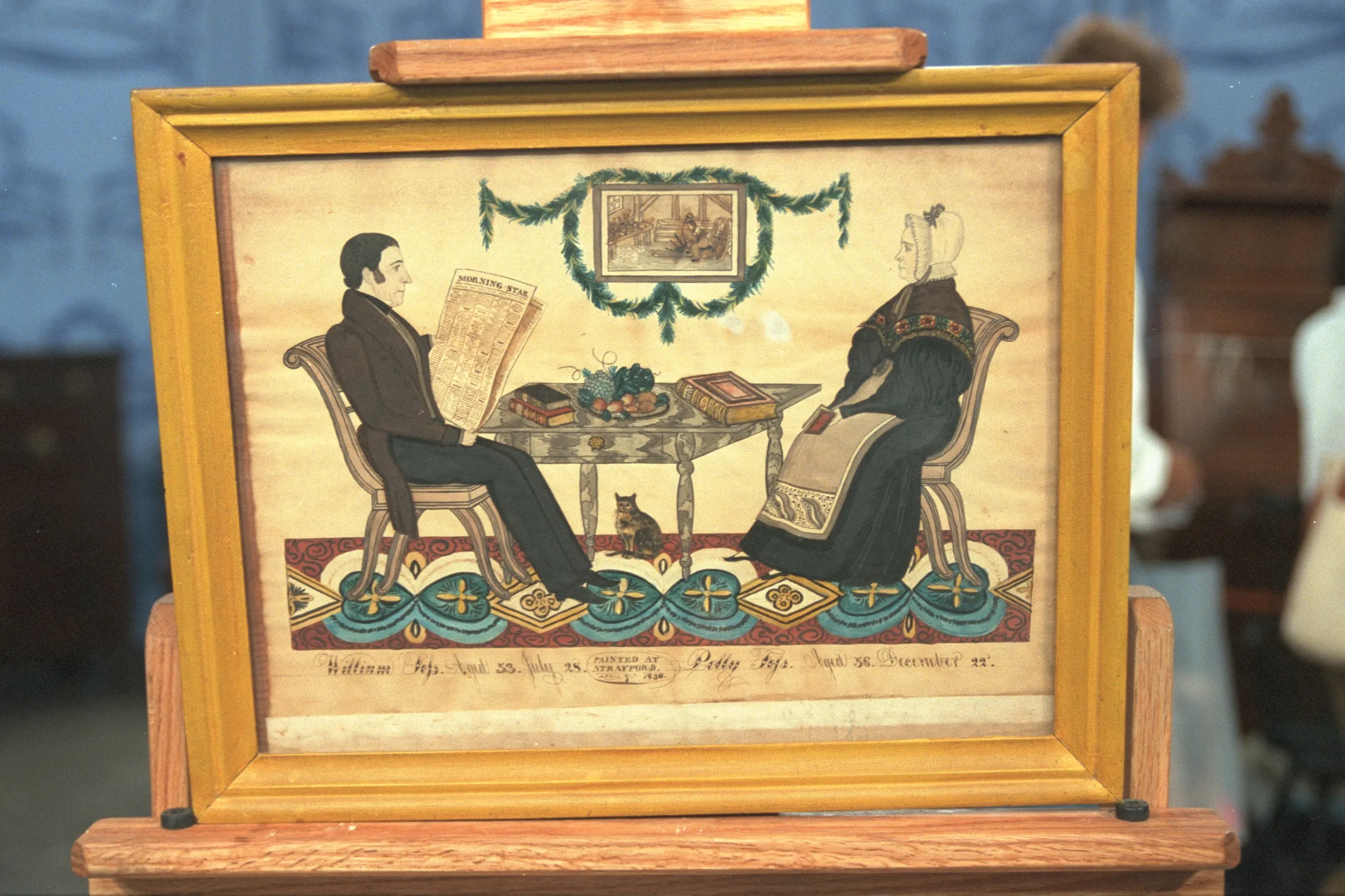
GUEST: This is an original painting which has been hanging in my house since it was originally painted in 1836. The people in the picture are my grandfather William Foss and his wife Polly, who are still buried on the family property. It was painted by Joseph B. Davis, an itinerant painter. He used to go from town to town, painting pictures of...
APPRAISER: The local people.
GUEST: The local people.
APPRAISER: Right.
GUEST: And this is one of the few that are still with the same family. It goes back five generations to my grandfather, William, here.
APPRAISER: Unbelievable. I mean, that alone would make this a great piece but added on top of that is the piece itself. The artist's name is Joseph H. Davis.
GUEST: Joseph H. Sorry, I got the wrong initial.
APPRAISER: And we don't know for sure who he was, but we know that he was active in southern Maine and New Hampshire from about 1832 to 1837, and that sort of corresponds with the date that we've got here.
GUEST: The bottom, yeah.
APPRAISER: He obviously was somebody who understood pattern and line and color, because look at how he's done this floor cloth.
GUEST: He's even got the picture in the top of the old blacksmith's shop.
APPRAISER: Oh, the old blacksmith's shop with a man making a wagon wheel, which is, to my knowledge-- and I've been doing this for 30 years-- the only such depiction. So I can't tell you how excited I was to see you and see this piece...
GUEST: We're glad to see you and I'm glad to show it to so many people.
APPRAISER: Yeah, because it really is an extraordinary thing.
GUEST: Even got the cat in the picture. We've still got three cats.
APPRAISER: Got the cat in the picture. You've got the Holy Bible there. Everything is working. You had this appraised in 1975?
GUEST: In 1975, yeah, local dealer.
APPRAISER: And how much was it appraised for?
GUEST: Uh, back then, it was $5,000.
APPRAISER: This thing, I would love to see it in an auction estimated at something like $40,000 to $50,000.
GUEST: That's interesting.
APPRAISER: But I have a feeling that in the right circumstances, on the right day, this could bring well, well in advance of that.
GUEST: Beauty's in the eye of the beholder.
APPRAISER: Well, I think you've got a lot of beholders today that would agree with you.
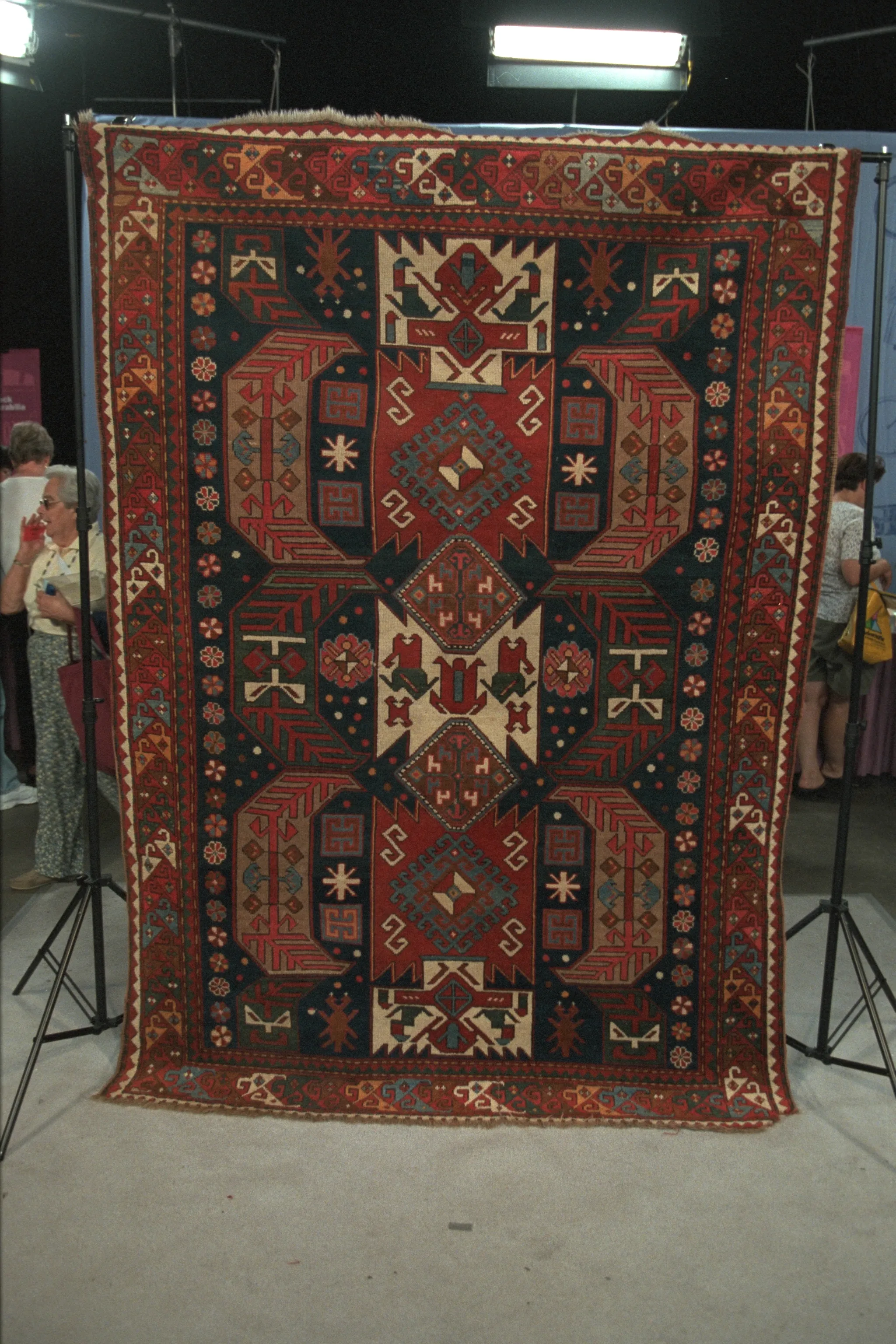
APPRAISER: Betsy, you tell me that this rug resided on the third floor of your grandmother's house?
GUEST: Of my grandmother's house, I think for at least 20 years, and maybe longer. And when she died, I got it when we divided up the estate, and I just always loved the colors. So I've had it about 30 years.
APPRAISER: And you've been using it all that time?
GUEST: Yep, it's been in living rooms and kitchens.
APPRAISER: Do you have any idea where the rug was made?
GUEST: I know nothing about it, which is why we brought it. I don't know very much about oriental rugs and they're hard to sort of take around and get an evaluation.
APPRAISER: Yes, well, the rug is a Karabagh, and that is a Caucasian rug woven in the mountains of southern Russia. And there's a particular name for this design, which is called a "Kasim Usag." Now, that might be hard to understand, and it's hard for us to understand as well because there's really no documented village by that name. And most of the rugs that are woven we like to attribute to a certain village or at least nomadic group. Now, in this region, there were Kurds that had been exiled in the 17th century by the various shahs that were in power at that time, and it's believed that the Kurds are the ones that made this rug. Now, the thing that's most interesting about this is the curled-leaf design. It dates back to 17th-century embroideries.
GUEST: Oh, wow.
APPRAISER: And from the 17th-century embroideries where it's thought that even before it was a leaf form, it came from dragon floral carpets, it is then found in 18th-century floral carpets. And so it's always wonderful to have this graduation of design, and then you find yourself into the 19th century and the early 20th century, and you have a production like this, which is woven in a village.
GUEST: Oh, okay.
APPRAISER: There are a couple of reasons why I think that this is probably early 20th century. It has a couple of synthetic dyes in it. There's a pink color that is synthetic, and then there's also an orange color that is synthetic, and that puts it firmly in the early 20th century for this group of rugs. Basically, it's in very, very good condition. I would assign a retail value in the area of $8,000.
GUEST: Oh, wow!
APPRAISER: Yes.
GUEST: Oh, my Lord.
APPRAISER: If this rug had been woven in the 19th century and had essentially the same sort of design, it would have been worth two to three times as much to a collector.
GUEST: Oh, okay.
APPRAISER: And that's a big thing to know about antique rugs, is whether they fall into a collectible category or more of a decorative category.
GUEST: Oh, okay, okay.
APPRAISER: So this is more than likely, if this were on the market, it would be bought by somebody who was decorating because a collector would hold out for a 19th-century example that had all natural dyes.
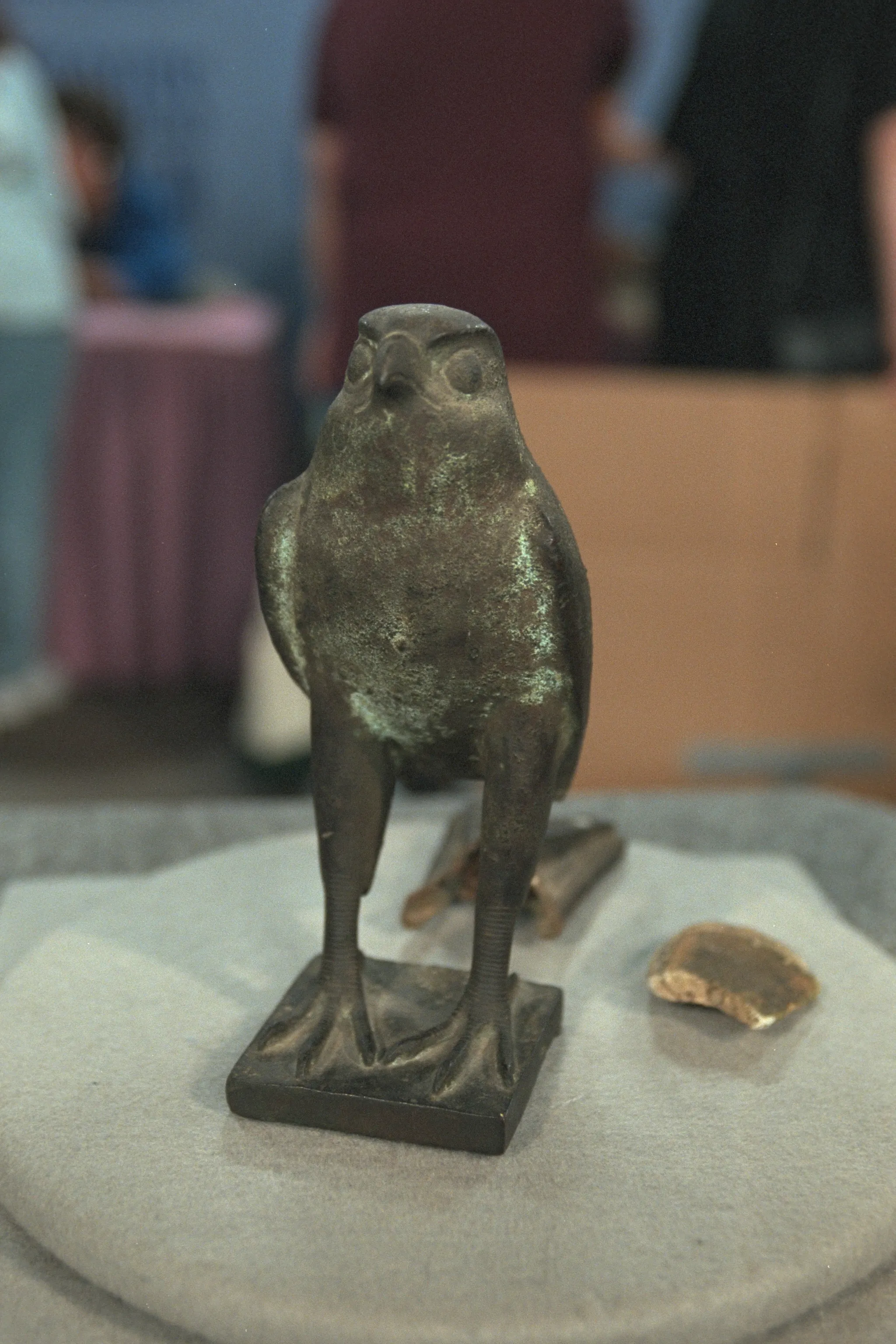
GUEST: I inherited this from an uncle of mine, and I guess I was one of his favorite nephews and he was one of my favorite uncles. And he had this bird, and I looked at him all my life when I stayed there and I was fascinated by him. I loved him, and I still do. And when he passed away, he left it to me.
APPRAISER: That's great. Well, this is a very special piece. Obviously, you know already that it's Egyptian, and it dates to what we call the Late Period, so that means it dates between 664 B.C. and 304 B.C. And it's not just an image of a bird. It was sacred to the god Horus, and as such, it was hollow cast, and it originally contained a falcon mummy. And if you look where the tail has broken off, you'll see that there's remnants of the mummy inside. You can also see when you flip this over that it's hollow, and that the falcon mummy would have been fit up into here. There's also the remnants of a hieroglyphic inscription on the base which would have named the dedicant-- the person who gave this piece. It's beautifully cast. You have great details of the feathers here and the eye markings for the falcon. It's absolutely exquisite. Now, how did it get broken?
GUEST: Well, unfortunately, two of my sons apparently got the idea of playing with it back in 1962 or so. And it lasted all that time, and somehow or another, it fell off the shelf, and each of them went like that.
APPRAISER: "Not me."
GUEST: Yeah, "Not me, it's got to be the other one."
APPRAISER: Maybe they thought it was the Maltese falcon and were trying to find treasure inside.
GUEST: They probably did.
APPRAISER: Any idea what it's worth?
GUEST: Oh, none whatsoever, no, none whatsoever.
APPRAISER: Well, if this were coming up at an auction I would have estimated it at about $12,000 to $18,000, and I would probably expect that it would sell for more.
GUEST: Really? Wow, that's unbelievable.
APPRAISER: It's really a special object.
GUEST: Oh, that's super. Well, I really appreciate that. What would it have been worth if it wasn't broken?
APPRAISER: It won't affect the value at all.
GUEST: Really?
APPRAISER: No, because it's a clean break.
APPRAISER: These guys, at one time, no one cared about plastic in the '50s. You know, it was made very cheaply. These were sold for 69 cents, at best. Now, because of the colors on them-- because they're multicolored-- they sell for about $125 apiece. So it was very good you didn't throw these away.
GUEST: Oh, definitely, or even sell them in a lawn sale.
APPRAISER: They're both signed R. Lalique, but what's nice about this piece is that the opalescent color is so very strong. I would tell you on today's market this piece would sell for probably around $800 to $1,200, and this one would sell for around $600 to $800. And while most people would think that the larger piece would be the more valuable of the two, actually, it's the smaller piece.
APPRAISER: This is a Stanley number one. It's probably the most desirable tool Stanley ever made in terms of collectors. This particular one was made in the 1920s, and in this condition, it's worth around $1,200.
GUEST: Wow.
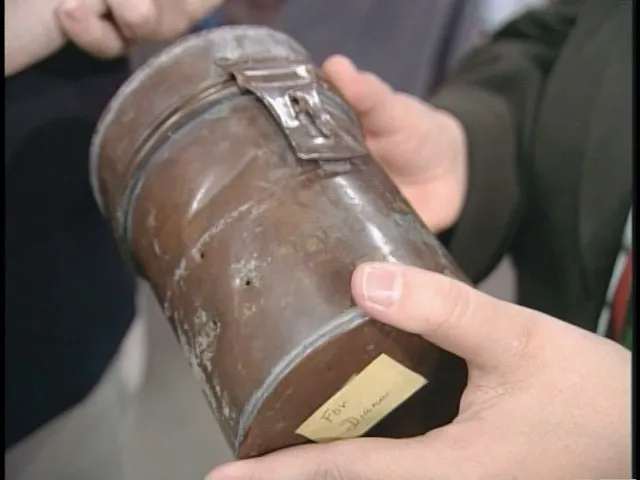
GUEST: Well, I bought it in an antique shop up the coast of Maine about five years ago. Was told it's a copper church collection plate.
APPRAISER: Partially right. It is for collecting, but it's actually Jewish art. It would have been used in a synagogue for collecting charity. Made out of copper, probably made in Poland or Eastern Europe, Poland, Russia, Eastern Europe, and probably in the early to mid-1800s. And these type of items are very heavily worn. They would have been used constantly. You can see the traces of Hebrew lettering here. The latch is a little bit damaged. It's been repaired, but surprisingly enough, even in this condition, Judaica is so rare and highly prized that this would bring about $1,000 at auction.
GUEST: Very good.
APPRAISER: So what a nice piece.
GUEST: It is.
APPRAISER: Thanks for bringing it in.
GUEST: Thank you.
GUEST: Well, I acquired the document through the WGBH Auction in 1978.
APPRAISER: Oh, my goodness.
GUEST: Yes. And it was certainly before black memorabilia became popular.
APPRAISER: The rage that it is today, yes.
GUEST: But because it was a certificate of citizenship for a person of color, I personally felt it should belong to a person of color, so I got the high bid.
APPRAISER: If I may ask, how much did you pay for this in 1978?
GUEST: I paid $75, which at the time my mother thought was outrageous, but... (chuckles) It was well worth it.
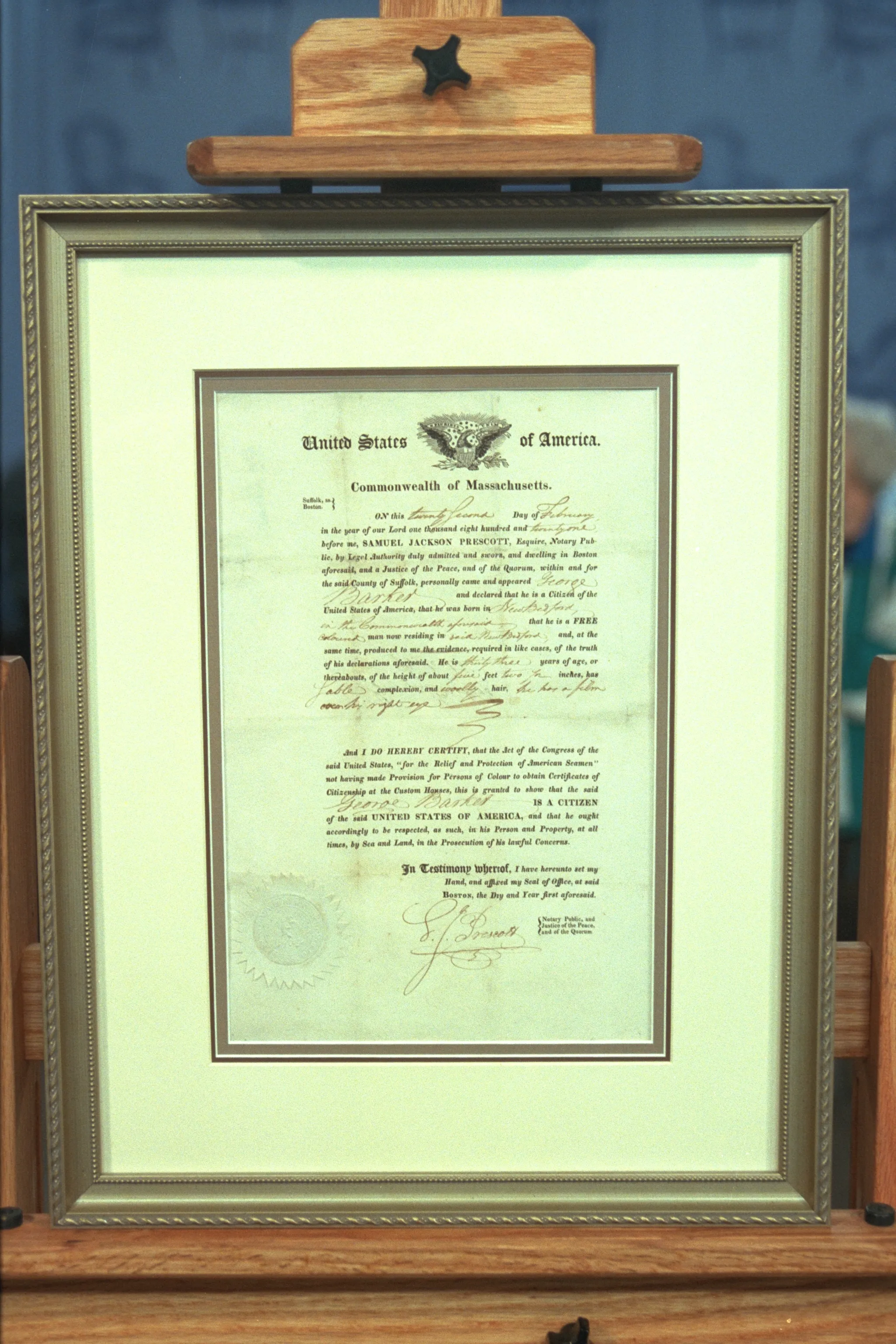
APPRAISER: In retrospect, it wasn't outrageous. I need to share a couple exciting things with you here. This is an important document that is showing George Barker-- the gentleman right here, and he was born in 1788-- and that he is a free person of color and a citizen of America. And more importantly, it's showing descriptive information about his height-- he's five foot two; he has a "sable" complexion and he has "woolly" hair.
GUEST: (chuckling) Yes.
APPRAISER: Is that just not indicative of the time period, where they were describing African Americans with "woolly" hair?
GUEST: Right, exactly.
APPRAISER: The other thing that's exciting is that down here, we have where it says "'for the relief and protection of American seamen'…not having made provision for persons of color to obtain certificates of citizenship."
GUEST: Right.
APPRAISER: This document is so important. You have a wonderful seal right here. It's archivally framed. It's from Massachusetts. I've never seen something like this. With the genre of black memorabilia, we get to see so many types of documents that are attributed to slavery. We get to see certificate of freedom, we see manumission, writ of affidavit, bill of sales, court cases. But it's very unusual to see a document of this significance concerning a free person of color where it's all laid out in such exquisite form. We know his name, his height, his age, and the notary public. I mean, this document could not be more significant. Do you have any idea what it could be worth today?
GUEST: Not a clue, just, uh... Yeah, no idea.
APPRAISER: Just let me tell you. Scholars, collectors, museums, libraries would eat this up. How about $3,500 to $5,000 for this document?
GUEST: Oh, my God! That's unbelievable!
APPRAISER: Now, is your mom still living?
GUEST: Yes, she is, and she's going to be mighty shocked!
APPRAISER: Make sure you tell her that $75 many years ago was well spent.
GUEST: That is amazing.
APPRAISER: Thank you very much for sharing with the Antiques Roadshow.
APPRAISER: I understand that you got this tureen from your great-aunt, was it?
GUEST: Yes I did, she... it was in her estate and I was lucky enough to get it.
APPRAISER: And where do you think she got the tureen?
GUEST: I think she must have gotten it from her parents, my great-grandparents who traveled a great deal.
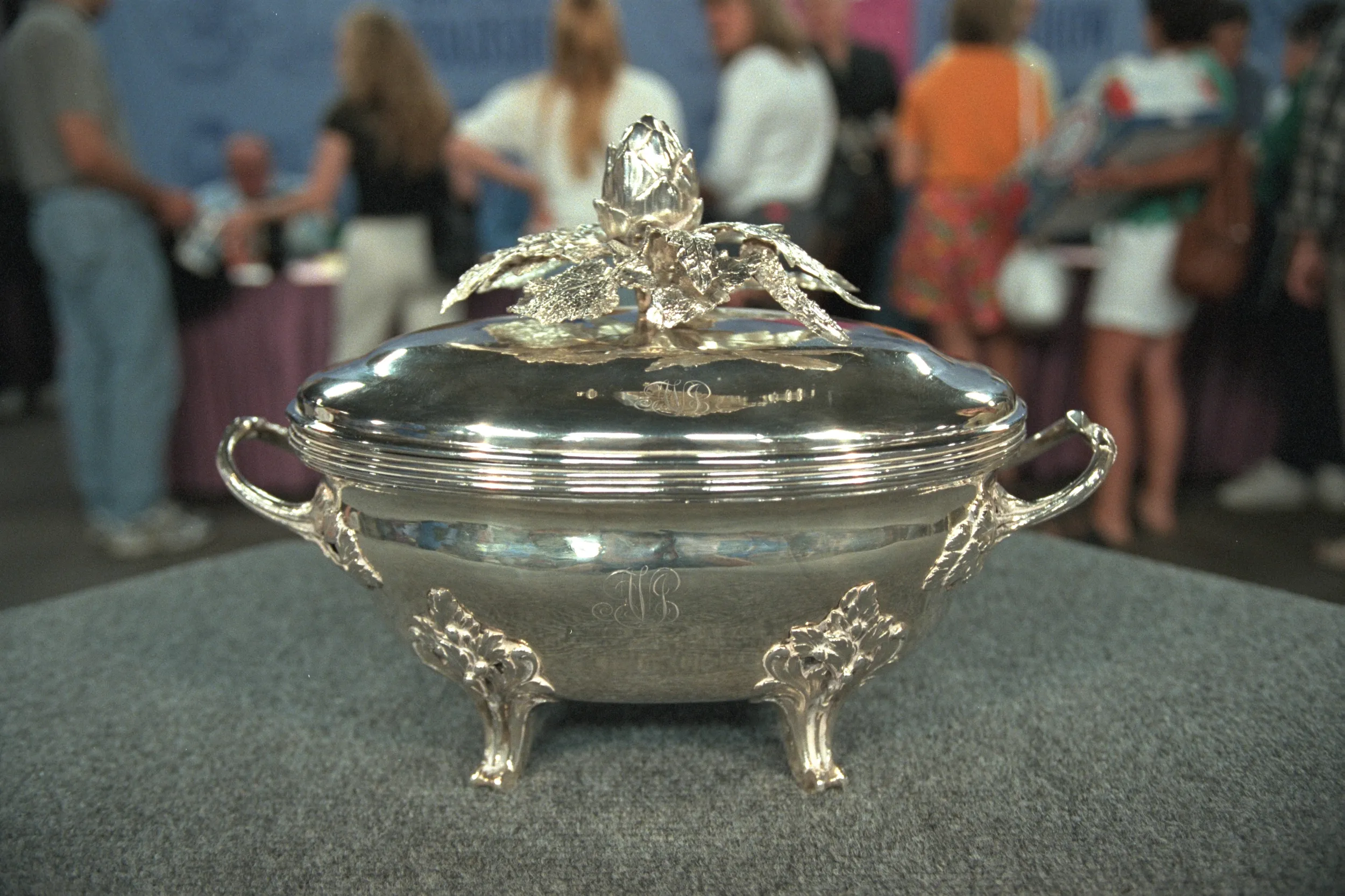
APPRAISER: Ah, well, that would make sense because I have to say, I was stunned to see a French 18th-century soup tureen here in Boston. French 18th-century silver is extremely rare. This one was made in 1774 in Paris. And most French silver that was made before the French Revolution was melted down, some of it to finance wars and some if it in the throes of the revolution. So even in... if we were in Paris today, I would be equally surprised to see a piece of 18th-century silver. It's beautiful, as you well know. What interests me about it is this typical decoration on the cover. All of these vegetables here were cast from life. You see a parsnip, a wonderful open pea pod with the peas inside-- it's superb-- and an artichoke, even a little sort of pickle. These French tureens practically give you the recipe for the kind of soups that would have been contained. Do you use it for soup?
GUEST: I've never used it for soup.
APPRAISER: Oh, shame. Well, now you know how to make the recipe. At any rate, it is extremely beautiful and very, very rare. I notice here-- this is interesting-- you've had an old appraisal, uh... at $2,700.
GUEST: Right. That, I assume, was the estate appraisal from my great-aunt's estate.
APPRAISER: Well, it must have been awhile ago because any 18th-century French soup tureen with this sculptural cover of such rarity and beauty is going to sell today at auction for at least $30,000.
GUEST: Really?
APPRAISER: Yes, I think you should tear this up. (laughs) And I would raise... I'd call your insurance company, because it's an incredible treasure.
GUEST: That's amazing. Well, I've always loved having it, so now I'll...
APPRAISER: You going to make soup in it now?
GUEST: I don't know. I don't think for that amount of money I should be using it for soup.
APPRAISER: How did you come to own this?
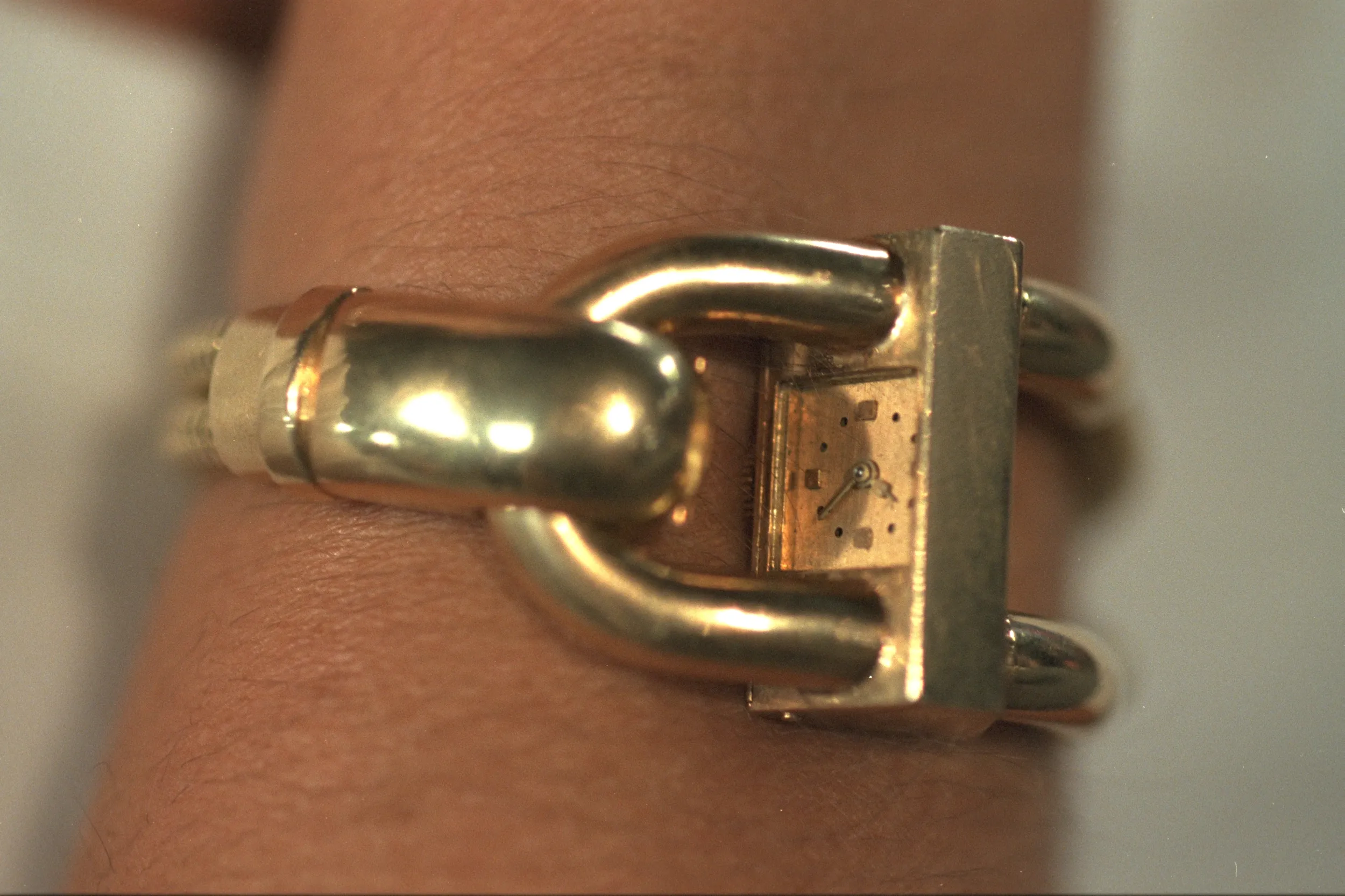
GUEST: Actually, my grandmother gave it to me several years ago. And the story that she tells me is that her husband-- my grandfather-- had given it to her sometime during the war. And he passed away many, many years ago, so I really don't know that much about the watch, and I've actually kept it in a safe deposit box ever since.
APPRAISER: Gee, you haven't been wearing it.
GUEST: No, I haven't.
APPRAISER: What a shame. You'll have to start wearing it soon.
GUEST: Okay!
APPRAISER: First, as a piece of jewelry, it's a very beautiful bracelet, but what's really neat is that it's also a watch.
GUEST: Yes.
APPRAISER: The style is late-1940s deco, early retro. It's manufactured out of 18-karat yellow gold. It has a very nice patina on it, also. The interesting thing about this watch is it was retailed by Van Cleef & Arpels, a very fine jewelry store in Paris and in New York. However, they did not make everything in-house. They sometimes farmed out things to have them made elsewhere. This particular bracelet was made by a man in New York City. His name was Edward Wiener, and I have seen some raw, unfinished examples of this watch, this exact watch. This is the first time I've seen one finished, so I was really excited, especially with the very fancy snake chain for the bracelet. We open up this toggle back here, and we close it, and you can see that on the wrist, it's very dramatic.
GUEST: Yes.
APPRAISER: So, again, you really have to start wearing it.
GUEST: (chuckling) Okay.
APPRAIER: So, again, it's more about being a piece of jewelry than a watch. In today's market, at auction, I think this watch would probably bring around $5,000 or $6,000.
GUEST: Really? Oh, my goodness.
APPRAISER: Yeah, it's quite a desirable watch because it has a very specific style and sense of fashion to it.
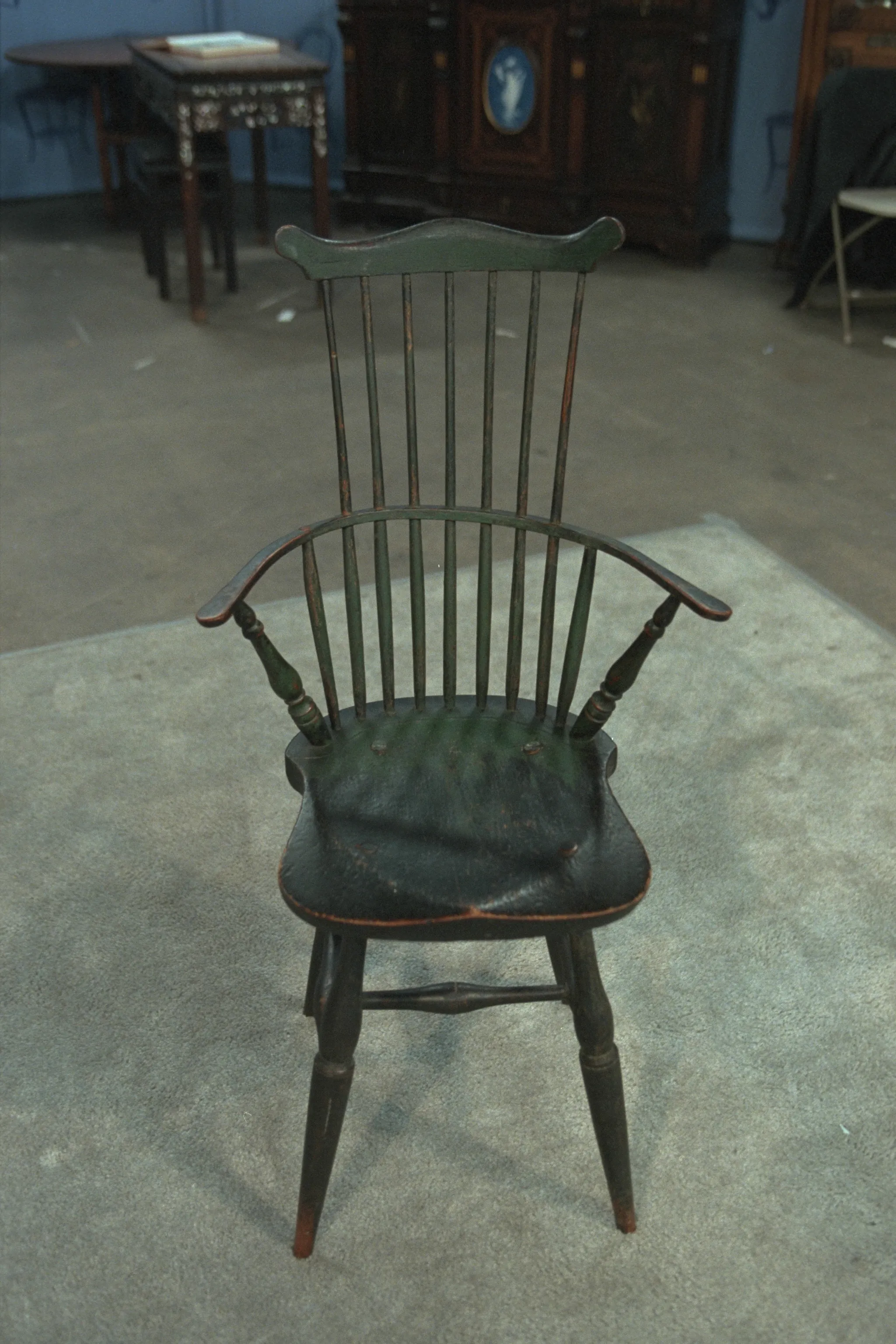
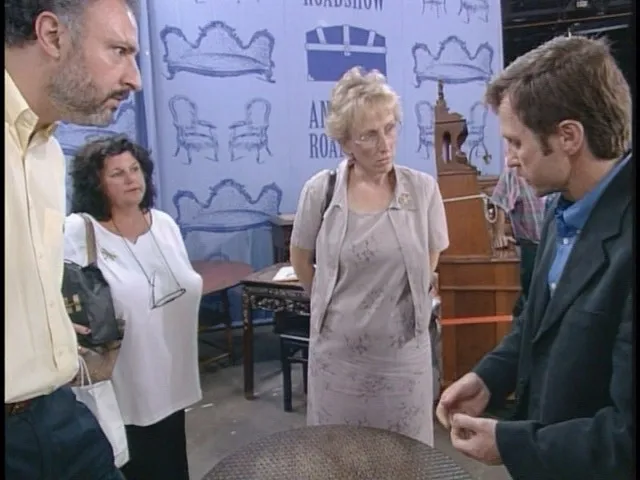
APPRAISER 1: We were absolutely startled when we looked across the room and we saw you arrive with your wonderful Windsor. It's a family piece, yes?
GUEST: Yes, it came down through my grandparents. I grew up in their home, and it was always in the house, so I don't know where it was before.
APPRAISER 2: We were excited about the chair, obviously, as John said, but also, some other people that came into your home were trying to buy the chair, is that right?
GUEST: Yes, one antique dealer just traveling through stopped to see what I had. And I showed him this chair and he made an offer. It was $5,000.
APPRAISER 1: Regionally, the form is very much in line with what we find made in southeastern Rhode Island and Connecticut-- its wonderful little comb back and small little ears. Wonderful surface here.
APPRAISER 2: The condition is absolutely extraordinary. It's in amazing condition. It has only two coats of paint, and this apple green you see here in the seat and the back, just this wonderful, brilliant green which makes collectors' adrenaline levels go way up.
GUEST: Well, that dealer that made me the offer... I always was afraid my mother had painted it. He said no, that was the original paint.
APPRAISER 2: Exactly, there's an underlayer here of sort of a darker green at the top, but it's just two layers, and it's... What's great are the wear patterns on the surface here, where it was touched by people and using it. And next, the proportions...
GUEST: Mostly by me, because I always sat in the chair.
APPRAISER 2: These are your wear patterns, then. But the proportions are what really, really sing. Most chairs are a little wider. This is vertical. It really shoots up, like a rocket ship.
APPRAISER 1: Nice height in the feet.
GUEST: It's high, that's why I sat in it as a child, because it got me up, you know, with the other adults.
APPRAISER 2: John and I talked about this, and we both feel that actually, an auction estimate on this chair would be $30,000 to $50,000.
GUEST: Oh, my word! Oh, my word.
APPRAISER 1: Do you need to sit down?
GUEST: Yeah, I need the chair.
APPRAISER 2: We've made you happy, Dot?
GUEST: Very, very happy.
APPRAISER 2: Congratulations. Thanks a lot, thanks for coming.
GUEST: Thank you so much. It made my day, it made my year. (laughing) It made my life.
APPRAISER: It's called a ken. It's a double-edged sword with gold inlay of a dragon on the blade. Did you have any idea of its value?
GUEST: I have no idea of its value.
APPRAISER: It's worth about $5,000 to $7,000.
GUEST: Are you serious?
APPRAISER: It's fantastic.
GUEST: My kids will be fighting over who gets it.
APPRAISER: These are really unusual- looking Penobscot clubs. They're quite funny, actually. I can't help but think, looking at the faces, that they're poking fun at the tourists who they were sold to. Value-wise, maybe $600 to $800 for the pair. We're talking more folk art than Native-American art.
APPRAISER: These things are very collectible, so I would think probably something in the $10,000 to $15,000 range. Are you happy?
GUEST: I'm very happy. Yeah.
APPRAISER: Great, really great.
APPRAISER: Nice, early Heywood-Wakefield label on there. It's a company that most people now associate with blonde furniture from the '40s and '50s, but actually, they got started... they made their name in wicker furniture, of which this is a great example of it. They did a lot of what's called "photographer wicker" at the time, the very fancy rolled wicker. This is a little bit newer than that. It dates from probably about 1910, 1915. You can see by the base it's really almost like an empire revival base. They've taken that form and then wrapped it in wicker. This is called a "basket-weave" wicker. It's in incredibly good condition. You mentioned that you paid a phenomenal amount for it.
GUEST: Yeah, it was an incredible amount-- ten dollars-- and I had to run home to find the ten dollars. Yeah, somebody had been extremely tired of looking at it.
APPRAISER: Great buy.
GUEST: So, I took it off her hands.
APPRAISER: It's in good condition.
GUEST: I was a little bit concerned about the staining.
APPRAISER: Color can be put in that. It's original finish now. It's great, I wouldn't do anything to it. A little bit of color could be added and rubbed to it and brought it back nice and fine. Valuation on it: far more than the ten dollars you have paid for it. Colloquial phrase, "You done good." Valuation today: probably in the neighborhood of, conservatively, $1,200 to $1,500.
GUEST: You're kidding me.
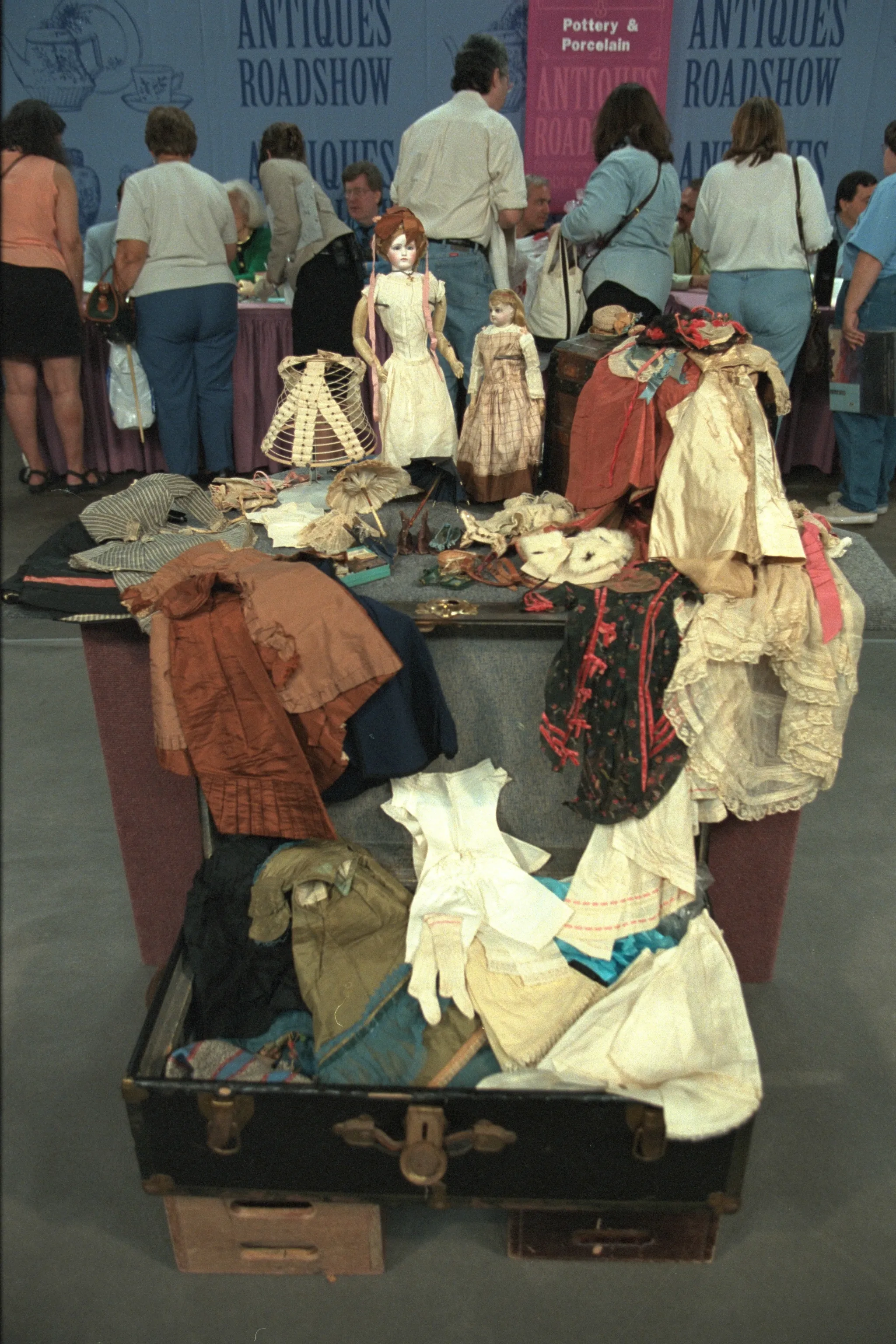
APPRAISER: There was a letter in this trunk. It says, "There will be an exhibit "of a remarkable lady doll "with an intensive wardrobe. "She took first prize at a big bazaar many, many years ago." And this is in 1922. What is this letter in reference to?
GUEST: This doll right here, Dolly Varden.
APPRAISER: "Dolly Varden," so she has a name. And who did she belong to?
GUEST: My great-grandmother.
APPRAISER: And what was your great-grandmother's name?
GUEST: Thursa Gammons.
APPRAISER: Okay, and do you know when she would have received this particular doll?
GUEST: No, I don't.
APPRAISER: Looks to be probably in the 1860s, possibly. Does that make sense?
GUEST: That's when they made the clothing for her.
APPRAISER: Okay, and do you have any idea where the doll was made at all?
GUEST: France.
APPRAISER: Do you have any idea who made the doll?
GUEST: No.
APPRAISER: Okay, well, what it is, it's what's called a "French fashion doll," or "fashionable doll." If you look at her closely-- beautiful face, paperweight eyes. She's in her underwear and her hat right now. She has all her trousseau of clothes-- her parasols, her boots, handbags, letter racks, books for her travels. A very, very fine doll of the period, sort of like Barbie today. She was the Barbie of the mid-19th century. She has a little friend here, too. That's her friend from the same period. It's made by a company, Emile Jumeau, in Paris in the 1860s. It's very possible this doll was one of the sanitary fair dolls from the Civil War, which were benefits where people made clothing and accessories for a doll, then they were raffled off. You said something, that your grandmother won this in a raffle?
GUEST: My great-grandmother won it in a raffle.
APPRAISER: So it's probably a sanitary fair doll. There's some indication about Wisconsin. Do you know anything about that?
GUEST: That's where they made the clothes in a convent there-- that's all I know.
APPRAISER: Some of the clothes are American, some of the clothes are French. All the accessories are definitely French. Okay, any idea of the value of the doll?
GUEST: None at all.
APPRAISER: Okay, well, Dolly Varden herself is probably in the $6,000 to $8,000 range. Her little friend, little portrait Jumeau, is probably, oh, $4,000 to $5,000.
GUEST: Wow.
APPRAISER: Dolly Varden's clothes and accessories sort of push her up a little more in value. Any idea about that?
GUEST: None at all, none at all.
APPRAISER: Probably Dolly Varden and wardrobe, probably in the $20,000 to $25,000 range.
GUEST: Really, that much?
APPRAISER: Yeah, that much.
GUEST: Oh, my God.
APPRAISER: Her little parasol's worth at least $1,000.
GUEST: Oh, I didn't know that.
APPRAISER: The boots are worth $400 to $500. The petticoats are all $20, $30, $40. A complete fashion outfit is between $500 and $1,000. So you have a fortune in accessories that have stayed with this doll.
GUEST: Right.
APPRAISER: So I notice it's been stored in this trunk for a long time. If TV had smell-o-vision, you could tell this thing has been stored away forever and ever. You should probably conserve her, put her in acid-free paper. With all her clothes and accessories, she's worth between $20,000 and $30,000. I mean, she's a very lucky young lady. And you're a lucky young lady to own her.
GUEST: These were my father's cards. I was cataloging my son's cards one day and he said that he didn't have many sports cards, but he had a lot of Indian cards. And we went around and found them in his closet.
APPRAISER: It's very interesting. It's an extensive collection of "non-sport cards," they're called. They date from the 1930s and they're among the first cards that were actually sold with bubble gum. Kids collected them for the first time. Before that, kids had to get their cards from their parents who'd get it in tobacco packages. You have quite an extensive collection here. You have Indians, aviators, pirates, boy scouts, comic characters. Dozens of companies made these cards, and there were literally hundreds of sets made. By the late 1930s, war was looming, and a lot of kids were very interested, just like today, in battles and ships and things, and they began to make war cards. We have these here as well represented. Your collection actually has about 500 or so cards. Among them are a few sport cards, but not baseball cards. You have a football card here: Knute Rockne, the coach of Notre Dame. That's probably your best card in the whole collection. You also have hockey cards, golf cards, basketball cards. You also have an enormous variation in condition in your cards. You have one here that's in excellent condition of Sitting Bull; one next to it in fair condition; and another one with a punch hole and a tear in poor condition. I'd say the majority of your collection is probably in fair condition. These aren't just cards; they're miniature pieces of American pop culture circa the 1930s. People love them. I'd say your collection—around 500 cards-- is probably worth about $2,000 to $3,000.
GUEST: Wow, great.
GUEST: The tomahawk came to me from my grandmother. It was handed down in the family. It originally came, I understand, a lady came from Philadelphia and married into the family and brought that with her. Now, my grandmother gave it to me years ago and it's been in a closet ever since.
APPRAISER: Well, let me tell you, this was a wonderful frontiersman's tomahawk. It was made for a man that would go out in the frontier with probably a rifle, and maybe he was a fur trader, maybe he was a soldier. I probably think he was a soldier. It was made by a gunsmith in Pennsylvania or Virginia around 1780 or 1790. It's wonderful. It has this early Federal eagle, which is very, very hard to find. It has this silver medallion, engraved "G.W.", and we can think it was George Washington that might have given this tomahawk to somebody whose initials are "J.H.", which could have been Josiah Harmar or John Harden. They were soldiers in the 1780s and '90s. And a tomahawk like this is very scarce. It's a national treasure, in my opinion, and very seldom turns up. It's curly maple. When you were a young man, you lost the cap which kept this head on.
GUEST: I was always beating on stumps with it.
APPRAISER: And you lost the silver mouthpiece, but still, there's enough of it here. It's just a wonderful, wonderful piece of 18th-century frontier Americana. Do you have any idea of the value?
GUEST: Not a clue.
APPRAISER: Well, if you had an idea when you were playing with it, you might have been more careful. But if I were going to offer this tomahawk in my shop or at a show, I would ask $150,000. I think it's worth every bit of that.
GUEST: My God...
APPRAISER: It's just a wonderful piece of Americana.
GUEST: Wow, I'm stunned.
APPRAISER: Well, there are probably 30 of this quality that I've seen. There aren't a lot of tomahawks like this. So I thank you very much for bringing it in. And don't play with it anymore.
GUEST: It will not beat any more stumps. Thank you so much, I appreciate it.
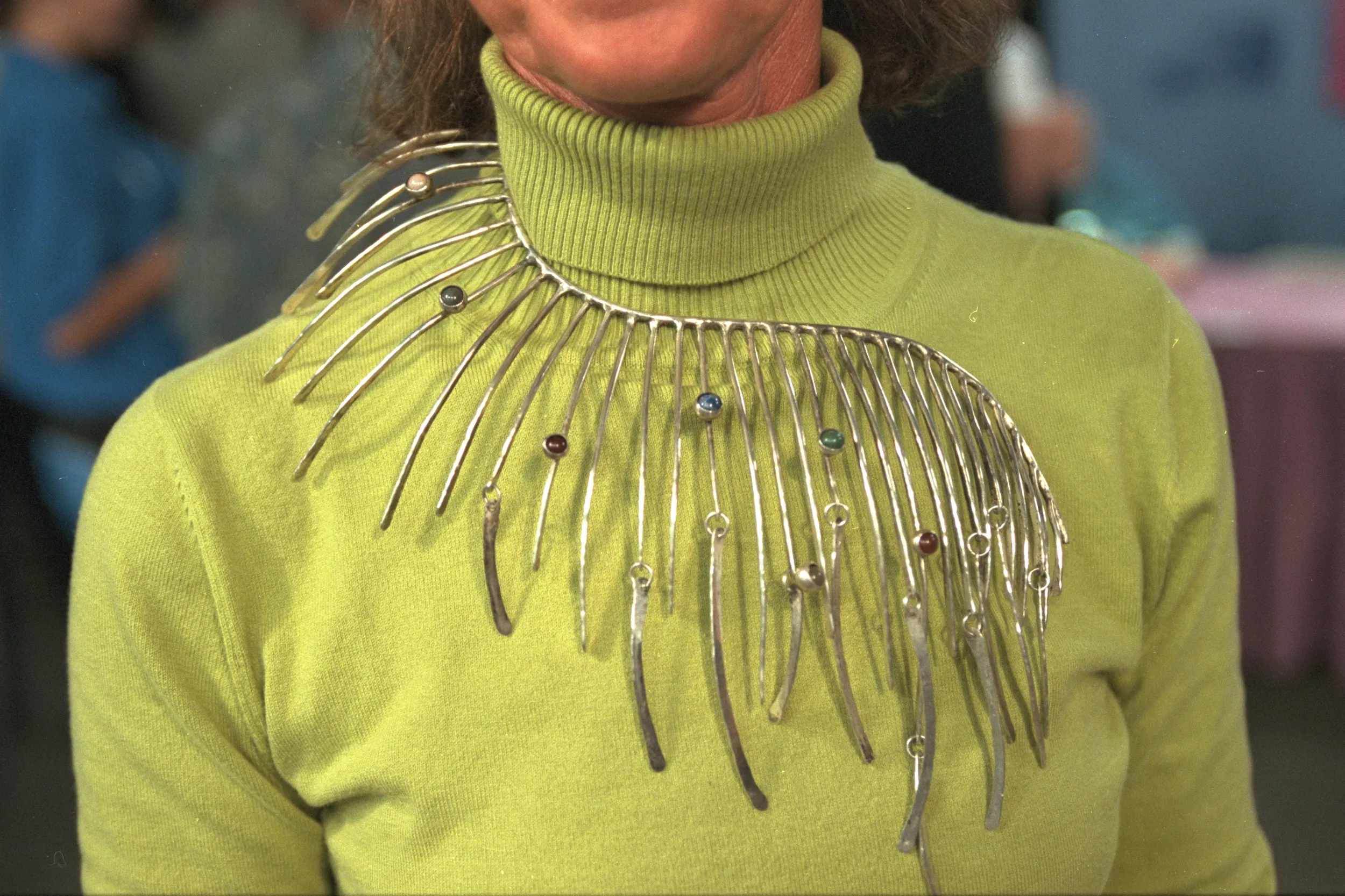
APPRAISER: What is someone from Wellesley doing with that necklace? How did you get it? What is it?
GUEST: It's the first time I've ever worn it. It's always been hanging on the wall.
MARK WALBERG: Did this Art Smith silver necklace hang on to its value since 2001? Stay tuned-- there's more "Vintage Boston" right after this.
APPRAISER: What is someone from Wellesley doing with that necklace? How did you get it? What is it?
GUEST’: It's the first time I've ever worn it. It's always been hanging on the wall.
APPRAISER: And where did you get it?
GUEST: It had been my mother's. She bought it to wear, but she never wore it either. It didn't translate well from her excitement of New York to Andover, Massachusetts, where I grew up.
APPRAISER: And where did she buy it?
GUEST: She bought it, I think, from someone in Greenwich Village.
APPRAISER: And that would have been what year, you think?
GUEST: When I was in high school, probably in the early '60s.
APPRAISER: Now, do you know who made it? You sort of--
GUEST: Yes, she told me someone named Art Smith made it.
APPRAISER: And she bought it from the artist directly, right? Well, I can tell you about Art Smith. He was one of the art jewelers that worked in the '50s. He started in 1953, and he had an upstairs studio in Greenwich Village. And he was part of that movement. We call them... actually, there was a book called The Messengers of Modernism that talks about all these people like Calder, Sam Kramer, Ed Wiener, and of course, Art Smith. Now, Art Smith was black, and he was one of the first black artists to do jewelry during that period. The necklace is in silver. The stones that you're looking at here, they are out of the quartz family. They don't have great value and they're just very colorful, and some of them actually move when you move them, they actually turn. The necklace is grand and certainly eye-catching, and I think it's probably an extraordinary one-of-a-kind by Art Smith. You know, in the market today, these necklaces are very, very collectible. And I think what you've done by wearing it on a wall, so to speak-- wearable art-- is the perfect venue for something like this. But I'm hoping that you'll wear it again. Um, any thoughts on it? Do you love it? Are you afraid of it?
GUEST: Well, no, I'm not afraid of it. I couldn't decide what to wear it with. And I also noticed, I couldn't find his name. Could you find his name anywhere in it?
APPRAISER: Now, this one is not signed. Art Smith signed some pieces, didn't sign others. I didn't think he'd have to sign this piece because to me, this is the ultimate piece of jewelry by Art Smith and it continues all the way around. Any thoughts as to value? Are you curious?
GUEST: Oh, well, of course I'm curious. I have no intention of doing anything beyond hanging it on the wall or maybe wearing it.
APPRAISER: You are at a level today at $5,000 to $7,000 in the market.
GUEST: Oh. Is that your final answer?
APPRAISER: No, because, you know what? It could bring $10,000. (laughs)
MARK WALBERG: I'm Mark Walberg. Thanks for watching. See you next time on Antiques Roadshow.
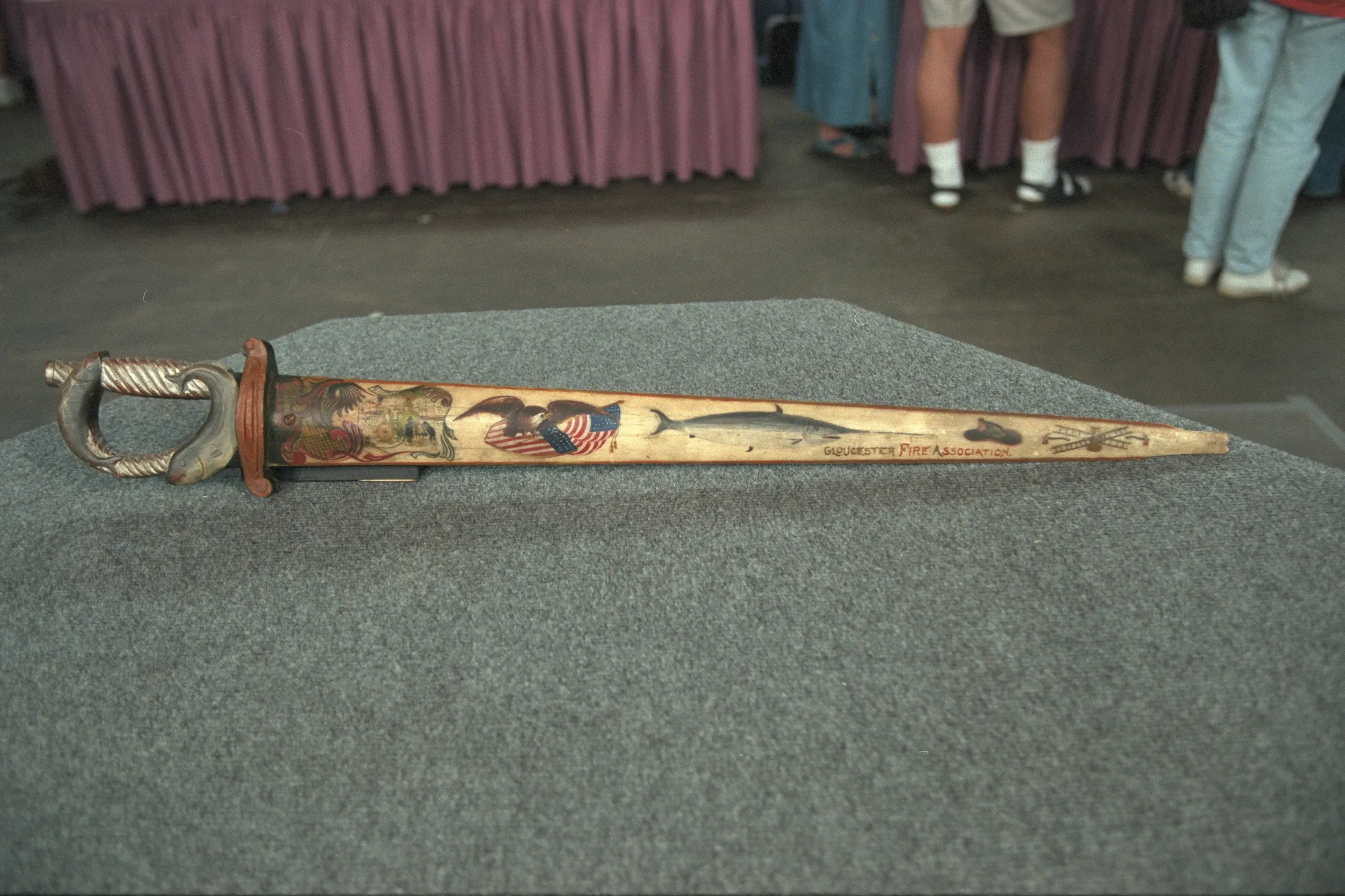
GUEST: This was a gift presented to my dad when he was ten years old from a gentleman whose father had received it from the Gloucester Fire Department. It's a swordfish. This is his swordfish's sword.
APPRAISER: It's a presentation sword from the fire department and done, as you said, from a swordfish bill, hence the reason for the large swordfish in the center. Nice decoration. It has an absolutely incredible fire department scene down here, where you see the pull fire engine, the two firemen, the scene in the background-- the city scene-- the firemen's hat, the ladders and the axes. Then, on top of everything else, it's got the American eagle. You've got the American flag, you've got the American shield. It's absolutely incredible. And to top it all off, you've got this wonderful carved wooden handle carved in the shape of two fish going around in a circle with a rope twist in between. And I believe that if this was to come up to auction, this would probably bring somewhere in the $2,000 to $3,000 range.
GUEST: Wow.
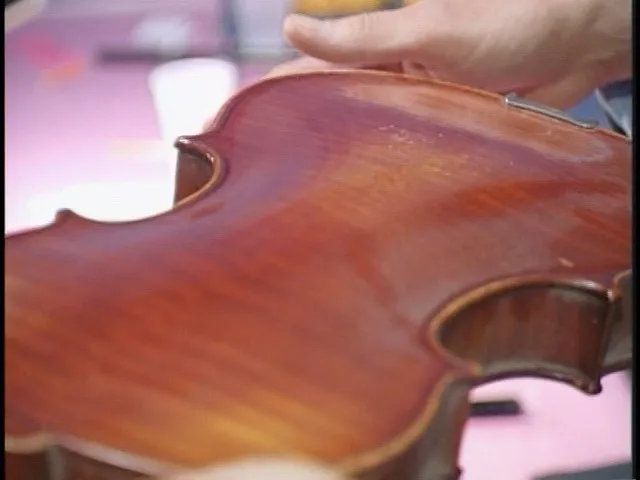
APPRAISER: In fact, it's a very nice French violin by Amédée Dieudonné. And in fact, Dieudonné trained many of the really fine makers who are seen as experts nowadays. It's from the mid-1920s, and I would give it a retail value of between $9,000 and $10,000.
GUEST: No! (laughs)
GUEST: It's worth the trip for me! (laughs)
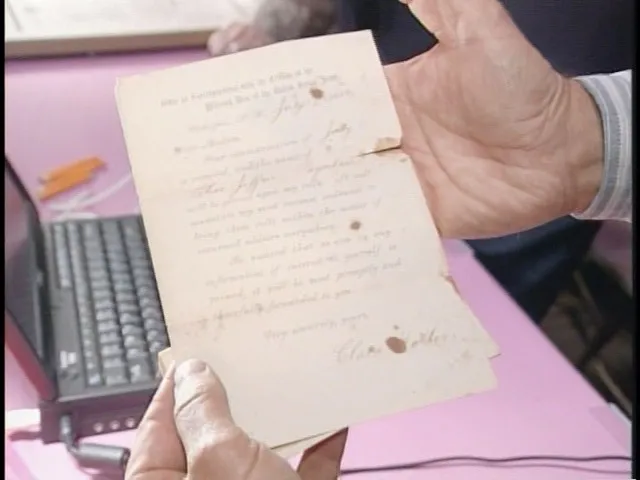
APPRAISER: Someone at the end of the war was going, "Where are they?", the same as the M.I.A.s are now. And the one handling that was Clara Barton. A group of letters like this is interesting. It's great Civil War memorabilia. They're probably worth $300 to $500 on this. And this letter earlier in the thing, talking about going into battle and war, is again worth about $300 to $500. So you might be talking $1,000 for the two, but this one particularly, the missing in action, and I wonder if they ever found them.
Learn how the antiques market has evolved since 2001. Highlights include a violin attributed to Johannes B. Ceruti, an 1836 Joseph H. Davis painting, and a frontiersman's pipe tomahawk. Which item saw a value increase of up to $124,000?
More ways to watch
episode
episode
History meets fantasy with treasures fit for a period costume drama!
appraisal
appraisal
appraisal
appraisal
appraisal

appraisal
appraisal

appraisal
appraisal
appraisal
appraisal
appraisal
appraisal
appraisal
appraisal
appraisal
appraisal
appraisal

appraisal

appraisal
appraisal
appraisal
appraisal
appraisal





A weekly collection of previews, videos, articles, interviews, and more!
Funding for ANTIQUES ROADSHOW is provided by American Cruise Lines and Ancestry. Additional funding is provided by public television viewers.
ANTIQUES ROADSHOW is a trademark of the BBC and is produced for PBS by GBH under license from BBC Studios. PBS is a 501(c)(3) not-for-profit organization.
A weekly collection of previews, videos, articles, interviews, and more!