Previous Episode

episode
Season 20
Vintage New York (2016)
Uncover how appraisals from 15 years ago have changed! Which one doubles in value?
Next Episode

episode
Travel back to 2001 to learn today’s values for previously appraised items!
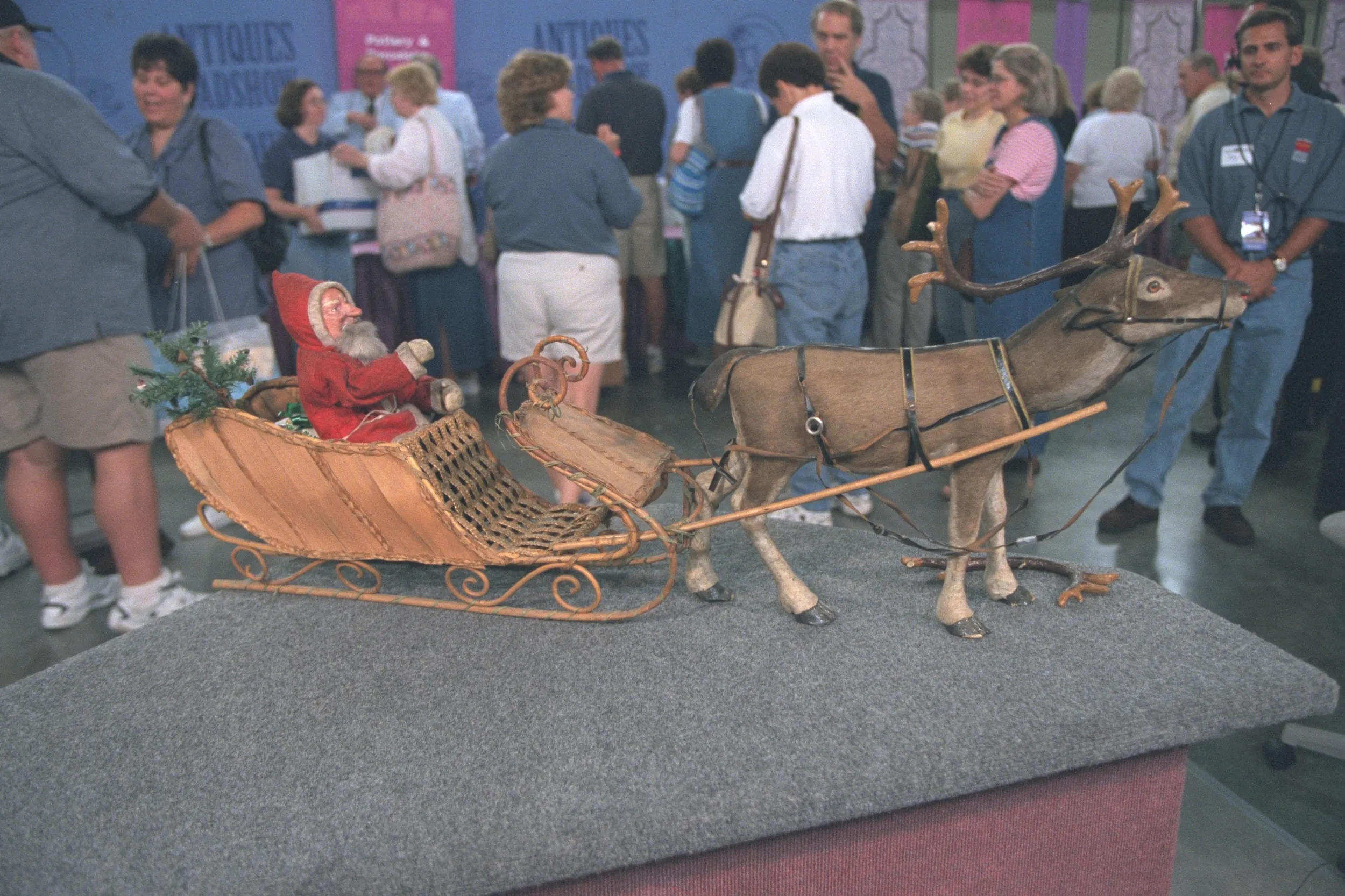
APPRAISER: Well, Jim, here comes Santa Claus!
GUEST: That's right.
APPRAISER: Great toy for kids as well.
GUEST: Oh my gosh!
APPRAISER: It's darn comfortable too, I'll tell you. Can I sit in it?
GUEST: Sure you can!
APPRAISER: Do you want to sit with me?
GUEST: Sure, why not?
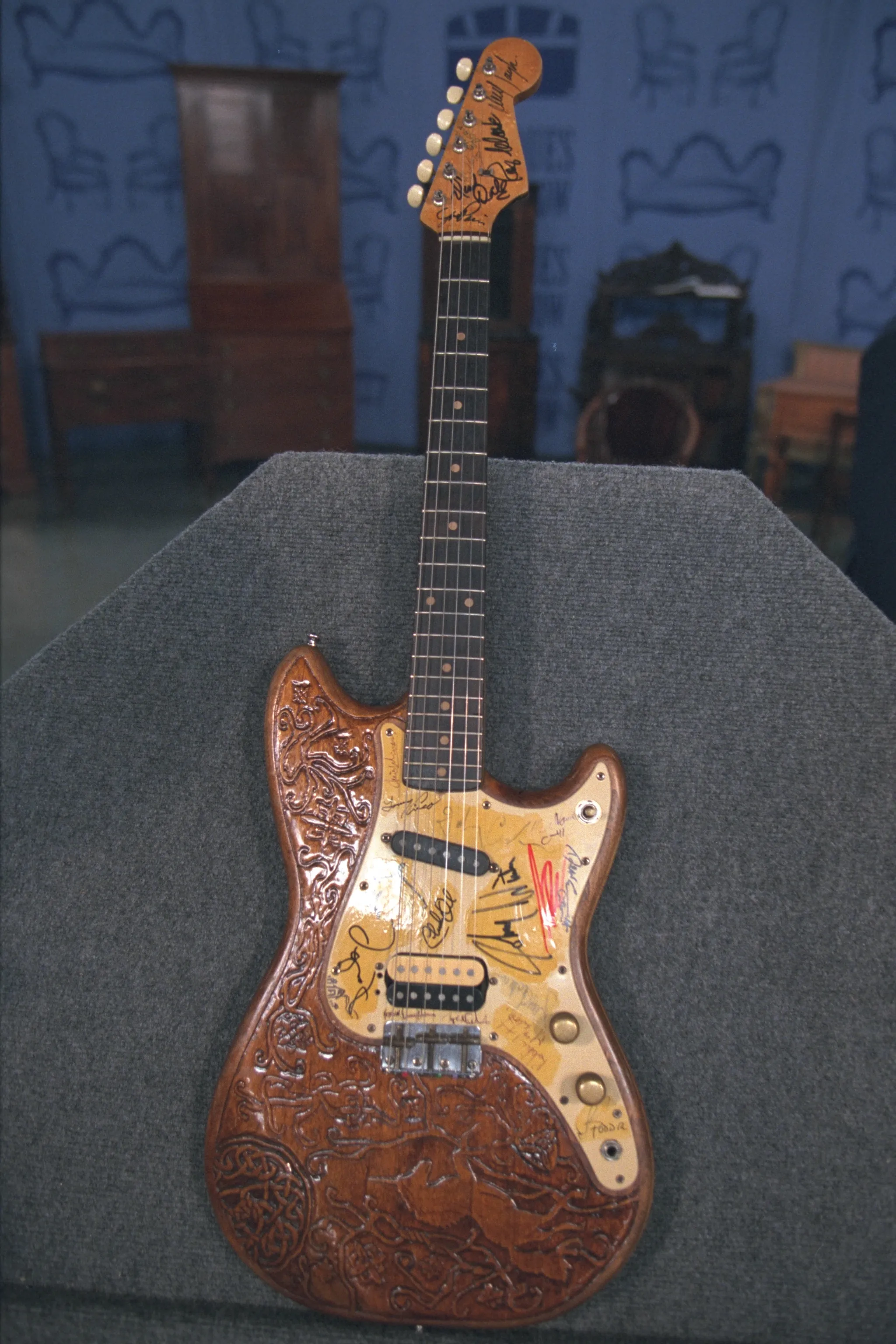
MARK WALBERG: In 2001, ANTIQUES ROADSHOW visited Indianapolis, home of the Indianapolis Motor Speedway and one of the most famous races on earth, the Indianapolis 500. Back then, we discovered this electric guitar covered in autographs by some of the most famous names in music. Has the value of this guitar sped past its previous appraisal? Let's find out in this fresh look at Indianapolis.
APPRAISER: I always thought I was the ultimate music fan until I met you today. And here we have this guitar, 150 signatures on this, some of the biggest names in music. Everyone from Johnny Cash to Johnny Winter, and it took you 16 years to accrue these. Let's flip this over. How did you decide to do this? Why? It's such a journey.
GUEST: When I got the guitar, it had been painted-- model paint-- by someone, and so I took it, stripped that off, carved the front of it and cut 23 spaces along the center of the back.
APPRAISER: Right.
GUEST: Those got filled a lot quicker than I had anticipated, and it ended up where it is now.
APPRAISER: How did you decide who to go after?
GUEST: There was no real rhyme or reason-- people I appreciated-- and had them sign for that.
APPRAISER: We span everything from jazz to bluegrass to country to rock 'n' roll. I see one here, fabulous musician, unfortunately no longer with us, Stevie Ray Vaughan. You said he was one of your favorites. How'd you get him?
GUEST: Yeah, he was a really nice guy. I had gone down to Louisville, which is fairly close, and it was a general admission concert. I went down the night before and was there first thing in the morning, not knowing when he would arrive, and it started snowing. His tour bus pulled up, and he invited me on. So then, I'm there talking to him and he's signing my guitar--really, really nice guy.
APPRAISER: We've got Dizzy Gillespie down here. We've got Chick Corea. Peter, Paul, and Mary, all together. It's a "who's who." The way I would appraise this guitar is, A, I'm looking at the fact that you have everyone from Bonnie Raitt to Don Was, John Denver. You have Timothy Leary--going back to the acid age of the '60s. Johnny Cash, Elton John, David Crosby, Aretha Franklin, Bill Monroe--bluegrass. So when you take that breadth and width of musicians all together and put them into 150, it's amazing. A lot of them may not be rare and each one of them separately may not be worth much, but you put them all together and that is quite a grouping, plus the fact of the time. I mean, how many hours do you think you spent on the road?
GUEST: I couldn't begin to tell you. Way a lot. I really enjoy it, and these are people who I've greatly admired, and it was a chance to actually get to meet them as well.
APPRAISER: Absolutely. So that's really the thrill for you, is that you get to meet these musicians. So looking at all of this, I would put an auction estimate of the guitar for about $4,000 to $6,000.
GUEST: Wow, thank you.
APPRAISER: Well, Jim, here comes Santa Claus.
GUEST: That's right.
APPRAISER: Tell me, where'd you get him?
GUEST: Bought him in a yard sale about four years ago.
APPRAISER: And, uh, what'd you pay for it?
GUEST: $200.
APPRAISER: $200. And did you get any history with it?
GUEST: Just understood it was a store display in a hardware store.
APPRAISER: Well, that's exactly probably what it was. This is what we call a sales stimulator. It would be used in the store windows to attract attention as you walked down the street. And how did that work? Has this clockwork motor here. Wound that up—big, strong spring-- and this guy would just sit here and nod away all day long. So you'd be walking down the street, and you'd see this movement in the window, and you'd say, "Hey!" And then I guess they figured you'd look at something else in the window, too. Well, it was made in Germany, from the 1920s, and it's really a lovely, lovely piece. And this is just the way you found it. I see he's got... your... a little feather tree, and he actually would be handling that in his hand, which was sort of in his hands on a little spring, so it would get a little movement, too. Well, it's really terrific. What do you think something like this might be worth?
GUEST: Well, I was hoping $300 or $400.
APPRAISER: Well, I'd say definitely that. You know, you do have a few problems here. The reindeer, it's needing one little repair here, but, um, I'd say at auction today, we're looking at least $3,000 to $5,000.
GUEST:(chuckling) You're... you serious?
APPRAISER: Yeah, so you've got a real wonderful piece here.
GUEST: This was my mother-in-law's, and her mother-in-law had given it to her. And I believe it was a wedding gift originally. About 1898 is when they were married.
APPRAISER: Okay, all right, well, that would be about right because this piece probably dates from the 1890s. This piece would go for between $4,000 and $5,000.
GUEST: Oh, very nice.
APPRAISER: Yes, very nice.
APPRAISER: This is an incredible piece of American jewelry. It dates from the turn of the century, anywhere from 1895 to 1905, and it really represents the finest jewelry that was being made in America. We would put a value of $10,000 to $12,000 on the piece.
APPRAISER: This is a crossover collectible. It's a great visual, good graphics all the way around. What's interesting is using the wording, "Carbo Magnetic." Around 1900, "magnetic" was everything. We saw it in medical plaquery, medical this... Are you curious as to its value?
GUEST: Sure.
APPRAISER: Yeah, I'd say it would be going for about $3,000 to $4,000 today. Great toy for kids, as well.
APPRAISER: Don, where did you get this now?
GUEST: It was given to me out of my uncle's estate, and many years ago, he bought that for my aunt as a gift.
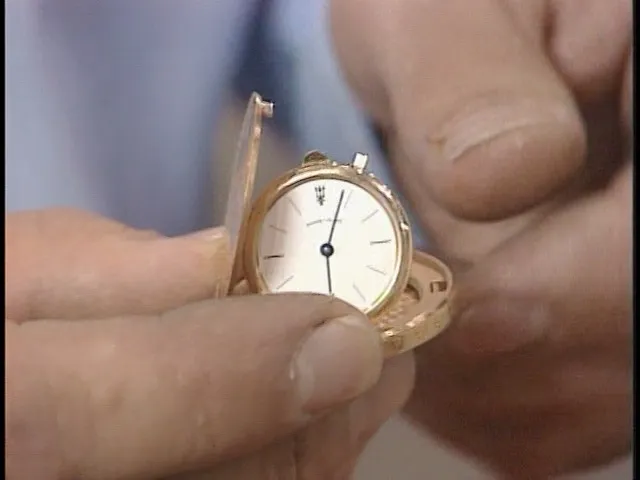
APPRAISER: It's great, and when people look at this, what you see right away is you see a Saint-Gaudens $20 gold piece with the eagle on it-- one of the most beautiful U.S. coins ever made. And on the front, you see Walking Liberty, and most people will leave it at that and say "gold coin." However, you know the little secret that it opens up, and inside is a little watch. Now, these watches were made by a few companies. This one is made by a company called Favre-Leuba. They're in Switzerland. They were one of the finest watchmakers for making wristwatches and watches like this. And what's interesting about these watches, you had to ruin two coins to make one piece because of the milling to make the door and the bottom plate. You have an idea what you think it may be worth?
GUEST: Have no idea.
APPRAISER: Never thought about it?
GUEST: No.
APPRAISER: Well, as a coin, it's worth maybe $400, $500, and remember, they ruined the coin. But as a watch, about $5,000.
GUEST: Oh, my goodness!
APPRAISER: Yeah, and I think that's a very fair market value.
GUEST: Oh, my! Had no idea.
APPRAISER: You've had this painting for a fairly long time, you said.
GUEST: About 20 years.
APPRAISER: And where’d you buy it?
GUEST: I bought it at a local auction here in town.
APPRAISER: Just an estate sale?
GUEST: Just, yeah, it was out of an estate.
APPRAISER: Did you pay a lot of money for it?
GUEST: Uh, at the time, it was $100.
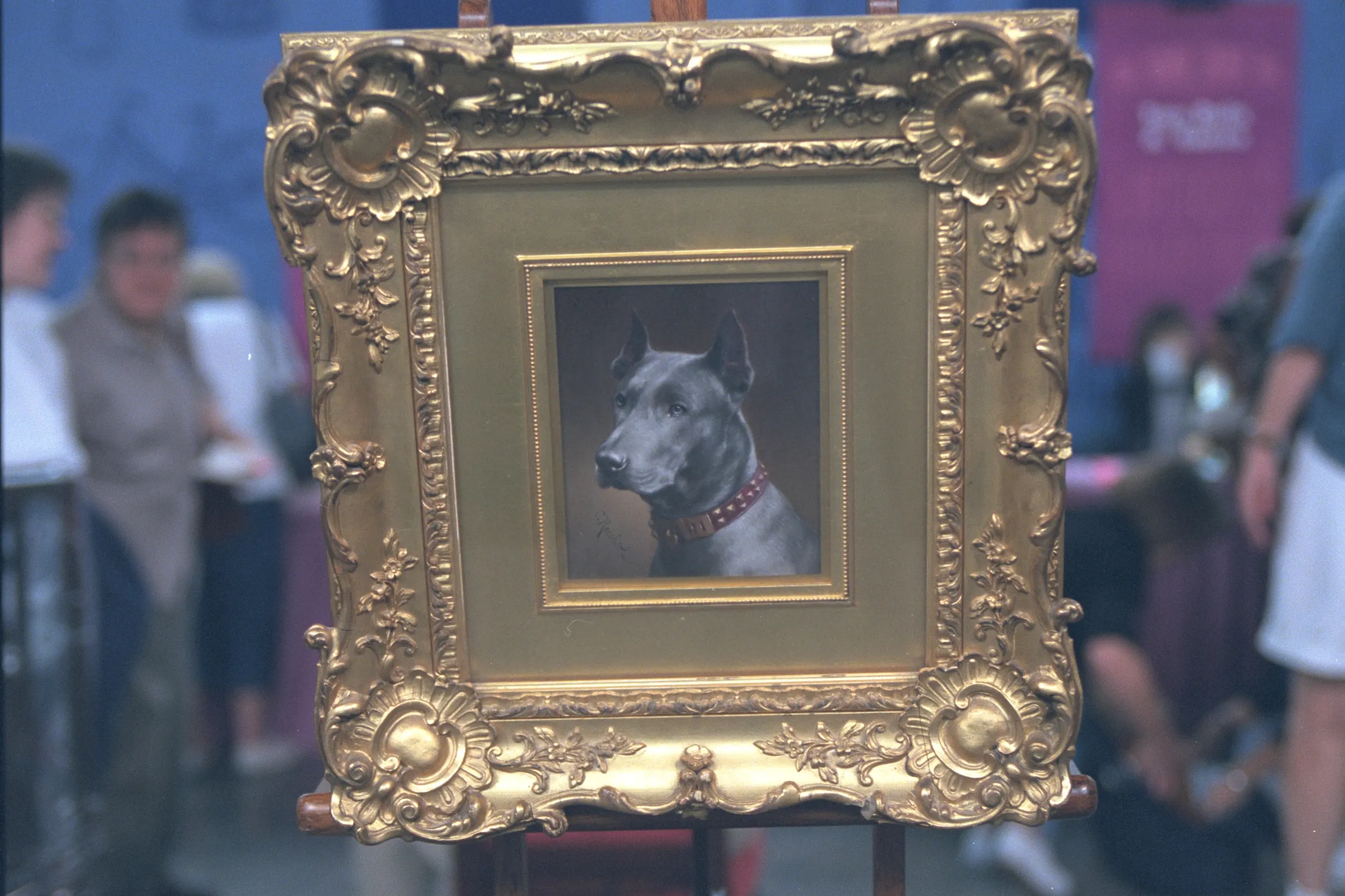
APPRAISER: The artist is Carl Reichert. It's very clear. It shows that "C. Reichert." He has a very clear signature and a very distinct signature. But Carl Reichert is an Austrian artist, and he's a specialist, primarily in animals and specifically dogs. Most of his paintings focus around animals, and mostly that small format. But Reichert has two really distinct sort of kinds of paintings. You have one here. One type is the anecdotal painting, and that will tell a story, or it's sometimes humorous, about dogs chasing cats or parrots and the house being torn up by them. And then there's the other type, which is what you have here, is the purebred dog portraits. Now, the purebred dog portrait in the 19th century is really more of an English kind of a domain, and generally in the English ones, they show the entire dog because they're trying to show the conformation, the legs, the tail, the size and all that-- proportions. But Reichert focuses primarily just on the faces and the facial expressions. Do you have a dog like this at all?
GUEST: No, no, no.
APPRAISER: Well, he's a Great Dane, obviously, and I love the blue of the eyes here, a great color that you pick up, and it's just somebody's specific dog. It was painted probably for a commission, as you'd have a portrait of a family member. But the thing I really like about this painting is the collar. This is a great illustration of a 19th-century dog collar. These collars themselves today are collectible. If you had that collar, it could be as much as $1,000 for just the collar.
GUEST: I see.
APPRAISER: But as you said, you paid $100--probably a good deal. A painting like this by Reichert in one of my auctions, I'd probably put an estimate of about $4,000 to $6,000 on it.
GUEST: This coverlet came to my wife and myself from my mother-in-law about ten years ago, and we use it as a wall hanging. And I understand that my wife's great-great-grandmother sheared the sheep, dyed the wool, made the thread, designed the pattern, and wove this all in the early 1850s.
APPRAISER: So that's the story that came down through the family?
GUEST: That's right.
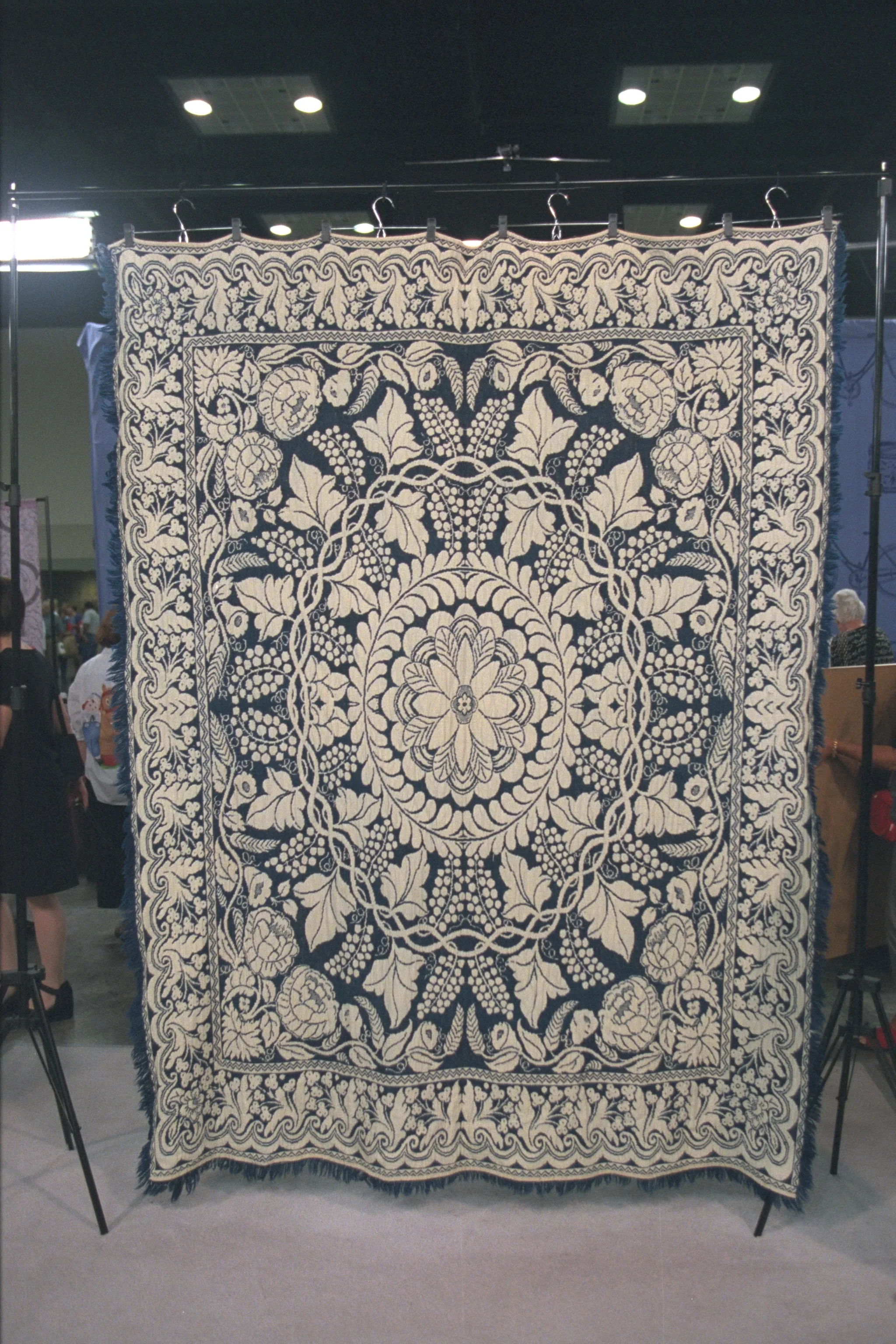
APPRAISER: Okay, first of all, this is called a Jacquard coverlet. J-A-C-Q-U-A-R-D. The technology to make these kind of patterns was invented by a Frenchman, and they used that technology a lot in America. And you see a lot of coverlets like this in the Midwest, Pennsylvania, New York, pretty much all over the United States. And what they did was they would set their looms up, and there was a set of cards at the top of the loom that would drop the heddles down in the loom so that they could do these real complicated patterns. Now, this particular one has a combination of linen fabric and wool. Where you see the blue, that's the wool, and where you see the white, that's the linen. And almost always, they have a nice border, they have a nice cohesive design. And this one, of course, has a nice center medallion. And the other thing that's neat about these is that you have, basically, two ways to display it.
GUEST: Yeah.
APPRAISER: And the thing I really like about this one, too, is that it has a finished border. And you told me earlier you've never had this appraised before.
GUEST: No, uh-uh. Okay, well...Like I say, it's just because it's, uh... sentimental value is the only reason we're interested in it.
APPRAISER: Well, in today's market, a nice blue-and-white coverlet like this would sell for at least in the $800 to $1,200 range.
GUEST: Mmm. Worth preserving. (both laughing)
GUEST: My mother purchased it in London, England, at an antique shop. My parents were living in India at the time, and they went on a holiday to England, and that's where she found it.
APPRAISER: Well, I guess my next question would be how did she get it home? Carried it in her lap on the airplane, do you think?
GUEST: Well, she did, yes.
APPRAISER: I bet she did. And, um, what were you told about the piece?
GUEST: Uh, Mother said that the dealer told her that it's Venetian glass and that this is enameling on top. They thought it was from the late 1700s.
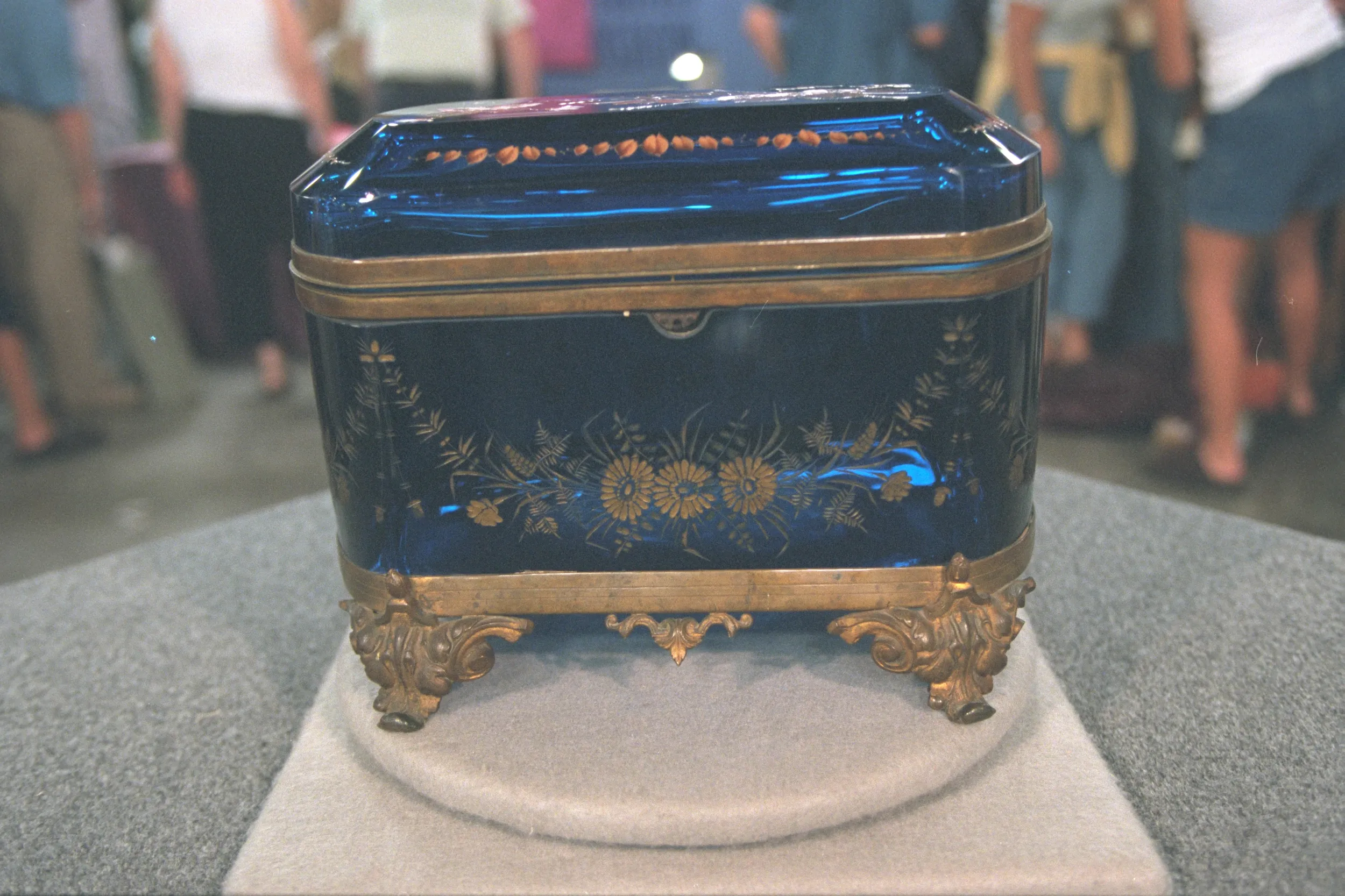
APPRAISER: Okay, well, let me tell you a little bit what you have here. The first thing that you and I both had fun over is the size of this piece. This is just unbelievable in size. Now, once I get through the size issue on it, we'll get to the glass itself, which is Bohemian, or some say Moser-type glass, in the blue, which is an extremely desirable color. Made in Austria, and in the last quarter of the 19th century-- not 18th century, but in the 19th century. In the 19th century, they called them jewel caskets. Today we call them jewel boxes or dresser boxes or vanity boxes.
GUEST: Okay.
APPRAISER: And the wonderful part about it, again, is the unbelievable size! And then we have nice enameling on top. And do you have an idea of what this piece is worth, or do you know how much...?
GUEST: I have no idea of what it's worth, but Mother said she paid $100 for it.
APPRAISER: Oh, $100. Well, this today, in a nice antique show or a nice shop, would be $2,500 to $3,500.
GUEST: Oh, my! Oh! Wow, that's wonderful!
APPRAISER: Thank you for coming to the show.
GUEST: Thank you. I appreciate it.
APPRAISER: You brought in a book by a great Indiana author, James Whitcomb Riley. Where did you get it?
GUEST: I got it at a library auction.
APPRAISER: The first edition. What did you pay for it?
GUEST: $360.
APPRAISER: It must be worth more in the range of $500, so you did very well, and it was fun to see an Indiana book.
APPRAISER: What these are are shades for a light fixture. They might have hung from a wall sconce or a four-light fixture, since there are four of them, that hung from the ceiling at some point. So, these were all made by Steuben, and if you look at the other one, the other one doesn't have it. Sometimes they were signed, and sometimes they weren't.
APPRAISER: Well, the table looks to be probably 1880s, and the cabinetmaker who carved these legs here was really having fun. The dog is just chasing the squirrel right up the tree. It's really cute.
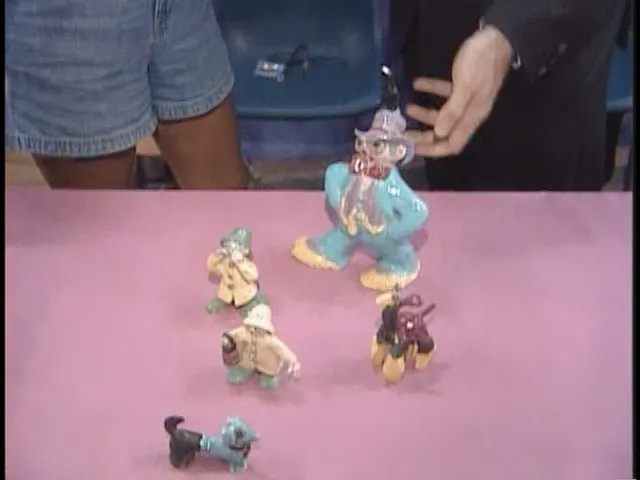
APPRAISER: The Overbecks were six sisters who were involved in the arts one way or another, and I like to say as each of them died, the remaining sisters got progressively weirder until Mary was left, and Mary was the last of the six. She worked primarily in the '30s through the '50s, making these sculptural figurines. She signed them all. They're usually signed on the bottom with the "OBK" mark. She didn't really sign them "Mary Frances" often-- every once in a while-- but she made a lot of brides and grooms, and she was never married, so I thought that was kind of odd, but she made a lot of animals with this suppressed sexuality, with big eyes and their tongues sticking out-- really weird stuff. I mean, check out the dog. What was happening there, you know? But that is about a $300 to $400 dog if it's in perfect condition. That's about a $500 dog if it's in perfect condition. These guys here are worth about $300 to $400 apiece. And this man has a chip on his hat, so he's only worth about $1,000 to $1,500, but without the chip, he's about a $2,000 figurine. This is a really good one. I've seen about 500 Overbeck figurines and that's in the top one percent of what I've come across, so very nice ones. Take good care of them, they're quite fragile.
GUEST: Thanks-- I used to keep them on the back of the toilet, so maybe it's a good thing we... (laughs)
APPRAISER: Okay.
GUEST: Well, my grandfather purchased this near Swindon, England, at an antique shop around 1953, when he was stationed there for the Air Force. And that's about all I know. My grandma's had it ever since.
APPRAISER: What did your grandmother say about it?
GUEST: She didn't say very much. She just asked me to take it to the show and see what you guys would say about it.
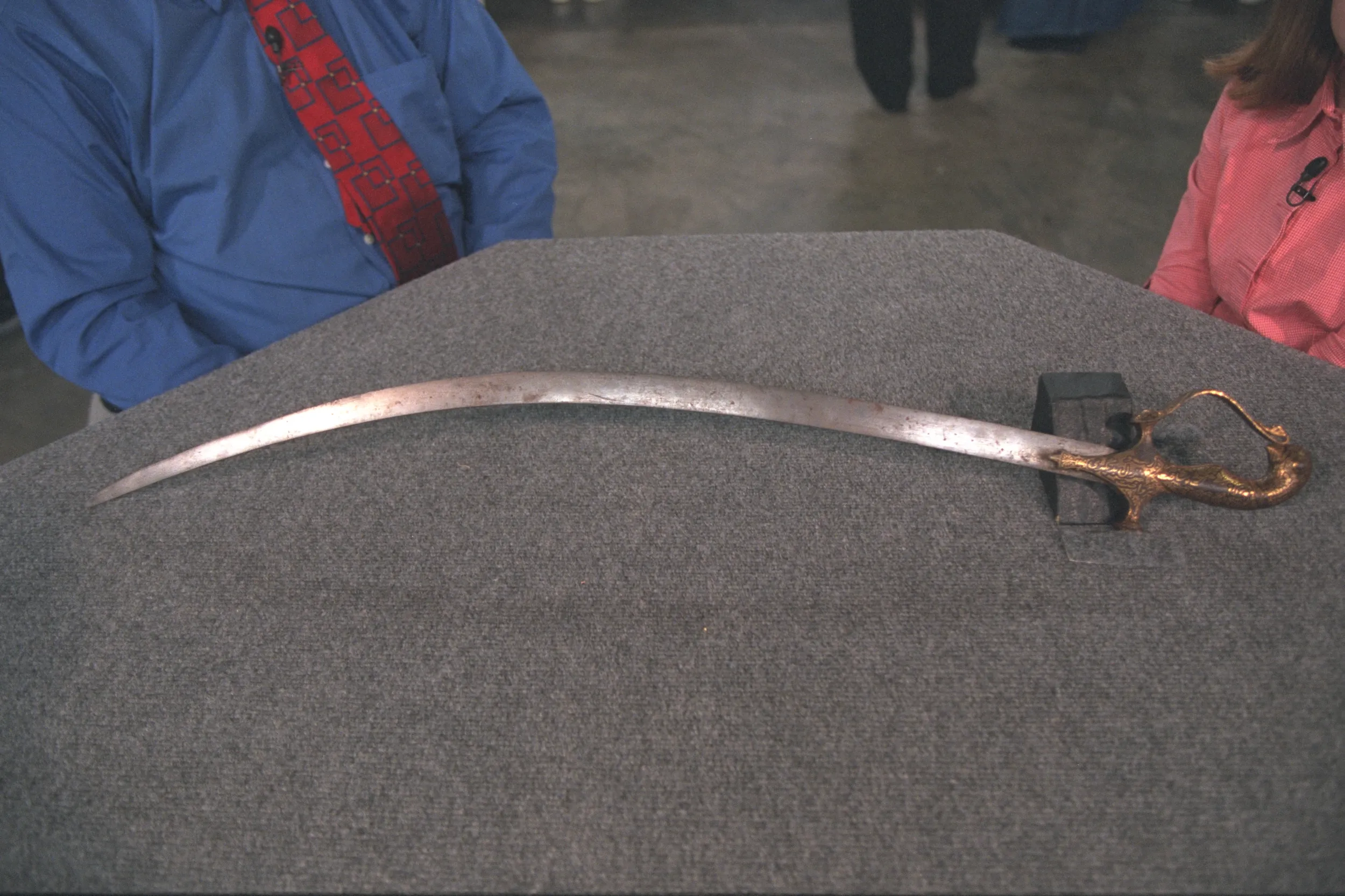
APPRAISER: It's actually... the sword was made in India.
GUEST: Okay.
APPRAISER: And it's a type of weapon that's called a "shamshir,”and it's a hunting sword. And the work on this sword is called "Koftgari work" and what it is, is it's an iron hilt that's been inlaid with gold. And at the pommel, the end of the sword, there's a parrot there. And right above it is a little goose's head on top of it. And then, all floral work has been, you know, inlaid in gold over the surface, including a rather lengthy inscription that's on there, and the inscription is a poem in Persian. But it's a beautifully made sword. If you also look at the blade, you'll notice that the blade has a fine grain in it that they referred to as "Damascus steel" or "watered steel," and if you had that polished a bit more, you could actually see the grain much more pronounced than it is. It could use a good oiling and a cleaning. Now, what did you think it was worth?
GUEST: I'm not sure. Well, knowing my grandpa, he never would have paid more than $10 or $20 for it, so I don't think it's worth that much.
APPRAISER: Really? It's worth about $3,000.
GUEST: Okay.
APPRAISER: These kind of swords are very, very popular now, because they're beginning to understand the complexity of the way these blades were made and the workmanship, you know, involved in them. And they're just very, very fine, fine, quality pieces of work.
GUEST: The decoys belonged to a neighbor of ours who passed away a few years ago. And they had an estate-type sale, and we purchased it from there. And I talked to his wife, and she said that he had the decoys when they were married in 1943.
APPRAISER: Yeah.
GUEST: And attributed to Charles Perdew.
APPRAISER: Right.
GUEST: I guess a rather well-known carver from the Illinois region. And evidently, his wife did the painting, or at times did some of the painting. I know they were never used in the water. They've always been used as a decorative-type thing in their home.
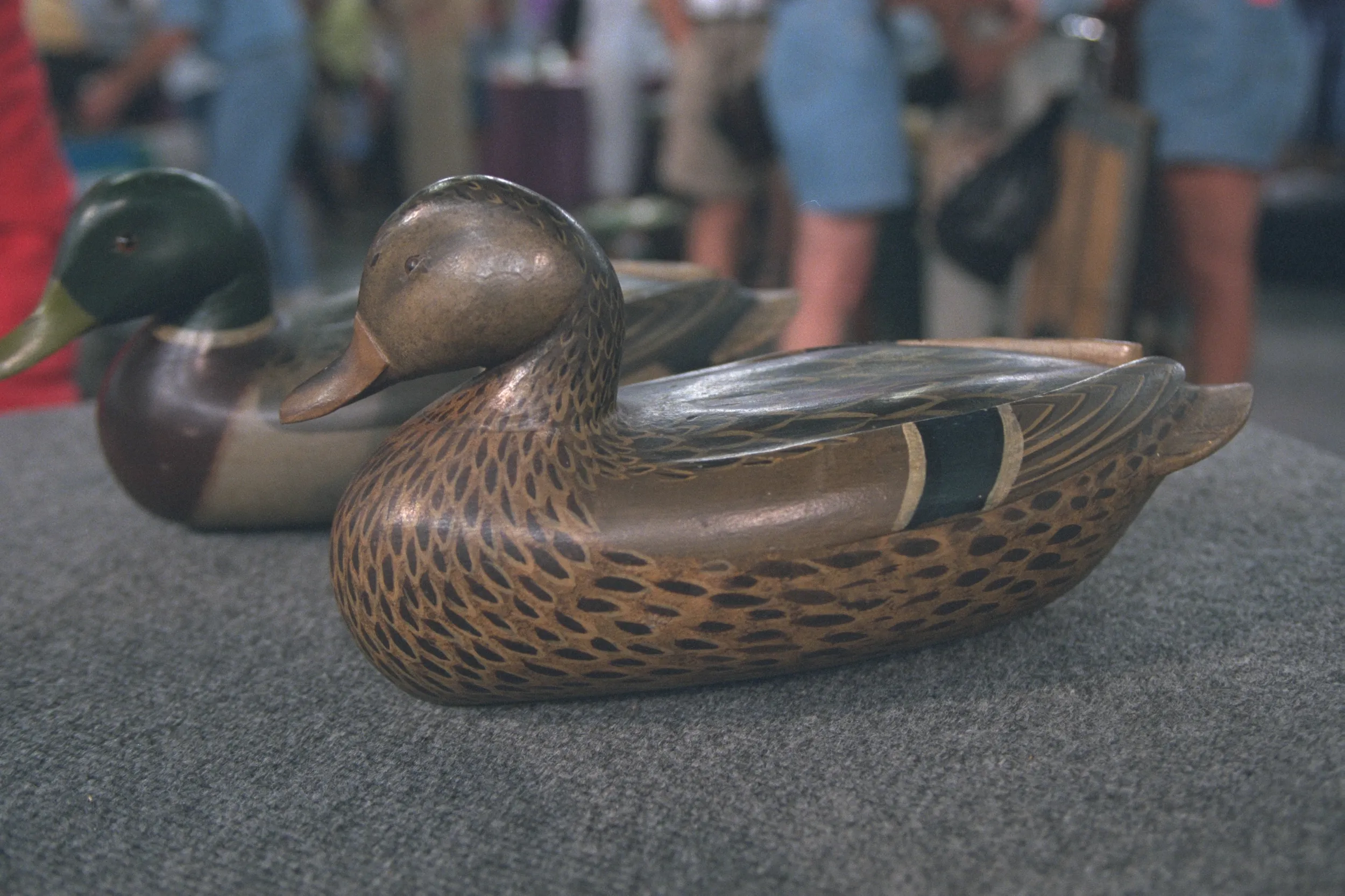
APPRAISER: Right, well, um... these are about the best decoys that I have seen. As you have been told, these are the work of Charles Perdew, who was born in Henry, Illinois, in 1874. And he worked in that area on the Illinois River for all of his professional career. And these, which are hen and drake mallards, are from his peak period of output, when he was really at the height of his powers. This is the hen, and she has got a sleepy eye. You can see the eye beginning to close a little bit. And Edna, Charles Perdew's wife, did, in fact, help with the painting. She was the better of the artists, between Charles and herself. This is actually by Charles, and the way that you can tell it is that the paint is applied in these sort of U-shape markings. She was much more refined and much more careful, and so the feathering is more feathery.
GUEST: So this would be his...?
APPRAISER: This is his work. But they're in mint condition. The paint is great. They're a lovely form. They've never been used. And so tell me what you paid for them at the auction.
GUEST: We paid $150 apiece for them.
APPRAISER: Okay, well, this pair of decoys, for the two of them, would be worth between $10,000 and $20,000.
GUEST: (chuckling) Oh. My son will be amazed.
APPRAISER: He will be amazed. "Sitting pretty," as we say in the duck business.
GUEST: Yes, that would be nice.
APPRAISER: They're wonderful.
GUEST: This belonged to my husband's family. It's been, as you can tell, kept in attics and basements and closets for several generations, handed down from generation to generation. It was sent back from Nashville, Tennessee, by my husband's great-great-grandfather, William Law Kinthorne, who was a volunteer with the Illinois regiment, and he was stationed in Tennessee, sent this back before he was shipped out to Kennesaw Mountain, and that was where he was killed, in the Battle at Kennesaw Mountain in Georgia.
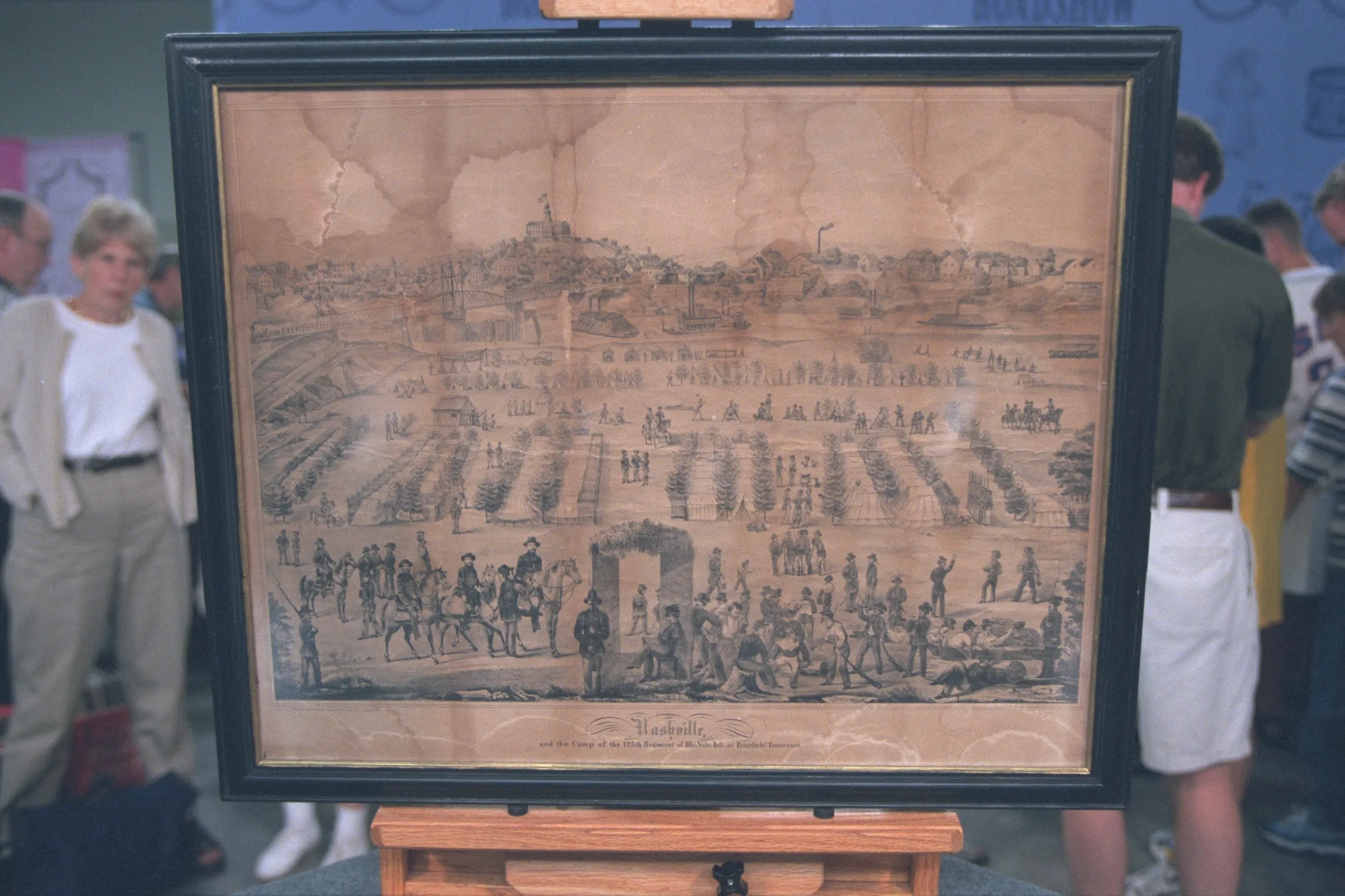
APPRAISER: Wow-- this is a wonderful camp scene. I've seen many, many camp scenes from the Civil War. This one actually exists on three levels. Most of them just show the camp, but this has a series. In the foreground, you have these wonderful vignettes of the kinds of people that were in the camps. You have officers, soldiers. Here's a woman who was probably a freed slave who was working in the camp, making a living as a laundress, and some of these men might have been identified just by the fact of what they were doing. For instance, here's a barber working, and often a barber would have doubled as not only to cut hair, but to pull teeth and things like that. And you have these wonderful little vignettes of the various troops. Here's a very sad scene, digging a grave. So it's a poignant piece that shows the individual men. Well, there's a second level that gets into the camp itself and the outline of the camp and the way the military men organize things, and you have tents for the soldiers, but back here, little cabins for the officers. But then the third thing-- and very few of these camp scenes have this-- there's a wonderful city view, and here's Nashville, Tennessee, in the background. Now, I particularly like seeing the state capitol of Tennessee, which is still there. Uh, it was designed, and the architect was William Strickland, who was from my own town of Philadelphia, so, you know, this is delightful for me. And with the Cumberland River, you have, troop transports, you have ironclads and so on, and you look at the Cumberland River today, and you say, "How could they get these ships in there?" But they were there, and this is really a great piece on the Civil War. I've seen thousands of Civil War prints, read hundreds of Civil War books. I've never seen this print before. Uh, you've never had it appraised or anything?
GUEST: We've never had it appraised, have no idea.
APPRAISER: Well, this one is badly stained, and it's missing a little section here and everything, but even with that, if I would consider just as is, a fair market value of this would be about $900.
GUEST: Oh, my goodness. Much more...much more than a dollar.
APPRAISER: Oh, yes, right, yeah. And if I had it cleaned and everything, I'd say, you know, $1,800 would be a fair price because it's Illinois history, it's Tennessee history, and it's a wonderful thing.
GUEST: Oh, thank you.
GUEST: Well, it was made for my great-great-grandmother back in the late-1900s by a man from West Union, Ohio, and it's been in our family ever since.
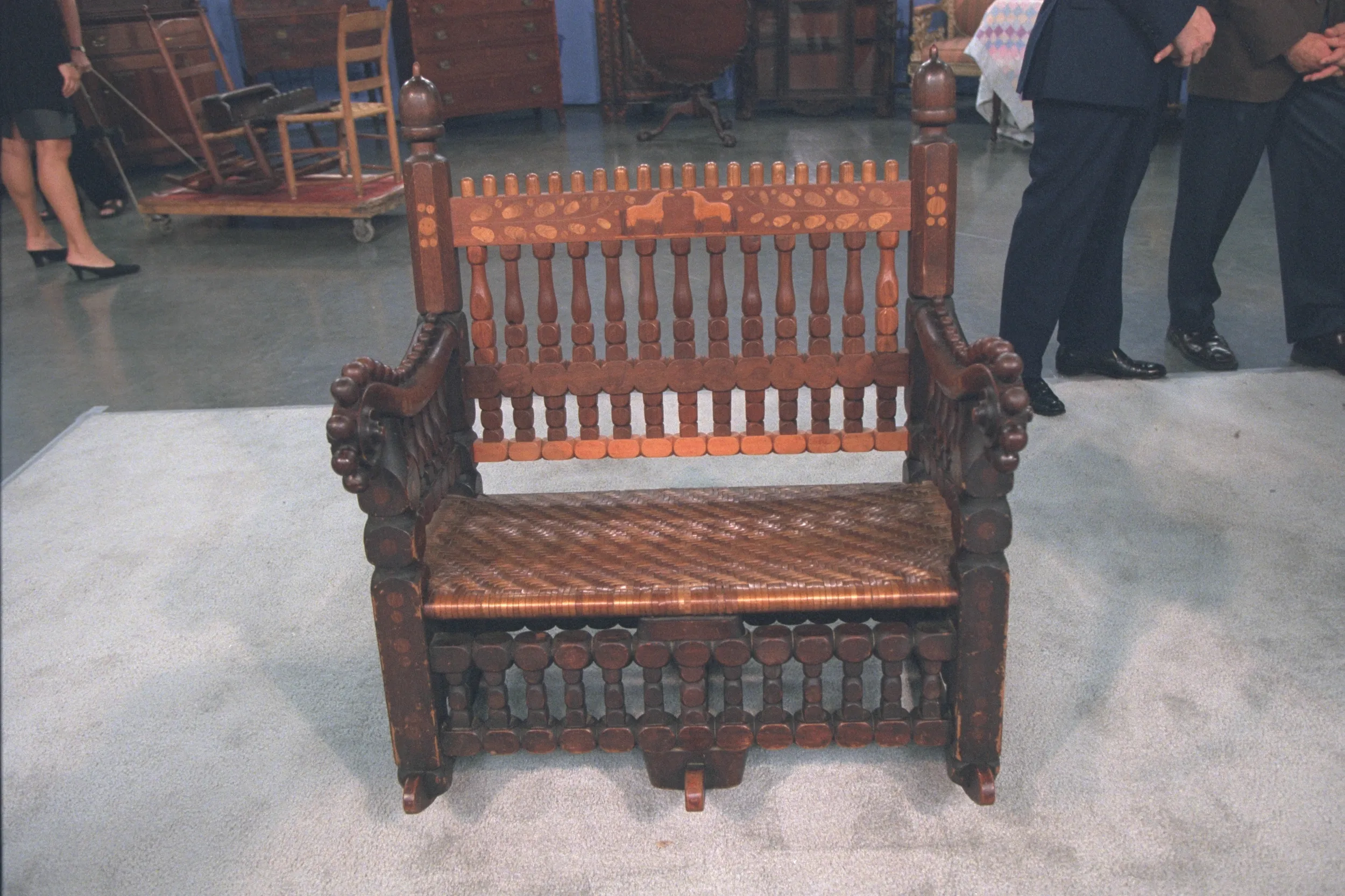
APPRAISER: Well, what I like about this piece is that it has a personality. It's way beyond a piece of furniture. It really goes into folk art, right? It's really a creation. Someone made this to impress and to show off their skills, to show that they could do inlay. And these acorns, in England, they symbolize strength. And I love all of these turned elements, these vase-and-block turned elements. I saw these scratches here. How did those happen?
GUEST: My grandkids.
APPRAISER: When they were like three or four?
GUEST: They're now about five and six years old, yeah.
APPRAISER: Okay, and they did it. It's not... I don't think it really hurts the value. My three-year-old would do something like that, I'll tell you. He just made a couple little lines in here. But when we come down to these scroll handholds-- and we can see this one over here, this reminds me-- doesn't it remind you of a violin? I wonder if the man who made this also made some musical instruments. And I really like this inlay, these circular motifs all the way down the leg. So all these elements add up to making a piece that is, really, a folk object. My favorite thing about this rocker are these horses. And is this your favorite also?
GUEST: Yes, it is.
APPRAISER: The detail of this pair of horses flanked by these inlaid leaves, that really is the center of the piece. It gives it the real thrust as folk art. The last thing I want to mention is the finish of this thing really helps it, because of all the wear from your three-year-olds and from you using it, you see how it's rubbed it? But it's left the dirt in the dark areas also. So it really has that contrast of dark to light, which is what's nice about having an old finish on a piece. So, do you have an idea of what it's worth? You haven't had it appraised?
GUEST: No, no we never have.
APPRAISER: You said an auctioneer once said you could do really well with it.
GUEST: Name my price, yeah, but we didn't.
APPRAISER: And that's why you brought it, you're curious about that?
GUEST: Yeah, we didn't know if you knew who made it or not, the man.
APPRAISER: We can't identify the artist. It's a folk artist working in a folk tradition, and there are a lot of collectors out there that love pieces like this, and its value in the marketplace... In my shop, in my gallery, I would probably put upwards of about $18,000 on it.
GUEST: Whoo!
APPRAISER: Maybe even $20,000. So in that range, $18,000 to $20,000. You're still going to rock in it, right?
GUEST: Yes.
APPRAISER: You're going to rock... And it's darn comfortable, too, I'll tell you. Can I sit in it?
GUEST: Sure, you can.
APPRAISER: Do you want to sit with me? Can you? Do you mind?
GUEST: Sure, why not?
APPRAISER: Let's just sit. There, that's nice. I like that.
GUEST: Yeah, it's nice.
APPRAISER: Thanks for being here. That’s nice, this isn't bad.
GUEST: Yeah, it is.
APPRAISER: It's comfortable, yeah. Now, your husband's not going to be upset, right?
GUEST: No, he'll be thrilled.
APPRAISER: Okay, all right, all right. I like this.
GUEST: Yes, it's nice.
APPRAISER: Are you surprised at the price?
GUEST: Yes, I am.
APPRAISER: You didn't have any idea?
GUEST: No, no.
APPRAISER: These were done in the '50s and '60s by Harris Strong in his workshop, working out of New York, in the Bronx. While they were tile, you would buy them already framed and you would just put them on the wall.
GUEST: My great-great-grandfather gave this to my great-great-grandmother on their anniversary.
APPRAISER: Now, she gave this to you. Andy, what did you get?
GUEST: Nothing.
APPRAISER: Nothing?
GUEST: I guess I'm chopped liver.
APPRAISER: (laughing)
APPRAISER: A lot of people collect steins. This is, I think, this is made by Mettlach, the company of Villeroy & Boch, which are really the top of the line on these German pottery steins. Certainly could bring in the $300 to $400 range, whereas most of the steins we see are in the $30, $50, $70 range.
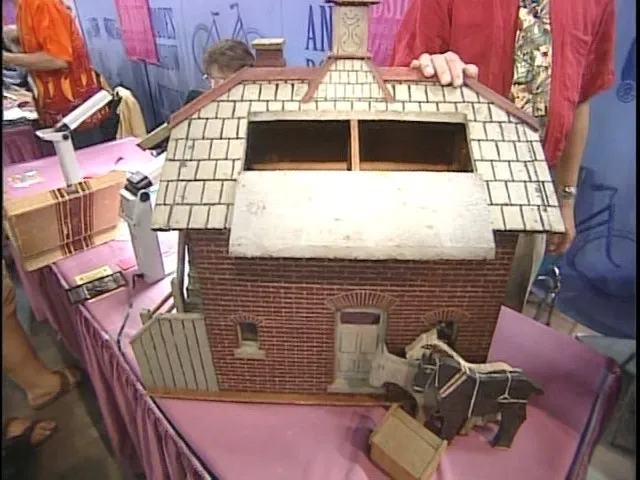
GUEST: This is a replica of a barn that was owned by my great-great- grandfather, and this replica was built by my great-grandfather. The original barn was on Massachusetts Avenue, behind my great-great- grandfather's meat market.
APPRAISER: Which is this building right here.
GUEST: Right, and then this is the barn back here.
APPRAISER: Oh, yeah, I can see the same staircase that's on the front here. Well, these things were very, very popular in the late 19th century into the early 20th century. This was probably built early 1890s. It's a little different because it's a barn, not a dollhouse, and you have some little funky wooden horses there, which are cute, and a chicken coop, which is way cool. Well, it's really, really, nice. It's got great paint, nice history. It's been here in Indianapolis. I love the cupola. It probably did have a little weathervane at one time. Interesting family history. Did you ever have it appraised by anybody?
GUEST: No.
APPRAISER: Okay, well, it goes into a folk art category for dolls and toys, and a little barnhouse like this is probably in the $3,000 to $4,000 range.
GUEST: Wow, cool.
APPRAISER: So it's good. Don't make it into a birdhouse.
GUEST: Oh, no, it's going to stay in the family.
APPRAISER: Thanks a lot.
GUEST: It belonged to a friend of my mother's, Christine Hoyt. When my mother was little, she used to go over to Christine's house, who was her next-door neighbor, and she used to read her the Reader's Digest, and as my mother got older, she moved away, but she still kept in touch with Christine. Christine used to travel to different parts of the world, and right before World War II, she traveled to Europe, like France, Italy, and Germany. And when she got back, she brought home a ton of antiques. This statue was one of them, and when she died at the age of 93 in 1975, she left a lot of antiques, including this statue, to my mother.
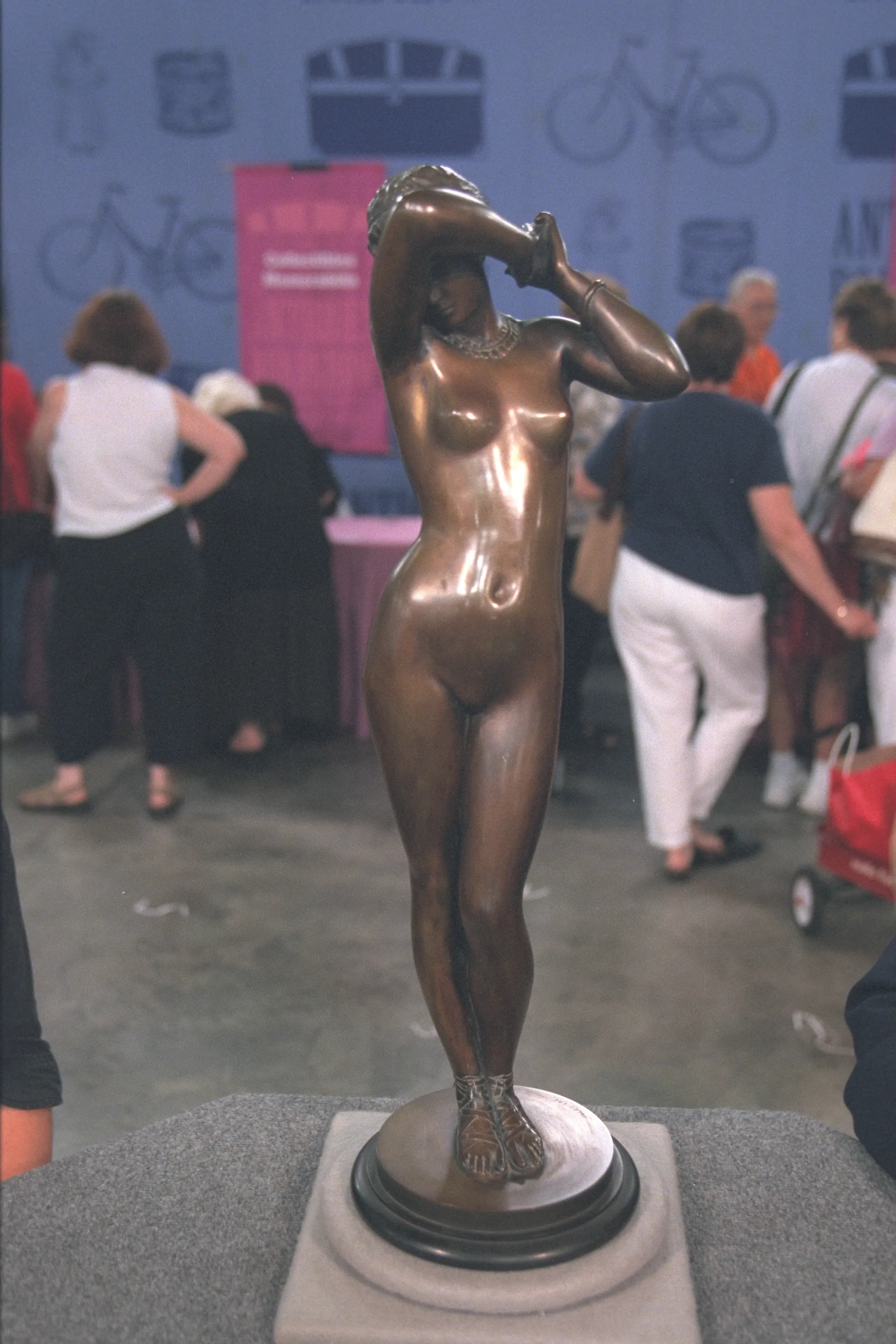
APPRAISER: Uh-huh. That's wonderful. Well, you've brought in this wonderful French 19th-century sculpture. It's by, actually, one of the leading academic sculptors in France at this time. His name was Alexandre Falguière. He's not particularly known in this country, but in his period, he was very, very well-known. He got lots of public commissions, he did things for the Paris Opera, he worked on architectural decorations, and he actually had five workshops, and he's also well-known as a teacher. One of his students was the famous American sculptor Frederick MacMonnies. The piece is very interesting because it's actually signed here, "Falguière," right on the top. And I think even more interesting is that it's signed "Goupil"-- G-O-U-P-I-L-- "& Company." And Goupil was a very famous gallery in Paris, and they had branches all over the world-- in London, in Vienna, in Berlin, and also in New York. And they published prints of paintings, and they also made editions of these bronzes, and they're very, very well-known. And, in fact, Vincent Van Gogh worked for Goupil Galleries in their London office, and his brother Theo Van Gogh also worked for Goupil and introduced the impressionist painting... painters to the market, through the Goupil Galleries. So you have a wonderful thing. But there's something else you... one of your primary interests was what that was, right?
GUEST: Yeah, we've been wondering about that for years.
APPRAISER: And it's really very, very straightforward. It's just a little knob to turn the piece. Originally, this piece would have had a pedestal. It had a turntable just like this, and this piece was used to turn it so that you could look at it from all sides because it's really quite wonderful all the way around. You have any idea of what the value is?
GUEST: I have absolutely no idea.
APPRAISER: Yeah. Well, again, it's very desirable, it's a good quality, the casting is wonderful, the patina is wonderful, the size is great, it has this wonderful, exotic subject matter. At auction we would probably get between $8,000 and $10,000 for it.
GUEST: Oh, my gosh!
APPRAISER: Okay.
GUEST: Oh, my gosh, that's amazing.
GUEST: I was told by my grandmother that this belonged to her father, so my great-grandfather.
APPRAISER: Great-grandfather.
GUEST: Yes. He was a career soldier, and he picked this up while he was down around Mexico chasing Pancho Villa around the turn of the century.
APPRAISER: Well...I guess I've got the, uh...as we say here sometimes, good news and bad news.
GUEST: Okay.
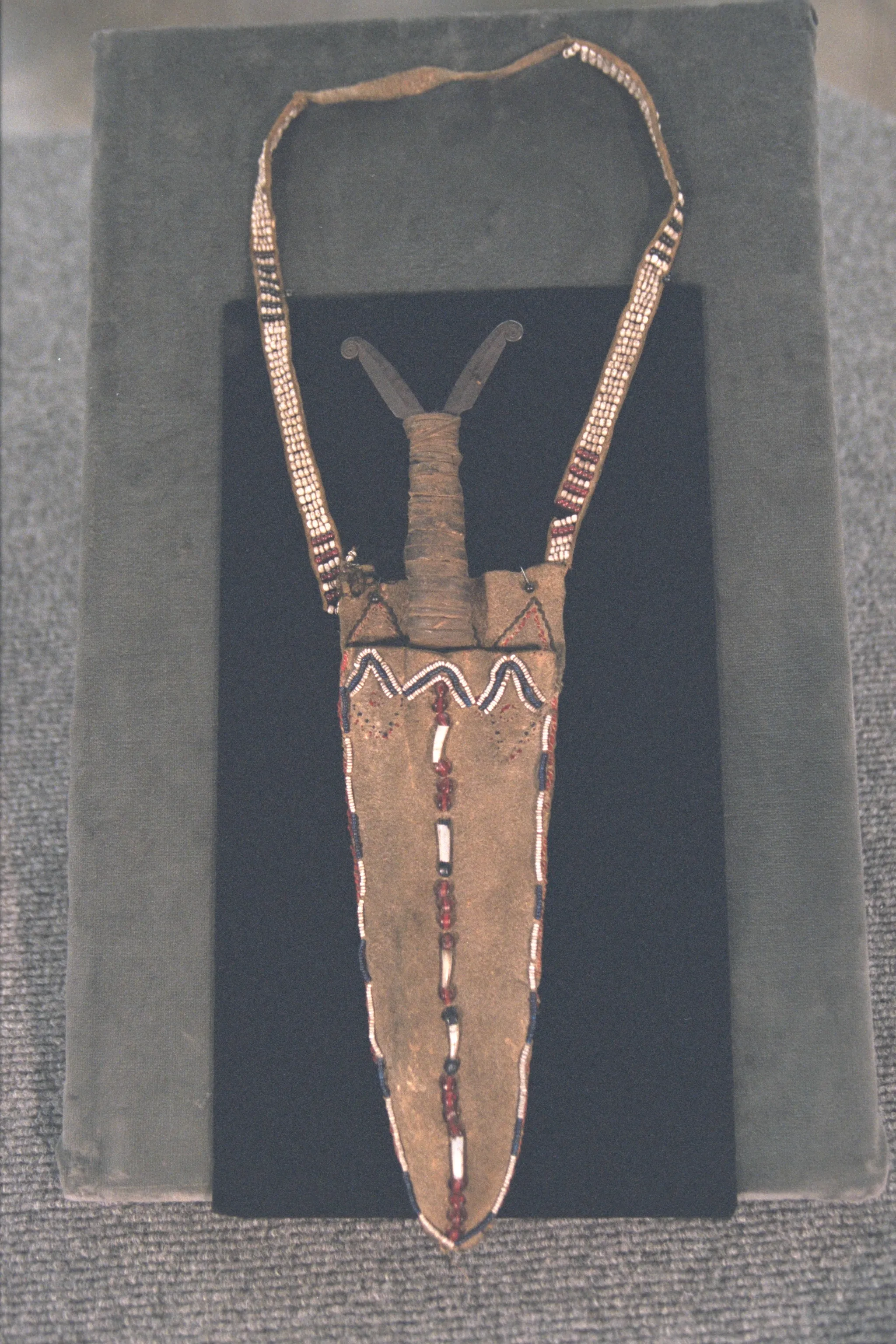
APPRAISER: Um, this is actually a very interesting thing you've brought into the ROADSHOW today. It unfortunately...in terms of your story, in Mexico and Pancho Villa, this was made in what is now the Yukon, or the Yukon-Alaska border. This is actually made by Athapaskan- speaking tribes, as I said, from the Yukon area, western-eastern Alaska, probably a tribe by the name of the Gwich'in, and these were used by men. They were hunting knives, hunting daggers, and I'll first show you, talk about this a little bit. They were fantastic metalsmiths, and they would get old files in trade, files that had been worn out that were of no use to the English anymore, and they would make these extraordinary daggers, and you can see the beautiful fluting of the blade and these wonderful curlicues. We call them ram's-horn volutes, and wrapped in hide so the hunter wouldn't cut himself. These were worn over the neck, and so they were carried right on the middle of the chest, and the beads here are quite interesting. These were obtained from Russia. We call them pony beads because of the large size. Um, with the use of these beads, we can accurately date this to about 1850. Another interesting aspect of this is these shells right here are called dentalium shells, and what's interesting about those is they are only found one place in the entire world. That's off the west coast of Vancouver Island. They were extremely valuable to a whole number of native groups, and they were traded, and they were used as currency. It was considered as a form of money, so it signified that the man who owned this, with these shells, was probably a pretty important man. Has this ever been appraised?
GUEST: No, not that I know of.
APPRAISER: Well, I can tell you that in our gallery, we sold a dagger for $3,500 about three months ago. The sheath in itself is worth probably in the neighborhood of $5,000, and I think together as a pair, probably in the neighborhood of $8,000, $10,000.
GUEST: Oh, my gosh.
APPRAISER: Thank you very much for bringing it in.
GUEST: Thank you.
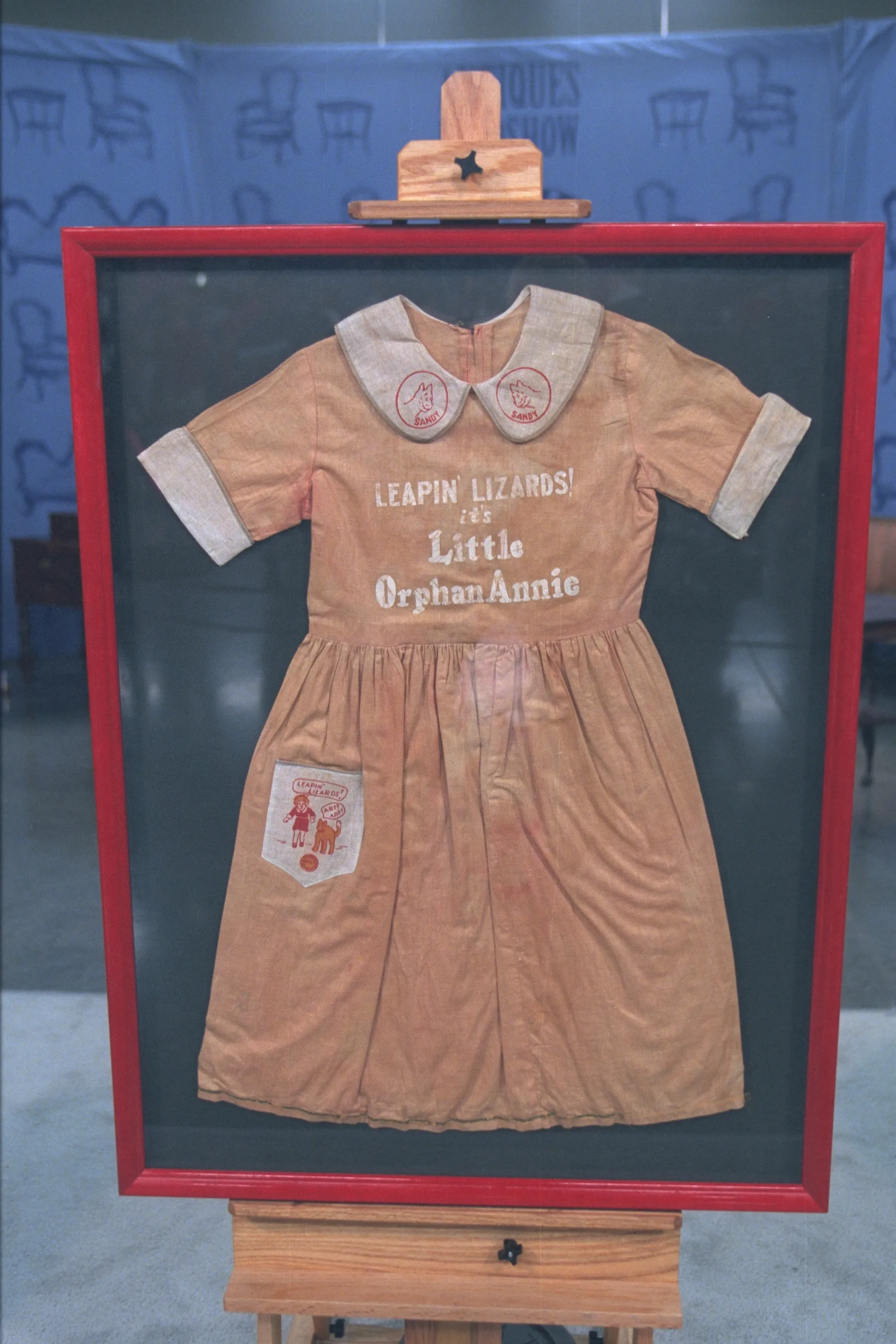
GUEST: I was Daddy Warbucks in our school play, “Annie,” and, um, my parents were at a private estate, and they saw this piece, and they purchased it for me for our collection of different Annie things and for all the different plays that I've been in and stuff.
APPRAISER: Well, that's great. Well, as you know, Little Orphan Annie...the Annie play was one of the most successful ever produced on Broadway. It started in 1977. But before Little Orphan Annie ever sang "The sun will come out tomorrow," she was too busy fighting Nazis and capturing villains to ever have time to actually sing any songs. Um, originally, it was based on a poem by a local person, a Hoosier here, James Whitcomb Riley, who wrote the poem about Little Orphant Annie in 1885, and Harold Gray, in 1924, who was an illustrator and cartoonist for the Chicago Tribune, invented Little Orphan Annie, and she was incredibly popular. Um, she was very heavily licensed. There was a lot of commercial product based on Little Orphan Annie. There were decoder rings and buttons and clubs and games. And what you have, actually, we all think is a Halloween costume, which came from the late '20s, early '30s, and it probably also had a Little Orphan Annie mask with it. Um, this is in fabulous, fabulous condition, and tell me a little bit about what your parents paid for it.
GUEST: Um, I think they paid around $1,000.
APPRAISER: Wow, that probably seems like a lot of money to you.
GUEST: Yeah.
APPRAISER: Well, I think you'll be happy to find out that Little Orphan Annie memorabilia is very, very sought after, and something like this would sell for between about $2,500 to $3,000.
GUEST: Wow.
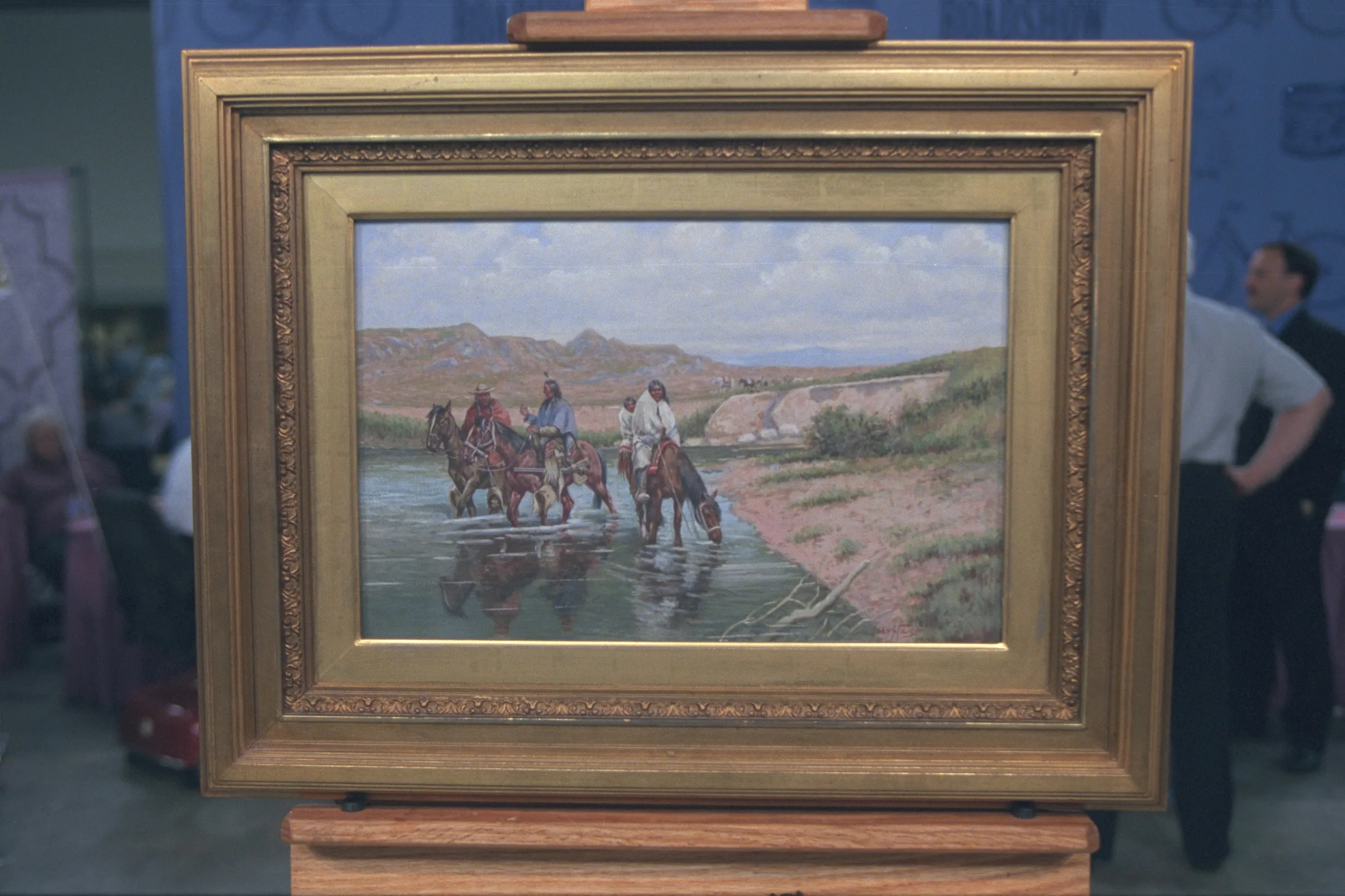
GUEST: My father was an ophthalmologist here in Indianapolis, and he had a number of paintings, most of which were gifts from patients and friends, and I have a feeling that he may have acquired this from the Eiteljorg family. They were friends and neighbors. They lived close to where we live.
APPRAISER: Right, and of course, the museum here of Western art is named after them.
GUEST: That's right, yes. They had quite an extensive collection of American Indian art.
APPRAISER: Well, this is a marvelous example of Western art, so that fits rather nicely. When we saw it first, we thought it might have been by Henry Farny, the Cincinnati, Ohio, artist, but in fact it's by another Cincinnati artist, John Hauser, equally good. He studied in Cincinnati and then went off like many American artists, studied also in Munich and in Dusseldorf, and while he was in Munich, he worked with the great Greek artist Nikolaos Gyzis, and while he was there, he would have had a very strict, formal training, hence the realism in this work. I love the composition here. As we see, the side of the riverbank coming up in this diagonal and then being picked up in the horse's neck and leading you right into the center of the work. Do you know anything else about John Hauser? Had you come across him before?
GUEST: My mother, as it happens, was from Cincinnati originally, and I think she was aware that he was from Cincinnati, but that's all she knew about it. She very much liked this painting, as did my father.
APPRAISER: Yeah, yeah. He's painted it in gouache, which is a medium favored by many artists and also designers because of its quick- drying properties, unlike oil paint, which takes a long time to dry. He worked a lot in gouache, as many of the other artists who did this kind of subject did. We can see his signature down here, and unfortunately, because of the framing, the date is slightly...
GUEST: You can barely see it.
APPRAISER: You can barely see it, but it appears to be 1909.
GUEST: Mm-hmm.
APPRAISER: Now, I'm no expert on Native American Indian tribes. I can't profess to have a great knowledge of them, but my guess would be that they're probably Sioux, Sioux tribe, because in fact he was adopted by the Sioux in 1901 and given the name Straight White Shield, so it's a nice little story to go along with it. Have you ever given any thought as to the price of the work?
GUEST: No, not at all.
APPRAISER: Yeah, well, I hope it will come as a pleasant surprise, but at auction, I would expect this to comfortably reach between $12,000 and $18,000.
GUEST: Oh, my God! You're kidding.
APPRAISER: So, I hope that's good news.
GUEST: Yes. I'm amazed.
APPRAISER: Okay, you bought this in a yard sale for how much?
GUEST: I paid $15. It had a bunch of dirt on it, so I didn't even know...I thought it was metal at first, so I started wiping it off and saw the blue and liked the blue.
APPRAISER: Well, I think you got a deal here. The value would be in the $3,000 to $4,000 range.
GUEST: Jeez.
APPRAISER: So, 15 bucks...you did good!
APPRAISER: This might have been worth about $300 let's say 15 years ago, and a bracelet like this today is about $750, and they're only going to continue to go up in value.
APPRAISER: They're very early drums. They're very primitive. They were made for the militia troops in Colonial America. They couldn't afford drums made by regular drum makers.
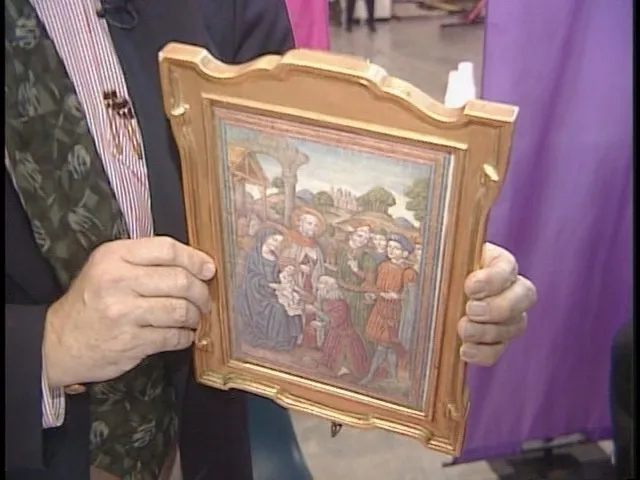
APPRAISER: What you have is probably the most famous fakes ever to walk through the doors here at the ANTIQUES ROADSHOW. This is something by an artist known as the "Spanish Forger." We don't know his real dates-- we know he's painting around 1900 to about 1930-- and he was producing these manuscript illuminations on the backs of old antiphonals, or old, um, songbooks, and I can show you the back of that. You can see here, what we have is this old musical notation, but it doesn't match up what's on the front, so he has old paper--paper from the period he wants-- but he's doing it in the 1900s. But the funny thing about it is they're actually worth about $4,000.
GUEST: Oh, my God.
APPRAISER: Yeah, even as a fake.
GUEST: Wow, that's great.
APPRAISER: Well, thanks for bringing it in.
GUEST: Well, thanks a lot.
GUEST: I was in a used furniture store in North Vernon, Indiana. They had used furniture and antiques. I bought the item from the owner of the store for about $35, and that was about 20 years ago.
APPRAISER: Okay, okay. And did you find out where it had come from?
GUEST: Yeah, it had originated from the Knights of Pythias Hall in San Jacinto, Indiana, so it was used in some of their rituals, I guess.
APPRAISER: For some of their lodge fraternity work. So it was part of their meetings and all that.
GUEST: Right.
APPRAISER: Okay, well, what we have here is not your standard magic lantern. Magic lanterns tended to be very boxy, either mahogany or Japan metal with maybe a brass lens in the front, and you would change the slides individually. What this is is...you've got your brass lens in the front, with focusing, which is normal, and then, you know, the main lens. But then this part is wonderful. Instead of changing slides, you have this...this fan of slides so that you just spin the wheel. And the slides we have here are colored lithograph; they're not hand-painted. I like this one in particular because it's got the factory that it was made at.
GUEST: Yeah, that's interesting.
APPRAISER: And that's very important, you know. You don't see that very often. And the whole thing is nickel-plated. Nickel was kind of the chrome of the Victorian era, nickel and lacquered brass, which this is. And although it says it's an oil burner, it is in fact electric. It's a very early electric, uh, machine. Because these contacts here are all original; these were not added. The venting down here is to allow air to get into the electric lamp housing back here, and there is no place for oil to have been. This was originally electric.
GUEST: Okay.
APPRAISER: Now, magic lantern collectors like showy pieces. They love pieces that look unusual. But they don't like them to be too big, either. I think, conservatively, in an auction of early technology and of cameras, you'd easily get 1,000 to 1,500. But I would not at all be surprised if the two, three, four, five collectors fight it out, and it goes up even higher than that. It's a real collector's piece and a really beautiful, beautiful piece of American technical history.
GUEST: Pretty good return for $35.
APPRAISER: Excellent return for $35.
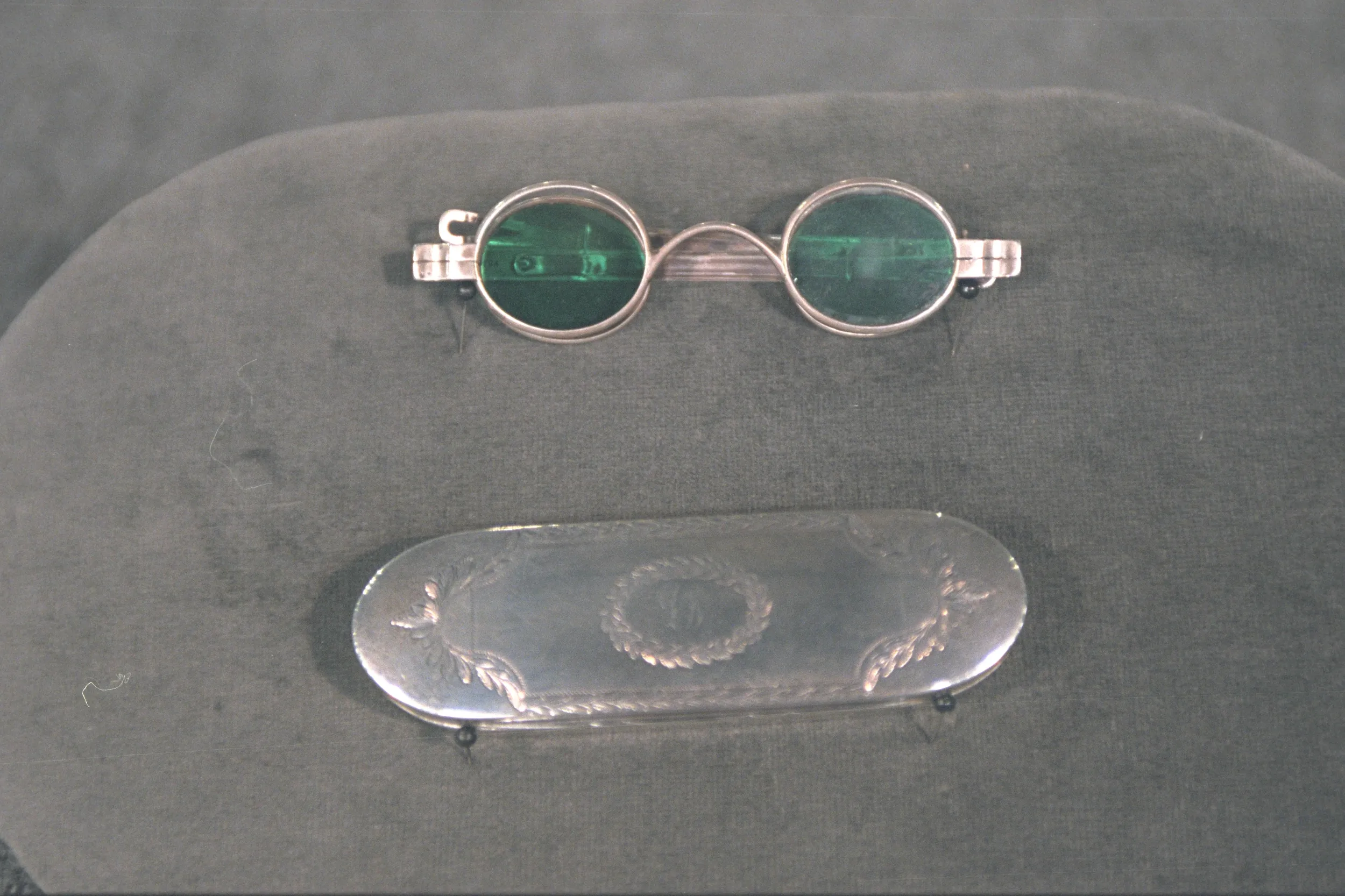
GUEST: I have brought a silver eyeglass case that belonged to my great-great-great-grandfather. He lived, uh, between 1728 and 1768. So he died at a very young age. It was made in Philadelphia, Pennsylvania, out of nine silver dollars, and the eyeglasses, as you can see, have a colored lens, um... the first sunglasses, let us say.
APPRAISER: Okay. And how did we know that it was made from nine silver dollars?
GUEST: In the little case when it was handed to me was this little slip of paper in my grandmother's handwriting-- which I knew very well-- in which she had written this information: "Made out of nine silver dollars in Philadelphia, Pennsylvania, sometime between 1728 and 1768."
APPRAISER: Okay, well, great. You know, it's a very interesting object. First of all, the only confusing thing is that we open it up, and we discover it's an American coin silver eyeglass case, and we see the maker's mark of "Robert & William Wilson, Philadelphia," and he was working around 1825 to the middle part of the 19th century, which, unfortunately, makes it impossible for it to have belonged to that relative of yours in the 18th century. It's still a very interesting box, however. You don't find too many American coin silver spectacle boxes, so it's extremely interesting. It was, um...It's not by one of the great makers like Benjamin Burt or Jacob Hurd, but as an American coin silver box of the early 19th century, it's worth about $1,000 to $1,500. Now, the spectacles are also silver. They're from the 19th century, as well. They're very early sunglasses. They come in and out according to the sun. And I assume these belonged to another relative of yours, and these fetch at auction about $100 or so. They're not as rare as the box.
GUEST: They...do they...they don't belong, then, as part of the box?
APPRAISER: No, they probably were made at a different time, and they just fit quite nicely in there. In fact, some people may argue that this is not a spectacle box. It could also be called a snuff box.
GUEST: Oh, really?
APPRAISER: Right. But they do happen to fit in perfectly.
GUEST: Yes, they did. In all my lifetime, they have been in that box.
APPRAISER: Thank you very much for bringing it in, and I guess you'll have to do more research as to who might have been your relative in the early 19th century with the initials E.S.
GUEST: I have that information documented. I don't have it in my head.
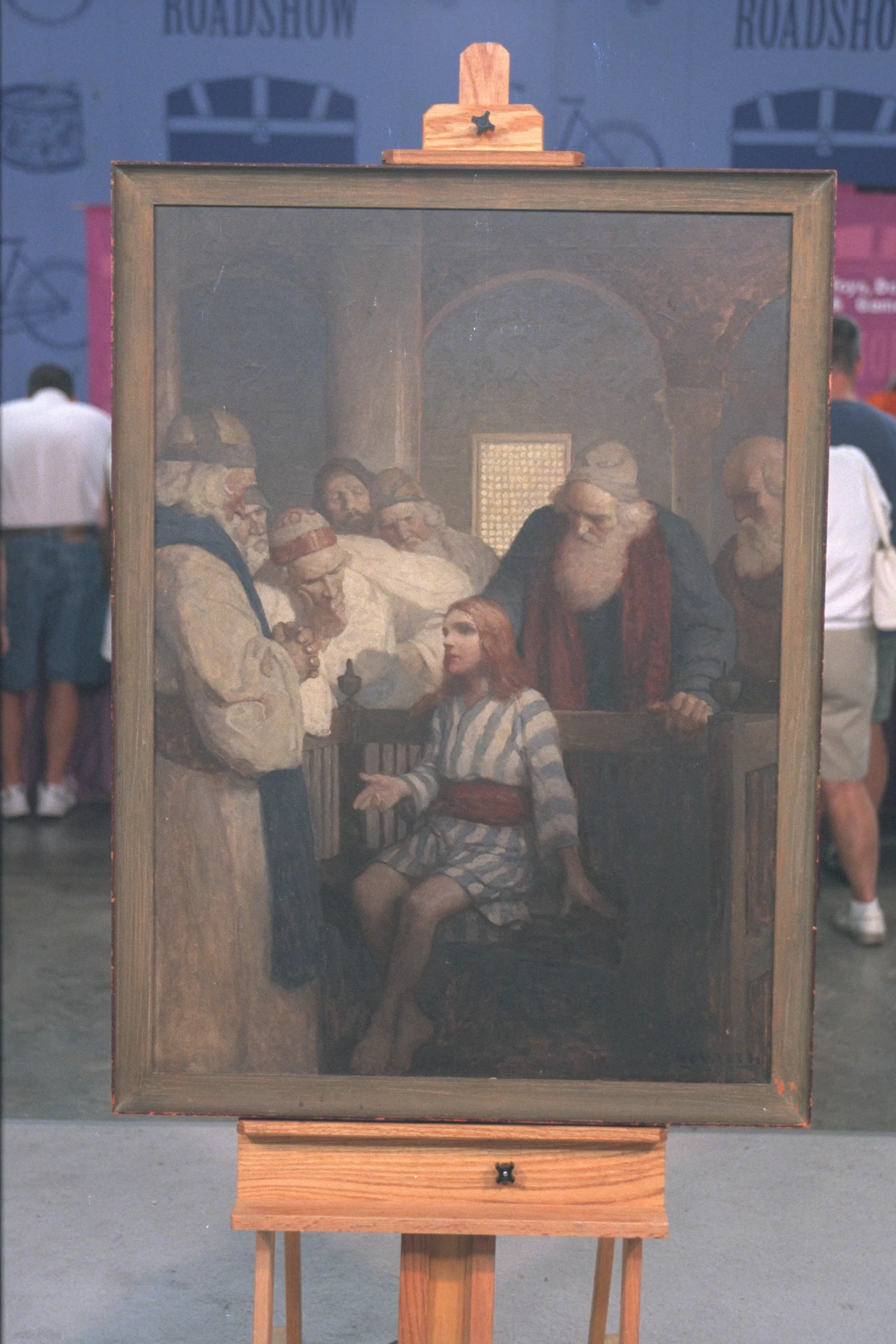
GUEST: This is a painting by N.C. Wyeth.
APPRAISER: That's right, and as everyone knows, N.C. Wyeth is associated with the Brandywine School of illustrators in Brandywine, Pennsylvania, outside of Philadelphia. Wyeth himself was born in Needham, Massachusetts, in 1882 and came into Wilmington, Delaware, which is near Chadds Ford, around 1902. Wyeth started his career, or gained most of his notoriety when he was doing illustrations for Scribner's Classics-- most notably, Robert Louis Stevenson's “Kidnapped” and “Treasure Island,” and he also did illustrations for magazines. And this particular piece was done for the December 13 issue of “Harper's Monthly” magazine. It was for a story called "The Lost Boy," by Henry Van Dyke. And this particular piece is called “When He Comes, He Shall Rule the World.” And you have a very interesting story to tell us on how you acquired the painting.
GUEST: Well, allegedly, it was given to my grandfather by the artist. I'm not sure the reason he was given it, but when we went back east, back in the early '60s, my mom went to her sister, my aunt, and says, "Well, where's the painting?" And my aunt said, "Oh, that old thing? Nobody wants it, so I'm selling it." And we jumped right in the car and drove into Boston and took it out of the gallery it was being sold in, threw it in the trunk, and it's been in our family ever since.
APPRAISER: And you've had it for how long?
GUEST: I would say 35 years right now, at least, yeah.
APPRAISER: Wow. Oh, that's great. Well, why don't we talk a little bit about the picture itself. First of all, it's in really terrific condition. The painting is not lined. It's in its original state. It probably needs a light cleaning. It's a little bit yellowed in the areas in the center. The whites would probably pop out if it were cleaned. It has the original frame, which is great-- that also adds to the value. And of course, it's signed "N.C. Wyeth" in the lower right. Now, have you ever had the painting evaluated?
GUEST: Back in 1980, when my father passed away, we had to have it evaluated for the estate.
APPRAISER: Mm-hmm.
GUEST: And it was valued at $5,000 by a art dealer around where I live.
APPRAISER: And then, I understand that you did send a photograph to the Brandywine Museum, which is in Chadds Ford, Pennsylvania, which has a number of Wyeths. And they gave you an evaluation, as well?
GUEST: Yeah, they... a friend of mine went out there and was talking to them about this painting. And they said I should call in and give them some...some background on it because they classified it as a lost work of art. And they just...they wrote it up that it was valued between $30,000 and $50,000 at the time. That was '94, '93, something like that.
APPRAISER: Well, I'm sure they were thrilled to discover that it existed and where it was. Well, the market for American illustrators has really soared in the last 10 to 15 years, and particularly for N.C. Wyeth. I think at the time they gave you the evaluation of $30,000 to $50,000, that was probably pretty near it in the early '90s. But today, if we had this at a gallery in New York City, we would be asking $250,000.
GUEST: (chuckles) Wow. That's great.
APPRAISER: It's a very exciting...very exciting piece.
GUEST: That is great.
GUEST: We always knew that there was a sister rocker. We were always told by my grandmother that there were two of them made.
WALBERG: A Cincinnati viewer spots a long-lost family treasure on ANTIQUES ROADSHOW. Stick around for the reunion right after this.
WALBERG: While sitting at home happily watching ANTIQUES ROADSHOW, a viewer in Cincinatti was shocked to see a woman with a rocking chair she'd been looking for her whole life. You see, she had its twin. A trip to Indiana led to a reunion of the rockers and some new friendships. Take a look.
GUEST: It's been in the family for over 100 years. It was made for my great-great-grandma.
APPRAISER: Can I sit in it?
GUEST: Sure, you can.
APPRAISER: Do you want to sit with me? Can you? Do you mind?
GUEST: Sure, why not?
APPRAISER: There, that's nice, I like that, thank you.
GUEST: Thank you too.
APPRAISER: It's nice, this isn't bad. It's comfortable.
GUEST: This lady from Cincinatti seen it, and the lady said it was made as a set and she has the other one. So she's coming, and I'm excited about it.
GUEST: We always knew that there was a sister rocker. We were always told by my grandmother that there were two of them made.
GUEST: I'm so glad you guys came.
GUEST: I'm so excited, I can't even imagine what it's gonna be like, just seeing that rocker next to my rocker.
GUEST: You come in, and now you can see mine up close.
GUEST: If my grandmother was here, how excited she would be! She would be so proud. I sat in it when I was a child. All the kids have sat in it. It's just amazing. (all laughing)
GUEST: It's amazing how much it's alike. The spindles and the back, and the acorns. Took a lot of work.
GUEST: My grandmother always wanted the rocker to stay in the family. It meant so much to her, and it was very near and dear to her heart, and it will stay that way.
WALBERG: I'm Mark Walberg, thanks for watching. See you next time on ANTIQUES ROADSHOW.
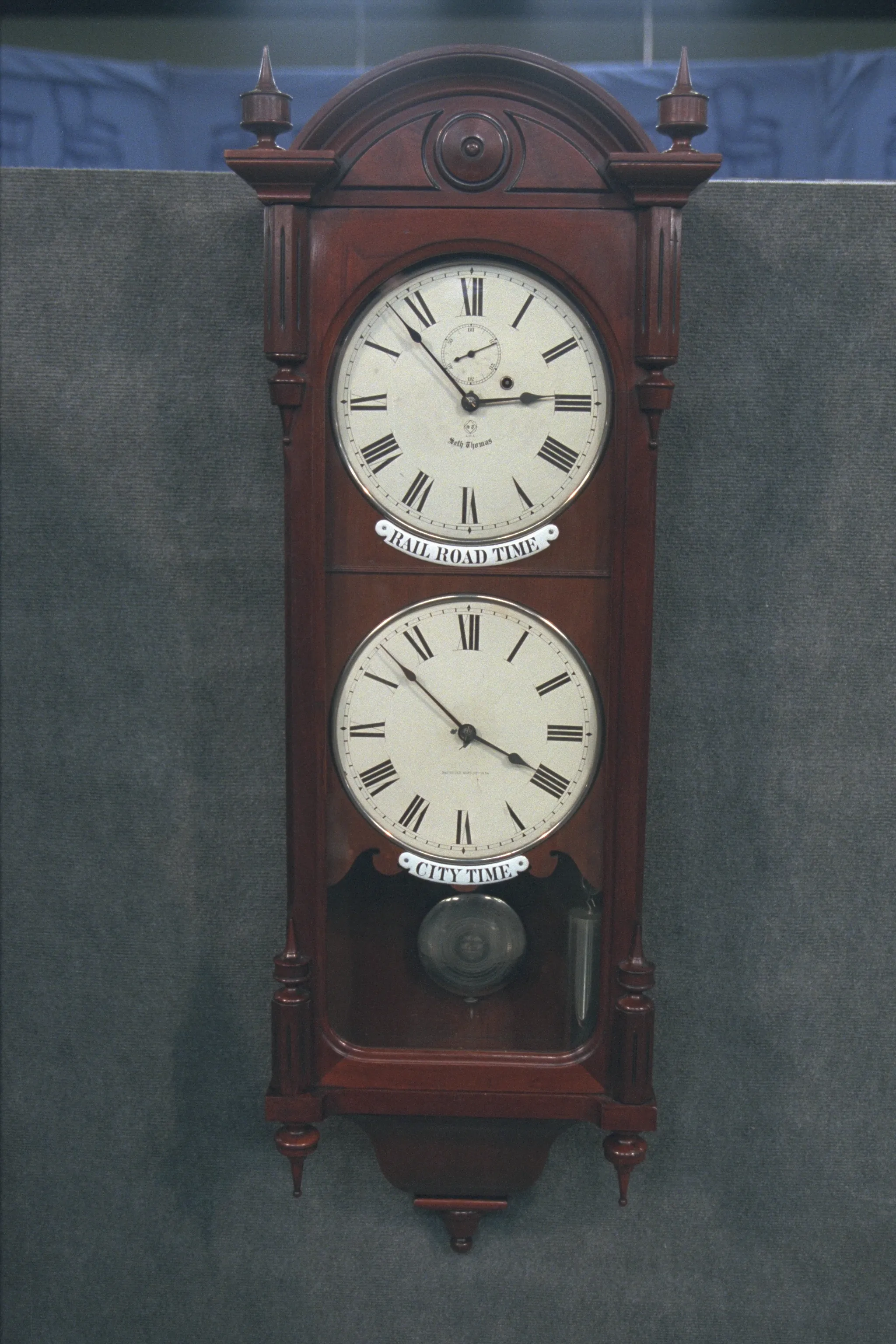
GUEST: I like to go to old jewelry stores in little towns and ask the jeweler or the watchmaker if they have any old pocket watches they want to sell and... I found this as well. The jeweler was telling me he didn't want to sell me any of his pocket watches, and I looked up on the wall behind him and saw this clock and made the other mistake that a collector can make, which is, I said, "Wow!"
APPRAISER: Prior to 1850 or so, almost every city in the country kept local time, which was independent of all the other times.
GUEST: Right.
APPRAISER: But this clock represents a transition between the 1880 period, when we knew there was a need for time zones and so on and actual time zones. It shows... here the railroad time, but down here, in Indianapolis, we're an hour ahead, so it shows the local time.
GUEST: Solar time, right.
APPRAISER: That's right. I think we have to say that its replacement value would be about $7,500.
GUEST: Great, that's wonderful.
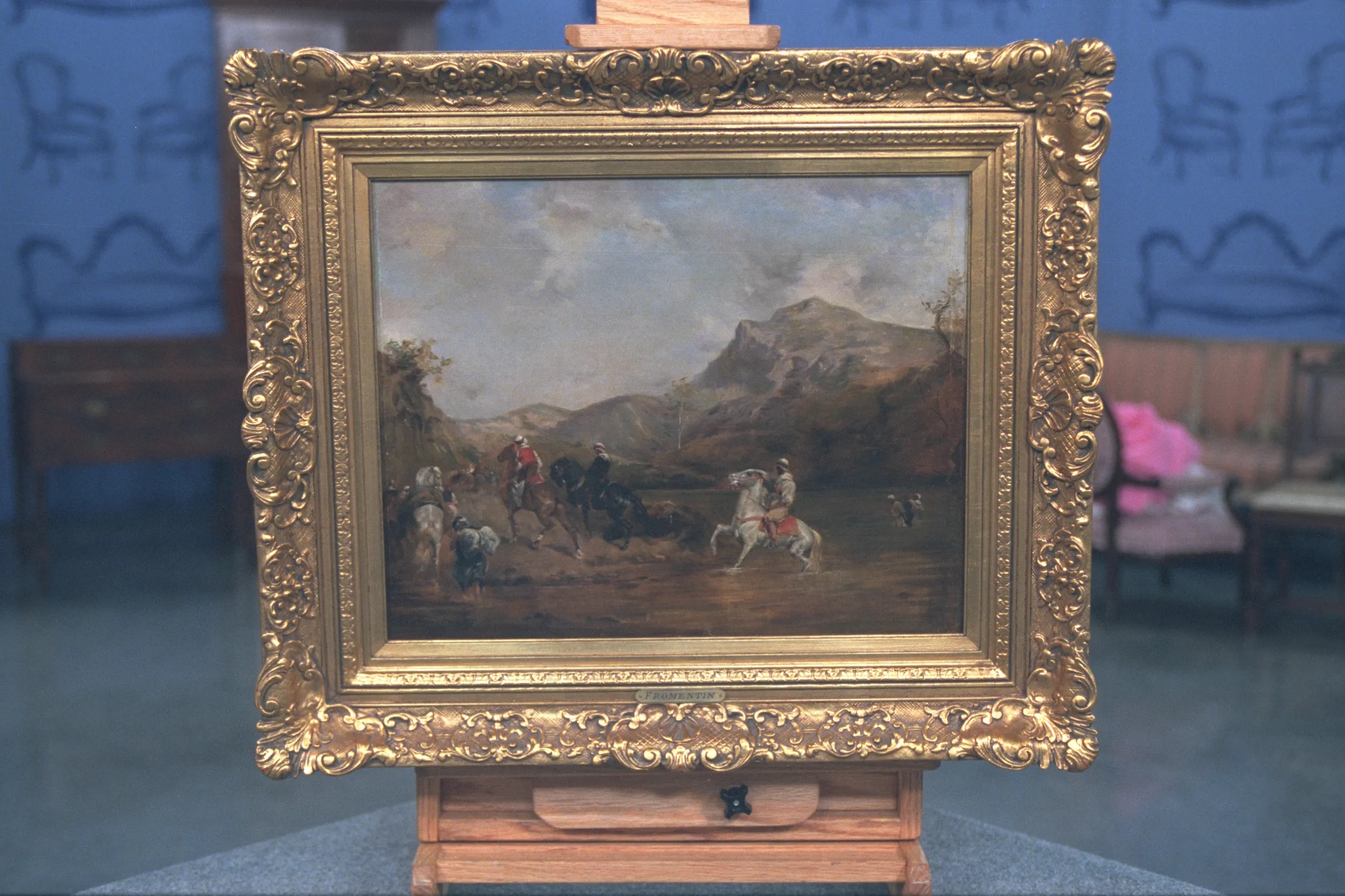
APPRAISER: This is a terrific painting by Eugène Fromentin, and he was a 19th-century French Orientalist artist. This painting has been in your family for a while, yes?
GUEST: Yes, passed down from my husband's grandmother to his mother, to us.
APPRAISER: Well, Algerian scenes were very popular in the late 19th century in France, but this really has everything that you would want in a Fromentin painting. And I would estimate it between $25,000 and $35,000.
GUEST: Wow. Wow, okay. (laughing)
APPRAISER: Great.
GUEST: Thank you.
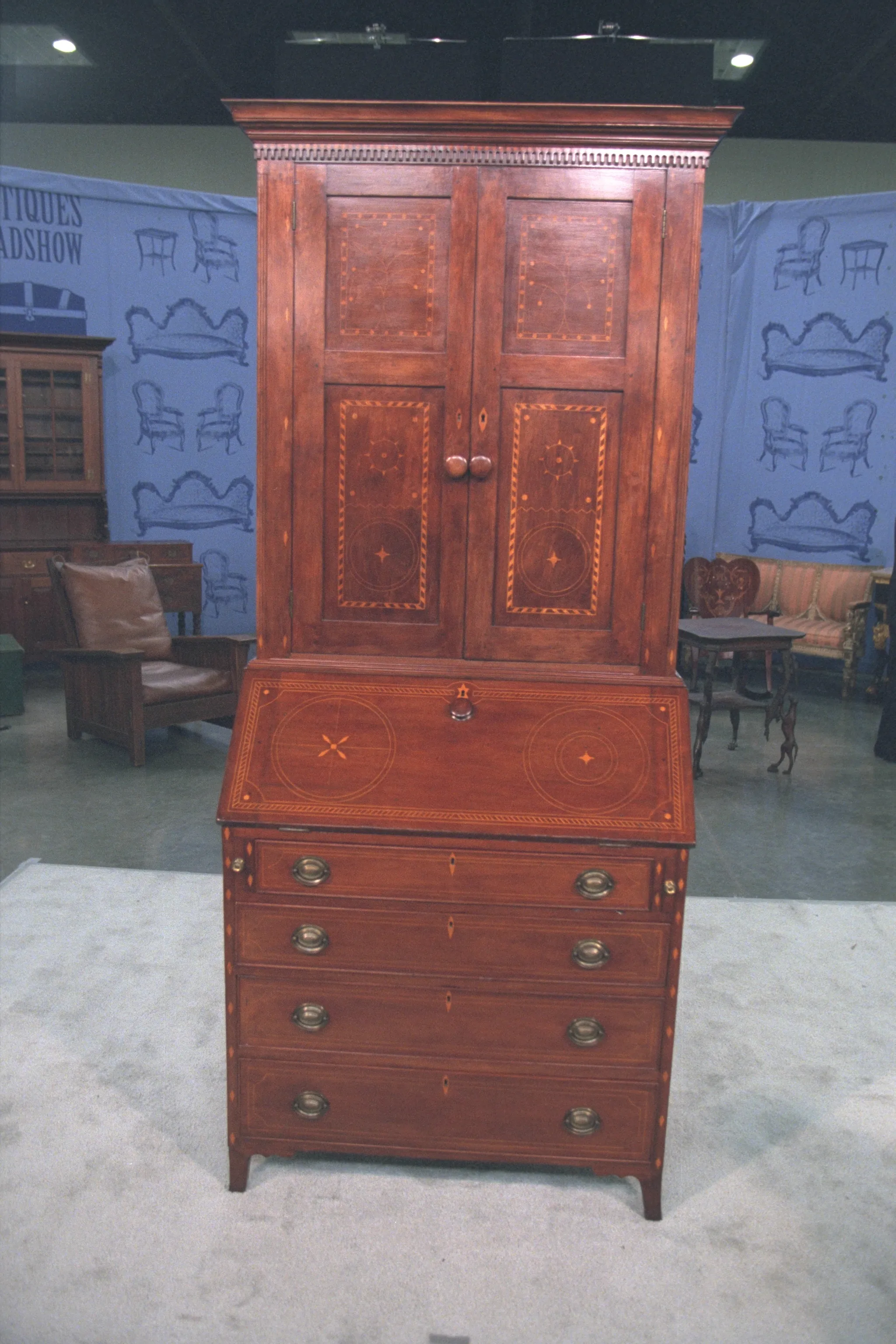
GUEST: Well, it was made for my great-great-grandfather by his oldest son, and it's been passed down to me.
APPRAISER: Like most of the furniture in the Tennessee-Kentucky-Ohio Valley area, its primary wood is cherry. And it's a piece which is listed here sold to your great-grandfather for $25. Well, it would be a little bit more today. I think we're in the $30,000 to $50,000 range.
GUEST: Oh, wow.
APPRAISER: Does that sound good?
GUEST: It sounds great.
Travel back 15 years to learn the current values for previously appraised finds. Highlights include an autographed electric guitar, a Little Orphan Annie dress, ca. 1930, and a 1913 N.C. Wyeth painting. Which item values fell and which ones soared?
More ways to watch
episode
Uncover how appraisals from 15 years ago have changed! Which one doubles in value?
episode
appraisal
appraisal
appraisal
appraisal
appraisal
appraisal
appraisal
appraisal
appraisal
appraisal
appraisal
appraisal
appraisal
appraisal
appraisal
appraisal
appraisal

appraisal
appraisal
appraisal
appraisal
appraisal
appraisal






A weekly collection of previews, videos, articles, interviews, and more!
Funding for ANTIQUES ROADSHOW is provided by American Cruise Lines and Ancestry. Additional funding is provided by public television viewers.
ANTIQUES ROADSHOW is a trademark of the BBC and is produced for PBS by GBH under license from BBC Studios. PBS is a 501(c)(3) not-for-profit organization.
A weekly collection of previews, videos, articles, interviews, and more!
New DETOURS Season 7 podcast videos have dropped — Watch now! »