OnQ
OnQ Mars Robot
Clip | 6m 44sVideo has Closed Captions
This clip features Carnegie Mellon University's new robot that is headed for Mars.
Science and technology contributor and former astronaut, Dr. Jay Apt, learns about Carnegie Mellon University's new robot that is headed for Mars. From OnQ Episode 2188.
Problems playing video? | Closed Captioning Feedback
Problems playing video? | Closed Captioning Feedback
OnQ is a local public television program presented by WQED
OnQ
OnQ Mars Robot
Clip | 6m 44sVideo has Closed Captions
Science and technology contributor and former astronaut, Dr. Jay Apt, learns about Carnegie Mellon University's new robot that is headed for Mars. From OnQ Episode 2188.
Problems playing video? | Closed Captioning Feedback
Where to Watch OnQ
OnQ is available to stream on pbs.org and the PBS app.
Providing Support for PBS.org
Learn Moreabout PBS online sponsorshipA little piece of Pittsburgh could be headed for Mars.
Now, that's because scientists at Carnegie Mellon University are testing a new type of robot, one that could someday explore distant planets.
And who better to report on this than a former astronaut?
Well, Dr.
Jay Apt has been on four NASA space shuttle flights, and he's also the science and technology contributor for OnQ.
Tonight, Jay shows us Hyperion, the robot made in Oakland.
Imagine a robot.
A robot that can explore the surfaces of the moon and Mars for months, even years, using only solar power.
Solar powered robots are actually nothing new, but researchers at Carnegie Mellon University have designed a way for the robots to intelligently draw energy from the sun while exploring space.
It's called sun synchronous navigation.
We've taken a number of the capabilities that we've developed over the years that allow robots to navigate autonomously.
What we are trying to do is allow the robot to autonomously reason about its power resources so that they can run for a long period of time, so they don't just start out and then run till the batteries are dead.
To test sun synchronous navigation, Dave Wettergreen and other researchers from CMUs Robotics Institute created a prototype named Hyperion after a Greek god associated with the sun.
In July, they took Hyperion to Devon Island in the Canadian Arctic.
A place that's barren, rugged, cold and desolate.
Well, we went for a number of reasons.
One, obviously, its a similarity to Mars and the ability to test a robot in that environment and learn more about how it might behave on Mars.
The other is the 24 hour sunlight.
With the Canadian sun always shining during the summer, continuous solar power was readily available.
So you mean it could figure out when it's running low on juice and stop and point itself to the sun and get the batteries all charged up?
Exactly.
Or is it something more.. We had a... The robot has a planning capability that first examines the path it's going to travel, and reasons about how much power it thinks it's going to require to do that.
It then looks at the position of the sun and calculates when it should start, and when it should reach each of its intermediate goals so that it gets the most power as it does that.
So these are the batteries in which we store the power coming from the solar panels.
The computer here in the middle of the robot is monitoring that power, as well as receiving input from the video cameras to monitor the terrain.
And we have amplifiers here that take the power and send it out to the four motors, as commanded by the computer that allows the vehicle to steer and drive through the train.
Up in the front here we actually have a power tracking system that is connected directly to the solar panels so that as the sunlight varies, we can produce a continuous power input to the batteries as we charge things up.
Hyperion designed to travel over some pretty tough terrain.
Four motors.
One for each wheel, helped maneuver the craft.
- In order to steer the vehicle, we have two passive degrees of freedom here, one in roll and one in yaw.
And that steering is actuated by setting different speeds on the wheels.
So each of the wheels drives a different speed.
And then that front axle turns based on their individual speeds.
The robot has no problem rolling over rocks up to a foot high, but anything larger it simply avoids.
Tests on Hyperion were conducted around the clock.
So after two weeks of experiments, how did this planetary rover do?
We did two experiments.
Both experiments completed with the batteries fully charged.
So we're able to follow the path.
And we had enough margin to make it make it home and be charged and ready to do it again, which is which is the point to show that we can do continuous long term operations.
That's amazing.
Isn't it great?
It's amazing and welcome Jay, now it looks pretty sophisticated.
So how much did it cost?
Well, you know, like any concept car that Detroit would make.
It costs more than you can imagine, but this one's the other way around.
NASA paid for this with just $100,000.
Spacecraft in general cost hundreds of millions of dollars.
But this this kind of like a concept car.
When you say concept car, that means this this vehicle.
This robot will never actually see Mars.
You won't see that in a showroom on Mars any time soon.
But you may see pieces of it.
And, you know, as we get out into the planets, we're going to have to get there smarter because we're not going to have a whole lot of money.
But it's nice to know that we're still going there.
When I read that the Europeans are putting lots of money into a mission that's going to go up in 2015 to discover Earth like planets around other stars, and I think, how are we going to really explore it?
It's going to have to be through robots like this one that can manage their own power, because we won't be able to have it phone home and figure out what to do.
And it's such the nature of man to look forward to the future.
It is great in these times to know that people are still doing that.
Absolutely.
As Senator Helms asked of a Hubble Space Telescope person many years ago, What does this have to do with the defense of the country?
And the scientist thought about it for a moment, and then said, Senator, it has absolutely nothing at all to do with the defense of the country, but it makes it worth defending.
That's right.
Looking towards the future.
And I guess we can add venture capitalist to your resume, too, now.
That's what I just heard.
INetworks is a great venture capital company downtown.
It gives me the opportunity to see all these new technologies.
Well, I hope you still come back and give us more technologies.
Thank you Jay.
There's a lot of it here in Pittsburgh.
Society for Contemporary Crafts Clip
Video has Closed Captions
This clip of OnQ highlights The Society for Contemporary Crafts in the Strip District. (8m 17s)

Video has Closed Captions
This clip highlights Pittsburgh’s City Theatre and their production of Hedwig and the Angry Inch. (7m 52s)
Latino Pittsburgh! - Clip from OnQ6122
Video has Closed Captions
An OnQ segment about the growing Latino population in Pittsburgh. (8m 59s)

OnQ - Reflection of Papal Reconciliation PSO Concert
Video has Closed Captions
A reflection of the Pittsburgh Symphony's concert for Pope John Paul II after his death. (14m 19s)
OnQ - 2003 PSO European Tour Report Part 3
Video has Closed Captions
Part 3 of Jim Cunningham's PSO 2003 European Tour Coverage in Amsterdam and London. (9m 14s)
OnQ - 2003 PSO European Tour Report Part 2
Video has Closed Captions
Part 2 of Jim Cunningham's PSO 2003 European Tour Coverage in Vienna, Austria. (9m 16s)

OnQ - 2003 PSO European Tour Report Part 1
Video has Closed Captions
Part 1 of Jim Cunningham's PSO 2003 European Tour Coverage in Valencia, Spain. (9m 20s)
Video has Closed Captions
Ambridge resident Bob Justiss shares a large piece of space junk that fell in his mother's backyard. (8m 2s)
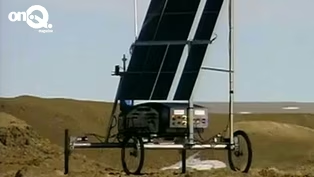 Now Playing
Video has Closed Captions
This clip features Carnegie Mellon University's new robot that is headed for Mars. (6m 44s)
Video has Closed Captions
Director of the Buhl Planetarium, John Radzilowicz, talks about the gathering of the planets. (6m 4s)
The War That Made America OnQ Clip - Braddock History
Video has Closed Captions
OnQ segment exploring Braddock’s revitalization through its War history and Carnegie Library. (15m 33s)
The War That Made America OnQ Clip - Behind the Scenes
Video has Closed Captions
OnQ segment previews a behind-the-scenes look at the PBS documentary The War That Made America. (8m 40s)
The War That Made America OnQ Clip - Robert Griffing
Video has Closed Captions
OnQ segment features Robert Griffing’s French and Indian War paintings and artistic inspirations. (12m 46s)

The War That Made America OnQ Clip - Preview Party
Video has Closed Captions
OnQ segment previews The War That Made America with interviews, behind-the-scenes stories, and art. (26m 22s)
The War That Made America OnQ Clip - Local Street Names
Video has Closed Captions
OnQ segment explores Pittsburgh street names, General Braddock, and Steelers sideline photographers. (19m 45s)
The War That Made America OnQ Clip - Fort Necessity
Video has Closed Captions
OnQ segment explores Fort Necessity, the French and Indian War, and The War That Made America. (8m 32s)
The War That Made America OnQ Clip - Casting and Models
Video has Closed Captions
OnQ segment explores casting George Washington and creating lifelike models for a historic exhibit. (17m 20s)
The War That Made American Launch OnQ
Video has Closed Captions
OnQ explores early test footage, interviews, battle recreations, and insights on TWTMA production. (9m 30s)
Early American History OnQ Clip - Andy Masich
Video has Closed Captions
This OnQ segment explores Pittsburgh history from the French and Indian War to the modern city. (3m 33s)
Joe Negri Performs Sleigh Ride
This clip from OnQ features Joe Negri performing Sleigh Ride from December, 16 2003. (4m 12s)
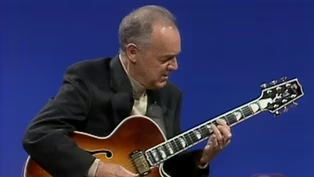
Joe Negri Performs Minha Saudade
This clip from OnQ showcases Joe Negri performing Minha Saudade. (3m 19s)

Video has Closed Captions
This clip of an OnQ episode explores debate in Pittsburgh over same sex unions in the church. (8m 28s)

Video has Closed Captions
This clip of an OnQ episode is about National Coming Out Day and LGBTQ+ lives in Pittsburgh. (18m 32s)

Video has Closed Captions
Hosted by Michael Bartley, this episode explores Rachel Carson’s life, legacy, and impact. (7m 4s)

Video has Closed Captions
12 senior citizens posed for a racy calendar to raise money for their hometown. (10m 43s)
Providing Support for PBS.org
Learn Moreabout PBS online sponsorship New Episode
- News and Public Affairs

Top journalists deliver compelling original analysis of the hour's headlines.

- News and Public Affairs

Today's top journalists discuss Washington's current political events and public affairs.
 New Season


 New Episode

 New Episode



Support for PBS provided by:
OnQ is a local public television program presented by WQED