OnQ
The War That Made America OnQ Clip - Robert Griffing
Clip | 12m 46sVideo has Closed Captions
OnQ segment features Robert Griffing’s French and Indian War paintings and artistic inspirations.
Produced and reported by Stacy Smith, this OnQ segment spotlights artist Robert Griffing and his historical paintings inspired by the French and Indian War. Griffing discusses his commissioned painting of British General Braddock’s defeat for the Westmoreland Museum, along with the creative process, research, and inspiration behind his historically detailed artwork. This is from Season 6, ep 70.
Problems playing video? | Closed Captioning Feedback
Problems playing video? | Closed Captioning Feedback
OnQ is a local public television program presented by WQED
OnQ
The War That Made America OnQ Clip - Robert Griffing
Clip | 12m 46sVideo has Closed Captions
Produced and reported by Stacy Smith, this OnQ segment spotlights artist Robert Griffing and his historical paintings inspired by the French and Indian War. Griffing discusses his commissioned painting of British General Braddock’s defeat for the Westmoreland Museum, along with the creative process, research, and inspiration behind his historically detailed artwork. This is from Season 6, ep 70.
Problems playing video? | Closed Captioning Feedback
Where to Watch OnQ
OnQ is available to stream on pbs.org and the PBS app.
Providing Support for PBS.org
Learn Moreabout PBS online sponsorshipWelcome to OnQ magazine.
I'm Stacy Smith.
Four weeks from tonight, WQED multimedia will proudly present a major national documentary, The War That Made America, tells the story of the French and Indian War, which began right her in this region.
250 years later, the war still has a majo presence in the Pittsburgh area.
And in the weeks leading up to the documentary OnQ, we'll look at the war' impacts and impressions locally, and we begin by profiling a local man, the nation's preeminent artist, whose work reflects the time period of The War That Made America.
Nestled in a wooded area of Pittsburgh's North Hill is the studio of Robert Griffin.
Inside, he combines his love of history with his talent.
This is pretty much the end of the battle.
Braddock has been wounded, and now anything that had any kind of order at all is now disintegrating.
The troops are now.
And these guys are in full.
Yeah.
You see them totally out of order.
Just, fleeing the scene.
Fleeing the scene as.
And of course, the highligh of the picture here is Braddock.
The right.
The highlight of the picture is the wounding of Braddock, with George Washington.
The characters that you see here that I've put into the painting, of course, is Georg Washington and General Braddock.
This fellow's name is, Robert.
This large painting was commissioned by the Laurel Foundation for the Westmoreland Museum to commemorate the 250th anniversary of the defeat and the death of Braddock.
When you look at it, you'r looking at a capsule of history, as it probably was.
This one here is Braddock background.
So Robert Griffin doesn't paint what he imagines might have been.
He researches the subject matter to make it as accurate as possible.
Actually, Braddock's, battle is pretty well documented.
There's quite a few written accounts on it, and, there's even maps that were done, at the time, showing where things were and who was where.
You know, in the column where the battle actually started and how it progressed through the, through the day.
So even the terrain is, is is there, is documented.
We know at the time that Braddock was was wounded is what everything started to deteriorate.
The troops then started, to abandon their, their officers and, start heading for the Monongahela.
And, so I'm showing that in the painting also.
So you're seeing the thing that were happening at the time.
Braddock was wounded as he neared the end of a successful career with Mark Advertising.
Griffin started painting to see if that's what he wanted to do in retirement.
The only retirement has been for Mark Advertising, his love of history launched a new career, and he has been fascinated with the eastern or the Woodland Indians since he was a child, early 1700s.
Most of my life I've been collecting, stone artifacts.
It wasn't till the 80s that when I really started to research it, that I was able to zero in on a particular time period, that I thought was fascinating.
When you did the research, you found out more and more about it.
It's like, this is this is it shows right here in my own backyard.
What's great is we're coming in on a period which a lot of trade was going on.
So it was a very colorful period because of all the trade.
This not only was it was an exchange of cultures that started to take place at that time, but it was also a change in a particular culture itself.
And that would be more so the Indian than the English or the French that came up.
And you try to capture some of that also.
Oh, yeah.
Yeah.
And the contact period.
Is, is was a tough period for the natives, of course, but it was also as far as subject matter goes, it, it provided a lot of great stories.
Which do you prefer to do, a historical scene or a new way to paint the Eastern Indian by himself or interchanging with other Indians?
Well, I actually, I really enjoy doing both.
I actually enjoy what I really enjoy doing is a little scenarios that maybe involve maybe 3 or 4 guys, you know, doing something together.
That way you can get a little story going.
I'm thinking of one right now where some Indians came upon a, an old.
Yes.
Yeah, that's that's a that's a natural, only a matter of time.
What's the title of that painting?
And obviously it had a double meaning, you know, just, finding the clock an and only a matter of time before their whole way of life would be, in disarray.
Battle scenes are not his favorites, but Griffin acknowledges the time period that he likes.
The time of the French and Indian War had its share of conflicts.
And for the Pittsburgh area, the defeat of British General Braddock is paramount.
Original concept of that was to do, four paintings on the Braddock campaign, and I chose, two of the scenes were very dramatic, and the other two were not as dramatic as the two central, the two centerpieces, and they were obviously the biggest pieces of crossing, Braddock crossing in the Monongahela with all the troops and and then the, Indians returning to Fort Duquesne with all the spoils.
The other two paintings were a warning for General Braddock and the reunion, which takes place several years after the battle as British soldiers search for remains of those who were killed.
Griffin says it was a couple of years before he was ready to paint the scene of a mortally wounded Braddock.
I think because of all the characters that are in the painting.
Washington, who was an aide-de-camp for Braddock.
You have, Robert Orme.
It was also an aide-de-camp.
You have George Grogan, who was, head of the Scouts and Guides.
And so it was an opportunity to get some big characters into the painting.
This time period, of course, has so much history with it, but also, this area lends itself to so many different scenes that you can paint, but one that you can, you can constantly use is the point, isn't it?
Oh, yeah.
Pittsburgh is, without a doubt, one of my favorite, subject matters.
I've done quite a few paintings that involve the point, and I probably won't be doing more that involve the portrait because it's just a it's a natural.
The point was also the background for one of Griffin's early works.
Commissioned by the wife of the late Johnny Carson, the Carson's had a place on Mount Washington.
It was quite obvious when I looked out the window of the tri art and looked down at the point I said, here's your painting right here.
And it was in the winter time when we were up there, and there was snow on the ground and everything, and, and, I said, how about if we show the scene from Mount Washington looking down on Fort Pitt Indians coming up the hill, you know, towards you?
I said it would be I think it would be very dramatic scene and she said, well, it sounds good to me.
She says, go ahead and do it.
So that's how that whole scene evolved.
That's dying in there today.
Robert Griffin is quick to point out that it would be difficult t do his paintings without models.
People who dress like either the British and the French or the Native Americans.
He finds many of them at reenactments of historical scenes.
And several years ago there was one Indian re-enactor who caught his eye at Bushy Run.
It just happened to b one of the sons of the late U.S.
Senator John Heinz.
John Heinz, the fourth was just a natural as far as Native Americans, had good features and and did a great job of portraying the woodland Indians.
So I took a lot of shots of him at that time.
Just shot him all day long basically all time he was there.
And then from that painting I did a portrait, of him, which, Theresa bought and, from me and I think that's hanging in the, in the Heinz Foundation building there.
Well, it's a Brain Tanned Leather.
Griffin says that when he paints, he has to immerse himself into the scene.
And the period that he is painting and to help inside his studio are constant reminders of the past.
What's the story behind this?
This canoe was found in upstate Indiana on the Kankakee River.
Griffin was putting the finishing touches on the wounding of Braddock when we talked with him, but he already knew what his next painting was going to be.
A moment ago, you told me that, this particular piece of, clothing, this is instilled in you an idea to paint, you see something like this there, that particular thing I had up until I had acquired that robe.
Obviously, I had no intention of doing painting until I got that particular piece.
So, yeah, certain things that you come across, do inspired paintings and, we're constantly looking for different things, you know, things that will add new light to, to this whole time period.
And when things like this come along.
Is that Painted Robe?
That's, an opportunity to, Hey, let's let's include that in one of the paintings and add a new dimension to it.
Griffin says that he never runs out of ideas for new paintings, and while that means more research and more hours at the easel, it's easy to let his finished work go.
It's like a turnover.
You just as soon as you finish one painting, you've got another painting that you're you have in your min that you're excited about doing, and you're able to work on that.
So it's a it's just constant turnover of paintings.
And you have them here in your studio a lot of time.
And like, the one painting called Moving Among the Giants, which I just sold out West, that was in my studio for almost six months.
So it's not like, painting this and it' going out the door the next day.
I actually have them around for a while.
I get to look at them.
Sometimes I even hang them on the wall for a period of time before they go to the shows.
So it's a constant turnover of paintings.
And so it's it's almost the better part of, of, having original paintings, because I can have a lot of them where I don't have to have one painting sitting on the wall at a time.
I can just keep moving them around.
So it's actually kind of nice to have them for a while, sell them and do another one.
Robert Griffin has created more than 175 paintings on the Eastern Indian and the French and Indian War.
Griffin's paintings also help the creators of his upcoming national documentary, The War That Made America, will air four weeks from tonight, with part on premiering on Wednesday, January the 18th at 9:00 in the evening and then part two airing on Wednesday, January 25th, also at 9:00.
And you can see it right here on WQED TV 13.
Society for Contemporary Crafts Clip
Video has Closed Captions
This clip of OnQ highlights The Society for Contemporary Crafts in the Strip District. (8m 17s)
Video has Closed Captions
This clip highlights Pittsburgh’s City Theatre and their production of Hedwig and the Angry Inch. (7m 52s)
Latino Pittsburgh! - Clip from OnQ6122
Video has Closed Captions
An OnQ segment about the growing Latino population in Pittsburgh. (8m 59s)
OnQ - Reflection of Papal Reconciliation PSO Concert
Video has Closed Captions
A reflection of the Pittsburgh Symphony's concert for Pope John Paul II after his death. (14m 19s)
OnQ - 2003 PSO European Tour Report Part 3
Video has Closed Captions
Part 3 of Jim Cunningham's PSO 2003 European Tour Coverage in Amsterdam and London. (9m 14s)
OnQ - 2003 PSO European Tour Report Part 2
Video has Closed Captions
Part 2 of Jim Cunningham's PSO 2003 European Tour Coverage in Vienna, Austria. (9m 16s)
OnQ - 2003 PSO European Tour Report Part 1
Video has Closed Captions
Part 1 of Jim Cunningham's PSO 2003 European Tour Coverage in Valencia, Spain. (9m 20s)
Video has Closed Captions
Ambridge resident Bob Justiss shares a large piece of space junk that fell in his mother's backyard. (8m 2s)
Video has Closed Captions
This clip features Carnegie Mellon University's new robot that is headed for Mars. (6m 44s)
Video has Closed Captions
Director of the Buhl Planetarium, John Radzilowicz, talks about the gathering of the planets. (6m 4s)
The War That Made America OnQ Clip - Braddock History
Video has Closed Captions
OnQ segment exploring Braddock’s revitalization through its War history and Carnegie Library. (15m 33s)
The War That Made America OnQ Clip - Behind the Scenes
Video has Closed Captions
OnQ segment previews a behind-the-scenes look at the PBS documentary The War That Made America. (8m 40s)
 Now Playing
The War That Made America OnQ Clip - Robert Griffing
Video has Closed Captions
OnQ segment features Robert Griffing’s French and Indian War paintings and artistic inspirations. (12m 46s)
The War That Made America OnQ Clip - Preview Party
Video has Closed Captions
OnQ segment previews The War That Made America with interviews, behind-the-scenes stories, and art. (26m 22s)
The War That Made America OnQ Clip - Local Street Names
Video has Closed Captions
OnQ segment explores Pittsburgh street names, General Braddock, and Steelers sideline photographers. (19m 45s)
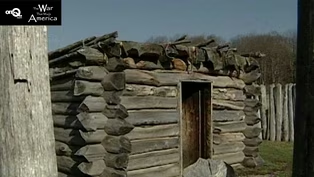
The War That Made America OnQ Clip - Fort Necessity
Video has Closed Captions
OnQ segment explores Fort Necessity, the French and Indian War, and The War That Made America. (8m 32s)
The War That Made America OnQ Clip - Casting and Models
Video has Closed Captions
OnQ segment explores casting George Washington and creating lifelike models for a historic exhibit. (17m 20s)
The War That Made American Launch OnQ
Video has Closed Captions
OnQ explores early test footage, interviews, battle recreations, and insights on TWTMA production. (9m 30s)
Early American History OnQ Clip - Andy Masich
Video has Closed Captions
This OnQ segment explores Pittsburgh history from the French and Indian War to the modern city. (3m 33s)
Joe Negri Performs Sleigh Ride
This clip from OnQ features Joe Negri performing Sleigh Ride from December, 16 2003. (4m 12s)
Joe Negri Performs Minha Saudade
This clip from OnQ showcases Joe Negri performing Minha Saudade. (3m 19s)
Video has Closed Captions
This clip of an OnQ episode explores debate in Pittsburgh over same sex unions in the church. (8m 28s)
Video has Closed Captions
This clip of an OnQ episode is about National Coming Out Day and LGBTQ+ lives in Pittsburgh. (18m 32s)
Video has Closed Captions
Hosted by Michael Bartley, this episode explores Rachel Carson’s life, legacy, and impact. (7m 4s)
Video has Closed Captions
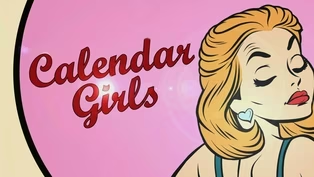
12 senior citizens posed for a racy calendar to raise money for their hometown. (10m 43s)
Providing Support for PBS.org
Learn Moreabout PBS online sponsorship New Episode
- News and Public Affairs

Top journalists deliver compelling original analysis of the hour's headlines.

- News and Public Affairs

Today's top journalists discuss Washington's current political events and public affairs.
 New Season


 New Episode

 New Episode



Support for PBS provided by:
OnQ is a local public television program presented by WQED