OnQ
OnQ: On Coming Out
Clip | 18m 32sVideo has Closed Captions
This clip of an OnQ episode is about National Coming Out Day and LGBTQ+ lives in Pittsburgh.
This clip of OnQ episode 1139 is about National Coming Out Day and explores the experiences of LGBTQ+ people in Pittsburgh through personal stories of coming out, family acceptance, identity, and community. Featuring interviews with gay and lesbian individuals, parents, and advocates, this special examines challenges, progress, and the importance of visibility, support, and living authentically.
Problems playing video? | Closed Captioning Feedback
Problems playing video? | Closed Captioning Feedback
OnQ is a local public television program presented by WQED
OnQ
OnQ: On Coming Out
Clip | 18m 32sVideo has Closed Captions
This clip of OnQ episode 1139 is about National Coming Out Day and explores the experiences of LGBTQ+ people in Pittsburgh through personal stories of coming out, family acceptance, identity, and community. Featuring interviews with gay and lesbian individuals, parents, and advocates, this special examines challenges, progress, and the importance of visibility, support, and living authentically.
Problems playing video? | Closed Captioning Feedback
Where to Watch OnQ
OnQ is available to stream on pbs.org and the PBS app.
Providing Support for PBS.org
Learn Moreabout PBS online sponsorshipToday marks an event that most Americans will not recognize, but to the gay community.
National Coming Out Day marks a milestone.
This day commemorates the first gay march on Washington in 1987.
The Human Rights Campaign then started this National Coming Out Day, hoping that it would encourage people to open up about their homosexuality.
Well, Pittsburgh is often seen as a traditional town, so you may be a little surprised to learn there are more gay people here than in other similar cities.
What is it like to be gay in Pittsburgh?
To come out to family and friends?
Well, you are about to find out.
Came out in 1981.
It was a very easy transition for me.
I know a lot of people go through a lot of pain and suffering when they come out, but, I didn't come out to my family at first.
I went out on my own and, went to some bars and met some people.
And that's how I got into the community and started expressing my own gay feelings.
I came out and I had a girlfriend in high school, and when I was going through puberty, I always wanted to, you know, be with the girls and, so I always sort of knew that I was a lesbian, but I didn't really tell anyone until the end of high school.
The beginning of college.
But I feel like I'm constantly having to tell people because, Rose and I might go on vacation somewhere and someone else said, says, oh, we've been there.
You know, who were you there with?
And it's my partner.
My life partner.
What do you say?
Do you you have to choose the person you're talking to.
Do you say Rose and I, my partner Rose and I. And actually, the more you do it, the easier it gets, because the more people just accept it.
When I came out and I was living in Albany, I happened to be living in a in an apartment, very large apartment with five other males, four of whom had grown up with me from my hometown and and had known me all of my life.
And, the amazing thing about it was that after I came out, I came out, shall we say by, taking somebody home.
And all my roommates realized that I'd taken somebody home.
that had to be the same gender and spend the night with them.
And so the next day, I went around each one of them individually and talked to them about it.
And I had no problems.
When I came out at 18, my family was first and foremost concerned about my personal safety.
Worried that someone would harm me because of who I was and who who I am.
And also, they were also concerned that people would judge me unfairly based on, on my sexual orientation rather than who I was as a complete person.
And, yes.
There, there.
You know, when you do come out, you do take some chances, but the rewards are so much greater than the, the poison of internalized homophobia and not living your life.
I was out of town that weekend, that Mitch had a phone conversation with Julie when I came home that Sunday night, she was dissolved in tears and told me that Julie had said that she was, she was a lesbian.
And, the first thing occurred to me was, you know, I don't really understand this.
I don't know how we're going to deal with that.
But again, we go back to the fact that I think the first thing I said to Mitch was, I don't understand and I don't know what we're going to do about this, but at least she's alive.
Well, she really didn't tell us she might be.
She told me she was coming out and that she's gay.
And I didn't believe her.
I really didn't.
She had dated, she had been dating and was in her teens and going through a lot of different phases.
And I just thought, well, here's another one.
So it took a while to really sink in.
And then when it did.
I became very frightened because it was at the beginning of the Aids crisis in the gay community, and it wasn't yet known how or why that was taking place.
So I was rather frightened.
But the overriding thing was my love for my child.
And I sat back and I thought to myself, I certainly don't love her any less.
We all sat down in the living room and, everyone else knew his sister was there also, and, everyone knew except me.
So, I was informed and I, I was not happy.
He thought that because we loved him so much, and he knew that we loved him, that we would just accept that.
And, he'd just come to the realization himself in his his first year of college, he had just come home and he was very happy that he had finally, you know, discovered, who he was.
And he thought we would be equally happy.
And I was not happy at all.
I reacted very poorly.
And then he got upset because I was acting so poorly.
And in terms of my response to it I think, it's always a question.
Well, is she or isn't she?
And the fact that this process happened when she was probably 14 or 15 years old, I think as a parent, your initial response is, are you sure?
And how can you know?
You're probably just haven't matured to this stage.
And so these were the sorts of thoughts that were going through my mind at that point in time.
We don't ever say to someone, even parents, you know, you must come out because you really can't do it until you're ready to.
You know that you're ready for whatever it is you get from the person that you're telling, whether it's a good reaction or a bad reaction.
You've got to work that out in your own mind and be prepared for it.
But coming out means that the rest of the world sees that there are gay and lesbian people, and they do have parents who care for them and love them very much.
And they have aunts and they have uncles and everybody else.
They don't.
They have a face that they have a face and they have a family.
I don't know whether they'll said it in this part or not, but just the fact that oftentimes people are surprised that gay folks have families, that they have moms and dads.
One of the realizations we had early on was that Julie was not any different after we knew she was a lesbian than all those, 21 years before.
And we have worked for ten year to try to convince other people.
We know that that's true, that just because a person is a homosexual, their life is not any different than mine as a heterosexual person.
And so the work that we do is in an effort to show people, that we're all different in some way, but that our daughter, being a gay person, is a is a is an okay thing.
We've we've worked in the church to try to change some of the feelings in the church.
I believe the church is at the root of all society's difficulties with gay people that, the church has, has perpetuated the myth that there's something wrong with being gay.
It's important for parents to, regardless of whatever issue is raised by your kids to keep, be flexible, keep an open mind on what's happening in society today.
Not as you'v grown up in the past, but what's what's today's society is is developing as.
And, again, it's unconditional lov that you have for your children.
And support.
It's important to be visible just to put a face on it.
A lot of people still are under the impression that it's a subculture within a subculture, and they're not really aware that, which is late, everyday middle class lives in a middle class, middle American city.
Like Pittsburgh, which has, I think, a pretty large gay population.
I've seen, figures that it's the 15th highest percentage nationwide.
So that's a pretty good percentage of people.
But it's important that people are aware just to see that it's not that unusual.
And, a lot of people say it's a choice.
And if we have to hammer home that, it's not by seeing people in everyday circumstances doing everyday things, they'll understand that it's the person next door and it's somebody in their family and it's somebody they work with.
It's easy for us to be out because we've both been on the other side, where we've been in the closet and denied who we were, and we both found that to be extremely painful and toxic.
And now we've built a life together.
And I consider Dena as my family.
And I think a lot of it is because of a lot of people who live here now, grew up here, and so they still have a lot of family.
And I think for most people, and I know for me, it was the way that it was made easier coming out by not having family around, so that I wasn't worried that someone would see me going into a bar or going into the community center or something like that.
And I think for people who have a lot of family living in the same town, it's hard to get over that step where you can't go out and explore as much because you're afraid someone will see you.
And so I think it's very hard for a lot of people.
It's really hopefully to continue the paving of the road for the people who come behind us.
In terms of people's jobs, in terms of the youth, and so, you know, I guess I just urge people to come out wherever you can, whenever you can.
You know, I, I strongly believe the one thing that I believe in is that if somebody has the courage to ask if you're gay, you need to have the courage to say yes.
Well, National Coming Out Day is also meant to show that to let gays and lesbians come from all walks of life.
Patrice Walters is a computer support specialist and doctor.
Shawn Fultz is an internal medicine resident at UPMC.
Doctor Fultz will start with you.
Thank you for being with us.
You came out when you were in the Air Force?
Correct.
Tell us a little bit about that.
I was attending medical school on an Air Force scholarship.
And I came out to myself during my senior year in medical school, and about three months later, came out to the Air Force.
And then after about 18 months of wrangling with the Air Force, I was honorably discharged.
But I have to pay back my scholarship as part of the settlement.
All right.
Now, Where did.
I mean, I'm sorry I kind of lost you here.
You're.
You were in the Air Force, and I was attending medical school, but I was still in the Air Force.
Right.
As part of.
They were paying for medical school at the time.
So how did this happen to do with you coming out, though?
I knew under don't ask, don't Tell that I couldn't be open in the Air Force, and I was dating someone at the time and decided that I couldn't hide it.
So I sent a letter to the Air Force outing mysel and subsequently was discharged.
Okay.
Now, has it, been better at you feel since?
Because you did that?
Yes, I've been.
I'm 100 times happier not having to hide things than I would have been had I continued and had to hide who I was and who I was dating, and who were important people in my life for the next four years.
All right.
Now, Patrice, you have a ten year old, almost ten, almost ten year old right now toward the end of the segment that we just had on.
People say that you have to have the courage to say something.
If people ask if you are gay, how do you react to this?
I think it' hard, but I think it's necessary for those people who can.
I think what's real is people at different phases in their lives, and what's wonderful about coming out days, people can come out in many, many ways.
I'm out in most aspects of my life.
My family knows, my coworkers know, and that's wonderful for me, for the person today who can just admit it to themselves and come out to themselves and say, wow, I've got a homosexual identity.
That's my affection orientation.
That's as great as, you know, the people who are here or in film talking about being out in Pittsburgh.
I'm going to ask you, Shawn said in the piece that we just aired, that he thinks it might be easier if you are from out of town when you come out with as opposed to having your family here.
Do you think that's true?
I think family's always tough.
When I came out, I was 19, and I told my mother she was the first person I told.
And that was hard.
But I think it's it's hard every time.
I've been out for 12 years, and every time I say it, there's still, you know, a ball in my stomach that says, well, I don't know what's going to happen here.
The reaction from other people more than anything else.
Yeah.
Okay.
But their family is okay.
My family's pretty okay.
They're coming.
It's a process for them like it is for me.
All right.
We only have about 10s.
Shawn how did it react with your family.
Not quite as well.
I mean, it's still a process, and things are getting better.
All right, well, Shawn, Patrice, thank you so much for being with us on OnQ.
living as a single gay or lesbian is one issue, but what about gay marriages?
Well, let's go over to OnQ host Carol Lee Espy now with that part of the story.
Thank you Stacey.
Now I'm joined this evening by Scott Safier and Champ Knecht.
Now they've recently joined in a civil union in Vermont.
Now Vermont is the only state that will legally sanction such a union.
Welcome to both of you.
Thank you.
Thank you for having us.
Now, why was this so important for you to go all the way up to Vermont to have this union sanctioned?
Well, as you said, Vermont is the only state that will sanction the union.
And I love Champ.
And because I love Champ, I have the same worries that heterosexual people that want to get married have.
I worry about growing old together.
And when the bad times come.
Because bad times always come, what's going to happen?
And having somebody is a next of kin is important.
Somebody that you're going to spend your life with, but also that has the medical and legal things that they can take care of you and you can take care of them.
Now, will they if something were to happen to you in Pennsylvania, will they recognize that this is a union?
Well, not necessarily, but what we did as a preparation for having this civil union was see a lawyer and have all of the legal documents that we need in place.
So we have medical power of attorney and financial powers of attorney and wills and the, excuse me, those sorts of things.
So you have to have all your ducks in a row and be, you know, get it straight in line.
How did your family react to this?
Did any did any of them join you for this to come up for this or?
We really wanted to elope and our families won't let us.
We have to go.
Well, next weekend we're going back to New York, where Champ is from, and his family's throwing a party for us there.
And then in November, we're having a party for ourselves here, where we're inviting our families from this area.
And, our friends and coworkers.
So speaking of friends and coworkers, let's say people who are not in your family.
How did they respond to this?
I mean, do you call each other?
This is my partner.
And you say that you're married.
How do people respond to that?
The people in my workplace have, Xerox, the civil union announcemen that was in the Post-Gazette and hung it on the bulletin board.
So I think there were more now.
Yeah.
And the first wedding present we got was from my boss and his wife.
They gave us a mantel clock that we have in our living room right now.
So this has been entirely favorable for you?
Yeah.
Yeah.
I haven't seen any kind of resistance or anything.
Now, are you hoping that Pennsylvania, at some point in time will turn it around?
So it makes it easier for you?
I think when you're kind of a stranger to the benefits that your government gives to all the other citizens, it's difficult.
And so, sure, we hope that Pennsylvania will become more enlightened.
But, you know, we're prepared just in case they aren't.
Are you at a place that has same sex benefits?
Do you have work or you going to workplace that offers that?
My workplace just recently offered it.
And so.
Mine is promising next year, we'll see.
But you do you have the license on the wall now.
So.
Well we haven't got it yet.
It's coming in the mail.
It's coming in the mail.
Well thank you so much for being here.
Thank you for having us, Scott and Champ.
Society for Contemporary Crafts Clip
Video has Closed Captions
This clip of OnQ highlights The Society for Contemporary Crafts in the Strip District. (8m 17s)
Video has Closed Captions
This clip highlights Pittsburgh’s City Theatre and their production of Hedwig and the Angry Inch. (7m 52s)
Latino Pittsburgh! - Clip from OnQ6122
Video has Closed Captions
An OnQ segment about the growing Latino population in Pittsburgh. (8m 59s)
OnQ - Reflection of Papal Reconciliation PSO Concert
Video has Closed Captions
A reflection of the Pittsburgh Symphony's concert for Pope John Paul II after his death. (14m 19s)
OnQ - 2003 PSO European Tour Report Part 3
Video has Closed Captions
Part 3 of Jim Cunningham's PSO 2003 European Tour Coverage in Amsterdam and London. (9m 14s)
OnQ - 2003 PSO European Tour Report Part 2
Video has Closed Captions
Part 2 of Jim Cunningham's PSO 2003 European Tour Coverage in Vienna, Austria. (9m 16s)
OnQ - 2003 PSO European Tour Report Part 1
Video has Closed Captions
Part 1 of Jim Cunningham's PSO 2003 European Tour Coverage in Valencia, Spain. (9m 20s)
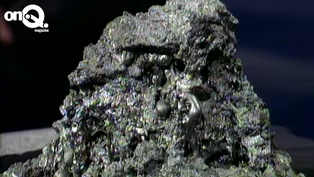
Video has Closed Captions
Ambridge resident Bob Justiss shares a large piece of space junk that fell in his mother's backyard. (8m 2s)
Video has Closed Captions
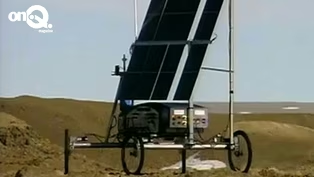
This clip features Carnegie Mellon University's new robot that is headed for Mars. (6m 44s)

Video has Closed Captions
Director of the Buhl Planetarium, John Radzilowicz, talks about the gathering of the planets. (6m 4s)
The War That Made America OnQ Clip - Braddock History
Video has Closed Captions
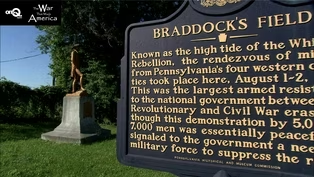
OnQ segment exploring Braddock’s revitalization through its War history and Carnegie Library. (15m 33s)
The War That Made America OnQ Clip - Behind the Scenes
Video has Closed Captions
OnQ segment previews a behind-the-scenes look at the PBS documentary The War That Made America. (8m 40s)
The War That Made America OnQ Clip - Robert Griffing
Video has Closed Captions
OnQ segment features Robert Griffing’s French and Indian War paintings and artistic inspirations. (12m 46s)
The War That Made America OnQ Clip - Preview Party
Video has Closed Captions
OnQ segment previews The War That Made America with interviews, behind-the-scenes stories, and art. (26m 22s)
The War That Made America OnQ Clip - Local Street Names
Video has Closed Captions
OnQ segment explores Pittsburgh street names, General Braddock, and Steelers sideline photographers. (19m 45s)
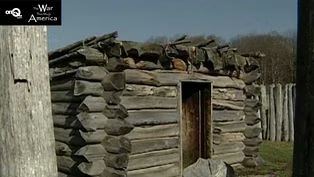
The War That Made America OnQ Clip - Fort Necessity
Video has Closed Captions
OnQ segment explores Fort Necessity, the French and Indian War, and The War That Made America. (8m 32s)
The War That Made America OnQ Clip - Casting and Models
Video has Closed Captions
OnQ segment explores casting George Washington and creating lifelike models for a historic exhibit. (17m 20s)
The War That Made American Launch OnQ
Video has Closed Captions
OnQ explores early test footage, interviews, battle recreations, and insights on TWTMA production. (9m 30s)
Early American History OnQ Clip - Andy Masich
Video has Closed Captions
This OnQ segment explores Pittsburgh history from the French and Indian War to the modern city. (3m 33s)
Joe Negri Performs Sleigh Ride
This clip from OnQ features Joe Negri performing Sleigh Ride from December, 16 2003. (4m 12s)
Joe Negri Performs Minha Saudade
This clip from OnQ showcases Joe Negri performing Minha Saudade. (3m 19s)
Video has Closed Captions
This clip of an OnQ episode explores debate in Pittsburgh over same sex unions in the church. (8m 28s)
 Now Playing
Video has Closed Captions
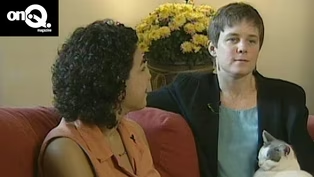
This clip of an OnQ episode is about National Coming Out Day and LGBTQ+ lives in Pittsburgh. (18m 32s)
Video has Closed Captions
Hosted by Michael Bartley, this episode explores Rachel Carson’s life, legacy, and impact. (7m 4s)

Video has Closed Captions
12 senior citizens posed for a racy calendar to raise money for their hometown. (10m 43s)
Providing Support for PBS.org
Learn Moreabout PBS online sponsorship New Episode
- News and Public Affairs

Top journalists deliver compelling original analysis of the hour's headlines.

- News and Public Affairs

Today's top journalists discuss Washington's current political events and public affairs.
 New Season


 New Episode

 New Episode



Support for PBS provided by:
OnQ is a local public television program presented by WQED