OnQ
OnQ - Reflection of Papal Reconciliation PSO Concert
Clip | 14m 19sVideo has Closed Captions
A reflection of the Pittsburgh Symphony's concert for Pope John Paul II after his death.
OnQ host Chris Moore interviews Pittsburgh Symphony Orchestra member Cynthia DeAlmedia, Mendelssohn Choir of Pittsburgh member, Hank Mader, and concert-goer Betty Robinson, about their thoughts about the January 2004 PSO concert for Pope John Paul II. This reflection was due to the death of the Pope prior to the airing of this episode.
Problems playing video? | Closed Captioning Feedback
Problems playing video? | Closed Captioning Feedback
OnQ is a local public television program presented by WQED
OnQ
OnQ - Reflection of Papal Reconciliation PSO Concert
Clip | 14m 19sVideo has Closed Captions
OnQ host Chris Moore interviews Pittsburgh Symphony Orchestra member Cynthia DeAlmedia, Mendelssohn Choir of Pittsburgh member, Hank Mader, and concert-goer Betty Robinson, about their thoughts about the January 2004 PSO concert for Pope John Paul II. This reflection was due to the death of the Pope prior to the airing of this episode.
Problems playing video? | Closed Captioning Feedback
Where to Watch OnQ
OnQ is available to stream on pbs.org and the PBS app.
Providing Support for PBS.org
Learn Moreabout PBS online sponsorshipWelcome back.
As mourners all over the world prepare to say a final goodbye to Pope John Paul II.
We invited three Pittsburghers to join us tonight so they could share their stories about the historic papal concert of Reconciliation that took place January 2004.
Cynthia DeAlmeida is principal oboist for the Pittsburgh Symphony.
Hank Mader is a member of the Mendelssohn Choir.
Betty Robinson is from Canonsburg and made the trip to Rome to attend the concert at the Vatican.
Cynthia, let me start with you.
What was it like to play there for the Pope?
The first American symphony to be there too.
- Thats right, the first and now only American orchestra ever to play for the Pope.
Chris.
The Pittsburgh Symphony being a world class orchestra, I'm proudly can say that we've played in great concert halls all over the world.
But never have we experienced something quite like this.
The hall itself, I think, holds 10 to 12,000.
It's a giant auditorium, so musically it is not the acoustic of a concert hall.
There were 7500 people there.
Many of our family members were there.
I brought my children, Veronica and Danny, my mother, my husband.
Many of us did.
And they were sitting out there.
Then you see Bishop World, he's sitting so close I could wave to him.
My bishop.
Did you?
Well, I talked with him and with.
Sure.
And then, you know, not to mention what's going to happen in a few minutes.
Now everyone waits.
We all go through the security.
The tension is building, building, building.
The orchestra's way ready.
We know this piece very, very well.
The choir is there, the soloists.
And everyone's just waiting.
Well, the first piece actually did not use any of the string players or any of the woodwinds, just the brass.
So we all had to be moved.
Guess where they moved they woodwinds?
Into chairs like this over to the right, very close to where the Pope would be sitting.
We didn't know this bonus was going to happen, so we were all moved over there.
Some of my colleagues had cameras in their laps like this.
Now, of course I didn't because we were told not to bring a camera, but I wanted the copies of those pictures.
You went with the rules, right?
I went with.
Well, here he comes.
The doors open, Chris.
And then I'm shaking talking about it.
Remembering it And you have to play.
Well, I didn't have to play the first piece.
About ten minut I didn't have to play.
And he comes out.
He's wheeled out as you as you see on the coverage, the footage.
And I was overwhelmed with emotion and I just lost it.
I became crying and I thought, how am I going to play?
Well, then the professional part of you takes over.
And when the Mahler Symphony started and we were moved a little further away from the Pope, just a little bit into our normal seats, and then you see your colleagues, you realize you're in with the team and you can do this.
And I tuned the orchestra.
So the first note is the A. And then we played this incredible piece and we wanted we all wanted him and our audience to enjoy it.
So you become a professional.
And they did.
So let's take a look at some of the setup for it.
As the symphony is getting ready and that huge crowd of more than 7000.
Let's take a look at this clip.
Inside this Vatican concert hall, world renowned maestro Gilbert Levine takes the stage.
For the first time in history, the Vatican has invited an American orchestra to perform for the Pope.
As the crowd of 7000 awaits the entrance of Pope John Paul II, you can't help but notice the dynamics of the audience.
Christians, Jews, Muslims.
This unprecedented interfaith gathering is what the Vatican calls a concert for reconciliation.
Among faiths existing in a world filled with religious misunderstandings and violence.
The performance is being broadcast live across Europe.
The international media is here to cover.
Several hundred people from Pittsburgh are here to see it.
That's because the first ever American orchestra chosen to play for the Pope is the Pittsburgh Symphony.
Pope John Paul II was wheeled into the concert hall and seated on a special platform to the left of the orchestra.
The audience was struck by his appearance.
The Pope seemed healthier and much more alert than many expected, as he prepared for an evening with the Pittsburgh Symphony.
Hank Mader talk to me as a member of the Mendelssohn choir about this spirit of reconciliation that the Pope wanted, and how many people from various countries speaking different languages from different faiths had to come together and sing together, all in the German language, but understanding different languages, what was that reconciliation like?
Well, it was the more I got into it and involved with the the whole process, I mean, the more impressed I was with the concept of reconciliation, which was the purpose for the whole concert.
And, you know, if I can give you a quick example, we had two rehearsals before the performance on Saturday night.
And during those rehearsals, of course, there were some subtleties within the music that Gilbert Levine wanted to make with the whole chorus.
And you have a chorus with 80 people from England, five of us from the US, representing the Mendelssohn Choir of Pittsburgh.
We had 40 from Krakow, Poland, which was the Pope's native native town.
And they were trying to get, I understand a chorus from Egypt politically that didn't work.
So they ended up with a chorus from from Ankara, Turkey, who spoke, of course, Turkish.
So you've got Polish, Turkish and English singing a work in German.
And so when Levine would give his directions to the chorus, of course we understood what he was saying.
But then the artistic director for the chorus from Krakow would translate everything in Polish.
Then the artistic director from the chorus in Ankara, Turkey would translate everything in Turkish.
And if you were trying to get a concept of people working together from different faiths and different parts of the world, singing one piece of work in German, which is the Mahler's Second Symphony, you know, the fact that the end product come out is beautiful as it was, was is the whole concept.
In matter of fact, Bob Page, when he's over in Europe, you know, with us and, you know, at times the Robert Page Singers go over to Europe and he is saying, you know, music is a universal language, you know.
And so he had an American chorus going over to sing with a European Orchestra.
And here and now we have the Pittsburgh Symphony Orchestra, a world class orchestra with membership from all over the world.
Well, music must have been a universal language.
The Pope loved it so much that he, in fact, requested an encore.
And I understand that that's another first.
Let's take another look at a report that OnQs Robert, I'm sorry Michael Bartlett did on that report and the Pope requesting that encore.
Something that hasn't happened for 15 years at a papal concert, the Pope asked for an encore.
- And I went back to the podium and looked back toward him, and he gave a gesture and said, yes, yes.
Then I started up again at the end of the Mahler.
Just having his presence there and requesting an encore.
That's always a special moment, especially from the Pope.
I think we're on top of the charts with this event, and we're certainly happy that we were able to be ambassadors for all Pittsburghers.
Here's a pope for 25 years thats been trying to promote unity of spirit between factions that haven't been able to achieve that throughout history, and that here we are with through this music and trying to do this.
I was absolutely thrilled.
The point of tonight's concert was reconciliation.
It was fantastic, and it brought tears to my eyes when I realized that the world loves Pittsburgh Symphony.
So we're really talking about a recognition globally and the Pittsburgh Symphony, of course, is at the heart of it all.
I thought they were the world class orchestra.
They were meant to be, that they needed to be for this occasion.
And they absolutely were.
Pittsburgh has every right to be extraordinarily proud of this orchestra tonight.
Cynthia and Hank, were you surprised at the encore?
Did you know where you were going to pick up what you were going to do as musicians?
No.
We saw the conductor leave and speak to the Pope and come back, and people in the front could hear what he said, but it filtered back very quickly.
We figured it was somewhere in the last movement, but the rehearsal number just filtered back through the team, and Hank just told me the choir didn't know either where they were.
But, you know, Chris, that was most of our whole wish was that the Pope himself would enjoy the music.
He chose that symphony.
He chose the the message that music can bring people together.
And obviously he did.
Now, Mrs.
Robinson, I have to get to you.
As a Pittsburgher, as a concert goer, what was it like for you being there?
It was an awesome experience, a chance of a lifetime.
And the anticipation for the Pope's arrival kept building and building and building.
And then when he came, I was like, Cynthia.
The tears rolled, you know, and it was almost like an out-of-body experience.
There was a feeling that I never had before and probably would never have since, because you just knew you were in the presence of a very special, very spiritual person.
And that was an opportunity that many people should have had.
But unfortunately, it was a limited group of people.
What do you think, Mrs.
Robinson, the Pope has done in terms of his theme of reconciliation?
When the choir went there, when the symphony went there, when all these people from disparate nations and face were there.
Do you think that that was accomplished at all?
I think so, I think he that was his purpose.
And that's why he was on, you know, the Pope as long as he was.
I think his mission from the very beginning was to bring all the world together in a very peaceful kind of way.
And you know, music is a universal language.
But we seem to all be in agreement on that.
Let's take one more look at Michael Bartlett's report from the Vatican, where Pittsburghers, members of the choir and others were talking about what they felt doing that concert.
Imagine we arrive in La Paolo Sesto in Vaticano.
Harbison music made the Vatican's multinational choir happy with singers from London, Krakow, Poland.
Ankara, Turkey, and five members of the Mendelssohn Choir of Pittsburgh.
I think that the experience of singing with these other choirs and mixing with the other countries, and the whole feeling of the cultural getting together here, is just, I mean, the whole experience is just dazzling.
It's all I can say.
It's really been a fantastic experience.
To my right, I have a member of the Krakow choir, and to my left is a member of the London chorus.
A couple members of the Ankara choir sitting right in front of me, and it's just a giant melting pot of religions and language, and it's a great, great experience.
Well, I feel like a musical ambassador representing in Pittsburgh to whole world.
I'm proud of it.
I'm thrilled it.
I'm just excited and just.
This is just great.
Hank, do you share that musical ambassadorship?
Without question, you know.
And when we went over there, Gilbert Levine called us into his chambers before we went over.
He says, you're not going over there just to sing a concert.
You're going over there to experience a world class experience in history in the making.
Now you ask about whether this ecumenical or the reconciliation, you know, rubbed off on everyone.
I think it's probably going to rub off on people a lot more after he has passed, unfortunately, because, I mean, we're all excited about the music and the Pittsburgh Symphony going there, but, you know, the reconciliation.
And can people work together in peace in a long term affair?
I think that will start to sink in.
It's sinking in for me.
Mrs.
Robinson, again, as a Pittsburgher, this was a world class experience, and we should all be proud of the great people that we have here that make up the choir, the symphony, and everyone else who participated in this.
Indeed so and this is what I've said.
That the world can appreciate and does appreciate the Pittsburgh Symphony.
Pittsburghers don't always do it, and I hope this is part of the reconciliation thing.
You know that people will appreciate the the gems because the symphony is a gem and the Mendelssohn Choir is just a fantastic group of folks.
All right.
And you all did a great job.
Last word from you, Cynthia, about this.
I wanted to thank the diocese too and the Knights of Columbus.
Chris.
They paid for the whole thing to bring an orchestra of that size to one concert in Rome.
And I want to thank those who came with us and thank the city.
All right.
Well, thank you all for being here.
We appreciate you being here and sharing your experiences with us.
Thank you again.
Society for Contemporary Crafts Clip
Video has Closed Captions
This clip of OnQ highlights The Society for Contemporary Crafts in the Strip District. (8m 17s)
Video has Closed Captions
This clip highlights Pittsburgh’s City Theatre and their production of Hedwig and the Angry Inch. (7m 52s)
Latino Pittsburgh! - Clip from OnQ6122
Video has Closed Captions
An OnQ segment about the growing Latino population in Pittsburgh. (8m 59s)
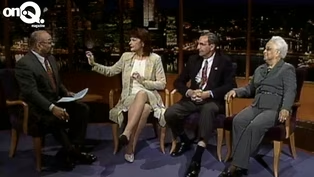 Now Playing
OnQ - Reflection of Papal Reconciliation PSO Concert
Video has Closed Captions
A reflection of the Pittsburgh Symphony's concert for Pope John Paul II after his death. (14m 19s)
OnQ - 2003 PSO European Tour Report Part 3
Video has Closed Captions
Part 3 of Jim Cunningham's PSO 2003 European Tour Coverage in Amsterdam and London. (9m 14s)
OnQ - 2003 PSO European Tour Report Part 2
Video has Closed Captions
Part 2 of Jim Cunningham's PSO 2003 European Tour Coverage in Vienna, Austria. (9m 16s)
OnQ - 2003 PSO European Tour Report Part 1
Video has Closed Captions
Part 1 of Jim Cunningham's PSO 2003 European Tour Coverage in Valencia, Spain. (9m 20s)
Video has Closed Captions
Ambridge resident Bob Justiss shares a large piece of space junk that fell in his mother's backyard. (8m 2s)
Video has Closed Captions
This clip features Carnegie Mellon University's new robot that is headed for Mars. (6m 44s)
Video has Closed Captions
Director of the Buhl Planetarium, John Radzilowicz, talks about the gathering of the planets. (6m 4s)
The War That Made America OnQ Clip - Braddock History
Video has Closed Captions
OnQ segment exploring Braddock’s revitalization through its War history and Carnegie Library. (15m 33s)
The War That Made America OnQ Clip - Behind the Scenes
Video has Closed Captions
OnQ segment previews a behind-the-scenes look at the PBS documentary The War That Made America. (8m 40s)
The War That Made America OnQ Clip - Robert Griffing
Video has Closed Captions
OnQ segment features Robert Griffing’s French and Indian War paintings and artistic inspirations. (12m 46s)
The War That Made America OnQ Clip - Preview Party
Video has Closed Captions
OnQ segment previews The War That Made America with interviews, behind-the-scenes stories, and art. (26m 22s)
The War That Made America OnQ Clip - Local Street Names
Video has Closed Captions
OnQ segment explores Pittsburgh street names, General Braddock, and Steelers sideline photographers. (19m 45s)
The War That Made America OnQ Clip - Fort Necessity
Video has Closed Captions
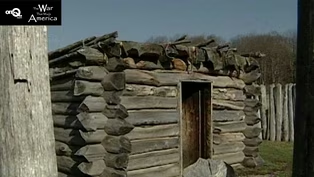
OnQ segment explores Fort Necessity, the French and Indian War, and The War That Made America. (8m 32s)
The War That Made America OnQ Clip - Casting and Models
Video has Closed Captions
OnQ segment explores casting George Washington and creating lifelike models for a historic exhibit. (17m 20s)
The War That Made American Launch OnQ
Video has Closed Captions
OnQ explores early test footage, interviews, battle recreations, and insights on TWTMA production. (9m 30s)
Early American History OnQ Clip - Andy Masich
Video has Closed Captions
This OnQ segment explores Pittsburgh history from the French and Indian War to the modern city. (3m 33s)
Joe Negri Performs Sleigh Ride
This clip from OnQ features Joe Negri performing Sleigh Ride from December, 16 2003. (4m 12s)
Joe Negri Performs Minha Saudade
This clip from OnQ showcases Joe Negri performing Minha Saudade. (3m 19s)
Video has Closed Captions
This clip of an OnQ episode explores debate in Pittsburgh over same sex unions in the church. (8m 28s)
Video has Closed Captions
This clip of an OnQ episode is about National Coming Out Day and LGBTQ+ lives in Pittsburgh. (18m 32s)
Video has Closed Captions
Hosted by Michael Bartley, this episode explores Rachel Carson’s life, legacy, and impact. (7m 4s)

Video has Closed Captions
12 senior citizens posed for a racy calendar to raise money for their hometown. (10m 43s)
Providing Support for PBS.org
Learn Moreabout PBS online sponsorship New Episode
- News and Public Affairs

Top journalists deliver compelling original analysis of the hour's headlines.

- News and Public Affairs

Today's top journalists discuss Washington's current political events and public affairs.
 New Season


 New Episode

 New Episode



Support for PBS provided by:
OnQ is a local public television program presented by WQED