OnQ
The War That Made America OnQ Clip - Braddock History
Clip | 15m 33sVideo has Closed Captions
OnQ segment exploring Braddock’s revitalization through its War history and Carnegie Library.
OnQ segment on Braddock, PA, where community groups and civic leaders use the town’s deep history to support revitalization. It revisits the French and Indian War battle of General Edward Braddock, George Washington, and Fort Duquesne, showing how colonial history shapes the region. It follows the Carnegie Library restoration and plans for museum and immersive experiences to bring visitors back.
Problems playing video? | Closed Captioning Feedback
Problems playing video? | Closed Captioning Feedback
OnQ is a local public television program presented by WQED
OnQ
The War That Made America OnQ Clip - Braddock History
Clip | 15m 33sVideo has Closed Captions
OnQ segment on Braddock, PA, where community groups and civic leaders use the town’s deep history to support revitalization. It revisits the French and Indian War battle of General Edward Braddock, George Washington, and Fort Duquesne, showing how colonial history shapes the region. It follows the Carnegie Library restoration and plans for museum and immersive experiences to bring visitors back.
Problems playing video? | Closed Captioning Feedback
Where to Watch OnQ
OnQ is available to stream on pbs.org and the PBS app.
Providing Support for PBS.org
Learn Moreabout PBS online sponsorshipThe mayor is not alone in his plans to revitalize Braddock.
Several local groups are also working hard, and one group believes the key may be educating everyone about Braddock's history.
Long before Andrew Carnegie in the steel industry, Braddock was important for another reason, and you may be surprised to find out how lessons about Braddock's past could have a big impact on its future.
20 years before the American Revolution, the French and Indian War began to transform the world, as shown in the WQED film The War That Made America.
The British, the French and the Native Americans were fighting for control of the Ohio Valley.
Braddock is named for British General Edward Braddock, who was wounded here and later died in a disastrous defeat.
This battle is a fascinating story of the French and Indian War, and one of the most intriguing stories in American colonial history.
Intriguing because General Braddock and his men were caught by surprise on their way to capture Fort Duquesne.
The French and the Native Americans killed nearly a thousand of Braddock's men.
One officer who survived, a young George Washington.
We know the Indian move.
Where did this come from?
These artifacts were all found within hundreds of yards of where we are right now.
On the battlefield itself, by a man with a metal detector in the late 40s.
Robert Messner is the director of the Braddock's Field Historical Society for the past ten years.
He's also been a one man curator of sorts, collecting items from and about the battle.
Quite frankly, the motivation was, when I came here that first day, I asked the people, does anybody ever call and ask about the battlefield?
And the person said, oh yeah, people call lots.
They call from all over the country saying, if we come there is there anything for us to see?
And of course, we have to tell them there isn't.
And I thought, what a colossal waste that is.
So Messner and the Historical Society set up a small museum inside the Carnegie Library in Braddock.
But Messner couldn't help but think it still wasn't enough.
It was pretty clear that if this thing had happened in Massachusetts or Virginia or New York, that for the past 100 years, busses would be pulling up here and discharging large numbers of people who would leave their money for souvenirs in the community.
The historical society is now working to build a freestanding museum and visitor center to commemorate the war.
The museum is expected to cost $3 million.
With the help of foundations the society has already acquired three acres of the battlefield at Sixth and Baldridge streets.
We acquired, two buildings, on of which was an old supermarket, a Kroger supermarket, and that's the one we'r currently preparing to demolish.
The other one was the Pontiac agency here, and we're going to keep that up for a while.
Fundraising for construction is still underway, but as the society continues to raise money, it also continues to think of ways to set the museum apart.
It might be possible to recreate the actual experience of one of the members of the Braddock expedition, as he's walking along carrying his musket.
And suddenly all hell breaks loose around him.
And with virtual reality type things or experiences that can be done totally indoors.
I think the History Center is going to be important.
And the community seems to feel the same way.
It's a little bit like the old saying, when you've got lemons, make lemonade.
When you take a look at what Braddock and North Braddock have.
One of the assets that they have is this incredible history.
I think that's one aspect of of what can help Braddock come back.
It could be a major one.
Major Robert Messner says because Braddock's great history extends well beyond the war 40 years later.
This was such a famous place in colonial America that when the Whiskey Rebellion occurred in 1794, there was a meeting of about 4000 to 5000 people that occurred right here on the battlefield.
This also became the place where, Andrew Carnegie buil his first integrated steel mill, the first Carnegie library.
The Charles Schwab Mansion is located up the street.
He was the only person to ever be the president of both U.S.
Steel and Bethlehem Steel, which makes him totally unique.
And he was generally regarde as America's greatest dealmaker.
Braddock was also the setting for Thomas Bells novel Out of This Furnace, which depicted the lives of immigrant steelworkers in the 1900s.
The work is used in various universities around the world.
And then there's the Carey Furnace.
This old mill site straddle Swissotel, Rankin, and Braddock.
It's being restored as a tourist attraction by the Rivers of Steel group.
New development is also expected in that area.
Most of these items are metal.
A lot of them are parts from muskets.
Like these items in here?
Back inside the Carnegie Library.
Robert Messner continues to collect items from the past.
All the while thinking of what it could mean to Braddock's future.
And it's why we have, at least now, an interim facility.
So that if somebody says, is there something for us to see?
Yes, there is.
And there's going to be something better.
And the historical society hopes construction on the museum will be underway by the year 2007.
And much of the renewed interest in Braddock and other historical sites in western Pennsylvania was sparked by the recent PBS film on the French and Indian War, The War That Made America.
It was made right here in Pittsburgh by WQED.
Now, we've mentioned it several times.
The Carnegie Library here in Braddock, it's the very first Carnegie library in the entire country.
And no trip to Braddock would be complete without seeing it inside.
And knowing what this place means to the community.
This building has stood the test of time.
It is a gem and we want more people to know about it.
My father used to play basketball in the main gym.
here.
More than a century after its dedication, the very first Carnegie library in the United States.
The Carnegie Library in Braddock is still standing, and it's still a bold and attractive educational, recreational and entertainment center in the borough of Braddock.
The Music Hall is my very, very favorite.
The acoustics are so great.
You don't need microphones.
Made of brick, granite and steel.
This three story structure was built to last.
Andrew Carnegie designed it that way.
Carnegie built the library not only for his employees at the Edgar Thomson steelworks, but for future generations of people in Braddock, North Braddock, Rankin, and East Pittsburgh.
The back doors are finished.
They need to be hung.
Vicki Vargo is the library's executive director.
The building was dedicated on March 30th, 1889.
So if it took a year to build, I think that's pretty much of a feat right there.
But when it was built, it was just the library.
It wasn't until three years later that they added on the music hall, the gymnasium, the bowling alley, and the swimming pool.
And in an era when few homes had indoor plumbing, the library was also a place where workers could get showers, shaves and haircuts.
The addition was put on, and I can't speak for Carnegie himself, but from things that I've read about him, pretty much so that people in his mill towns would have a place to go not only to read books and educate themselves, but to pretty much have a well-rounded education physically, mentally.
There was a bathhouse in the basement, and at that time, a lot of people didn't have running water, so it was a place to come and get clean for three quarters of a century.
The library stood as a valuable community meeting place and hub of learning.
But then things began to change.
The Braddock School District took over the library in the 1960s, but it cost a lot to operate, and membership began to decline as more and more people began moving out of Braddock.
Some wouldn't come, fearing crime in the community.
Still others perceived the once segregated building as a symbol of racism and elitism.
There are certain generations who will not set foot in here because, they have bad feelings, or they remember bad stories about Andrew Carnegie and how their grandparents or great grandparents were treated in the mill.
The library slowly slipped into disrepair.
It was actually on the demolition list, if you can believe that.
It had deteriorated to the point not only from the elements, but from vandalism.
And, you know, it's hard to believe that this building was once ready to be torn down.
The building sat abandoned for five years until former librarian David Solomon stepped in to rescue it from the wrecking ball.
He did so by first forming the Braddock's Field Historical Society.
He then purchased the building from the school district for just $1.
Evelyn Benzo and Lida Stell are longtime volunteers here.
They even people from the neighborhood, got together.
And so we got involved in.
Do remember the book sale?
We had things with all the books.
Dave was kind of the person that kind of invigorated me because he said what he meant, and he meant what he said, and he didn't really care whether you liked it or not.
But he was just dedicated and devoted.
And this building here, I think it was about 1982 when I came back, and I couldn't believe it was in such bad shape.
The roof was bad and everything.
And this Mr.
Solomon, he was the last librarian here from the school.
And it was his dream that it would never be closed.
Today the building is once again a full functioning library, although for financial reasons it's only open part time.
Many repairs and renovations have been made, but there is still a lot of work to be done.
Despite that, the beauty and wonder of this library continues to amaze and astound visitors.
Oh wow, this is beautiful.
This is the music hall.
Originally this space was used for concerts for lectures, public meetings.
In later years, Braddock High School had their graduations here, and they had their plays here.
How much work have you done to restore this?
A lot.
The roof was damaged, so there was a lot of ceiling damage There was a lot of paint damage.
This mural was all redone here.
These are original.
Are they safe to sit in?
Can I sit in one?
Sure.
Okay.
Here.
There are a lot to see.
They're a little stiff.
They're not like your regular movie theater seats.
They make you sit up straight.
So another surprise.
This is the swimming pool.
There was a swimming pool.
Holy cow!
Now, how long has this been empty?
It closed in 74.
So many people who come here for tours sa this is where I learned to swim.
And.
Yeah, that's a good feeling.
You gave something to somebody, and right now, the pool is being used for storage, and so is the area that houses the bowling alleys.
The bowling alley, it's it's storage, but really, it's not that bad a shape.
It probably wouldn't take much, although it, it's the old, you know, you roll the ball down and set the pins up yourself, so, you know, which might be interesting to people.
Of interest to people who visit the library, the spacious reading rooms, a gym and fitness center, a computer lab, and what was once a bathhouse in the basement is now a ceramics studio.
We're going to make plans for.
So we're going to put holes in the bottom, too.
As the Braddock's Field Society continues to raise money to undo the decades of decay, there is renewed hope from the people who work and visit here that the library will prosper and become a jewel in Braddock once again.
It's surprising the people that can drive by here and don't realize this is a library that is open, you know, what we need to do is satisfy the needs of our community first.
And I think if we do that, then we can't help but attract other people to this town.
But first, we have to meet the needs of the people who live here, the people who patronize this building on a regular basis.
And the people have committed their lives to this area.
The library hopes it can eventually go back to full time hours and offer even more programs for the community.
If you would like more information about the library or anything you've seen in our program, log on to our website at wqed.org.
Now, during this half hour, we seen Braddock's important link to history and the community's desire to build a better future.
No one here believes the process will be easy, but they say they're committed to both fighting and winning Braddock's new battle.
I'm Tonia Caruso.
Thank you for joining us.
Society for Contemporary Crafts Clip
Video has Closed Captions
This clip of OnQ highlights The Society for Contemporary Crafts in the Strip District. (8m 17s)
Video has Closed Captions
This clip highlights Pittsburgh’s City Theatre and their production of Hedwig and the Angry Inch. (7m 52s)
Latino Pittsburgh! - Clip from OnQ6122
Video has Closed Captions
An OnQ segment about the growing Latino population in Pittsburgh. (8m 59s)
OnQ - Reflection of Papal Reconciliation PSO Concert
Video has Closed Captions
A reflection of the Pittsburgh Symphony's concert for Pope John Paul II after his death. (14m 19s)
OnQ - 2003 PSO European Tour Report Part 3
Video has Closed Captions
Part 3 of Jim Cunningham's PSO 2003 European Tour Coverage in Amsterdam and London. (9m 14s)
OnQ - 2003 PSO European Tour Report Part 2
Video has Closed Captions
Part 2 of Jim Cunningham's PSO 2003 European Tour Coverage in Vienna, Austria. (9m 16s)
OnQ - 2003 PSO European Tour Report Part 1
Video has Closed Captions
Part 1 of Jim Cunningham's PSO 2003 European Tour Coverage in Valencia, Spain. (9m 20s)
Video has Closed Captions
Ambridge resident Bob Justiss shares a large piece of space junk that fell in his mother's backyard. (8m 2s)
Video has Closed Captions
This clip features Carnegie Mellon University's new robot that is headed for Mars. (6m 44s)
Video has Closed Captions
Director of the Buhl Planetarium, John Radzilowicz, talks about the gathering of the planets. (6m 4s)
 Now Playing
The War That Made America OnQ Clip - Braddock History
Video has Closed Captions
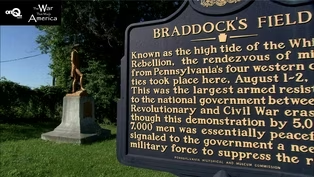
OnQ segment exploring Braddock’s revitalization through its War history and Carnegie Library. (15m 33s)
The War That Made America OnQ Clip - Behind the Scenes
Video has Closed Captions
OnQ segment previews a behind-the-scenes look at the PBS documentary The War That Made America. (8m 40s)
The War That Made America OnQ Clip - Robert Griffing
Video has Closed Captions
OnQ segment features Robert Griffing’s French and Indian War paintings and artistic inspirations. (12m 46s)
The War That Made America OnQ Clip - Preview Party
Video has Closed Captions
OnQ segment previews The War That Made America with interviews, behind-the-scenes stories, and art. (26m 22s)
The War That Made America OnQ Clip - Local Street Names
Video has Closed Captions
OnQ segment explores Pittsburgh street names, General Braddock, and Steelers sideline photographers. (19m 45s)
The War That Made America OnQ Clip - Fort Necessity
Video has Closed Captions
OnQ segment explores Fort Necessity, the French and Indian War, and The War That Made America. (8m 32s)
The War That Made America OnQ Clip - Casting and Models
Video has Closed Captions
OnQ segment explores casting George Washington and creating lifelike models for a historic exhibit. (17m 20s)
The War That Made American Launch OnQ
Video has Closed Captions
OnQ explores early test footage, interviews, battle recreations, and insights on TWTMA production. (9m 30s)
Early American History OnQ Clip - Andy Masich
Video has Closed Captions
This OnQ segment explores Pittsburgh history from the French and Indian War to the modern city. (3m 33s)
Joe Negri Performs Sleigh Ride
This clip from OnQ features Joe Negri performing Sleigh Ride from December, 16 2003. (4m 12s)
Joe Negri Performs Minha Saudade
This clip from OnQ showcases Joe Negri performing Minha Saudade. (3m 19s)
Video has Closed Captions
This clip of an OnQ episode explores debate in Pittsburgh over same sex unions in the church. (8m 28s)
Video has Closed Captions
This clip of an OnQ episode is about National Coming Out Day and LGBTQ+ lives in Pittsburgh. (18m 32s)
Video has Closed Captions
Hosted by Michael Bartley, this episode explores Rachel Carson’s life, legacy, and impact. (7m 4s)
Video has Closed Captions
12 senior citizens posed for a racy calendar to raise money for their hometown. (10m 43s)
Providing Support for PBS.org
Learn Moreabout PBS online sponsorship New Episode
- News and Public Affairs

Top journalists deliver compelling original analysis of the hour's headlines.

- News and Public Affairs

Today's top journalists discuss Washington's current political events and public affairs.
 New Season


 New Episode

 New Episode



Support for PBS provided by:
OnQ is a local public television program presented by WQED