OnQ
The War That Made America OnQ Clip - Local Street Names
Clip | 19m 45sVideo has Closed Captions
OnQ segment explores Pittsburgh street names, General Braddock, and Steelers sideline photographers.
Hosted by Stacy Smith, OnQ Episode 7011 explores Pittsburgh history and sports culture. Michael Bartley traces local street names to the French and Indian War through interviews with historians Holly Mayer and Laura Fisher. Alex Coleman discusses portraying General Braddock, while Dave Crawley profiles Steelers sideline photographers Matt Freed and Peter Diana.
Problems playing video? | Closed Captioning Feedback
Problems playing video? | Closed Captioning Feedback
OnQ is a local public television program presented by WQED
OnQ
The War That Made America OnQ Clip - Local Street Names
Clip | 19m 45sVideo has Closed Captions
Hosted by Stacy Smith, OnQ Episode 7011 explores Pittsburgh history and sports culture. Michael Bartley traces local street names to the French and Indian War through interviews with historians Holly Mayer and Laura Fisher. Alex Coleman discusses portraying General Braddock, while Dave Crawley profiles Steelers sideline photographers Matt Freed and Peter Diana.
Problems playing video? | Closed Captioning Feedback
Where to Watch OnQ
OnQ is available to stream on pbs.org and the PBS app.
Providing Support for PBS.org
Learn Moreabout PBS online sponsorshipTonight on PBS stations across the country.
A major WQED television production will debut.
We're talking, of course, about The War That Made America.
And coming up next, we'll show you how the French and Indian War shaped our region and led to the many streets, towns and cities named after the people who fought the war that made America.
And then after that, an exciting Steelers season as seen through the eyes of two Post-Gazette photographers.
Get us all next OnQ.
So stay connected.
Welcome to OnQ magazine.
I'm Stacy Smith.
Tonight is the big night at 9:00.
A national PBS television audience will see The War That Made America the acclaimed film chronicling the French and Indian War.
It is a WQED multimedia production, and OnQ has been bringing you related stories leading up to tonight's premiere.
Michael Bartley continues our coverage now and shows you why you don't have to look far to find prominent reminders that the war that made America started right here in western Pennsylvania.
It might take on a whole new meaning the next time you look at the point.
Western Pennsylvania and the significance of the upcoming premiere of The War That Made America.
It's huge.
It's really huge.
Huge for Pittsburgh.
Finally, a national audience will be exposed to this region's critical place in American history that it all started here.
And you just might be taking it for granted as you pass Grand Street, Fort Pitt Boulevard, Stanwix Street, Forbes Avenue.
Ever wonder why we have those names and so many others?
It's all because of the French and Indian Wars, says Holly Mayer, who teaches it and her history courses at Duquesne University.
She tells her students to take a closer look at the point.
Talk about the French and Indian War.
When did it start?
Where did it start?
What did it become?
It all happens here.
It starts primarily in 1754.
Fire!
When George Washington, this young man coming out of Virginia, starts heading into the backwoods to warn the French out and of course, to help establish a fort.
At the rivers where the rivers all meet.
And instead, the French are coming in the other direction.
Of course, to warn out the British colonists.
And it all starts then, when Washington, with his Indian allies actually attack them.
Then a French expedition.
And centuries later, we honor those in the French and Indian War with our unusual names.
For example, the very campus where mayor teaches Duquesne.
Why do we have Fort Duquesne?
Why do we have Duquesne University?
Why do we have streets named Duquesne, areas named Duquesne?
Duquesne was actually the governor general of French Canada.
He was a naval officer.
And when the French were defeated by the British.
Fort Duquesne was renamed Fort Pitt after the British Prime Minister at the time he took over.
Actually, the British were not doing very well at the beginning of this war.
There was a change of government.
William Pitt took over.
He was willing to make deals with the colonists.
He was certainly willing to put funds in.
He was seen as a really good guy.
After the British prevailed, they name a whole lot of things after Pitt, including Pittsburgh.
We also have the name Forbes all over the place.
Brigadier General John Forbes comes out in 1758.
He is to take western Pennsylvania, essentially to secure the Ohio Country.
He is on the British side.
Forbes also built the first railroad through western Pennsylvania.
Mayer says you'll be able to relate.
They build the road they get through one winter in western Pennsylvania, and all they do is complain about all the potholes and the ruins in the road.
So I'm going.
Western Pennsylvania roads have continued the way they started.
After all these years, we still don't.
You get the same exact complaints about Forbes Road from the very beginning, that we hear all the time now.
And at the corner of Forbes and Grant know, our busy Grant Street downtown is not named for Ulysses S. Grant.
Grant was a British officer.
He was actually with the Highlander Regiment.
He was a Scot himself, Major James Grant.
And he was with this contingent that was with Forbes and with Bouquet.
Bouquet as in Bouquet Street in Oakland.
Lieutenant Colonel Henry Bouquet.
He was Swiss.
He was the commander of the Royal Americans under General Forbes.
So he was absolutely essential again to taking this area.
General John Stanwix, he was in charge of the Southern Department for a while.
In other words, he was the commander of this area.
He was on the British side.
Get back to the fight.
A central figure in the war.
And in the film The War That Made America British General Edward Braddock.
He was actually defeated, actually.
Not to mind your place.
At the battle of the Monongahela on the 9th of July, 1755, and he lost his life.
He was mortally wounded there.
A few days later he died.
But we still honor this fallen hero, if you will.
And the list goes on.
Even little known streets and towns are named for French and Indian War figures, including Shingiss Street in Pittsburgh's Uptown neighborhood, one of the few Native Americans who get some recognition in our maps here, showing us was a Delaware war chief in this area who did support the British.
If you consider names like Kittanning, Monongahela, Allegheny, these are Indian names.
Yes they are.
So there's so much more.
There's so many names in this community that came out of this period.
Very much so, though it's rather interesting that most of the Native American names are kept for natural features.
Mayor and others say the national presentation of The War That Made America will no doubt be required.
Watching for college and high school students and history buffs will become fixated on historic Pittsburgh.
Big deal for Pittsburgh.
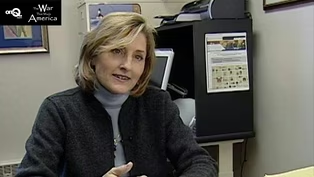
This is the office for French and Indian War 250 ink.
Laura Fisher runs the French and Indian War 250 project, part of the Allegheny Conference.
Its mission provide not only educational and support materials about the film, but drive our local tourism industry, bring national prominence to Pittsburgh and western Pennsylvania as the significant and historic site of the war.
Fisher calls The War That Made America one of the single most important contributions in decades promoting Pittsburgh.
We were always interested in stories about people first, and I think this film, more than any of the other things that we have been able to do and there have been lots of programs, is really bringing some of those stories to life.
And there are some great characters, and I think it touches and I think film can touch our emotions in a way that very few other things can.
And so to have the opportunity not only for the people in the Pittsburgh region to understand what a big story this is, but that it stars Pittsburgh.
But to have that played out all across the country, I think is really a wonderful thing.
It's a great thing for Pittsburgh.
We couldn't imagine buying that kind of publicity or awareness.
Gentlemen, a declaration by the representatives of the United States of America.
And I think, you know, part of the larger effort we're all trying to move forward is sort of changing these outdated perceptions people have about Pittsburgh or in some cases, they have no perception about Pittsburgh.
You know, they know it's not a smoky city anymore, but they can't really tell you what it is now.
And I think it's just one more way of helping to define that, that this has always been an incredibly important place where things happen.
Are really on our way.
Fisher says one of her favorite elements of the film weaved throughout, is accurately bringing to light the story of the Indians who lived in western Pennsylvania.
The richness and sophistication of the Native American nations who really controlled the balance of power.
I mean, it's just not even in our heads that that's sort of what this world looked like.
It was a very multicultural, diverse world.
Fisher predicts tourism will be on the rise locally after The War That Made America is shown nationally.
She believes tourists will want to visit the various forts and battle sites.
And local viewers won't take for granted why our tunnels are Fort Pitt and why we have Forbes Avenue and Grant Street.
It's a way of asking some questions about our past that we don't always tend to in textbooks.
Professor Mayer believes viewers who watch will finally understand the importance of the French and Indian War and the British prevailing, and the critical turning point in American history that eventually came our ultimate independence and the birth of a nation.
So this great victory that allows them to acquire all this territory ultimately, in the end, creates this split between the colonists who have one goal in mind and the British Empire another.
In the course of human events, it becomes necessary for one people to dissolve the political bonds which have connected them with another.
And ultimately, it's up to the revolution.
Absolutely.
And that's where I see it is so important.
And as some say, we could be speaking French right now if the French prevailed.
The first two hours of this historic film aired tonight at nine, right here on WQED TV 13.
The second two hours.
Don't forget our next Wednesday night at nine.
And truly, when it comes to names and places honoring the French and Indian history, we really just got a few tonight.
Stacy, there are more.
They are all around the place.
I'll even say the obvious.
Washington, PA?
Washington.
Who's that?
Yeah, exactly.
Yeah, he's he's big time.
Yeah.
He's like all right.
Thank you.
Michael.
And still to come.
General Braddock, or at least the actor who played him in The War That Made America.
We'll find out what it was like to play such an important role in this major production.
And then after that, the Pittsburgh Steelers as seen through the eyes of two local photographers.
We'll see how they capture the guts and the glory week after week.
So stay connected.
You're watching OnQ magazine because these foundations care enough about local programing to help pay for it.
The Howard Heinz Endowment, the Richard King Mellon Foundation, the McCune Foundation, the Pittsburgh Foundation, the Hillman Foundation, the Grable Foundation, the Eden Hall Foundation.
These corporations also support OnQ.
Kids who are ready for school are ready for life.
PNC Grow Up Great is helping families with great tips and resources.
More information is available at any branch or online.
It was so hard for Angela when her mom died.
You know, sometimes dad is the last person the teenager wants to talk to him.
He's the caring place that made a big difference.
Angela is doing better in school and we talk a lot more.
Some days are still hard, but she's come a long way.
Sometimes it takes more than health care to ensure the family's health.
A helping hand in the places we call home.
Highmark.
And we couldn't do it without you.
The members of WQED.
It is a big night here at WQED.
The long anticipated premiere of The War That Made America is coming up in just a little over an hour.
And one local man played a pivotal role in the film, that of General Braddock, a man who played a pivotal role in the actual war.
Actor and associate professor at the University of Pittsburgh, Alex Coleman joins us now.
Welcome to OnQ.
Thank you.
Thank you.
The obvious question what was it like to play General Braddock?
It was it was an amazing experience, actually.
The scale of the production was overwhelming.
And, it was it was just interesting because you had the historical part of it that was there as a major consideration.
You had the dramatic elements in the script.
Wonderful interaction with my fellow actors and, particularly enjoyed working with Larry Nehring, who played Washington.
But you had to find out who and what General Braddock was really like, didn't you?
It was pretty, clear in the script what this guy was like.
And, of course, the scope of it, didn't allow for a lot of varied aspects of his personality.
We we saw a very specific side to him.
And I think there's one, bit in the, in the film that has a lighter, gentler moment for him, which I was grateful for because it added a little bit of three dimensionality to the to the character.
And of course, the reference was the, book, The Crucible of War, which was a wonderful historical account of the, the only events and that was used to guide the, the writing of the script.
As I came to understand it.
We were provided, excerpts from the book to help flesh out the historical part of our character.
What kind of a character was he?
He was a bit of a, stiff SOB.
He would not listen, apparently, to the colonial people who would tell him, you know, he can't do that here.
And, the advisors had said, that's the way you you may fight in Europe, but you can't fight that way here.
Apparently, he was not really a, a battlefield commander in Europe.
I get the impression that he was a, sort of a logistics officer and that this was his, major step forward when he was given command of the British and ultimately the colonial forces that were supposed to go up against the French.
Well, to back up what you say, Robert Griffin has a wonderful painting on the death or the wounding.
It is really titled of Braddock.
And he has the head of the Indian scouts in the expression on, on that, man's face who was a Native American.
Looking at Braddock, it's like I told you this was going.
And so it plays right into what you're saying here.
Yeah.
The, actor playing Washington.
Larry and I posed for that, for that painting.
And, it was very interesting.
The painting contains apparently there are five historical accounts of Braddock's death and the painting is not an accurate depiction of any of them, but rather a commemorative that includes all with all of them.
So in that vast tapestry, there are five different points of view about this particular wound.
Well, we talk about the wounding of Braddock and, also the death of Braddock, which you had to play in the, in the, in the documentary.
Yeah.
And I think we have a clip of that right now.
We're going to show what that looks.
The general's been hurt.
It doesn't take long for the attackers to reach the rear of the British column.
How was he in death?
Because he, General Braddock did not die immediately.
They put him on a cart and headed down toward Fort Necessity.
And, I think he lingered two days after the wounding.
And then he died, of course, just above Fort Necessity on Route 40.
And what became Braddock Road.
And it's interesting that he was buried in the road.
And then they marched the troops back and forth over the site, so that the French and Indians would not find the body.
And then later, apparently, a, renovation was going on there, and they found bones.
Is that right?
And identified them as Braddock's bones and moved them to the side of the monument.
Oh, wow.
Yeah.
When in his in his two days of dying, was there were there any regrets or any writings about that or about the man at all?
Not that I'm aware of.
I'm sure there was something, Washington did an account which I actually have not read, but, he wrote about it later.
And when Braddock either, I guess when he died, Washington collected a purple sash that was apparently part of Braddock's paraphernalia and was quite fond of it.
And he also collected his pistols and kept them as more or less souvenirs or mementos, because he had been Braddock's aide de camp, and apparently, according to the historical account, was trying to get a commission in the British Army.
Okay.
But did Braddock was killed before I could, so that happened.
One other point for most of you, if Alex looks a little familiar to you because this is not his first major motion picture, first dramatization.
You're an actor by trade.
Also, as an associate professor.
But you also were in Silence of the Lambs.
Yes, as the stunt quarter said.
Coordinator said to me after the movie, he said, you really lost face in that movie.
What was your role?
I was the cop who one of the two cops that he kills in the cage scene.
Right.
And I was the one who was facing cut off.
And then where to get away?
Well, I don't know.
You seem to just get dying roles.
I think, you know, on on an actor's resume, there's this thing called, special skills or special talents I'm gonna put dying.
All right.
Alex, thank you so much for looking for your part tonight.
for The War That Made America.
Thank you.
And one more time, just in case you missed it.
The War That Made America premieres tonight at 9:00 on PBS stations across the country.
And of course, right here on WQED TV.
The next installment airs next Wednesday, January the 25th, also at 9:00.
Now still to come.
The glory, the heartbreak.
And then a little more glory.
We'll take a look at Pittsburgh Steelers as seen through the eyes of two local photographers.
So stay connected.
When viewers request, we respond.
Is there an OnQ story you think bears repeating when you heard about from friends?
Or maybe miss the first time around?
Let us know by logging on to our website wqed.org.
Then click OnQ to submit your request for an OnQ story.
Society for Contemporary Crafts Clip
Video has Closed Captions
This clip of OnQ highlights The Society for Contemporary Crafts in the Strip District. (8m 17s)
Video has Closed Captions
This clip highlights Pittsburgh’s City Theatre and their production of Hedwig and the Angry Inch. (7m 52s)
Latino Pittsburgh! - Clip from OnQ6122
Video has Closed Captions
An OnQ segment about the growing Latino population in Pittsburgh. (8m 59s)
OnQ - Reflection of Papal Reconciliation PSO Concert
Video has Closed Captions
A reflection of the Pittsburgh Symphony's concert for Pope John Paul II after his death. (14m 19s)
OnQ - 2003 PSO European Tour Report Part 3
Video has Closed Captions
Part 3 of Jim Cunningham's PSO 2003 European Tour Coverage in Amsterdam and London. (9m 14s)
OnQ - 2003 PSO European Tour Report Part 2
Video has Closed Captions
Part 2 of Jim Cunningham's PSO 2003 European Tour Coverage in Vienna, Austria. (9m 16s)
OnQ - 2003 PSO European Tour Report Part 1
Video has Closed Captions
Part 1 of Jim Cunningham's PSO 2003 European Tour Coverage in Valencia, Spain. (9m 20s)
Video has Closed Captions
Ambridge resident Bob Justiss shares a large piece of space junk that fell in his mother's backyard. (8m 2s)
Video has Closed Captions
This clip features Carnegie Mellon University's new robot that is headed for Mars. (6m 44s)
Video has Closed Captions
Director of the Buhl Planetarium, John Radzilowicz, talks about the gathering of the planets. (6m 4s)
The War That Made America OnQ Clip - Braddock History
Video has Closed Captions
OnQ segment exploring Braddock’s revitalization through its War history and Carnegie Library. (15m 33s)
The War That Made America OnQ Clip - Behind the Scenes
Video has Closed Captions
OnQ segment previews a behind-the-scenes look at the PBS documentary The War That Made America. (8m 40s)
The War That Made America OnQ Clip - Robert Griffing
Video has Closed Captions
OnQ segment features Robert Griffing’s French and Indian War paintings and artistic inspirations. (12m 46s)
The War That Made America OnQ Clip - Preview Party
Video has Closed Captions
OnQ segment previews The War That Made America with interviews, behind-the-scenes stories, and art. (26m 22s)
 Now Playing
The War That Made America OnQ Clip - Local Street Names
Video has Closed Captions
OnQ segment explores Pittsburgh street names, General Braddock, and Steelers sideline photographers. (19m 45s)
The War That Made America OnQ Clip - Fort Necessity
Video has Closed Captions
OnQ segment explores Fort Necessity, the French and Indian War, and The War That Made America. (8m 32s)
The War That Made America OnQ Clip - Casting and Models
Video has Closed Captions
OnQ segment explores casting George Washington and creating lifelike models for a historic exhibit. (17m 20s)
The War That Made American Launch OnQ
Video has Closed Captions
OnQ explores early test footage, interviews, battle recreations, and insights on TWTMA production. (9m 30s)
Early American History OnQ Clip - Andy Masich
Video has Closed Captions
This OnQ segment explores Pittsburgh history from the French and Indian War to the modern city. (3m 33s)
Joe Negri Performs Sleigh Ride
This clip from OnQ features Joe Negri performing Sleigh Ride from December, 16 2003. (4m 12s)
Joe Negri Performs Minha Saudade
This clip from OnQ showcases Joe Negri performing Minha Saudade. (3m 19s)
Video has Closed Captions
This clip of an OnQ episode explores debate in Pittsburgh over same sex unions in the church. (8m 28s)
Video has Closed Captions
This clip of an OnQ episode is about National Coming Out Day and LGBTQ+ lives in Pittsburgh. (18m 32s)
Video has Closed Captions
Hosted by Michael Bartley, this episode explores Rachel Carson’s life, legacy, and impact. (7m 4s)
Video has Closed Captions
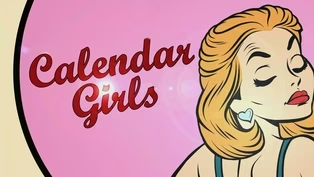
12 senior citizens posed for a racy calendar to raise money for their hometown. (10m 43s)
Providing Support for PBS.org
Learn Moreabout PBS online sponsorship New Episode
- News and Public Affairs

Top journalists deliver compelling original analysis of the hour's headlines.

- News and Public Affairs

Today's top journalists discuss Washington's current political events and public affairs.
 New Season


 New Episode

 New Episode



Support for PBS provided by:
OnQ is a local public television program presented by WQED