
The Mind-Bending Physics of Origami
Clip: Season 53 | 5m 52sVideo has Closed Captions
A simple fold can completely change how a material behaves.
By changing structure instead of material, origami can transform flimsy sheets into rigid, shape-shifting systems. And scientists are still discovering entirely new ways to fold.
Problems playing video? | Closed Captioning Feedback
Problems playing video? | Closed Captioning Feedback
National Corporate funding for NOVA is provided by Carlisle Companies. Major funding for NOVA is provided by the NOVA Science Trust and PBS viewers.
Support provided by:


The Mind-Bending Physics of Origami
Clip: Season 53 | 5m 52sVideo has Closed Captions
By changing structure instead of material, origami can transform flimsy sheets into rigid, shape-shifting systems. And scientists are still discovering entirely new ways to fold.
Problems playing video? | Closed Captioning Feedback
Where to Watch NOVA
NOVA is available to stream on pbs.org and the PBS app.
NOVA Labs
NOVA Labs is a free digital platform that engages teens and lifelong learners in games and interactives that foster authentic scientific exploration. Participants take part in real-world investigations by visualizing, analyzing, and playing with the same data that scientists use.Providing Support for PBS.org
Learn Moreabout PBS online sponsorship- I can turn this paper from a floppy sheet into a rigid structure strong enough to support the weight of another object.
Well, I can't, but people can.
All you have to do is fold the paper in a particular way, and now we've got all these structures that can move, and bend, and behave in unique ways, and that's because when we fold paper, we're not just changing its shape, we're changing its physical properties.
(pensive music) Origami is probably the world's most famous example of the shape-shifting power of paper.
It's an ancient Japanese art form of turning flat paper into intricate sculptures through a series of folds.
And for hundreds, or even over 1,000 years, we've been using origami to make art and decorations, to introduce geometry to elementary students, design buildings, and even solve major physics riddles.
How?
Well, paper is a material that can behave differently because of changes in its structure, even when the material itself doesn't change.
It's what's known as a mechanical metamaterial.
In other words, these flat and creased pieces of paper are made of exactly the same thing, but the creased paper is stronger because of the structure of its folds.
And when we stack folds in a systematic way, suddenly we've changed the paper's size, flexibility, and rigidity.
Let's take a closer look.
This one is called the waterbomb, or balloon, pattern.
Traditionally, it was used for making toys and boxes for trapping insects.
It can pucker closed or stretch open, giving it a lot of flexibility.
And once all the folds are complete, you have a flat shape.
But, (Athena blowing) you can inflate it with air or even fill it with water to expand it into a 3D object.
And this one is the Yoshimura pattern.
It actually forms naturally when a cylinder is compressed from the ends.
It also happens when you push up your sleeve.
But when we make it from a flat sheet of paper, the pattern can fold flat.
Then, when it expands, it forms a strong cylinder that can hold up to compression, and that's because the force of the compression is distributed evenly among these triangular structures, and there are no weak points that will collapse.
This last one is called the Miura fold.
It's made of these zigzagging folds that create a tessellated or repeating pattern of parallelograms.
Each section of this pattern stays flat.
There's no dimpling or bending to tuck one section inside of another.
And it's special because for most materials, like this piece of balloon, if you stretch it in one direction, it shrinks in the opposite direction.
But with the Miura fold, expanding it in one direction also makes it expand in the other.
Materials with this property are called auxetic, and they're really good for absorbing energy and resisting damage from impact.
But origami isn't just for paper.
Another way to think of it is that the folds are like hinges that connect the flat parts of the paper, which are called panels.
So we can replace the origami hinges with mechanical ones, and the panels can be made of metal or plastic or glass, and that opens up all kinds of other ways to use origami.
Like, in 2006, a team of researchers worked with the water bomb pattern to make the first origami-inspired medical stent.
It's a small metal device that's inserted into an artery or vein to keep it open.
With its origami design, the device can fold up small, then unfold and expand once it's in place in the body.
The strength of the Yoshimura pattern has applications in architecture and building things, like pop-up shelters from wooden cardboard.
And the Miura pattern can be used for making things, like deployable bridges or solar panels, that need to be compact for storage or transportation.
And we're still exploring new patterns and applications for origami.
Like, these patterns all use triangles or parallelograms.
But researchers are exploring new types of panels and folds.
In 2025, researchers even discovered a whole new class of folds that have been named Bloom patterns.
The Bloom pattern folds entirely flat into a compact, circular column.
Then, with a slight tug, it can expand into a bowl shape or even a large flat disc.
These patterns could be useful for everything, from making pop-up bowls that store flat in your kitchen cabinets, to storing and transporting space telescopes.
Physicists have also started modeling trapezoid panels.
That might not sound like much, but it's actually a really big deal.
Trapezoid origami has a unique way of expanding and contracting in even predictable patterns called breathing or twisting into a helix called shearing.
And that could open up new ways to combine folds and design objects that are particularly good for absorbing energy and impact.
Origami can have curved folds, too.
Curved crease origami is difficult to build and even harder to describe mathematically.
But in 2012, physicists finally came up with an equation to describe origami curves.
It's an entirely different way to create 3D structures from 2D sheets.
And when materials bend, they store potential energy.
So, curve structures may be able to unfold more easily and with less external guidance than other origami patterns.
Plus, they have smooth rounded sides that could be better for making medical devices that unfold inside the body without causing damage or irritation.
And that's kind of wild.
Think about it.
For hundreds of years, we've been figuring out how to harness the power of art, geometry, and physics to make innovative, useful, and beautiful things.
And we still don't have it all figured out yet.
We're still finding new ways to fold paper, and that means the possibilities of origami are still wide open for us to explore.
(pensive music)

The Battle to Breathe: The Last 10%
Video has Closed Captions
Clip: S53 | 18m 6s | Inside the race to bring life-saving genetic therapies to every person living with cystic fibrosis. (18m 6s)
The Battle to Breathe: CF Before Birth
Video has Closed Captions
Clip: S53 | 15m 51s | Inside one mother's fight to ensure a healthy life for her child with cystic fibrosis. (15m 51s)
 Now Playing
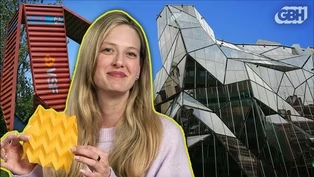
The Mind-Bending Physics of Origami
Video has Closed Captions
Clip: S53 | 5m 52s | A simple fold can completely change how a material behaves. (5m 52s)
Video has Closed Captions
Clip: S53 | 5m 48s | Modern physics and imaging techniques are finally solving the mystery. (5m 48s)
Why Earth’s Core Is Younger Than Its Surface
Video has Closed Captions
Clip: S53 | 6m | Time isn’t the same for everyone, according to Einstein. (6m)
The Truth about Quantum Computers
Video has Closed Captions
Clip: S53 | 6m 44s | Microsoft's breakthrough in quantum computing could have a huge impact on science, and our future. (6m 44s)
The Problem That Broke Physics (And Led to Chaos)
Video has Closed Captions
Clip: S53 | 6m 12s | The “butterfly effect” is often cited in pop culture, but it’s actually rooted in physics and chaos. (6m 12s)
The Ocean Wave Scientists Thought Was Impossible
Video has Closed Captions
Clip: S53 | 5m 46s | These massive walls of water may be far more common than we once believed. (5m 46s)
Is Electricity Instant? A Shocking Experiment from 1746
Video has Closed Captions
Clip: S53 | 5m 56s | It’s taken over 250 years of shocking experiments to understand how quickly electricity moves! (5m 56s)

Does Notre Dame Sound Different Now?
Video has Closed Captions
Clip: S53 | 6m 8s | Restoring Notre Dame wasn’t just about stone and stained glass. (6m 8s)

Evolution: Brain Power Preview
Video has Closed Captions
Preview: S53 Ep13 | 1m | The story of the dolphin reveals how intelligence evolved, step by step, over billions of years. (1m)
Video has Closed Captions
Preview: S53 Ep12 | 30s | Inside the escalating military struggle to control space and the satellites we rely on. (30s)
Video has Closed Captions
Preview: S53 Ep11 | 30s | Step into the stunning cave that’s reshaping our understanding of prehistoric art. (30s)
Video has Closed Captions
Preview: S53 Ep10 | 30s | Witness how Native North Americans have generated scientific knowledge over thousands of years. (30s)

Video has Closed Captions
Preview: S53 Ep9 | 30s | Follow the relentless quest that led to a breakthrough treatment for a deadly disease. (30s)
Video has Closed Captions
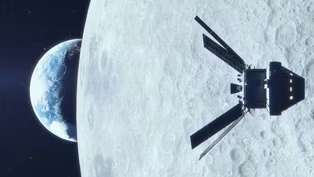
Preview: S53 Ep7 | 30s | Follow the Artemis mission to bring humanity back to the Moon for the first time since Apollo. (30s)

Athens: Birth of Democracy Preview
Video has Closed Captions
Preview: S53 Ep8 | 30s | Archaeologists investigate the dramatic origins of democracy in ancient Greece 2,500 years ago. (30s)
Stone Age Temple Mystery Preview
Video has Closed Captions
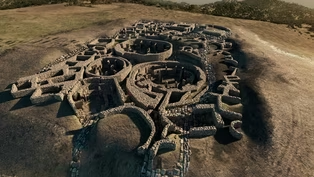
Preview: S53 Ep6 | 30s | Surprising evidence at the world’s oldest temple overturns our understanding of human history. (30s)

Video has Closed Captions
Preview: S53 Ep5 | 30s | A deadly—and growing—global weather phenomenon mystifies scientists. (30s)
Video has Closed Captions
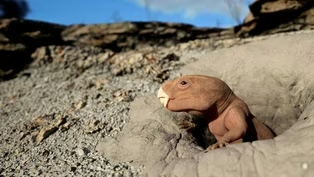
Preview: S53 Ep4 | 30s | Explore mammals’ surprising origins, long before the age of dinosaurs. (30s)

Video has Closed Captions
Preview: S53 Ep3 | 30s | Do speech buttons really allow dogs to talk to us? Scientists investigate. (30s)

Angkor: Hidden Jungle Empire Preview
Video has Closed Captions
Preview: S53 Ep2 | 30s | New evidence sheds light on the remarkable life—and mysterious collapse—of the ancient jungle city. (30s)
When Earth Was Bombarded by Asteroids
Video has Closed Captions
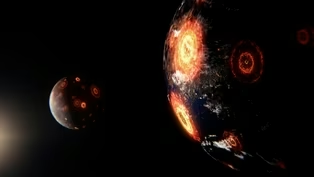
Clip: S53 Ep1 | 3m 41s | What studying the surface of the Moon revealed about Earth’s apocalyptic youth. (3m 41s)
Asteroids: Spark of Life? Preview
Video has Closed Captions
Preview: S53 Ep1 | 30s | What if violent asteroid impacts actually jump-started life on Earth? Explore a dramatic theory. (30s)
Providing Support for PBS.org
Learn Moreabout PBS online sponsorship













Support for PBS provided by:
National Corporate funding for NOVA is provided by Carlisle Companies. Major funding for NOVA is provided by the NOVA Science Trust and PBS viewers.