
Is Electricity Instant? A Shocking Experiment from 1746
Clip: Season 53 | 5m 56sVideo has Closed Captions
It’s taken over 250 years of shocking experiments to understand how quickly electricity moves!
How fast does electricity move – and why? In 1746, a French physicist electrocuted a large group of monks to learn about electricity, and he concluded that it moves with “infinite speed.” That wasn’t quite right, but it would take decades to figure out the real answer and its reason.
Problems playing video? | Closed Captioning Feedback
Problems playing video? | Closed Captioning Feedback
National Corporate funding for NOVA is provided by Carlisle Companies. Major funding for NOVA is provided by the NOVA Science Trust and PBS viewers.
Support provided by:


Is Electricity Instant? A Shocking Experiment from 1746
Clip: Season 53 | 5m 56sVideo has Closed Captions
How fast does electricity move – and why? In 1746, a French physicist electrocuted a large group of monks to learn about electricity, and he concluded that it moves with “infinite speed.” That wasn’t quite right, but it would take decades to figure out the real answer and its reason.
Problems playing video? | Closed Captioning Feedback
Where to Watch NOVA
NOVA is available to stream on pbs.org and the PBS app.

NOVA Labs
NOVA Labs is a free digital platform that engages teens and lifelong learners in games and interactives that foster authentic scientific exploration. Participants take part in real-world investigations by visualizing, analyzing, and playing with the same data that scientists use.Providing Support for PBS.org
Learn Moreabout PBS online sponsorship- How fast can electricity travel?
(thunder booming) Well, one guy decided the best way to find out was to shock a bunch of monks.
In 1746, (bells chiming) a French abbot and physicist named Jean-Antoine Nollet arranged a large group of monks and connected them by thick wires.
His plan was to measure the speed of electricity as the monks were electrocuted one by one.
So he was shocked when everyone got electrocuted at the same time.
Nollet concluded that electricity must move with infinite speed.
Of course, nothing moves that fast, but electricity does move really, really fast.
Nollet saw it, the monks felt it, (electricity zapping) and we experience it too anytime we flip a light switch on and the lights come on immediately.
So, what actually happened when Nollet shocked those monks?
And how did we figure it all out?
(bright music) Back in the seventeen and eighteen hundreds, the scientific atmosphere was electric.
Nollet was far from the only one experimenting with electricity.
Actually, he wasn't even the only one electrocuting large groups of people.
(electricity humming) All kinds of scientists, including Charles Francois de Cisternay du Fay, Benjamin Franklin, and Alessandro Volta, were studying lightning and static, observing sparks, experimenting with batteries, and trying to figure out what exactly electricity was and how it moved.
And at the time, people mostly thought of electricity as fluid.
Nollet even got in a fight with Franklin about whether electricity is made up of one or two fluids.
Neither one was right, but it would take a few more decades to figure that out.
Things really took off in 1831 when Michael Faraday used a battery to discover electromagnetic induction.
He showed that magnets in motion could create an electric current in a loop of wire, uncovering an important connection between electricity and magnetism.
Then in the 1850s, the Scottish physicist and mathematician James Clerk Maxwell looked at Faraday's experimental results and theories about electricity and magnetism, and he wrote mathematical equations that describe the observations.
He ended up with a set of equations, now called Maxwell's equations, which described the relationship between electric and magnetic fields.
Basically, a moving magnetic field creates an electric field and a moving electric field creates a magnetic field.
By the 1860s, Maxwell's work culminated in the theory of electromagnetism, the idea that a magnetic field can produce an electric field, which can produce a magnetic field, and so on.
This cycle creates a whole spectrum of waves of energy at different frequencies.
Everything from radio waves to visible light to gamma rays that we later identified and harnessed to use in things like radios and Wi-Fi.
Maxwell's theory, more than 100 years after the experiment with the monks, finally revealed the answer to Nollet's question.
In a vacuum, electromagnetic waves move at the speed of light because light waves are, in fact, electromagnetic waves.
So the speed of electricity isn't infinite, but it is just about the fastest thing we know of.
But what does that actually look like?
Well, as Joseph John Thomson helped figure out in the 1890s, electricity isn't fluid.
It's the movement of particles called electrons.
But it's not the electrons themselves that are moving so quickly.
In conductors, which are materials that allow electric currents to flow through them, there are free electrons, or electrons that can jump from one atom to another.
And they move at what's called the Fermi velocity, which depends on the amount of energy the individual particles have.
For copper, which many electrical wires are made from, the Fermi velocity is about 3.5 million miles an hour.
That is really fast.
But this motion happens randomly.
The electrons zip along in straight lines until they bump into other stuff, which happens pretty often.
(pinball clinking) Basically, they're pinging around like pinballs, moving super fast but not very far.
When a voltage is applied to the wire, it creates an electric field that puts a force on the free electrons.
They still move randomly at the Fermi velocity, but now they also get pushed by the electric field at the drift velocity.
But that doesn't explain how your lights turn on when you flip a switch because the net drift velocity depends on the size of the wire.
And it's usually only something like a couple millimeters per second.
At the drift velocity, it would've taken hours for all of Nollet's monks to be electrocuted.
So what we're really talking about is signal velocity.
And that works a lot like a bunch of really impatient people in line for the bathroom.
Say someone at the back of the line bumps into the person in front of them, who bumps into the person in front of them, and so on.
The person at the back of the line doesn't actually move much closer to the bathroom, but their action quickly reaches the bathroom door.
That's how electricity works too.
See, there's a lot of stuff inside a wire, so the electrons keep bumping into other particles.
And when an electric field makes the electrons start drifting, they've gotta push on all the other electrons ahead of them in the line.
That force reaches the other end of the wire almost instantaneously.
In fact, in copper, the signal velocity is nearly 671 million miles an hour, (air whooshes) AKA the speed of light.
So that's how all the monks in Nollet's experiment got electrocuted at the same time and how your lights turn on as soon as you flip the switch.
And in the end, (stopwatch ticking) he was onto something.
Electricity does move fast, just not infinitely fast.
(electricity zapping) But fast enough to light up our world and those monks.
(lighthearted electronic music)

The Battle to Breathe: The Last 10%
Video has Closed Captions
Clip: S53 | 18m 6s | Inside the race to bring life-saving genetic therapies to every person living with cystic fibrosis. (18m 6s)
The Battle to Breathe: CF Before Birth
Video has Closed Captions
Clip: S53 | 15m 51s | Inside one mother's fight to ensure a healthy life for her child with cystic fibrosis. (15m 51s)

The Mind-Bending Physics of Origami
Video has Closed Captions
Clip: S53 | 5m 52s | A simple fold can completely change how a material behaves. (5m 52s)

Video has Closed Captions
Clip: S53 | 5m 48s | Modern physics and imaging techniques are finally solving the mystery. (5m 48s)
Why Earth’s Core Is Younger Than Its Surface
Video has Closed Captions
Clip: S53 | 6m | Time isn’t the same for everyone, according to Einstein. (6m)
The Truth about Quantum Computers
Video has Closed Captions
Clip: S53 | 6m 44s | Microsoft's breakthrough in quantum computing could have a huge impact on science, and our future. (6m 44s)

The Problem That Broke Physics (And Led to Chaos)
Video has Closed Captions
Clip: S53 | 6m 12s | The “butterfly effect” is often cited in pop culture, but it’s actually rooted in physics and chaos. (6m 12s)

The Ocean Wave Scientists Thought Was Impossible
Video has Closed Captions
Clip: S53 | 5m 46s | These massive walls of water may be far more common than we once believed. (5m 46s)
 Now Playing
Is Electricity Instant? A Shocking Experiment from 1746
Video has Closed Captions
Clip: S53 | 5m 56s | It’s taken over 250 years of shocking experiments to understand how quickly electricity moves! (5m 56s)

Does Notre Dame Sound Different Now?
Video has Closed Captions
Clip: S53 | 6m 8s | Restoring Notre Dame wasn’t just about stone and stained glass. (6m 8s)

Evolution: Brain Power Preview
Video has Closed Captions
Preview: S53 Ep13 | 1m | The story of the dolphin reveals how intelligence evolved, step by step, over billions of years. (1m)
Video has Closed Captions
Preview: S53 Ep12 | 30s | Inside the escalating military struggle to control space and the satellites we rely on. (30s)
Video has Closed Captions
Preview: S53 Ep11 | 30s | Step into the stunning cave that’s reshaping our understanding of prehistoric art. (30s)
Video has Closed Captions
Preview: S53 Ep10 | 30s | Witness how Native North Americans have generated scientific knowledge over thousands of years. (30s)

Video has Closed Captions
Preview: S53 Ep9 | 30s | Follow the relentless quest that led to a breakthrough treatment for a deadly disease. (30s)
Video has Closed Captions
Preview: S53 Ep7 | 30s | Follow the Artemis mission to bring humanity back to the Moon for the first time since Apollo. (30s)

Athens: Birth of Democracy Preview
Video has Closed Captions
Preview: S53 Ep8 | 30s | Archaeologists investigate the dramatic origins of democracy in ancient Greece 2,500 years ago. (30s)
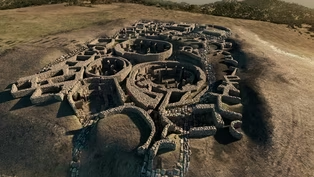
Stone Age Temple Mystery Preview
Video has Closed Captions
Preview: S53 Ep6 | 30s | Surprising evidence at the world’s oldest temple overturns our understanding of human history. (30s)

Video has Closed Captions
Preview: S53 Ep5 | 30s | A deadly—and growing—global weather phenomenon mystifies scientists. (30s)

Video has Closed Captions
Preview: S53 Ep4 | 30s | Explore mammals’ surprising origins, long before the age of dinosaurs. (30s)

Video has Closed Captions
Preview: S53 Ep3 | 30s | Do speech buttons really allow dogs to talk to us? Scientists investigate. (30s)
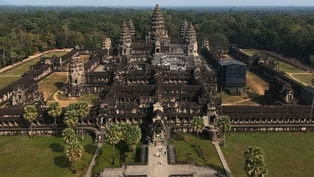
Angkor: Hidden Jungle Empire Preview
Video has Closed Captions
Preview: S53 Ep2 | 30s | New evidence sheds light on the remarkable life—and mysterious collapse—of the ancient jungle city. (30s)
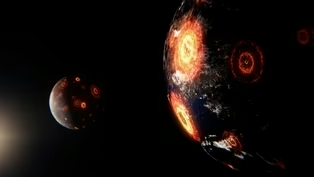
When Earth Was Bombarded by Asteroids
Video has Closed Captions
Clip: S53 Ep1 | 3m 41s | What studying the surface of the Moon revealed about Earth’s apocalyptic youth. (3m 41s)
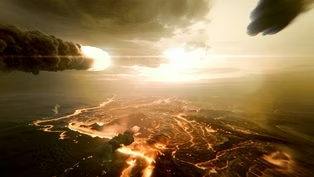
Asteroids: Spark of Life? Preview
Video has Closed Captions
Preview: S53 Ep1 | 30s | What if violent asteroid impacts actually jump-started life on Earth? Explore a dramatic theory. (30s)
Providing Support for PBS.org
Learn Moreabout PBS online sponsorship














Support for PBS provided by:
National Corporate funding for NOVA is provided by Carlisle Companies. Major funding for NOVA is provided by the NOVA Science Trust and PBS viewers.