
The Ocean Wave Scientists Thought Was Impossible
Clip: Season 53 | 5m 46sVideo has Closed Captions
These massive walls of water may be far more common than we once believed.
For centuries, scientists thought rogue waves were either impossible or so rare they might happen once every 10,000 years. But then they kept happening, forcing researchers to rethink how waves form.
Problems playing video? | Closed Captioning Feedback
Problems playing video? | Closed Captioning Feedback
National Corporate funding for NOVA is provided by Carlisle Companies. Major funding for NOVA is provided by the NOVA Science Trust and PBS viewers.
Support provided by:


The Ocean Wave Scientists Thought Was Impossible
Clip: Season 53 | 5m 46sVideo has Closed Captions
For centuries, scientists thought rogue waves were either impossible or so rare they might happen once every 10,000 years. But then they kept happening, forcing researchers to rethink how waves form.
Problems playing video? | Closed Captioning Feedback
Where to Watch NOVA
NOVA is available to stream on pbs.org and the PBS app.
NOVA Labs
NOVA Labs is a free digital platform that engages teens and lifelong learners in games and interactives that foster authentic scientific exploration. Participants take part in real-world investigations by visualizing, analyzing, and playing with the same data that scientists use.Providing Support for PBS.org
Learn Moreabout PBS online sponsorshipThis enormous German cargo ship was once thought to be unsinkable, which, bold claim, historically speaking.
A few nights into its 62nd voyage in December of 1978, the ship and its entire crew vanished.
It would be nearly 20 years before experts would solve the mysterious disappearance of the MS Munchen.
The answer was a phenomenon that scientists once thought was impossible, and that all these years later, we still don't fully understand: a rogue wave.
Fun fact: they're maybe not as rogue as you'd think.
Rogue waves are also called freak waves or killer waves.
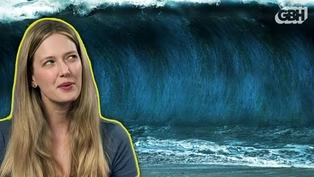
At their most dramatic, they can look like a massive, terrifying wall of water that seems to come out of nowhere, but they're not the same as tsunamis.
Those are triggered by underground activity and only get big when they reach shallow water.
But rogue waves happen on the surface of the water and can form way out in the middle of the ocean, and technically, they're defined as waves that are more than twice the size of the waves around them.
In the case of the MS Munchen?
That wave could have been more than 80 feet high.
But rogue waves aren't always massive.
A four-foot wave could also be a rogue wave if all the waves around it are two-footers.
It's all relative.
So rogue waves have long baffled scientists.
Typically, ocean waves are surface waves.
They form when wind transfers energy to the water.
Friction between the wind and water stretches the surface and creates ripples.
And as the wind continues to blow, it catches these ripples.
That puts more force on them and creates larger waves with higher crests and deeper troughs.
The longer and stronger the wind blows, the larger the waves become, and the farther they travel across the ocean.
Eventually, these waves develop a rhythm.
They form groups of waves with similar heights and regular timing between them called periods.
For a long time, scientists thought wave activity should be linear and predictable.
Early models showed that massive waves were impossible or extremely rare.
So people thought sailor stories of freak killer waves were just tall tales, like the Kraken.
Then on January 1st, 1995, a huge wave came out of nowhere and hit an oil platform in the North Sea.
The Draupner platform was equipped with laser detectors to measure wave heights, and while most waves in the area were around 39 feet, this wave was 84 feet high.
Luckily, the platform didn't take much damage, but our ideas about waves did.
The Draupner wave was one of the largest ever documented, and having it on record confirmed once and for all that rogue waves are real.
Plus, our linear wave models were way off.
So the Draupner wave launched all kinds of new research about waves.
In 2007, researchers put together a list of 50 historical events that probably happened because of rogue waves, including the disappearance of the MS Munchen.
And since we knew rogue waves existed, we also wanted to know why.
Figuring that out has been tough.
Research is ongoing, but we've got some theories.
For a while, experts thought the most likely explanation for rogue waves had to do with modulation instability, which is when something interrupts the regular size and spacing of a group of waves.
That changes the wave pattern and allows energy to sort of pile up.
This energy transfers unevenly between the waves, eventually concentrating into one much larger wave.
Scientists can model this happening with water waves flowing in one direction or within a narrow channel where the energy can't escape.
But it's harder to explain how it might work in the open ocean where energy can disperse in all directions.
So one skeptic of the modulational instability theory led a team of researchers that looked at 18 years worth of wave data from the North Sea.
They noticed two common wave behaviors playing out.
The first is linear focusing.
When waves that are going different speeds and directions line up just right, they can unite and form a taller crest.
The other effect is second order bound nonlinearities.
That's when waves change their shape, their troughs become flatter, and their crests get steeper.
And it can make waves 15 to 20% larger than normal.
On their own, those effects are just normal wave behavior.
But the team observe that when those two effects come together at the same time, they can create a wave that's much, much larger than the waves around it.
And we can watch it happening.
Scientists think there are as many as 10 rogue waves forming in the world's oceans at any given moment, and they seem to have a sort of fingerprint that we can trace.
You see, we can study groups of waves before and after a rogue wave happens, and that can help us figure out exactly how it got so massive and look for patterns that might show when the next rogue wave is likely to form.
Then we can update our models, make more accurate forecasts, and implement better warning systems for ships at sea.
And that could be lifesaving.
The more we learn, the more we can predict what causes these huge waves and when they'll strike next.
And maybe eventually, the idea that a massive, deadly wave could appear with no warning at all will once again just seem like a tall tale, like the Kraken.

Would a Penny Dropped from the Empire State Building Kill You?
Video has Closed Captions
Clip: S53 | 5m 52s | Falling is more complicated than you might think. (5m 52s)
Is There a Center of the Universe?
Video has Closed Captions
Clip: S53 | 5m 56s | Physics says the universe is centerless, but a cosmic alignment has scientists asking questions. (5m 56s)

Cats Accidentally Solved a Physics Mystery
Video has Closed Captions
Clip: S53 | 6m 17s | Falling cats seem to break the rules of motion, but the real explanation is stranger than it looks. (6m 17s)

The (Persistent) Illusion of Centrifugal Force
Video has Closed Captions
Clip: S53 | 5m 55s | Here’s why centrifugal force is considered a “fictitious” force. (5m 55s)

The Battle to Breathe: The Last 10%
Video has Closed Captions
Clip: S53 | 18m 6s | Inside the race to bring life-saving genetic therapies to every person living with cystic fibrosis. (18m 6s)
The Battle to Breathe: CF Before Birth
Video has Closed Captions
Clip: S53 | 15m 51s | Inside one mother's fight to ensure a healthy life for her child with cystic fibrosis. (15m 51s)

The Mind-Bending Physics of Origami
Video has Closed Captions
Clip: S53 | 5m 52s | A simple fold can completely change how a material behaves. (5m 52s)
Video has Closed Captions
Clip: S53 | 5m 49s | Modern physics and imaging techniques are finally solving the mystery. (5m 49s)

Why Earth’s Core Is Younger Than Its Surface
Video has Closed Captions
Clip: S53 | 6m | Time isn’t the same for everyone, according to Einstein. (6m)

The Truth about Quantum Computers
Video has Closed Captions
Clip: S53 | 6m 44s | Microsoft's breakthrough in quantum computing could have a huge impact on science, and our future. (6m 44s)

The Problem That Broke Physics (And Led to Chaos)
Video has Closed Captions
Clip: S53 | 6m 12s | The “butterfly effect” is often cited in pop culture, but it’s actually rooted in physics and chaos. (6m 12s)
 Now Playing
The Ocean Wave Scientists Thought Was Impossible
Video has Closed Captions
Clip: S53 | 5m 46s | These massive walls of water may be far more common than we once believed. (5m 46s)
Is Electricity Instant? A Shocking Experiment from 1746
Video has Closed Captions
Clip: S53 | 5m 56s | It’s taken over 250 years of shocking experiments to understand how quickly electricity moves! (5m 56s)

Does Notre Dame Sound Different Now?
Video has Closed Captions
Clip: S53 | 6m 8s | Restoring Notre Dame wasn’t just about stone and stained glass. (6m 8s)
Evolution: Brain Power Preview
Video has Closed Captions
Preview: S53 Ep13 | 1m | The story of the dolphin reveals how intelligence evolved, step by step, over billions of years. (1m)
Video has Closed Captions
Preview: S53 Ep12 | 30s | Inside the escalating military struggle to control space and the satellites we rely on. (30s)
Video has Closed Captions
Preview: S53 Ep11 | 30s | Step into the stunning cave that’s reshaping our understanding of prehistoric art. (30s)
Video has Closed Captions
Preview: S53 Ep10 | 30s | Witness how Native North Americans have generated scientific knowledge over thousands of years. (30s)

Video has Closed Captions
Preview: S53 Ep9 | 30s | Follow the relentless quest that led to a breakthrough treatment for a deadly disease. (30s)
Video has Closed Captions
Preview: S53 Ep7 | 30s | Follow the Artemis mission to bring humanity back to the Moon for the first time since Apollo. (30s)
Athens: Birth of Democracy Preview
Video has Closed Captions
Preview: S53 Ep8 | 30s | Archaeologists investigate the dramatic origins of democracy in ancient Greece 2,500 years ago. (30s)
Stone Age Temple Mystery Preview
Video has Closed Captions
Preview: S53 Ep6 | 30s | Surprising evidence at the world’s oldest temple overturns our understanding of human history. (30s)
Video has Closed Captions
Preview: S53 Ep5 | 30s | A deadly—and growing—global weather phenomenon mystifies scientists. (30s)
Video has Closed Captions
Preview: S53 Ep4 | 30s | Explore mammals’ surprising origins, long before the age of dinosaurs. (30s)

Video has Closed Captions
Preview: S53 Ep3 | 30s | Do speech buttons really allow dogs to talk to us? Scientists investigate. (30s)
Angkor: Hidden Jungle Empire Preview
Video has Closed Captions
Preview: S53 Ep2 | 30s | New evidence sheds light on the remarkable life—and mysterious collapse—of the ancient jungle city. (30s)
When Earth Was Bombarded by Asteroids
Video has Closed Captions
Clip: S53 Ep1 | 3m 41s | What studying the surface of the Moon revealed about Earth’s apocalyptic youth. (3m 41s)
Asteroids: Spark of Life? Preview
Video has Closed Captions
Preview: S53 Ep1 | 30s | What if violent asteroid impacts actually jump-started life on Earth? Explore a dramatic theory. (30s)
Providing Support for PBS.org
Learn Moreabout PBS online sponsorship New Episode
- Science and Nature

Capturing the splendor of the natural world, from the African plains to the Antarctic ice.

 New Episode


 New Episode




Support for PBS provided by:
National Corporate funding for NOVA is provided by Carlisle Companies. Major funding for NOVA is provided by the NOVA Science Trust and PBS viewers.