
Does Notre Dame Sound Different Now?
Clip: Season 53 | 6m 8sVideo has Closed Captions
Restoring Notre Dame wasn’t just about stone and stained glass.
After a 2019 fire destroyed much of the Notre Dame cathedral, the acoustics could have been dramatically changed, if not for a team of experts dedicated to restoring the legendary sound of this ancient cathedral.
Problems playing video? | Closed Captioning Feedback
Problems playing video? | Closed Captioning Feedback
National Corporate funding for NOVA is provided by Carlisle Companies. Major funding for NOVA is provided by the NOVA Science Trust and PBS viewers.
Support provided by:


Does Notre Dame Sound Different Now?
Clip: Season 53 | 6m 8sVideo has Closed Captions
After a 2019 fire destroyed much of the Notre Dame cathedral, the acoustics could have been dramatically changed, if not for a team of experts dedicated to restoring the legendary sound of this ancient cathedral.
Problems playing video? | Closed Captioning Feedback
Where to Watch NOVA
NOVA is available to stream on pbs.org and the PBS app.
NOVA Labs
NOVA Labs is a free digital platform that engages teens and lifelong learners in games and interactives that foster authentic scientific exploration. Participants take part in real-world investigations by visualizing, analyzing, and playing with the same data that scientists use.Providing Support for PBS.org
Learn Moreabout PBS online sponsorshipFrance Notre Dame Cathedral has endured for more than 850 years — through the Middle Ages, the French Revolution, and two world wars.
It's played roles in history, literature, architecture, and even a Disney movie.
But along with all that, one of the things that makes this place so unique is its sound.
From its bell towers to its massive pipe organ to the echo of every footste and whisper inside the building, Notre Dame has long been known for the way sound moves within its space.
So a lot was at stak when a fire broke out in 2019.
And without the work of hundreds of architects, engineers, builders, and physicists, much of Notre Dames iconic soun may have been lost to history.
Notre Dames sound is unique because, well, the sound in every space is unique.
Acoustics is a science that deals specifically with the physics of sound.
But “acoustics” can also refer to things like the materials and structures that make up a building.
Things like wood, stone, carpet, the shape of the ceiling, and the position of benches or columns can all shape the way things sound.
And even small changes to these materials and structures can change the way things sound in that space.
Sound travels through the air in waves.
When you do something like strum a guitar [or hit a drum], it makes a vibration.
That vibratio makes the air molecules around the instrument vibrate and as those molecules vibrate, they bump into more molecules and make them vibrate, and on and on, creating whats known as a longitudinal sound wave, which allows sound to trave from the instrument to your ear.
Along the way, these waves can interact with the materials and structure of a space.
They might bounce off hard surfaces like stone, or be absorbe by softer surfaces like carpet.
In a small space, it doesnt take long for sound to bounce off the walls and back to your ears, but in a larger space, there are a lot more places for the sound to go.
So one way to measure acoustics is to measure reverberation time, or how long it takes before we can no longer hear reflected sound in a space.
We measure that by seeing ho long it takes a specific sound, known as an impulse source, to fade away.
And in Notre Dame, with its high ceilings, marble floors, plenty of wood and limestone, plus some iron and lead [remember, it was the Middle Ages], theres lots of space for sound waves to move through and lots of stuff for them to bounce off of without being absorbed.
On average, sound hangs around in Notre Dames air for 6 seconds.
We know that because of Dr.
Brian Katz, an expert in acoustics who has spent more than a decade studying Notre Dames sound.
Katz published a series of acoustic measurement taken throughout the cathedral.
Before his work, there was very little consistent or reliable data documenting the buildings acoustics.
So Katzs team placed specialized equipment throughout the cathedral, including twelve-sided loudspeakers and omnidirectional microphones to capture and measure differences in sound in different parts of the building.
Then they conducted a series of tests to measure reverb in the cathedral.
Different pitches produce sound waves that may be closer or farther apart and can move around a space in different ways.
So they used the Swept Sine method, sending out audio signals at differen frequencies using loudspeakers and recording the reverberation with microphones.
They also did balloon burstsliterally, popping a balloon in different spots around the cathedral and measuring the sound.
Katz used all his data to create digital models of Notre Dame that could simulate how music would sound in different parts of the cathedraland what would change if Notre Dames materials or structures were different.
Which brings us back to 2019, when things in Notre Dame changed a lot.
Shortly after the fire, French president Emmanuel Macron announced that Notre Dame would be completely restored.
And since Katz was the only one who had measurements of the acoustics, his research would become a crucial part of the rebuild.
In 2020, as work was underway to make the building stable for workers to begi the restoration project, Katzs team was allowed back into Notre Dame to conduct more tests.
This time it wasnt safe to just walk in with a bunch of mics, so remote-controlled robots pulled equipment throughout the building.
And when they compared the 202 numbers to the data from 2015, the results were pretty star — Notre Dame was 20 percent less reverberant than it had been before the fire.
Katz used the data and models to consult with those working on the rebuild and show how the sound would change if they did things like adding more glass to the structure.
One proposal suggested moving the organ to a different locatio that would be more visiblebut the digital model suggeste the organs sound wouldnt carry throughout the building as well, so they left the organ where it was.
In December 2024, Notre Dame reopened to the public.
Soon after, Katz and his team began the work to take new measurements of the space Even before analysis of the data was complete Katz expected that the cathedral might be even more reverberant than it was before the fire.
Thats partly because the organ pipes and limestone were cleaned and a carpet that was installed in the 1980s was removed, leaving more exposed marble.
For a place like Notre Dame, no one expects things to remain unchanged for more than 850 years.
But thanks to Katzs work, we now have a clearer sense of how the cathedral once sounded, a fuller appreciation of its acoustics today, and the knowledge to preserve this living history of art, architecture, and reverberan sound for generations to come.
The Battle to Breathe: The Last 10%
Video has Closed Captions
Clip: S53 | 18m 6s | Inside the race to bring life-saving genetic therapies to every person living with cystic fibrosis. (18m 6s)
The Battle to Breathe: CF Before Birth
Video has Closed Captions
Clip: S53 | 15m 51s | Inside one mother's fight to ensure a healthy life for her child with cystic fibrosis. (15m 51s)
The Mind-Bending Physics of Origami
Video has Closed Captions
Clip: S53 | 5m 52s | A simple fold can completely change how a material behaves. (5m 52s)
Video has Closed Captions
Clip: S53 | 5m 48s | Modern physics and imaging techniques are finally solving the mystery. (5m 48s)
Why Earth’s Core Is Younger Than Its Surface
Video has Closed Captions
Clip: S53 | 6m | Time isn’t the same for everyone, according to Einstein. (6m)

The Truth about Quantum Computers
Video has Closed Captions
Clip: S53 | 6m 44s | Microsoft's breakthrough in quantum computing could have a huge impact on science, and our future. (6m 44s)
The Problem That Broke Physics (And Led to Chaos)
Video has Closed Captions
Clip: S53 | 6m 12s | The “butterfly effect” is often cited in pop culture, but it’s actually rooted in physics and chaos. (6m 12s)
The Ocean Wave Scientists Thought Was Impossible
Video has Closed Captions
Clip: S53 | 5m 46s | These massive walls of water may be far more common than we once believed. (5m 46s)
Is Electricity Instant? A Shocking Experiment from 1746
Video has Closed Captions
Clip: S53 | 5m 56s | It’s taken over 250 years of shocking experiments to understand how quickly electricity moves! (5m 56s)
 Now Playing
Does Notre Dame Sound Different Now?
Video has Closed Captions
Clip: S53 | 6m 8s | Restoring Notre Dame wasn’t just about stone and stained glass. (6m 8s)

Evolution: Brain Power Preview
Video has Closed Captions
Preview: S53 Ep13 | 1m | The story of the dolphin reveals how intelligence evolved, step by step, over billions of years. (1m)
Video has Closed Captions
Preview: S53 Ep12 | 30s | Inside the escalating military struggle to control space and the satellites we rely on. (30s)
Video has Closed Captions
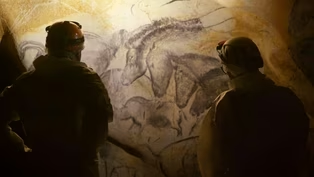
Preview: S53 Ep11 | 30s | Step into the stunning cave that’s reshaping our understanding of prehistoric art. (30s)
Video has Closed Captions
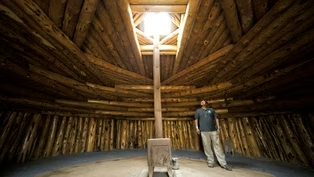
Preview: S53 Ep10 | 30s | Witness how Native North Americans have generated scientific knowledge over thousands of years. (30s)
Video has Closed Captions
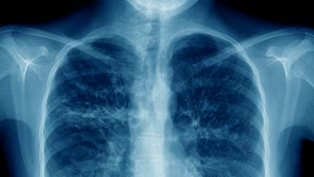
Preview: S53 Ep9 | 30s | Follow the relentless quest that led to a breakthrough treatment for a deadly disease. (30s)
Video has Closed Captions
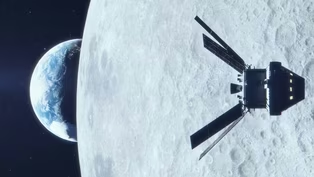
Preview: S53 Ep7 | 30s | Follow the Artemis mission to bring humanity back to the Moon for the first time since Apollo. (30s)
Athens: Birth of Democracy Preview
Video has Closed Captions
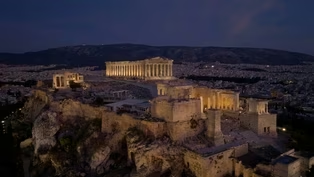
Preview: S53 Ep8 | 30s | Archaeologists investigate the dramatic origins of democracy in ancient Greece 2,500 years ago. (30s)
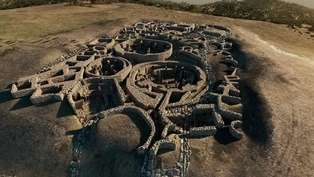
Stone Age Temple Mystery Preview
Video has Closed Captions
Preview: S53 Ep6 | 30s | Surprising evidence at the world’s oldest temple overturns our understanding of human history. (30s)
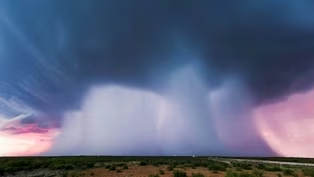
Video has Closed Captions
Preview: S53 Ep5 | 30s | A deadly—and growing—global weather phenomenon mystifies scientists. (30s)
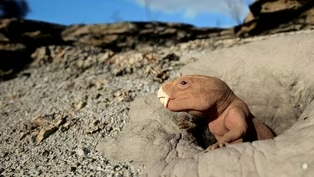
Video has Closed Captions
Preview: S53 Ep4 | 30s | Explore mammals’ surprising origins, long before the age of dinosaurs. (30s)

Video has Closed Captions
Preview: S53 Ep3 | 30s | Do speech buttons really allow dogs to talk to us? Scientists investigate. (30s)
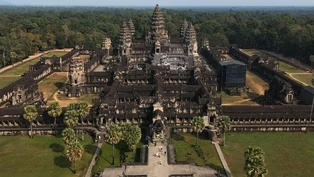
Angkor: Hidden Jungle Empire Preview
Video has Closed Captions
Preview: S53 Ep2 | 30s | New evidence sheds light on the remarkable life—and mysterious collapse—of the ancient jungle city. (30s)
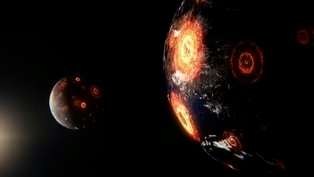
When Earth Was Bombarded by Asteroids
Video has Closed Captions
Clip: S53 Ep1 | 3m 41s | What studying the surface of the Moon revealed about Earth’s apocalyptic youth. (3m 41s)
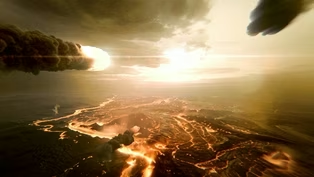
Asteroids: Spark of Life? Preview
Video has Closed Captions
Preview: S53 Ep1 | 30s | What if violent asteroid impacts actually jump-started life on Earth? Explore a dramatic theory. (30s)
Providing Support for PBS.org
Learn Moreabout PBS online sponsorship












Support for PBS provided by:
National Corporate funding for NOVA is provided by Carlisle Companies. Major funding for NOVA is provided by the NOVA Science Trust and PBS viewers.