
Why Earth’s Core Is Younger Than Its Surface
Clip: Season 53 | 6mVideo has Closed Captions
Time isn’t the same for everyone, according to Einstein.
Earth’s core is 2.5 years younger than the surface. According to Einstein’s theories of general and special relativity, time passes differently for different observers based on velocity and gravity. And those theories have helped us with navigation and fighting climate change.
Problems playing video? | Closed Captioning Feedback
Problems playing video? | Closed Captioning Feedback
National Corporate funding for NOVA is provided by Carlisle Companies. Major funding for NOVA is provided by the NOVA Science Trust and PBS viewers.
Support provided by:


Why Earth’s Core Is Younger Than Its Surface
Clip: Season 53 | 6mVideo has Closed Captions
Earth’s core is 2.5 years younger than the surface. According to Einstein’s theories of general and special relativity, time passes differently for different observers based on velocity and gravity. And those theories have helped us with navigation and fighting climate change.
Problems playing video? | Closed Captioning Feedback
Where to Watch NOVA
NOVA is available to stream on pbs.org and the PBS app.
NOVA Labs
NOVA Labs is a free digital platform that engages teens and lifelong learners in games and interactives that foster authentic scientific exploration. Participants take part in real-world investigations by visualizing, analyzing, and playing with the same data that scientists use.Providing Support for PBS.org
Learn Moreabout PBS online sponsorship- Earth's core is stuck in the past.
Literally.
Time there is lagging two and a half years behind time at the surface.
And that's not just some quirk of Earth's core.
We're all in slightly different eras.
Your time is different from my time, which is different from the microbe at the bottom of the ocean and the yak on Mount Everest and the astronauts on the International Space Station.
Even my feet and my head are experiencing slightly different versions of time.
That sounds like science fiction, but it's real and we know about it because with clocks we can measure not just time, but also how time interacts with gravity.
The connection between time and gravity goes back to the 1900s when Einstein predicted something known as time dilation.
It describes how time passes at different rates for different observers based on the relative velocity or the strength of the gravitational field they're in.
It's one of the weirdest things about our reality.
Einstein wasn't the first to discover time dilation, but he did go on to develop the most complete theories and the best explanations for it.
The first theory special relativity tells us that the faster someone moves with respect to an observer, the slower their time appears to be moving from the point of view of the observer.
So if you're on earth and watch someone fly by in a rocket ship, their time is dilated.
Einstein built on that theory to develop his theory of general relativity, which says that the more strongly gravity acts on you, the slower time passes for you compared to an observer in a weaker gravitational field.
To understand that it's helpful to think about the way Einstein pictured the universe.
According to his theories, space and time are linked in something called naturally space time.
And the way we usually picture space time is as sort of a fabric that's tightly stretched like a trampoline.
Objects with masss like say Earth, sit in space time like a bowling ball on a trampoline and bend the fabric.
That bend in space time is what we know of as gravity, and the more mass an object has, the more it bends space time or the stronger its gravitational pull is.
And since time is part of that fabric, the mass of an object also distorts and stretches time.
And the closer you are to the center of a big gravitational mass like a black hole, the slower time moves.
Here's another way to picture that.
Say we make a really basic clock with light bouncing between two mirrors, one tick or second on the clock corresponds to the light beam bouncing off both mirrors.
Then say we place one of these light clocks on earth's surface and an identical one way out in space.
The curve of space time means that the light in the clock at earth surface will follow a curved path between the two mirrors.
Light travels at the same speed in both clocks, but it will take longer for the light to travel between the two mirrors at earth's surface.
In other words, the clock at earth's surface will tick more slowly.
If you're feeling skeptical, that's totally fair.
But general relativity is one of the most tested theories in physics.
And time and again, experiments and practical applications have shown that Einstein's predictions are pretty solid.
Time dilation can be seen most clearly by using atomic clocks, which are super accurate because they measure time based on the ultra fast oscillations of atoms.
More specifically, one tick or a second on an atomic clock is equivalent to more than 9 billion oscillations, and in stronger gravity, it takes longer for those 9 billion oscillations to occur.
In experiments, atomic clocks installed on skyscrapers and satellites were found to tick faster than the ones at ground level.
Most GPS satellites carry atomic clocks, and at those elevations and speeds, the clocks run 38 microsecond faster than clocks on earth surface.
One team of physicists even measured the time dilation of two clocks situated only one millimeter apart.
Of course, we're talking pretty tiny numbers here with a 33 centimeter gap in elevation, the difference in time dilation only accounts for 90 billionths of a second over a period of 79 years.
That means by the end of my life, the top of my head might be just 90 billionths of a second older than my shoulders.
So you don't have to worry too much about whether your apartment is on the ground floor or the top.
But in some other cases, these tiny differences can matter a lot.
Take satellites, small differences in gravity can have a huge effect.
Without accounting for relativity, satellites can desync to the point that after a day your GPS directions would be off by six miles and it would just keep getting worse.
Scientists are experimenting with atomic clocks on the International Space Station too.
Since a future moon base or long haul space flight would need super accurate clocks for navigation and communication.
And here on earth we're experimenting with measuring minuscule differences in gravity due to differences in height above sea level.
The ground often shifts before volcanic eruptions and earthquakes, which would shift the position of an atomic clock and change how fast it runs.
With a network of atomic clocks, we can monitor these small changes and make better predictions, or we can measure melting ice and rising sea levels to help us monitor the effects of climate change.
These kinds of very precise time and gravitational measurements are essential for all sorts of science and technology.
And with the ability to map the universe's gravitational landscape down to the millimeter, we may be able to find out more about what makes up that landscape and answer all kinds of questions about everything from black holes and dark matter to quantum states and the nature of time itself.
(ominous music)

The Battle to Breathe: The Last 10%
Video has Closed Captions
Clip: S53 | 18m 6s | Inside the race to bring life-saving genetic therapies to every person living with cystic fibrosis. (18m 6s)
The Battle to Breathe: CF Before Birth
Video has Closed Captions
Clip: S53 | 15m 51s | Inside one mother's fight to ensure a healthy life for her child with cystic fibrosis. (15m 51s)
The Mind-Bending Physics of Origami
Video has Closed Captions
Clip: S53 | 5m 52s | A simple fold can completely change how a material behaves. (5m 52s)
Video has Closed Captions
Clip: S53 | 5m 48s | Modern physics and imaging techniques are finally solving the mystery. (5m 48s)
 Now Playing
Why Earth’s Core Is Younger Than Its Surface
Video has Closed Captions
Clip: S53 | 6m | Time isn’t the same for everyone, according to Einstein. (6m)
The Truth about Quantum Computers
Video has Closed Captions
Clip: S53 | 6m 44s | Microsoft's breakthrough in quantum computing could have a huge impact on science, and our future. (6m 44s)
The Problem That Broke Physics (And Led to Chaos)
Video has Closed Captions
Clip: S53 | 6m 12s | The “butterfly effect” is often cited in pop culture, but it’s actually rooted in physics and chaos. (6m 12s)
The Ocean Wave Scientists Thought Was Impossible
Video has Closed Captions
Clip: S53 | 5m 46s | These massive walls of water may be far more common than we once believed. (5m 46s)
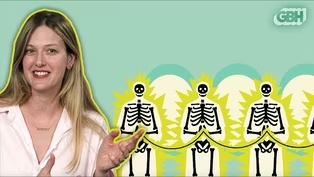
Is Electricity Instant? A Shocking Experiment from 1746
Video has Closed Captions
Clip: S53 | 5m 56s | It’s taken over 250 years of shocking experiments to understand how quickly electricity moves! (5m 56s)
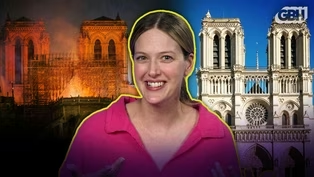
Does Notre Dame Sound Different Now?
Video has Closed Captions
Clip: S53 | 6m 8s | Restoring Notre Dame wasn’t just about stone and stained glass. (6m 8s)

Evolution: Brain Power Preview
Video has Closed Captions
Preview: S53 Ep13 | 1m | The story of the dolphin reveals how intelligence evolved, step by step, over billions of years. (1m)
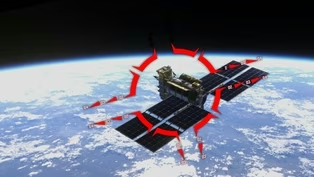
Video has Closed Captions
Preview: S53 Ep12 | 30s | Inside the escalating military struggle to control space and the satellites we rely on. (30s)
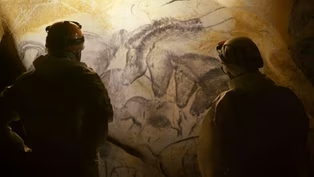
Video has Closed Captions
Preview: S53 Ep11 | 30s | Step into the stunning cave that’s reshaping our understanding of prehistoric art. (30s)
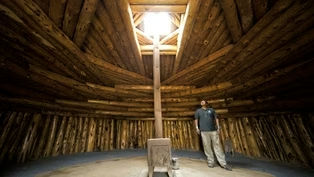
Video has Closed Captions
Preview: S53 Ep10 | 30s | Witness how Native North Americans have generated scientific knowledge over thousands of years. (30s)

Video has Closed Captions
Preview: S53 Ep9 | 30s | Follow the relentless quest that led to a breakthrough treatment for a deadly disease. (30s)
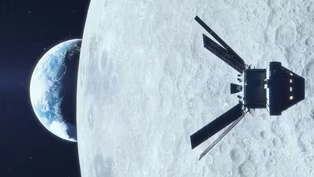
Video has Closed Captions
Preview: S53 Ep7 | 30s | Follow the Artemis mission to bring humanity back to the Moon for the first time since Apollo. (30s)
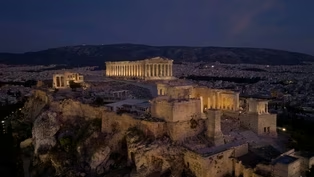
Athens: Birth of Democracy Preview
Video has Closed Captions
Preview: S53 Ep8 | 30s | Archaeologists investigate the dramatic origins of democracy in ancient Greece 2,500 years ago. (30s)
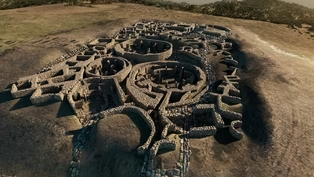
Stone Age Temple Mystery Preview
Video has Closed Captions
Preview: S53 Ep6 | 30s | Surprising evidence at the world’s oldest temple overturns our understanding of human history. (30s)

Video has Closed Captions
Preview: S53 Ep5 | 30s | A deadly—and growing—global weather phenomenon mystifies scientists. (30s)
Video has Closed Captions
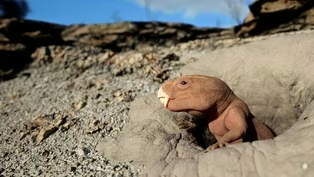
Preview: S53 Ep4 | 30s | Explore mammals’ surprising origins, long before the age of dinosaurs. (30s)

Video has Closed Captions
Preview: S53 Ep3 | 30s | Do speech buttons really allow dogs to talk to us? Scientists investigate. (30s)

Angkor: Hidden Jungle Empire Preview
Video has Closed Captions
Preview: S53 Ep2 | 30s | New evidence sheds light on the remarkable life—and mysterious collapse—of the ancient jungle city. (30s)
When Earth Was Bombarded by Asteroids
Video has Closed Captions
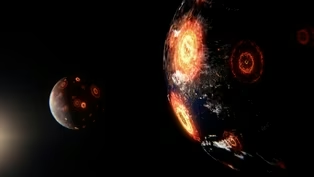
Clip: S53 Ep1 | 3m 41s | What studying the surface of the Moon revealed about Earth’s apocalyptic youth. (3m 41s)
Asteroids: Spark of Life? Preview
Video has Closed Captions
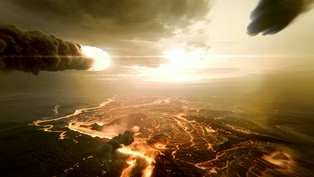
Preview: S53 Ep1 | 30s | What if violent asteroid impacts actually jump-started life on Earth? Explore a dramatic theory. (30s)
Providing Support for PBS.org
Learn Moreabout PBS online sponsorship












Support for PBS provided by:
National Corporate funding for NOVA is provided by Carlisle Companies. Major funding for NOVA is provided by the NOVA Science Trust and PBS viewers.