
Addison McDowell, Republican Candidate for NC’s 6th Congressional District
Special | 14m 11sVideo has Closed Captions
An interview with Addison McDowell, Republican candidate for NC’s 6th Congressional District (2026).
Addison McDowell is running as a Republican for NC’s 6th Congressional District. He discusses his 2026 campaign with PBS NC’s Kelly McCullen. This interview was recorded on September 18, 2026.
Problems playing video? | Closed Captioning Feedback
Problems playing video? | Closed Captioning Feedback
State Lines is a local public television program presented by PBS NC
Addison McDowell, Republican Candidate for NC’s 6th Congressional District
Special | 14m 11sVideo has Closed Captions
Addison McDowell is running as a Republican for NC’s 6th Congressional District. He discusses his 2026 campaign with PBS NC’s Kelly McCullen. This interview was recorded on September 18, 2026.
Problems playing video? | Closed Captioning Feedback
Where to Watch State Lines
State Lines is available to stream on pbs.org and the PBS app.
Providing Support for PBS.org
Learn Moreabout PBS online sponsorshipMore from This Collection
During major election cycles, PBS North Carolina's public affairs team sits down for in-depth conversations with candidates running for elected office in North Carolina. PBS North Carolina has invited major party candidates to a one-on-one interview with State Lines host and executive producer Kelly McCullen. Interviews are scheduled throughout the summer and early fall.
NC Judicial Candidates Forum: NC Court of Appeals Judge Seats 2 & 3
Video has Closed Captions
Meet candidates for the NC Court of Appeals Judge Seats 2 and 3. (26m 46s)
Candidates for NC Court of Appeals Judge Seat 3: Craig Collins (R) & Christine Marie Walczyk (D)
Video has Closed Captions
Meet the Republican and Democratic candidates for the NC Court of Appeals Judge Seat 3. (13m 7s)
Candidate for NC Court of Appeals Judge Seat 2: Tobias Hampson (D)
Video has Closed Captions
Meet the Democratic candidate for the NC Court of Appeals Judge Seat 2. (12m 57s)
Candidates for NC Supreme Court Associate Justice Seat 1: Anita Earls (D) & Sarah Stevens (R)
Video has Closed Captions
Meet the Democratic and Republican candidates for the NC Supreme Court Associate Justice Seat 1. (12m 38s)
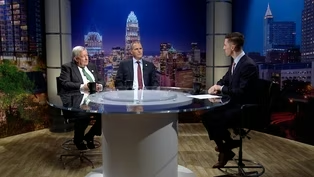
Candidates for NC Court of Appeals Judge Seat 1: John Arrowood (D) & Michael Byrne (R)
Video has Closed Captions
Meet the Democratic and Republican candidates for the NC Court of Appeals Judge Seat 1. (11m 54s)
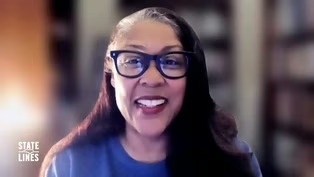
Kimberly Hardy, Democratic Candidate for NC’s 7th Congressional District
Video has Closed Captions
An interview with Kimberly Hardy, Democratic candidate for NC’s 7th Congressional District (2026). (14m 16s)
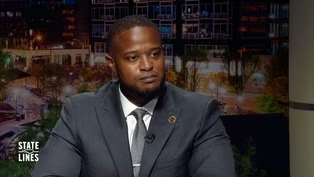
Cyril Jefferson, Democratic Candidate for NC’s 6th Congressional District
Video has Closed Captions
An interview with Cyril Jefferson, Democratic candidate for NC’s 6th Congressional District (2026). (13m 42s)
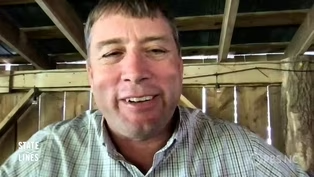
Jamie Ager, Democratic Candidate for NC’s 11th Congressional District
Video has Closed Captions
An interview with Jamie Ager, Democratic candidate for NC’s 11th Congressional District (2026). (14m)
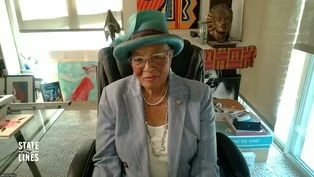
Alma Adams, Democratic Candidate for NC’s 12th Congressional District
Video has Closed Captions
An interview with Alma Adams, Democratic candidate for NC’s 12th Congressional District (2026). (15m 19s)
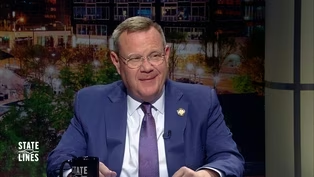
Tim Moore, Republican Candidate for NC’s 14th Congressional District
Video has Closed Captions
An interview with Tim Moore, Republican candidate for NC’s 14th Congressional District (2026). (14m 46s)
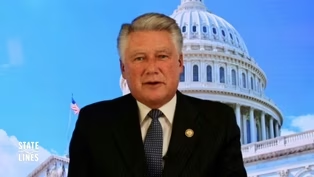
Mark Harris, Republican Candidate for NC’s 8th Congressional District
Video has Closed Captions
An interview with Mark Harris, Republican candidate for NC’s 8th Congressional District (2026). (15m 27s)
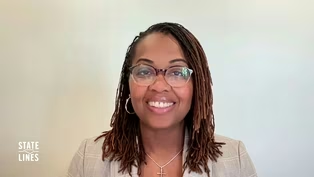
Lakesha Womack, Democratic Candidate for NC’s 14th Congressional District
Video has Closed Captions
An interview with Lakesha Womack, Democratic candidate for NC’s 14th Congressional District (2026). (14m 56s)
Providing Support for PBS.org
Learn Moreabout PBS online sponsorship- We're joined by Representative Addison McDowell of the 6th U.S.
Congressional District.
One term down, multiple turns you hope to go.
Representative, thanks for being on for this brief conversation.
- You got it.
Happy to be here.
- You know, there's a lot of people out there outside that 6th District, but most importantly, your voters.
And some may be new to that area.
Tell us about yourself.
- Well, yeah.
So, the most important thing about me, I always tell people, is not -- it's not even close to being that I'm a member of Congress.
It's that I'm Rachel's husband and a dad to three daughters.
And we've got a 3-year-old, a 2-year-old, and a 2-week-old.
And so that -- my family is the most important thing about me.
And so that's what I want people to know me as.
I'm a dad and a husband.
And I grew up in the 6th District of North Carolina and love it.
It's been my home for a long time.
Went to UNC Charlotte.
Met my wife there.
We were young life leaders in college.
And that's how we met each other.
And just have really, really loved growing up and living in North Carolina.
And I'm really grateful that I get to raise my family in the 6th District of North Carolina.
I grew up in Lexington, but am raising my family in Davie County.
And we just love it.
It's my favorite place on Earth.
- So, where is the 6th District exactly?
Up and down?
Is it I-77?
Is it up that way?
- So, it's 85.
- 85, that's right.
- And so, it's Greensboro kind of loops all the way down to Kannapolis and Concord.
- You know, a lot of voters out there have older kids or grown kids or grandkids.
They'll look at a younger legislator who says family first.
And tell me about balancing having a family and three young ones, but yet still saying it's -- I need to be -- I need to serve the 6th District.
- Well, you know, the only way that any of this is worth it to me is that if -- when my daughters are, you know, 18, none of them really speak great English right now.
It's kind of, you know, something -- but they -- if -- when they're 18 or, you know, adults, and they can look at me and say, Daddy, we understand why you had to go to Washington, D.C., when we were little.
We understand why you had to go from Monday to Thursday to go and serve our country in Congress, because you did things well.
You did the right things.
You did good things for our country.
And if I can give them the same kind of, you know, country that I got to grow up in, that's a win for me.
And it's -- you know, we want to do that for everyone's kids.
I want -- you know, I want your family to be able to grow up in an America that looks like what you want it to look like.
And that's really important to me.
But it is hard to balance the being away from home.
You know, my wife -- we have a little baby, and I had to go to Washington last week.
And so, logistically, that was a real challenge of, like, you can't lift our other two out of their bed right now after the delivery of that third one.
I'm not there.
So how do we deal with that?
And that's not a problem that my, you know, 95-year-old colleagues have anymore.
And so that's hard.
But I think, you know, it's challenging, for sure, when, you know, I get home and my kids look different, or they have, like, a new tooth or longer hair, or they've learned something new and I missed it.
That is hard.
But it is so important to do the job that I do, and I want to do it well.
And that's a way that I can honor that sacrifice to leave them.
- What are voters telling you in the 6th District as you travel around during this -- I won't call it a recess.
I've heard other Congress members call it, like, a working -- it's really a working -- you're just working at home.
What are they telling you about this, heading into the midterms?
What's going on?
- You know, I hear a lot about affordability, and that's -- you know, it's a problem.
And we have to get that under control.
I drive a pickup truck.
I know gas is expensive.
And I feel it just the same as you do.
I'm home more than I'm in Washington, and so I get it.
And so that's something that I hear about.
But if you were to only listen to the national media and what the folks that are in a New York City bubble or a Washington, D.C., bubble are telling you that I'm hearing about, they're wrong, that that's not actually what I'm hearing about.
What I'm hearing about is, you know, things that are as simple and just as common sense as, hey, these spam phone calls that we get that are making my elder parent lose their Social Security money, that's a problem.
You know, we just had a bill go through a committee process.
The bill passed the Senate.
It was Senator Budd.
He had a companion bill to the one that I did in the House, and it made it through the Senate.
We passed my version through the House committee this week.
But it addresses that problem.
And that's something I hear about.
I had a neighbor come and talk to me about that the other day.
They're not coming and talking to me about the things that, you know, that CNN or Fox or MSNBC are using to keep their 24-hour news cycle going.
It's real issues that people deal with.
- They're hitting you on gas prices and the cost of hamburger steaks and all that?
- Yeah.
Well, I mean, affordability.
Of course they are.
Yeah.
And I say, look, I get it.
It's too expensive.
And I think that Republican policies are certainly better than the alternative in driving those prices down.
But yes, I understand it.
I feel it, too.
- In the grand scheme of economic policy, where do you fall on this idea of many people will say the government spends so much money, it causes -- they print.
You have to print money to deficit spend.
Therefore, that causes the inflation.
So how does the government step in and reduce inflation while you're promising benefits or stimulus or whatever we're going to need if the economy were to turn soon?
- Absolutely.
Well, I mean, I'm on the House Budget Committee.
And so I, you know, I'll think of myself as a fiscal hawk.
And what we are doing as a government is overspending, overleveraging and overborrowing.
And we're not being good stewards of taxpayer money.
And we have to get very serious about our national debt, because it is a real, real problem that keeps me awake at night, because we're going to hamstring our children and their children with debt that they can't get out of.
And our debt is such a problem right now that we can't cut our way out of it.
There is no way we could cut enough spending to solve our national debt crisis.
And so I believe the best thing we can do is to, you know, go ahead and let's make economic growth possible.
Let's make GDP growth possible.
And I think Republican policies are what does that.
But it's you've got to make sure that our GDP is growing, that our economy is growing.
And there's different ways to do that.
But I think one of the things you've seen Republicans do over the last two years is really focus on policies that aren't a short-term fix.
You know, we saw, you know, the policies that we're trying to button these up right before an election.
That's not what we're trying to do.
We want to make long-term, looking, you know, five, 10 years in the future, we want to drive the price of everything down long-term.
And I can guarantee you one way not to do that is socialism.
And I think cutting regulation, cutting red tape, inspiring economic growth and building things here in America, that's how we do it.
That's how we begin to correct the -- bend the curve that we're on of national debt and kind of reverse the curse that I think the national debt is to our children and their children.
- We're hearing trade is part of the 2026 campaign, tariffs, free trade, fair trade, depending which side you're on.
- Sure.
- Lay it out for us with the tariff policy.
There's been a lot of fighting with Canada, but that's not the legislative branch.
That's the executive branch, to be fair.
How should we view tariffs in relation to economic growth?
Higher prices and building jobs in America?
- I think it's important to think about it not as, tariffs are not an economic policy.
They're a tool that we use to combat folks that are taking advantage of us.
And that's what we saw for many, many years, was other countries were ripping off the United States of America, and we obviously don't want that.
But I think you have to look at it as tariffs are a tool, but then also it's important that we have really good policy that couples with that tool that we're using.
And I think that's the way to think about it, not as tariffs are the economic policy.
They're not.
But I think, you know, I'm so grateful that I get to raise my family in the 6th District of North Carolina.
I want people to be able to do that.
I want them to have good jobs there.
And my district is one that just got hammered by NAFTA.
And we saw all those jobs go away.
And we want these industries to come back.
And there are efforts underway already right now on the ground to do that.
It's going to take time.
And so that's why it can't be an economic policy.
It has to be a tool.
- Do representatives like yourself deserve a seat at that table when tariff policy is being crafted?
It's been pretty much only the executive branch.
Executive power once taken.
The next president, Democrat or Republican, would certainly be emboldened, I would think, by the policies of the second administration of Trump.
- I certainly think that we should.
And it's -- you know, the Constitution is pretty clear.
You know, it lays out what our authority is.
I do think that the president is an incredible dealmaker.
And the team that he has around him and Secretary Bessent and Secretary Rubio and the folks that he has around him that are proven dealmakers, I trust them more than I trust the people that I serve with, that their only concern is to be famous.
You know, I would rather the serious minds of our nation, like Scott Bessent, be the one that's negotiating with a country that has been ripping us off for a long time, rather than somebody that's just trying to get a soundbite.
- Well, we've elected those people that just want a soundbite in Congress.
So let's go to election integrity.
I looked at your platform.
Big deal for you, the election integrity issue.
There's been a lot of movement at the legislative level in North Carolina.
But what should be a federal response, or should it be hands-off?
- Well, I think there's -- it should be hands-off, but not when people are cheating, and not when they're trying to take advantage of a system and do things that are illegal or certainly go against the spirit of the law.
I think it's really, really important that we have trust and faith in our elections.
Our elections in the United States of America are the marvel of the modern world, that people look at our elections and they're -- you know, they're amazed by them.
Over the last eight years, that's changed, and people no longer have faith in our elections.
And I think when you have, you know, different places that -- you've got Florida.
It's a massive state that can count their ballots and have their elections settled and done, well, certainly after the -- their 2000 election.
But now they can count these ballots very quickly, have them done by 8:30.
We know exactly who won in Florida.
But it takes -- California has still not done counting ballots from 2022.
I mean, that -- like, how is that possible?
And so, yes, I think we should be hands-on in the sense that if people are cheating and we can't trust Gavin Newsom to fix that problem, we're going to fix it.
And we have to.
It's that important.
This is our country.
We can't have our country be stolen by people that want to do wrong.
- What about North Carolina elections?
I mean, we've voted Trump as a state and elected Josh Stein and Roy Cooper in the same year we put Trump in the White House.
- Sure.
I think our state has always kind of done that.
I mean, if you go back to Jesse Helms, we can never make up our mind.
But I think what North Carolina -- what we do well is, we have our elections, we get our election.
But when you look at Durham, they -- it takes them forever.
When you look at other places -- and it just takes them way longer than it should.
And when you have courts that are legislating from the bench telling our election bodies what they can and can't do, that's when there's some real trouble that I see that comes up.
- What do you make of this executive order from the Trump administration winding its way through courts?
It's getting beaten in places.
It's being reinstated in places.
The post office collects the voter rolls.
The post office sets the ballot terms, the mail-in envelope standards and the distribution.
That seems like federalizing.
I know that's -- you said, I don't want to federalize.
- Sure.
- How do we balance those approaches to election integrity?
- Yes, well, I think the main thing for folks at home to realize is that it's too late to do it for this election.
Like, it's too late.
The election is starting now, so we have missed the window of when we could have done something at the federal level.
That's over.
And so now we look to -- we can try it again.
But right now, it's set.
We got to go with what we have.
But I think what's really important to look at and to think about right now is, you know, every person, what does every citizen have, a Social Security number?
And the post office has access to that.
And so there's got to be a way for us to identify who is an American citizen.
That is who should vote.
Who is not an American citizen, they cannot vote in a federal election.
They shouldn't be able to vote in state elections.
And in North Carolina, they can't.
But that's why I think it's important to think about a way to do that.
And now I -- the court has made it clear what they want to do.
The only thing I want is fair elections, free elections, and elections that people can trust.
That's what we have to do.
- A lot of folks outside your district would like to know more about you, and of course the voters within.
How can we learn more about the Addison McDowell platform, the candidate and the man running for office?
- Sure.
Well, if you want to go to mcdowell.house.gov, that is my website.
And you can find -- we have a newsletter that we send out weekly that you can sign up for there.
We have a list of everything that we have done over the course of the last week.
We're on all social media.
If you want to see some pictures of my kids, those sometimes find their way there with me, with my little girls.
So they're way cuter than me.
And my wife is certainly better looking than me.
So if you want to see pictures of my family, that's where you can find those.
But we're on YouTube, Facebook, Twitter, all of that.
- That's Representative Addison McDowell, folks, 6th U.S.
Congressional District.
First term in the House, looking for a second term.
As always, I appreciate you coming, making the trip here to our studios.
Always good to see you.
Hope you'll come back really soon.
I appreciate your time.
- Thanks so much.
♪
 New Episode
- News and Public Affairs

Top journalists deliver compelling original analysis of the hour's headlines.
 New Episode
- News and Public Affairs

Today's top journalists discuss Washington's current political events and public affairs.
 New Episode
 New Episode
 New Episode
 New Episode
 New Episode



 New Episode

Support for PBS provided by:
State Lines is a local public television program presented by PBS NC