
Candidates for NC Court of Appeals Judge Seat 3: Craig Collins (R) & Christine Marie Walczyk (D)
Special | 13m 7sVideo has Closed Captions
Meet the Republican and Democratic candidates for the NC Court of Appeals Judge Seat 3.
Candidates Craig Collins (Republican) and Christine Marie Walczyk (Democrat) discuss their background and why they’re running for the NC Court of Appeals Judge Seat 3 with PBS NC’s Kelly McCullen. The 2026 NC Judicial Candidates Forum is made possible by a partnership between PBS North Carolina and the North Carolina Bar Association.
Problems playing video? | Closed Captioning Feedback
Problems playing video? | Closed Captioning Feedback
State Lines is a local public television program presented by PBS NC
Candidates for NC Court of Appeals Judge Seat 3: Craig Collins (R) & Christine Marie Walczyk (D)
Special | 13m 7sVideo has Closed Captions
Candidates Craig Collins (Republican) and Christine Marie Walczyk (Democrat) discuss their background and why they’re running for the NC Court of Appeals Judge Seat 3 with PBS NC’s Kelly McCullen. The 2026 NC Judicial Candidates Forum is made possible by a partnership between PBS North Carolina and the North Carolina Bar Association.
Problems playing video? | Closed Captioning Feedback
Where to Watch State Lines
State Lines is available to stream on pbs.org and the PBS app.
Providing Support for PBS.org
Learn Moreabout PBS online sponsorshipMore from This Collection
During major election cycles, PBS North Carolina's public affairs team sits down for in-depth conversations with candidates running for elected office in North Carolina. PBS North Carolina has invited major party candidates to a one-on-one interview with State Lines host and executive producer Kelly McCullen. Interviews are scheduled throughout the summer and early fall.
 New
NewNC Judicial Candidates Forum: NC Court of Appeals Judge Seats 2 & 3
Video has Closed Captions
Meet candidates for the NC Court of Appeals Judge Seats 2 and 3. (26m 46s)
 New
NewCandidate for NC Court of Appeals Judge Seat 2: Tobias Hampson (D)
Video has Closed Captions
Meet the Democratic candidate for the NC Court of Appeals Judge Seat 2. (12m 57s)
Candidates for NC Supreme Court Associate Justice Seat 1: Anita Earls (D) & Sarah Stevens (R)
Video has Closed Captions
Meet the Democratic and Republican candidates for the NC Supreme Court Associate Justice Seat 1. (12m 38s)
Candidates for NC Court of Appeals Judge Seat 1: John Arrowood (D) & Michael Byrne (R)
Video has Closed Captions
Meet the Democratic and Republican candidates for the NC Court of Appeals Judge Seat 1. (11m 54s)
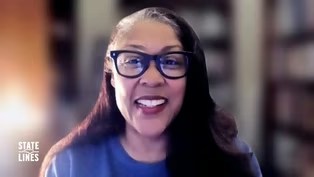
Kimberly Hardy, Democratic Candidate for NC’s 7th Congressional District
Video has Closed Captions
An interview with Kimberly Hardy, Democratic candidate for NC’s 7th Congressional District (2026). (14m 16s)
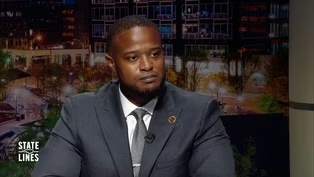
Cyril Jefferson, Democratic Candidate for NC’s 6th Congressional District
Video has Closed Captions
An interview with Cyril Jefferson, Democratic candidate for NC’s 6th Congressional District (2026). (13m 42s)
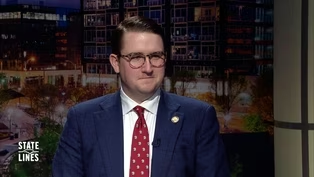
Addison McDowell, Republican Candidate for NC’s 6th Congressional District
Video has Closed Captions
An interview with Addison McDowell, Republican candidate for NC’s 6th Congressional District (2026). (14m 11s)
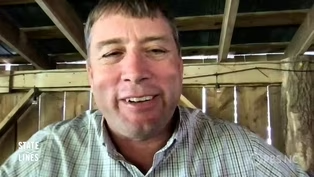
Jamie Ager, Democratic Candidate for NC’s 11th Congressional District
Video has Closed Captions
An interview with Jamie Ager, Democratic candidate for NC’s 11th Congressional District (2026). (14m)
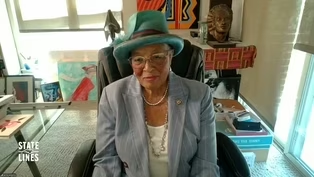
Alma Adams, Democratic Candidate for NC’s 12th Congressional District
Video has Closed Captions
An interview with Alma Adams, Democratic candidate for NC’s 12th Congressional District (2026). (15m 19s)
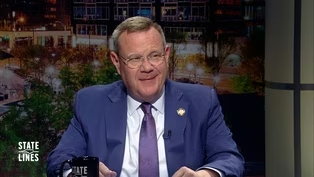
Tim Moore, Republican Candidate for NC’s 14th Congressional District
Video has Closed Captions
An interview with Tim Moore, Republican candidate for NC’s 14th Congressional District (2026). (14m 46s)
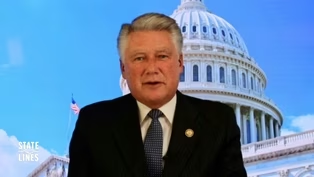
Mark Harris, Republican Candidate for NC’s 8th Congressional District
Video has Closed Captions
An interview with Mark Harris, Republican candidate for NC’s 8th Congressional District (2026). (15m 27s)
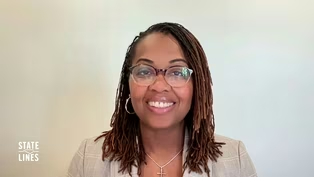
Lakesha Womack, Democratic Candidate for NC’s 14th Congressional District
Video has Closed Captions
An interview with Lakesha Womack, Democratic candidate for NC’s 14th Congressional District (2026). (14m 56s)
Providing Support for PBS.org
Learn Moreabout PBS online sponsorship- The 2026 Judicial Candidates Forum is made possible by a partnership between PBS North Carolina and the North Carolina Bar Association.
♪ - Joining us now are the candidates for North Carolina Court of Appeals.
Seat number three, Democratic candidate Christine Marie Walczyk and Republican candidate Craig Collins.
Thank you both for agreeing to appear on set and have a conversation about the race, especially that seat three race.
- Thanks for having us.
- Thank you for being here.
- So we did a flip of the coin and it turns out you will answer the first question.
You will get the last word, Ms.
Walczyk.
We'll start.
This is an easy question.
Tell us about your qualifications, Mr.
Collins, and why you're seeking a Court of Appeals seat in 2026.
- Sure.
I've spent time as a prosecutor, private attorney, district court judge and a superior court judge.
I think the cumulative impact of those four experiences has me ready to take the next step and move on to the Court of Appeals.
And I want to make sure that we have judges who have understood the proper role of the trial court and to make sure that we give clear cut rules for the trial courts.
And that's my goal along with make sure that we're protecting our Constitution at every step of the way.
- Ms.
Walczyk, your qualifications and why is the seat right for you?
- Thank you.
Well, thanks for having us here.
I have been working for the last two decades as a district court judge in Wake County, our state's largest county.
I have been hearing all the kinds of cases that they hear at the Court of Appeals.
And in that role, I was nominated for leadership positions by four different chief judges, both Democrat and Republican.
So I was lead family court judge for many years, and I'm currently our general civil lead judge.
And, you know, I have a record of enforcing and protecting due process in my courtroom.
And before I was a judge, I owned my own law firm.
So I was a small business owner for over a decade.
We started that firm in the 90s because we wanted the freedom to represent the little guy and be a voice for the marginalized.
And so we typically represented employees, small family run businesses, and we did some indigent defense work.
I'm running because I believe in the rule of law.
I think we need a stronger, balanced, independent court that's going to, you know, protect constitutional freedoms of the people and put people over partisan agendas.
- Family court for you, running your own small law firm.
Pick out a few unique experiences or skills.
What is it about that particular legal experience that makes you the right fit for court of appeals?
- Well, my district court role, you know, we have to make difficult decisions in the public eye.
So when I issue a decision, I am looking in the face of the parties that are in that case, and I'm explaining to them why I'm doing what I'm doing.
We have to see the gravity and the humanity of these cases.
I hope to bring that with me to the court of appeals, where they're really just looking at a cold record and reading transcripts.
I want to remember the gravity and the importance of these cases, that there is a face to every case.
- And Mr.
Collins, a superior court judge now, assistant district attorney prosecutor.
Tell me about that unique experience.
It's not family court per se, but what is it about that line of legal work that makes you prepared?
- Well, we both have the experience of private practice.
We both did that.
We both have the experience of district court, so I've been a district court judge as well, and so we've each handled those.
But being a prosecutor and a superior court judge means I've also had the high level civil lawsuits, along with felony trials up through drug traffickers, rapists, murderers.
The cases that take a lot of time in the court of appeals, a large bulk of the cases that they hear are handled in superior court.
And so, again, we both share the domestic issues.
We both share the district court cases, but I also have the superior court level, both as a judge and as prosecutor and private attorney.
- And Ms.
Walczyk, what do you see as the role or function of the intermediate court of appeals?
What is this role between the Supreme Court and the lower courts in North Carolina, in your opinion?
- So, well, the first thing I would say about that is I think there's a misconception about the court of appeals in that it's an intermediate level court, that it might not be as important as the Supreme Court.
And in 2023, they eliminated the automatic right to appeal to the Supreme Court if there's a dissent.
And so, I would say 80 to 90 percent of the cases that come through the court of appeals, that is going to be the court of last resort.
So, to me, it's extremely important.
I also think that judges, you know, we have an obligation.
We don't write laws.
We don't write policies or budgeting decisions.
But if the other two political branches are not meeting their constitutional obligations or if they are running afoul of the Constitution, then it is our job to make sure that there's constitutional compliance.
- How do you view the role of the court of appeals in North Carolina?
- Well, the primary concern or need is to just make sure that the trial judge has got it right.
So, trial judges are making decisions on the fly throughout a trial with -- in real time during a trial.
And the court of appeals is able to take a slower look at it afterwards and make sure that any trial was done fairly.
Because the last thing we want are these cases to be resolved when the Constitution wasn't followed, when the statutes weren't followed properly, and make sure that it finds a fact were done properly.
And so, again, we don't want someone sitting in prison on some serious felony without some sort of review to make sure the trial judge got it right.
And so, that's the biggest role of the appellate court at that point.
- And all the judges you've seen go through the court of appeals in your career, what are two qualities when you look at someone at a higher court level, you go, those are qualities that every judge should have?
- I think the number one issue is simply following the Constitution as written.
I think being able to read the Constitution and follow it, not read it as you wish it to be, not read it as you would have written it if you were the one writing it.
The last thing we need are judges who will put their own policy beliefs into their court orders or amend the Constitution and circumventing the amendment process.
That's the biggest issue.
And a judge willing to listen to all the arguments before making decisions, but being rigid on what the Constitution requires.
- And I'll ask the same question of you.
A couple of qualities that you've looked at other judges that you might admire and go, that's really what it takes.
- So, well, first and foremost, you have to be an extremely hard worker.
You have to be a good writer, be able to write well-reasoned, clear opinions that give guidance to the trial judges around the state and to the public.
But other than that, I would say, first of all, moral courage and integrity.
You need to be able to make difficult decisions in the public eye that might not be well-liked by the public at times.
And you need to have integrity.
You need to follow the oath of office and the ethical standards that we set for ourselves.
And then the second thing I would say is humility.
You know, as judges, we have a life of learning the law.
It's a dynamic area.
And we have to be able to collaborate with other judges and we have to be able to, you know, let the public know that we're serving them.
And so, this requires humility.
We have to be active listeners.
And so, I would say integrity, moral courage and humility.
- Of all those, which taught you the most when you were practicing law, when you were at the lower court level, which ones have you leaned on the most and found the most success?
- Well, my integrity is always paramount.
I mean, everything I do in this election and in my job and in my personal life is to increase public trust and confidence in the judiciary.
I think that the public has to, you know, our sole source of power and authority comes from the public's belief in the institution.
And when we lose that trust, we're weakened as a system.
And I don't think that weakened courts are able to stop abuses of power.
I don't think they're able to protect individual liberties or defend our democracy.
So, my goal is to build a stronger court that has the public's trust.
- I want to ask you the same question.
As a prosecutor and come climbing the ranks, what qualities did you maybe underestimate and went, wow, those are really good skills to have, made you a better attorney and a better judge?
- Well, a judge has to make difficult decisions that don't always match up to what they wanted the result to be.
At the times, the law or the Constitution says something clearly that you wouldn't have made the decision.
So, the judges I've respected the most have the character and the courage to stand up to the political pressures, the societal pressures, and sometimes their own internal pressures to make decisions different than what the law requires.
A judge has to be willing to set aside those personal policy beliefs, those personal wishes, and enter the orders that are required under the law.
- What is your opinion of an independent judiciary in an era where you can run as partisan, you both are running with political affiliation, but voters also expect to know where a judge stands in the political party before you ever reach the bench?
- Well, the important thing is that the politics of the people appearing in front of us should never matter.
So, the issues shouldn't matter of Republican, Democrat.
The laws aren't Republican or Democrat.
The law is what the law is, and the Constitution is what it is.
I think often the difference between a constitutionalist candidate and an activist candidate is that the constitutionalist will follow the Constitution rigidly and without exception, whereas an activist will be more inclined to amend the law or Constitution through court order and not simply follow the written words as they are.
- Ms.
Walczyk , what do you make of that opinion of the "some will read it as written and nothing more, some will see breathing room within the Constitution for interpretation"?
- Well, first I'd like to say I don't subscribe to any singular interpretive approach.
I think those labels are used by other people to sort of pigeonhole us.
If you're asking what my judicial philosophy is, I mean, first of all, I believe in precedent.
I respect precedent.
I believe in judicial restraint.
I think judges should operate with a scalpel and not a chainsaw.
And I agree that your race, your gender, your religion, your socioeconomic situation, none of those things should impact the outcome of the case.
But I just, you know, I don't - I can't subscribe to the originalist idea where we're tied to the framers that are, you know, wrote a document in the 1700s when African Americans and women had no rights.
I think that judges are required to apply the law to real world situations.
And those framers had no concept of flock cameras or drones or cars for that matter.
And so we're required to apply the Constitution and our laws to real world situations.
And so I don't subscribe to any singular interpretive approach, but I just try to apply the law faithfully.
I pay attention to the words, the purpose of the words, the practical consequences of the words, and we make the best decisions we can.
- I do see a small philosophical difference here between you two, but I'll ask you, isn't she right?
The founding fathers couldn't have known what a flock camera was or a drone.
What do you make of her comments to say the document needs to breathe a bit to modernize?
- We have an amendment process.
In fact, on this ballot alone, we have three opportunities to amend the Constitution as the Constitution gives us that power.
It should never be done in what most people consider a back room.
We call it chambers.
And so the Constitution says what it says.
We don't get to just make the amendments.
And quite honestly, that is the huge philosophical difference here of I believe the Constitution means what it says.
I think judges should follow it and judges should never amend that Constitution through court order.
There is a process to do that.
And it's just it's not intended to be by the courts.
And when the courts start writing amendments to the Constitution, we're writing policy through their decisions.
We have a runaway court and a true constitutional crisis on our hands.
- Take 30 seconds.
Tell folks why they should vote for you.
- I believe the Constitution means what it says.
I'll always follow it.
I will never amend it to fit some political agenda.
I think we have to stand up for our communities.
We need to stand on the side of the rule of law, accountability and justice.
And if you elect me, that I'll work tirelessly to defend our Constitution, protect our constitutional rights and work against those who want to do us harm, whether that's through violence out on the streets or in our courtroom by erasing, rewriting our Constitution.
- Ms.
Walczyk, same last word to you as as we unveiled on the coin flip.
Why should folks support your campaign?
- So I believe in the rule of law.
And you've probably heard about the analogy of the rule of law like a three legged stool with each one of the legs being one of the branches.
And I believe that if you have a broken or loose leg or you have two of the legs really close together, then the stool goes over.
So I'm fighting for a more balanced and a stronger court that's going to keep the other two political branches in check.
I want an independent court that's free from the influence of politicians and partisan agendas.
And I am endorsed by a wide group of organizations that, you know, represent teachers, social workers, grassroots organizations, all of those young people and lots and lots of judges who've done this job before.
- And that's Republican Craig Collins, Democrat Christine Walczyk.
Thank you so much for your time and the conversation.
- Thank you.
- Thank you.
♪ - The 2026 Judicial Candidates Forum is made possible by a partnership between PBS North Carolina and the North Carolina Bar Association.
♪
 New Episode
- News and Public Affairs

Top journalists deliver compelling original analysis of the hour's headlines.
 New Episode
- News and Public Affairs

Today's top journalists discuss Washington's current political events and public affairs.
 New Season
 New Episode
 New Episode
 New Episode
 New Episode
 New Episode
 New Episode

 New Episode
 New Episode
Support for PBS provided by:
State Lines is a local public television program presented by PBS NC