
Lakesha Womack, Democratic Candidate for NC’s 14th Congressional District
Special | 14m 56sVideo has Closed Captions
An interview with Lakesha Womack, Democratic candidate for NC’s 14th Congressional District (2026).
Lakesha Womack is running as a Democrat for NC’s 14th Congressional District. She discusses her 2026 campaign with PBS NC’s Kelly McCullen. This interview was recorded on August 31, 2026.
Problems playing video? | Closed Captioning Feedback
Problems playing video? | Closed Captioning Feedback
State Lines is a local public television program presented by PBS NC
Lakesha Womack, Democratic Candidate for NC’s 14th Congressional District
Special | 14m 56sVideo has Closed Captions
Lakesha Womack is running as a Democrat for NC’s 14th Congressional District. She discusses her 2026 campaign with PBS NC’s Kelly McCullen. This interview was recorded on August 31, 2026.
Problems playing video? | Closed Captioning Feedback
Where to Watch State Lines
State Lines is available to stream on pbs.org and the PBS app.
Providing Support for PBS.org
Learn Moreabout PBS online sponsorshipMore from This Collection
During major election cycles, PBS North Carolina's public affairs team sits down for in-depth conversations with candidates running for elected office in North Carolina. PBS North Carolina has invited major party candidates to a one-on-one interview with State Lines host and executive producer Kelly McCullen. Interviews are scheduled throughout the summer and early fall.
NC Judicial Candidates Forum: NC Court of Appeals Judge Seats 2 & 3
Video has Closed Captions
Meet candidates for the NC Court of Appeals Judge Seats 2 and 3. (26m 46s)
Candidates for NC Court of Appeals Judge Seat 3: Craig Collins (R) & Christine Marie Walczyk (D)
Video has Closed Captions
Meet the Republican and Democratic candidates for the NC Court of Appeals Judge Seat 3. (13m 7s)
Candidate for NC Court of Appeals Judge Seat 2: Tobias Hampson (D)
Video has Closed Captions
Meet the Democratic candidate for the NC Court of Appeals Judge Seat 2. (12m 57s)
Candidates for NC Supreme Court Associate Justice Seat 1: Anita Earls (D) & Sarah Stevens (R)
Video has Closed Captions
Meet the Democratic and Republican candidates for the NC Supreme Court Associate Justice Seat 1. (12m 38s)
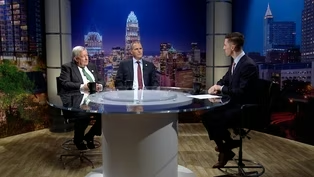
Candidates for NC Court of Appeals Judge Seat 1: John Arrowood (D) & Michael Byrne (R)
Video has Closed Captions
Meet the Democratic and Republican candidates for the NC Court of Appeals Judge Seat 1. (11m 54s)
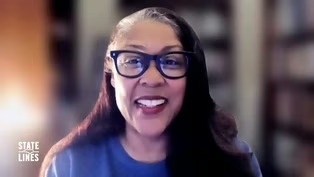
Kimberly Hardy, Democratic Candidate for NC’s 7th Congressional District
Video has Closed Captions
An interview with Kimberly Hardy, Democratic candidate for NC’s 7th Congressional District (2026). (14m 16s)
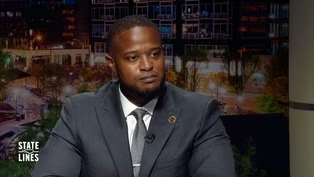
Cyril Jefferson, Democratic Candidate for NC’s 6th Congressional District
Video has Closed Captions
An interview with Cyril Jefferson, Democratic candidate for NC’s 6th Congressional District (2026). (13m 42s)
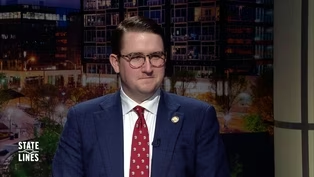
Addison McDowell, Republican Candidate for NC’s 6th Congressional District
Video has Closed Captions
An interview with Addison McDowell, Republican candidate for NC’s 6th Congressional District (2026). (14m 11s)
Jamie Ager, Democratic Candidate for NC’s 11th Congressional District
Video has Closed Captions
An interview with Jamie Ager, Democratic candidate for NC’s 11th Congressional District (2026). (14m)
Alma Adams, Democratic Candidate for NC’s 12th Congressional District
Video has Closed Captions
An interview with Alma Adams, Democratic candidate for NC’s 12th Congressional District (2026). (15m 19s)
Tim Moore, Republican Candidate for NC’s 14th Congressional District
Video has Closed Captions
An interview with Tim Moore, Republican candidate for NC’s 14th Congressional District (2026). (14m 46s)
Mark Harris, Republican Candidate for NC’s 8th Congressional District
Video has Closed Captions
An interview with Mark Harris, Republican candidate for NC’s 8th Congressional District (2026). (15m 27s)
Providing Support for PBS.org
Learn Moreabout PBS online sponsorship- We're joined by LaKesha Womack.
She's a Democrat running in the 14th Congressional District of North Carolina and challenging Representative Tim Moore, the Republican in that race.
Miss Womack, thanks for sitting down for a few minutes to discuss your campaign.
- Awesome, thank you all so much for having me.
- It's a pleasure on this end, but I have to start.
You know, people don't know their candidates.
They don't even know their elected leaders in many cases.
This is a midterm race, so, you know, candidate identity's a big deal.
I'll ask the most basic question first.
Who are you, why are you running for office?
- Awesome, I think that that's a great question.
So as you said, I am LaKesha Womack, candidate for the 14th Congressional District.
I've lived in Charlotte for the past 10 years, but the thing that a lot of people don't know about me is I actually fell in love with policy in high school.
So I participated in the Alabama Youth Legislature Program and just fell in love with the whole system of writing bills, passing bills, and that was during a time when, you know, Republicans and Democrats worked together.
So there's a lot of consensus building and, you know, just figuring out how we solve problems together.
For the past 20 years, I've had my consulting firm, Womack Consulting Group, and I like to say, people pay me to solve problems, and now I wanna go to D.C.
and solve problems for our country.
- Why is 2026 the year that you chose to take on Representative Moore for that 14th congressional seat?
- Well, you know, in '24, when Donald Trump was reelected, and then after that, we saw a lot of agencies and systems being, you know, dismantled by his administration.
And so I started thinking about, you know, how for decades we've had communities say that, you know, this government doesn't work for them, you know, this government wasn't built for them, and recognizing that we're going to have to rebuild a lot of those systems.
And again, as a consulting, that's what I do.
I analyze, you know, systems to see, like, you know, how do we build it better?
And so I wanna be a part of the rebuilding process when we do, you know, regain the House, and you know, hopefully the presidency in '28, to be a part of, you know, rebuilding our Department of Education, so that we have a system that works for all children, to prepare them for the future, that we have a healthcare system that works for everyone, and not just people who can't afford it.
And so many other systems that, you know, we've relied on for decades, and now we're seeing that they're actually not working for us.
- I was looking through your website, 'cause everyone has a platform, and whether you're a Democrat or Republican, the issues are remaining largely the same, affordability, healthcare, rural infrastructure, agriculture, all that, for North Carolina, at least.
But you say in the Affordable Care Act, you can strengthen it.
So many Democrats wanna get rid of it, replace it with the concept of Medicare for All, which is universal healthcare.
What's the difference in strengthening what we have, versus demolishing it and starting over with something with the government completely in control?
- Well, I definitely support Medicare for All, but I think that that is more of a long-term strategy, because we do have to acknowledge that there is an entire healthcare industry that we would have to revamp.
So in the short term, strengthening the ACA, I am a single mom and a business owner, and I pay close to $1,000 a month in my healthcare premiums for me and my son.
And for a lot of people, that's just not sustainable.
I've had people come to me and say that their health insurance premiums tripled this year because of the subsidies not being renewed.
And so making sure that in the short term, we strengthen the ACA subsidies so that people can have some healthcare benefits.
But in the long term, I do support a Medicare for All system so that everyone has access to healthcare, because people should not have to go bankrupt just because they get sick.
- What would be realistic in the climate of 2026 to '8?
Say Democrats do take the House, and the odds right now say the Senate might be 50/50, unless it's a blue wave.
So what's realistic?
- For the healthcare system?
- Yes.
- I would say strengthening the ACA and moving toward a Medicare for All system.
Again, I think that there's a lot more research that's gonna have to go into it.
How do we transition to that system?
What does it look like?
Because there are several options on the table, which is a private-public partnership, or would it be just a single payer for all?
And I just think that there's a lot of research that needs to happen.
And so as we're doing that research and figuring out the best path forward, making sure that we bring down the cost of those premiums so that more Americans are able to attain that insurance.
And then also ensure that our seniors are able to afford their health insurance, because a lot of people don't realize that their health insurance premiums come out of their Social Security.
So as food benefits are decreasing and their health insurance costs are rising, then that's less money that's in the pockets of our seniors at a time when everything else is rising as well.
- Let's talk about affordability.
There are a million different issues and ways to tackle this idea of affordability, which I don't know why we don't call it inflation.
It's inflation.
(laughing) What do working families need right now?
- I think right now working families need a healthy food supply.
I think we could start there.
I know a lot of people really didn't understand the role of the FDA, but I think now we're starting to see how important those inspections of our food supply are.
Because most working families, they're not watching the news every day to see what's being recalled.
They actually go to the grocery store and they trust that if they pick up a bag of lettuce, that that lettuce is gonna be healthy to feed their family.
And so I think that we need to make sure that we have a healthy food supply.
I think also gas prices, that is a huge problem for a lot of people, especially as we have more individuals who are having to live further away from where they work.
And so they're concerned about the cost of gas.
That eats into their grocery budget.
And then of course, education.
I think that some of the counties that I am serving, they're telling me about how the defunding of education has impacted them, although that is primarily a state issue.
I am in conversation with state candidates to talk about how can we solve this issue in the long term to make sure that all of our schools are fully funded and that we don't have unhoused students who are worried about food security as well as where they're gonna live.
So I think to your point, when we talk about affordability, it just encompasses so many areas of the everyday life of working Americans.
And unfortunately, a lot of them just don't have the bandwidth to pay attention to who's in charge of these issues and who's making decisions for them.
So shows like this are important to get in front of people and to let them know that there is someone who cares and who wants to work on these issues.
- Ms.
Womack, with the federal government spending at the rate it's spending, you have to print and get bonds and the whole thing.
There's a theory out there that a government in debt prints money, makes the money cheaper and things get more expensive.
If the government's tapped out at the federal level, how can it expand operations, expand services?
Because if it does that, it goes further in debt.
And if it goes further in debt, here comes money supply and everything goes up in price.
Do you agree with that?
But it's a theory that I've thought made lots of sense in the past.
- Yeah, and I think that a lot of people don't understand the economics of how the government works because they like to think about the government budget as a household budget, but it's actually not.
But one of the policies that I would support would be to not continue giving corporations federal tax breaks unless they're paying their workers a livable wage and they're paying into the tax system.
So I think that would alleviate some of that burden.
And also we know that when Americans have more money in their pockets, they do what?
They go out and spend those dollars.
And so when Americans have money, they're going to the local coffee shop, they're buying goods from Lowes and the Home Depots.
And that's what actually spurs our economy.
It's not giving corporations tax breaks because most of the companies that we've given tax breaks are laying off workers because there's no demand for their product.
And so the only way we create demand is by having people who are willing to buy their product and that's what causes them to make more.
So I think that one way that we can stimulate the economy is to remove some of those federal tax breaks and put more money into the hands of working families.
- Walk us through your plan for the tax structure for income taxes.
You said you don't want oppressive tax structures on working families.
What does that mean?
What does the future tax structure look like if you could wave your magic wand?
- Yeah, if I could wave my magic wand.
And again, one of the things I think about being a federal representative that a lot of people don't take into consideration is that they're legislative aides.
They do a lot of research and they do a lot of number crunching behind the scenes.
So sometimes candidates have like really great ideas and I think I have some great ideas, but I would rely on some of those legislative aides to do some research and to make sure that the ideas that we have are backed up by supporting like our federal budget.
But if I could wave my magic wand, I would not impose a federal income tax on the first $100,000 that people make.
And I think that again, that puts more money into the hands of working families and then that helps our counties because now we have a higher tax base so that the counties are not having to raise property taxes.
I would also ensure that we raise the cap on social security.
I don't think that it's fair that someone making $140,000 is paying the same into social security as someone making $2 million.
And so I would like to do some research to see how can we raise that cap and make sure that we're putting more money into social security so that the people who've worked their entire lives and paid into that system can be guaranteed that the money is gonna be there to help subsidize their retirement.
- Well, since you're taking care of my household and my mother's household, let's solve the federal deficit and federal debt load.
$40 trillion as of earlier in August, 2026 and now it's becoming a bipartisan issue.
What do we do about spending and can we possibly unload that debt and get out from under it?
- Yes, I think, you know, unfortunately it's gonna cause us to make some really hard cuts to our federal budget in the future.
And I think that's where our communities are going to come into place where we're going to have to, you know, support more community organizations and the work that they're doing to ensure that, you know, our seniors have rides to, you know, the hospital and that they can make it to their doctor's appointments.
That's why it's gonna be important for us to put more money into the hands of working families so that they can, you know, help support our counties because unfortunately I don't think the federal government in the future is gonna be in a position to provide a lot of the support that we have provided in the past.
And so, you know, it's not necessarily something that we can grow our way out of.
It is gonna cause us to have to make some really hard cuts in our budget.
But I think that, you know, we're just gonna have to be sensible about those cuts and, you know, see, you know, are we, are our tax dollars going as far as they could go?
And there are just some expenses that this administration are incurring that I do not believe are in the best interest of our working families.
And so those would be some of the first areas that I would wanna see cuts come to.
- But there are expenses being incurred dealing with the Iranian government and the Strait of Hormuz.
If you go to the House, you may, and likely will handle some part of this, if nothing more, being frustrated with the president for being executive.
- Yes.
- What do we do about Iran?
Get out?
Do we quit it?
Do we try to quote, win it?
Do we negotiate our way out of it?
- Yeah, and again, that's one of the things that, you know, we're gonna need to see some research on.
You know, unlike this president, I don't like making decisions on a whim.
I think that, you know, there are some case studies that have probably been prepared, and I don't know if he's reading those or not, but, you know, you do scenario planning.
You know, what happens if we just walk away?
What happens if we continue to fight?
You know, we have to do a cost-benefit analysis.
Like, what would be the cost of us continuing to fight?
You know, what would be the cost of us increasing our military presence?
But I think we also need to understand the cost that we've already incurred.
Right now, we don't know the damage that has happened to our bases in that region.
We don't know, you know, how many lives have actually been lost.
So I would wanna see, you know, what is the damage that we've already incurred, as well as, you know, what are the different paths that we could take, and then to figure out what would be the path forward for the American people.
But I know the path that we're on right now is not sustainable.
- Another huge topic, tariffs in the American economy as part of fiscal policy.
Where do you stand on tariffs as a whole?
Do tariffs have a place to protect certain domestic industries, which would protect jobs and factories, I would presume?
Where do you stand?
- Yeah.
Yeah, again, you know, I'm a research girl, so I believe, like, you know, data should drive decisions, and I do think that there are some tariffs that make sense, but I think, you know, imposing tariffs just because you had a bad day with the country is just not a good foreign policy role.
I know that there are some corporations that have received refunds of their tariffs, and I would like to see some of those refunds passed along to the consumer, because if the consumers are not getting those dollars back, then those corporations that are getting millions of dollars back should have, like, you know, a weekend where, you know, they're discounting their prices or those prices should be coming down for American consumers.
But I do think that there needs to be some guardrails around, you know, how do we impose tariffs, and then what happens in the case that we're dealing with right now, where corporations are receiving some of those tariff dollars back, but the consumers are not getting any of their money back.
- So that 14th Congressional District down around the Charlotte area, I guess, heading up, peeking out west a little bit into North Carolina, it is a local district, but those votes affect federal policy.
People outside your district will wanna watch this interview.
They wanna learn more about you.
How do we learn more about the candidate, LaKesha Womack?
- Yeah, so you can definitely visit my website, womack4nc14.com.
You can also follow me on Facebook.
I'm in the community almost every single day.
So my congressional district covers Burke, Cleveland, Gaston, Polk, Rutherford, and parts of Mecklenburg County.
And so I try to be as present as possible so that people can come out and meet me.
And as you can tell, I love questions.
I love to hear what's on the mind of people.
And so I get questions either through the website or when people come to the events.
And you know, some things I haven't thought about before, and I'm like, 'I'm great you brought that to my attention', because that hasn't been an issue in my life.
But if it's something that concerns the members of the 14th Congressional District or even members of North Carolina or this country, because as you said, when I vote in the House of Representatives, it's not just a vote that affects NC14, but it impacts this entire country.
So I welcome questions.
I welcome people just wanting to share what their thoughts are or wanting to know more about me.
And again, you can visit womack4nc14.com.
- LaKesha Womack, 14th Congressional District in North Carolina.
The Democrat running against Tim Moore.
Thank you so much for your time.
(dramatic music)
 New Episode
- News and Public Affairs

Top journalists deliver compelling original analysis of the hour's headlines.
 New Episode
- News and Public Affairs

FRONTLINE is investigative journalism that questions, explains and changes our world.
 New Episode
 New Episode
 New Episode
 New Episode
 New Episode
 New Episode
 New Episode
 New Episode
 New Episode
Support for PBS provided by:
State Lines is a local public television program presented by PBS NC