
Tim Moore, Republican Candidate for NC’s 14th Congressional District
Special | 14m 46sVideo has Closed Captions
An interview with Tim Moore, Republican candidate for NC’s 14th Congressional District (2026).
Tim Moore is running as a Republican for NC’s 14th Congressional District. He discusses his 2026 campaign with PBS NC’s Kelly McCullen. This interview was recorded on September 4, 2026.
Problems playing video? | Closed Captioning Feedback
Problems playing video? | Closed Captioning Feedback
State Lines is a local public television program presented by PBS NC
Tim Moore, Republican Candidate for NC’s 14th Congressional District
Special | 14m 46sVideo has Closed Captions
Tim Moore is running as a Republican for NC’s 14th Congressional District. He discusses his 2026 campaign with PBS NC’s Kelly McCullen. This interview was recorded on September 4, 2026.
Problems playing video? | Closed Captioning Feedback
Where to Watch State Lines
State Lines is available to stream on pbs.org and the PBS app.
Providing Support for PBS.org
Learn Moreabout PBS online sponsorshipMore from This Collection
During major election cycles, PBS North Carolina's public affairs team sits down for in-depth conversations with candidates running for elected office in North Carolina. PBS North Carolina has invited major party candidates to a one-on-one interview with State Lines host and executive producer Kelly McCullen. Interviews are scheduled throughout the summer and early fall.
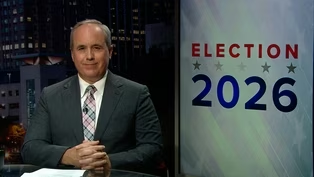
NC Judicial Candidates Forum: NC Court of Appeals Judge Seats 2 & 3
Video has Closed Captions
Meet candidates for the NC Court of Appeals Judge Seats 2 and 3. (26m 46s)
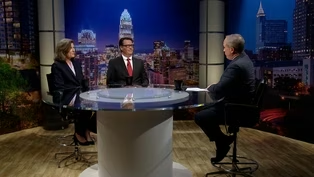
Candidates for NC Court of Appeals Judge Seat 3: Craig Collins (R) & Christine Marie Walczyk (D)
Video has Closed Captions
Meet the Republican and Democratic candidates for the NC Court of Appeals Judge Seat 3. (13m 7s)
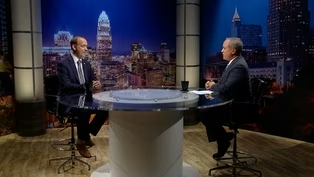
Candidate for NC Court of Appeals Judge Seat 2: Tobias Hampson (D)
Video has Closed Captions
Meet the Democratic candidate for the NC Court of Appeals Judge Seat 2. (12m 57s)

Candidates for NC Supreme Court Associate Justice Seat 1: Anita Earls (D) & Sarah Stevens (R)
Video has Closed Captions
Meet the Democratic and Republican candidates for the NC Supreme Court Associate Justice Seat 1. (12m 38s)
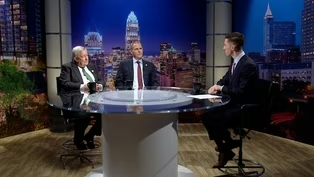
Candidates for NC Court of Appeals Judge Seat 1: John Arrowood (D) & Michael Byrne (R)
Video has Closed Captions
Meet the Democratic and Republican candidates for the NC Court of Appeals Judge Seat 1. (11m 54s)
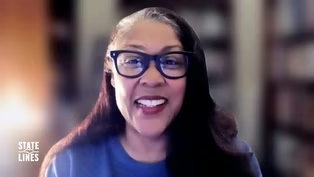
Kimberly Hardy, Democratic Candidate for NC’s 7th Congressional District
Video has Closed Captions
An interview with Kimberly Hardy, Democratic candidate for NC’s 7th Congressional District (2026). (14m 16s)
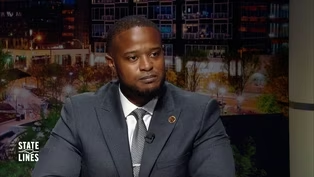
Cyril Jefferson, Democratic Candidate for NC’s 6th Congressional District
Video has Closed Captions
An interview with Cyril Jefferson, Democratic candidate for NC’s 6th Congressional District (2026). (13m 42s)
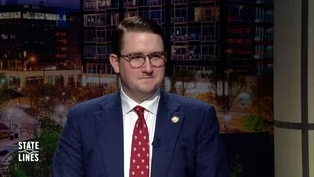
Addison McDowell, Republican Candidate for NC’s 6th Congressional District
Video has Closed Captions
An interview with Addison McDowell, Republican candidate for NC’s 6th Congressional District (2026). (14m 11s)
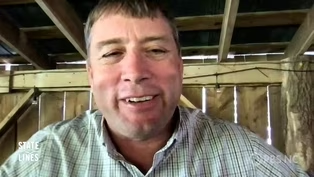
Jamie Ager, Democratic Candidate for NC’s 11th Congressional District
Video has Closed Captions
An interview with Jamie Ager, Democratic candidate for NC’s 11th Congressional District (2026). (14m)
Alma Adams, Democratic Candidate for NC’s 12th Congressional District
Video has Closed Captions
An interview with Alma Adams, Democratic candidate for NC’s 12th Congressional District (2026). (15m 19s)
Mark Harris, Republican Candidate for NC’s 8th Congressional District
Video has Closed Captions
An interview with Mark Harris, Republican candidate for NC’s 8th Congressional District (2026). (15m 27s)
Lakesha Womack, Democratic Candidate for NC’s 14th Congressional District
Video has Closed Captions
An interview with Lakesha Womack, Democratic candidate for NC’s 14th Congressional District (2026). (14m 56s)
Providing Support for PBS.org
Learn Moreabout PBS online sponsorship- We're joined by Congressman Tim Moore, the 14th Congressional District, one term in, seeking a new term.
Good to see you, sir.
Thanks for making time for us.
- Great to be with you, Kelly.
I appreciate you having me on the show.
- If you're like every other congressional district in this state, you probably have a few hundred, at least, new voters out there who might have heard of Tim Moore, former House Speaker, current Congressman.
Who are you?
What's your background?
And what makes your leadership style perfect, in your opinion, for U.S.
House?
- Well, of course, served in the legislature for 22 years, 10 years of which I was Speaker of the State House, and was in a great position to see where we saw North Carolina turn things around.
You covered state politics for years.
You can go back to prior to 2010.
We were going in the wrong direction, state.
Highest unemployment, highest taxes in the Southeast.
Fast-forward to today, where we are.
We have one of the hottest economies in the country.
People are moving here in droves.
In fact, if you think about the problems that we have, it has to do with how much growth we have.
And, you know, doing that work at the state legislature, the reason I ran for Congress, instead of doing a lot of other things, was because I wanted to take that same success that we saw here and apply that to Washington, D.C.
- What's the difference in legislating at the state level?
And you were at the highest of that level, versus going into Congress as a first-term Congress member and trying to influence people who have been there 30, 40 years?
- It's actually been great in terms of being able to be effective.
As you know, a lot of my region was impacted significantly by Hurricane Helene.
I have several counties—Chimney Rock, Lake Lure—were the ones that grabbed the headlines, but a lot of others that were.
And we've been very effective, for example, in securing federal dollars.
We got nearly $2.5 billion in additional federal money this year for North Carolina.
We're going to get even more this year.
But I will tell you, that experience of being a leader of a legislative chamber was very helpful when I got to Congress, even as a new member.
But whether it's legislation, whether it's resources for North Carolina—roads, water, sewer, you name it—we've been able to bring a lot of money home.
And I think that—I feel very effective, and it's been very beneficial for my district.
- What's been your perspective on how the money has been released from the Department of—as was Homeland Security and FEMA.
There was a controversy, at least down here around these parts, that there's plenty of money out there, but D.C.
wouldn't release it.
And it took some threats and Ted Budds and Tim Moores and others to step forward.
How hard could you push against the administration to release what was approved?
- Well, I'll tell you, since Mark Wayne Mullen came into the position, much easier.
It was, frankly, very frustrating with the previous secretary who was there.
And we were always calling, pushing and pushing.
But ever since Mark Wayne's been secretary, it's been a lot easier, and the money is flowing in.
I think we just did another release today of another, like, nearly $8 million for Rutherford County, one of my counties I represent.
So, a lot better.
But you know what?
It should have never been slow in the first place.
- How far along do you think recovery is in Western North Carolina?
It will never be the same, but when can it be made as whole as possible?
- You know, certain areas are doing quite well, but other areas, it's going to be a while.
In the biggest areas—and you guys have done a good job covering this here on UNC-TV—you have areas, like in those river valleys, where the water came through so deep, so strong, just raging through there, that it just eliminated the land.
You had landslides.
You have water—where there used to be homes and businesses are now part of the river.
And so that's—you know, they're probably not going to be rebuilt.
So it's a matter of making sure those folks get compensation for their losses, so that they can rebuild, rebuild businesses, their lives.
And so that's happening, but it's going to take a while.
But I'll tell you, I can point to Lake Lure.
If you ever saw those videos of just the utter destruction— - We did the videos.
- You did.
- Cleaning out the lake.
- That's right.
And we had one of your reporters out there one day.
We were walking around looking at it, as well.
It's back.
I mean, the lake's open.
It's beautiful.
They're going to be fully operational here at leaf season this year.
So to the folks watching, visit the mountains of Western North Carolina.
It's beautiful.
There's no better place in the world.
And so, it's great to see those success stories.
- Your district's interesting.
It's down around Charlotte.
It does go through the mountains.
But for those of us who have recovered or were never affected by Helene, you'll have a fair number of constituents who've been blessed not to have endured Helene's aftermath.
There are a lot of issues out there.
What are those voters telling you?
- You know, the issue that I hear the most is affordability, which is another word for inflation.
And if you look at what you had for the four years of the Biden administration, where you had inflation hitting at 9 percent per year—unbelievable in those years—it's now down to 3.4 percent.
Much improved.
But what's happened is, the cost of goods were going to go in like this, and wages were only going about like this.
So, big challenges.
I'll give you a couple of stats.
The first-time homebuyer, the average age right now, 40 years old.
It's never, never been that high in the United States.
One reason that I was proud to sponsor the bill, the Road to Housing Bill, to find ways to cut regulatory burdens, to increase the supply of housing.
That is now the law.
But that's going to be like a two-, three-year implementation before it's fully up and running.
You look at the cost of gas.
I mean, I'm like everybody else.
I put gas in my car.
And we've got to find ways to deal with that.
So what we've done, for example, the first refinery that's being built in the United States in 40 years is being built right now.
Now, why is it just happening now?
Because this administration and this Congress have cut some of the regulations that slowed down energy exploration, energy distribution, for example, like pipelines, and then also other changes needed so you could have refineries.
I mean, there were so many barriers that were put up, particularly during the Biden years, whether it came to nuclear energy, you name it.
They were pushing all this Green New Deal stuff, which raised the cost of stuff.
And so I believe in a portfolio that has green energy with it as well, but also the use of fossil fuels and things that are readily available and things that we have in supply.
So those things are going to help lower those costs going forward.
But those are really the big issues that I hear is about how expensive things are.
We also passed some significant legislation on health care.
Health care costs have gone up.
We passed what's called PBM reform.
A lot of people don't realize, when you go to the pharmacy and when you buy your drugs, a lot of that cost that's in there really are these—for these middlemen called pharmacy benefit managers, where they mark up money, and they provide absolutely no benefit, no service to it.
We've got to deal with that.
We've also got to make sure that when it comes to hospitals and their billing, that there's transparent.
We've dealt with that, where some of that was included in the Working Families Tax Cut legislation, but we need to build on that as well.
But if I had to pick one issue out of all of them, what's the top issue?
100 percent, it's affordability.
- People on the conservative side will say it's federal spending that drives inflation.
The federal government can only print money.
As a state health speaker, you had to balance a budget.
How do we make it more affordable if we're continually in deficit, printing more money and having to pay off federal debts?
How does that—do you believe in that?
- 100 percent - How do we get out from under not just the deficit, but the $40 trillion debt load?
- Yeah.
So, right now, the debt, to your point, you know, $40 trillion.
Did you know we spend more in interest, $1 trillion a year, we spend more in interest on the debt than we do to fund our entire military?
Think about that, right?
You couldn't run a business that way.
You couldn't run a home that way.
Anything.
And so, it is absolutely a spending problem.
And so, we did eliminate spending this year.
We did eliminate a lot of wasteful spending.
There was a lot of coverage, for example, on the USAID money, the money that was getting sent to, you know, foreign countries, and a lot of it, frankly, wasted with just silly things.
And we've trimmed that down.
We put in place, for example, work requirements for able-bodied people who were getting Medicaid, someone who was not disabled, doesn't have a dependent child, was able to get welfare and all these things, when they could go out and get a job.
So we did that.
That's helped.
But we're going to have to do more, because we can't keep mortgaging our children's future with this.
That's also one reason, by the way, I'm proud to be a sponsor of the balanced budget amendment.
We need a constitutional amendment, because Congress has shown it does not have the discipline -- and, frankly, it doesn't matter who's in charge -- does not have the discipline to control runaway spending.
A balanced budget amendment to the Constitution would fix that.
And I'm going to keep working on that.
We need to pass that.
Because, hey, our state, to your point, we've got a balanced budget, and it works great.
- What is the difference in passing legislation at the House level in North Carolina versus the U.S.
House of Representatives?
Because you do have a balanced budget requirement for the state of North Carolina.
And your preaching language conservatives love to hear, It's just never happened, never come close.
- Well, of course, we did it at the state.
But to your point, at the federal level, it hasn't happened.
It's because the pressure to fund things seems to be greater than the pressure to do the right thing by the federal budget, by the long-term health of the economy.
But I think people get it right now.
And what happens is, when you don't have that... And I got to... And, again, I'm not trying to be partisan, but I am going to point to the four years under Biden, all right?
Some may say it's because of COVID, whatever you want to say.
During those four years of the Biden administration, you know, when Democrats were in charge of D.C.
right there, you saw absolute runaway spending in ways that we've never seen before.
Now, Republicans have done their share, too, by the way.
It's happened, as well.
But that was like... That won the all-star at that point, right, the spending, out of control.
And so we're paying for that now.
So it's how you scale that back, trying to make sure that you get rid of things that are wasteful, but not hurt people that really need the help.
And so that's the balance.
So you can't just go in with a machete, so to speak.
You have to be nuanced on it.
And so, if you look at a lot of the budget changes that we've put forward, many of which, frankly, haven't passed, because we don't have the votes in the Senate, it would rein that spending in.
And we... But I think, next year, if we've seen what happens with inflation, this has to be a wake-up call to stop, to control it.
- I want to ask you about Medicaid expansion, because it did get expanded in North Carolina.
I remember Phil Berger saying, "Oh, we don't trust the feds.
As soon as we pass this and expand it, they're going to cut."
Well, he proved that was kind of right.
And now you've got local governments out there facing the compliance cost of the new work requirements coming on board October 1st.
What is the role between you, between Raleigh, and between county commissioners in your district to make sure that the bureaucracy at the county level can manage all the accountability that's going to be required of the big, beautiful bill, one big, beautiful bill?
- Well, of course, I was speaker when we adopted the expansion, as well.
And one of the provisions that I demanded be a part of that was an automatic trigger that if the federal government ever cut the benefit, that the state would follow suit with that, so that you would not have the state on the hook.
So, the reality is, the state's not going to get penalized for it at all.
And the way that we structured the implementation of the work requirements is in a way that most people would acknowledge is fundamentally fair.
In fact, when we undertook the state expansion, we wanted to put those same work requirements in place, but because of the current federal law at that time, we were unable to do so.
I mean, at the end of the day, Medicaid should be about helping somebody who truly cannot take care of themselves.
It should never be about someone who is able-bodied and able to get things done.
And, look, you've got a lot of these DSA, Democrat Socialist-type folks out there running who are advocating things like Medicare for all.
I mean, they're—and these are things that would absolutely bankrupt the country and would be some of the worst things you could ever do to healthcare.
I mean, we don't need European-style subpar healthcare in the United States.
And if you look at what the left is pushing, that's the kind of thing they want to see.
- Got under about three-and-a-half minutes.
I've got to hit you on Iran.
What do we do about that country and this conflict that was—it was launched at the executive branch, not the legislative branch?
What do you do about this?
- You know, it's a tough thing, right?
It's a choice—it's a choice of bad choices.
But I've got to say, I appreciate this president taking a stand and finally holding Iran accountable.
Past administrations, Republican, Democrat alike, have just tried to find ways to appease and keep things calm.
My understanding is, is in the—right before the initial bombing, when we launched the major bombing operation, that was—Iran was in a matter of days, if not—weeks, if not days, of actually having operational nuclear weapons.
Look, we cannot have a nuclear-armed Iran, full stop.
We cannot allow that to happen.
Look at what they've done to their neighbors, firing missiles indiscriminately now.
Look at what they did to their own people.
That government, they've killed anywhere between 50,000 and 60,000 people.
You have a radical, evil regime that is in charge of Iran.
They cannot have any kind of nuclear weapons.
And so, I'd say we need to—we need to make sure that that doesn't happen.
And hopefully we'll see a regime change.
But again, we don't need American boots on the ground.
They've got to take care of this themselves in a lot of ways.
But right now, the people are—you know, have been unable to effect change, because you have this—basically, it's a minority, if you will, of the country that's there, that's in charge.
But this regime is just so brutal and just so evil with what they've done.
So I'm glad we're taking a stand.
But, I mean, I visited Bahrain in the weeks just before they were attacked.
I just got back from Europe with a meeting with some of our NATO allies.
And I will tell you, there are great plans in place to happen.
But, you know, when it comes to any military conflict, there's always the unknown and there's always the risk.
But we cannot allow a nuclear-armed Iran.
- What about Israeli-U.S.
relations?
It has split the Democratic Party in some races, and even Republicans now are saying America first means America first, whatever that's supposed to mean.
What should be the stance on Israel and the U.S.?
Always allies.
I think that's pretty solid.
But on decisions of war and conflict and Middle East policy, what do you think?
- Well, we should always make decisions as to what advances the goals and the safety of the United States above anything else.
But Israel is a valuable ally in the Middle East.
They are a democracy when there are very few democratic governments in that region of the world.
They're a staunch ally of ours.
And generally, our interests are aligned.
And so I think making sure that they're able to be protected is in our national interest.
- Last question is always going to be the easy one.
Wrap this up by telling voters and North Carolinians, even Americans who want to look up Tim Moore, how can they find you and learn more about your platform and campaign?
- So I have a Web site.
It's timmoore.com.
That's about as easy as I know to make one.
But I'm back home.
I'm in Washington a lot, but I'm also back home in the district.
And North Carolina is my home.
I love this place.
I don't plan on moving.
And it's an honor to be the congressman.
And anytime I can ever be of help, let us know, either myself or our offices on the official side.
I appreciate you having us on.
- We appreciate you, Congressman Moore, safe travels on the campaign trail.
- Thank you much.
♪
 New Episode
- News and Public Affairs

Top journalists deliver compelling original analysis of the hour's headlines.
 New Episode
- News and Public Affairs

Today's top journalists discuss Washington's current political events and public affairs.
 New Episode
 New Episode
 New Episode
 New Episode
 New Episode



 New Episode

Support for PBS provided by:
State Lines is a local public television program presented by PBS NC