
Candidates for NC Supreme Court Associate Justice Seat 1: Anita Earls (D) & Sarah Stevens (R)
Special | 12m 38sVideo has Closed Captions
Meet the Democratic and Republican candidates for the NC Supreme Court Associate Justice Seat 1.
Candidates Anita Earls (Democrat) and Sarah Stevens (Republican) discuss their background and why they’re running for the NC Supreme Court Associate Justice Seat 1 with PBS NC’s David Hurst. The 2026 NC Judicial Candidates Forum is made possible by a partnership between PBS North Carolina and the North Carolina Bar Association.
Problems playing video? | Closed Captioning Feedback
Problems playing video? | Closed Captioning Feedback
State Lines is a local public television program presented by PBS NC
Candidates for NC Supreme Court Associate Justice Seat 1: Anita Earls (D) & Sarah Stevens (R)
Special | 12m 38sVideo has Closed Captions
Candidates Anita Earls (Democrat) and Sarah Stevens (Republican) discuss their background and why they’re running for the NC Supreme Court Associate Justice Seat 1 with PBS NC’s David Hurst. The 2026 NC Judicial Candidates Forum is made possible by a partnership between PBS North Carolina and the North Carolina Bar Association.
Problems playing video? | Closed Captioning Feedback
Where to Watch State Lines
State Lines is available to stream on pbs.org and the PBS app.
Providing Support for PBS.org
Learn Moreabout PBS online sponsorshipMore from This Collection
During major election cycles, PBS North Carolina's public affairs team sits down for in-depth conversations with candidates running for elected office in North Carolina. PBS North Carolina has invited major party candidates to a one-on-one interview with State Lines host and executive producer Kelly McCullen. Interviews are scheduled throughout the summer and early fall.
NC Judicial Candidates Forum: NC Court of Appeals Judge Seats 2 & 3
Video has Closed Captions
Meet candidates for the NC Court of Appeals Judge Seats 2 and 3. (26m 46s)
Candidates for NC Court of Appeals Judge Seat 3: Craig Collins (R) & Christine Marie Walczyk (D)
Video has Closed Captions
Meet the Republican and Democratic candidates for the NC Court of Appeals Judge Seat 3. (13m 7s)
Candidate for NC Court of Appeals Judge Seat 2: Tobias Hampson (D)
Video has Closed Captions
Meet the Democratic candidate for the NC Court of Appeals Judge Seat 2. (12m 57s)
Candidates for NC Court of Appeals Judge Seat 1: John Arrowood (D) & Michael Byrne (R)
Video has Closed Captions
Meet the Democratic and Republican candidates for the NC Court of Appeals Judge Seat 1. (11m 54s)
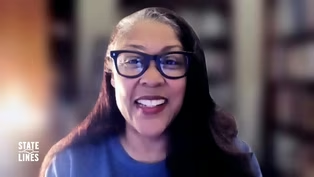
Kimberly Hardy, Democratic Candidate for NC’s 7th Congressional District
Video has Closed Captions
An interview with Kimberly Hardy, Democratic candidate for NC’s 7th Congressional District (2026). (14m 16s)
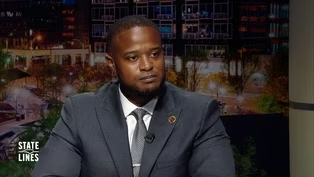
Cyril Jefferson, Democratic Candidate for NC’s 6th Congressional District
Video has Closed Captions
An interview with Cyril Jefferson, Democratic candidate for NC’s 6th Congressional District (2026). (13m 42s)
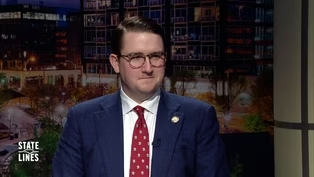
Addison McDowell, Republican Candidate for NC’s 6th Congressional District
Video has Closed Captions
An interview with Addison McDowell, Republican candidate for NC’s 6th Congressional District (2026). (14m 11s)
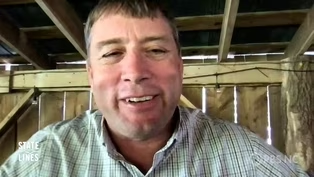
Jamie Ager, Democratic Candidate for NC’s 11th Congressional District
Video has Closed Captions
An interview with Jamie Ager, Democratic candidate for NC’s 11th Congressional District (2026). (14m)
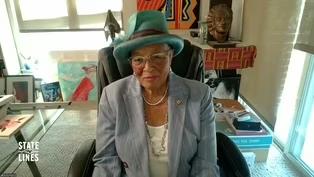
Alma Adams, Democratic Candidate for NC’s 12th Congressional District
Video has Closed Captions
An interview with Alma Adams, Democratic candidate for NC’s 12th Congressional District (2026). (15m 19s)
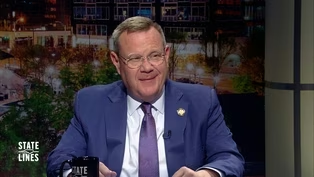
Tim Moore, Republican Candidate for NC’s 14th Congressional District
Video has Closed Captions
An interview with Tim Moore, Republican candidate for NC’s 14th Congressional District (2026). (14m 46s)
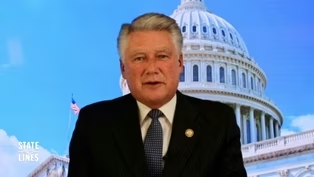
Mark Harris, Republican Candidate for NC’s 8th Congressional District
Video has Closed Captions
An interview with Mark Harris, Republican candidate for NC’s 8th Congressional District (2026). (15m 27s)
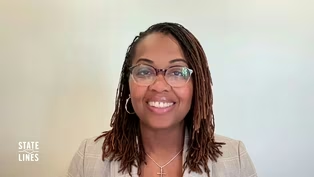
Lakesha Womack, Democratic Candidate for NC’s 14th Congressional District
Video has Closed Captions
An interview with Lakesha Womack, Democratic candidate for NC’s 14th Congressional District (2026). (14m 56s)
Providing Support for PBS.org
Learn Moreabout PBS online sponsorship- The 2026 Judicial Candidates Forum is made possible by a partnership between PBS North Carolina and the North Carolina Bar Association.
♪ - Joining us now are the nominees for the North Carolina Supreme Court Associate Justice seat, Democratic candidate Anita Earls and Republican candidate Sarah Stevens.
Thank you both for joining us today.
We appreciate it.
- Thank you for having us.
- Thank you.
- Now, this isn't necessarily a debate, just a chance for you to connect with voters, answer some questions.
We did do a coin toss just a minute ago.
Ms.
Earls, you won that coin toss.
You're elected to go second.
So, Ms.
Stevens, I'll put this first question toward you.
- Certainly.
- Beyond writing opinions, what are some of the most important roles, would you say, responsibilities for this role?
- To ensure being a conservative, and that is to listen carefully to both sides, apply the law as it's written, and then ensure that all the constitutional protections have been there.
That's what I did in the North Carolina General Assembly for 17 years.
- And Ms.
Earls, same question to you.
- Yes, well, I've been on the court for seven and a half years, and from my experience, in addition to what we do in the courtroom, hearing cases and deciding the controversies that come before us, as members of the judiciary, we also have administrative roles, and that means everything from proposing changes to the rules of appellate procedure to making sure that both the civil and criminal justice systems are working as best they can.
And so, there are a variety of ways as justices that we can carry out that responsibility, but the code of judicial conduct is very clear that in addition to our adjudicative role, our role in the courtroom, we have administrative responsibilities for the justice system.
- Ms.
Stevens, how would you decide whether a dissent is worth writing or not?
- It would need to be something that was very controversial to me or something that I felt was truly worthy if I felt like the majority opinion were completely wrong or had gone way off script, or if there was one specific special issue that I needed to cover.
That's what I would do.
- And for you, Ms.
Earls, how do you kind of navigate that decision?
- Well, I think, ideally, our court should try to deliberate and come to a decision that incorporates all points of view.
That's why there's seven of us and not just a single justice.
But when I believe that the justices in the majority, whoever they might be, when I believe that they have not either got the law right or are not right about the facts in the case or they haven't applied the law correctly to the facts, then I believe it is my responsibility to write an opinion, a dissenting opinion, that explains my point of view.
- Ms.
Stevens, you alluded to your career in the state legislature.
What would you say, whether it be that or something else, what would you say your experience, what kind of experience do you bring to this role?
- Certainly.
I've been an attorney for 40 years.
I've been a lifelong resident of North Carolina and practiced law in North Carolina.
Then I had the privilege 17 1/2 years ago of going to the North Carolina General Assembly.
I watched the process of how law was made, which is why I'm very clear that the court shouldn't be making the law.
This process of having a legislative body is a critical part of making sure that the law gets right.
Those 170 people have to answer to the voters every two years, whereas as a justice, you only answer every eight years.
So it's not a part of the court to change the law, but to simply follow it as written by the General Assembly unless you find a constitutional issue.
You don't just mess with the law because you can.
So I think that's what's most important.
In my role as a legislator, I chaired the Judiciary Committee.
And that was part of what I did, is look at the law that people were proposing, because some of them are not attorneys, to ensure that that law was clear in how it read, that it met the elements of the Constitution, and then took it before a bipartisan Judiciary Committee in which we debated it and worked on getting things together, worked on what are the unintended consequences, what about other people's perspectives, where I think if you are on the bench and you start to- you know, you're viewing it only from your perspective as opposed to everyone else's.
That's one reason the legislature makes the law and the judiciary just ensures it's followed.
- What about you, Ms.
Earls?
What would you say is the most valuable experience you bring to the Supreme Court?
- Well, prior to being elected in 2018, I was a civil rights attorney for 30 years.
That means I stood with people whose rights were being violated.
I litigated cases in state and federal courts, so I tried cases to juries, but also really significantly for an appellate court.
I argued cases in several federal circuits.
I argued cases in the North Carolina Court of Appeals, in the North Carolina Supreme Court.
So litigation experience is significant.
But I would also say that having a broad-based practice- so, as a civil rights attorney, I handled cases involving a wide range of types of issues.
And I think what I want people to know is that the reason why I wanted to be a civil rights attorney was the experience of growing up in a mixed-race family at a time when my parents' marriage was actually illegal in most of the country.
So I really saw how the law impacts people's lives and how important it is that we live up to that promise that's etched in stone over the U.S.
Supreme Court, the promise of equal justice under the law.
And so I believe that my experience in standing up with citizens and communities across North Carolina to try to guarantee those rights, to try to get us closer to equal justice under the law is very relevant to now serving on the Supreme Court.
- Ms.
Stevens, what would you say are the two most important characteristics for an associate justice?
- The ability to understand and know the law, and have read the Constitution, and the ability and willingness to listen to different opinions.
I think those are the two fundamental factors.
You have to set aside your own preferences, your own advocacy, and listen to both sides to try to reach an opinion, and I think that's important.
I think that's a lot of what I did in the legislature.
I was advocating for people as an attorney, and then in the judiciary, I was able to see what everybody thought would be the best policy for the state of North Carolina, and that's what we moved forward with.
So I think that's the critical part, is being willing to listen to both sides, but also understanding and reviewing the law and the Constitution.
- Same question to you, Ms.
Earls.
I'm sure there's lots of characteristics you could choose from, but what would you say are the two most important?
- So I think having broad experience in the law, because on the courts, we're generalists.
There's very few areas of law that we don't address in one way or another.
We impact people's lives on everything from electricity rates to whether if someone's injured on the job, they'll get fairly compensated, just a wide range of types of law.
So I think having a broad-based experience is helpful once you're on the court, so that's one quality.
And I think a second quality is being able to understand different points of view and listen carefully and be willing to entertain the views of people who might think differently from you or from, you know, often there's multiple sides in a case, maybe not just two.
And so being able to understand all of the arguments that might be made in a case and come to a resolution that's really the best for all the people of North Carolina.
- And Ms.
Stevens, a little bit of a lighter question here.
Who would you say are some of your judicial heroes?
- Wow, wow.
Again, on state level, Justice Newby.
I think he's an incredible conservative who's done a tremendous job for the state of North Carolina.
On the federal level, believe it or not, I think one of my preferences is John Roberts.
A lot of people view John Roberts as controversial when he went on the court.
They didn't agree with some of his opinions.
But as I watched and listened to him, I listened to him follow the Constitution.
It might not have gotten the results that some people wanted, but he did, even in the case of Ray versus Wade, it belongs to the state, not to the federal government.
So it's trying to get and stay in those lanes.
That's what we need to do.
I mean, I have a broad base of experience, too.
I've done multiple things.
I wound up settling into family law, but I did lots of things and I've been on appeal.
Didn't make it to the Supreme Court because we settled before it got there.
But I think that we need justices who are conservative and who will follow the law and not get in there and play politics.
- What about you, Ms.
Earls?
Maybe judicial heroes that you look up to or inspire you.
- So on the U.S.
Supreme Court, I would start with Thurgood Marshall, but I'm also, I was very influenced by Justice Ruth Bader Ginsburg.
And Justice Ketanji Brown-Jackson and I were both on the short list at the same time, and I think the president made an absolute wise decision.
It is wonderful to my, for me, to see the role that she's had on the U.S.
Supreme Court.
So those are some of my idols, I would say.
- So we've got about two minutes or so left.
I want to give each of you a chance, a minute or so, just of closing arguments, you would say.
Just a message to the voters, anything you might want to close with.
Ms.
Stevens, I'll start with you.
- Thank you, thank you.
And in my experience, both in the law practice, it's one thing, and the legislature, something different.
I have been a constitutional conservative.
I've been a law and order person.
Despite misleading advertisements that are out there, I have strongly advocated for children in all realms and features.
I have received awards from the Conference of District Attorney and the Sheriff's Association because I am such a law and order person.
Worked with those every year.
I'm a mother, a grandmother, and I'm a straight shooter.
- Ms.
Earls?
- Yes, well, thank you.
I want to thank PBS and the Bar Association for giving us this opportunity to come and speak to your viewers and to voters.
What I want people to know is that I am not beholden to any particular political ideology.
My goal has always been to make sure that we protect everyone's rights under the state and federal constitutions, and that we guarantee equal justice under the law for all the citizens of North Carolina.
And that's why I'm running to keep my seat.
I want to try to be a part of making sure that we enforce the Constitution and protect people's rights.
- Well, we've got still about another minute or so, so I'll each give you about 30 seconds.
I want to, Ms.
Stevens, hear from you just in terms of what maybe might be most important that North Carolinians know about this role and maybe some misunderstanding of what it does.
But what would you say overall is the most important thing about this role that you'd like people to understand?
- It deals with some of the most complicated issues, and it needs serious looking after.
It needs a non-political animal, and in essence, that's sort of what I have been.
I haven't held a fundraiser to raise money to build a Republican infrastructure.
I have stood independently, and that's what I will continue to do, is be that constitutional conservative who follows the law.
- Ms.
Earls, we'll give you the final word.
You've got about 30 seconds.
- Yes, well, our courts have impacted everything, as I said earlier, about electricity rates, not only that, but what kind of funding our public schools might have, how our democracy is structured, whether people's votes will count and count equally, how the balance of power between the three branches of state government, all of those are issues that our court decides, and my record is clear.
I have seven and a half years on the bench and opinions that our public and people can see, and I just hope that people understand how important our Supreme Court races are and that we hear everyone's voice in November through their vote.
- Well, thank you both for joining us.
We appreciate it.
- Thank you so much for bringing us in.
- Thank you.
- The 2026 Judicial Candidates Forum is made possible by a partnership between PBS North Carolina and the North Carolina Bar Association.
♪
 New Episode
- News and Public Affairs

Top journalists deliver compelling original analysis of the hour's headlines.
 New Episode
- News and Public Affairs

Today's top journalists discuss Washington's current political events and public affairs.
 New Episode
 New Episode
 New Episode
 New Episode


 New Episode
 New Episode

Support for PBS provided by:
State Lines is a local public television program presented by PBS NC