
Cyril Jefferson, Democratic Candidate for NC’s 6th Congressional District
Special | 13m 42sVideo has Closed Captions
An interview with Cyril Jefferson, Democratic candidate for NC’s 6th Congressional District (2026).
Cyril Jefferson is running as a Democrat for NC’s 6th Congressional District. He discusses his 2026 campaign with PBS NC’s Kelly McCullen. This interview was recorded on September 18, 2026.
Problems playing video? | Closed Captioning Feedback
Problems playing video? | Closed Captioning Feedback
State Lines is a local public television program presented by PBS NC
Cyril Jefferson, Democratic Candidate for NC’s 6th Congressional District
Special | 13m 42sVideo has Closed Captions
Cyril Jefferson is running as a Democrat for NC’s 6th Congressional District. He discusses his 2026 campaign with PBS NC’s Kelly McCullen. This interview was recorded on September 18, 2026.
Problems playing video? | Closed Captioning Feedback
Where to Watch State Lines
State Lines is available to stream on pbs.org and the PBS app.
Providing Support for PBS.org
Learn Moreabout PBS online sponsorshipMore from This Collection
During major election cycles, PBS North Carolina's public affairs team sits down for in-depth conversations with candidates running for elected office in North Carolina. PBS North Carolina has invited major party candidates to a one-on-one interview with State Lines host and executive producer Kelly McCullen. Interviews are scheduled throughout the summer and early fall.
NC Judicial Candidates Forum: NC Court of Appeals Judge Seats 2 & 3
Video has Closed Captions
Meet candidates for the NC Court of Appeals Judge Seats 2 and 3. (26m 46s)
Candidates for NC Court of Appeals Judge Seat 3: Craig Collins (R) & Christine Marie Walczyk (D)
Video has Closed Captions
Meet the Republican and Democratic candidates for the NC Court of Appeals Judge Seat 3. (13m 7s)
Candidate for NC Court of Appeals Judge Seat 2: Tobias Hampson (D)
Video has Closed Captions
Meet the Democratic candidate for the NC Court of Appeals Judge Seat 2. (12m 57s)

Candidates for NC Supreme Court Associate Justice Seat 1: Anita Earls (D) & Sarah Stevens (R)
Video has Closed Captions
Meet the Democratic and Republican candidates for the NC Supreme Court Associate Justice Seat 1. (12m 38s)
Candidates for NC Court of Appeals Judge Seat 1: John Arrowood (D) & Michael Byrne (R)
Video has Closed Captions
Meet the Democratic and Republican candidates for the NC Court of Appeals Judge Seat 1. (11m 54s)
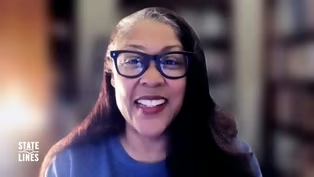
Kimberly Hardy, Democratic Candidate for NC’s 7th Congressional District
Video has Closed Captions
An interview with Kimberly Hardy, Democratic candidate for NC’s 7th Congressional District (2026). (14m 16s)
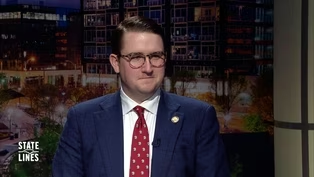
Addison McDowell, Republican Candidate for NC’s 6th Congressional District
Video has Closed Captions
An interview with Addison McDowell, Republican candidate for NC’s 6th Congressional District (2026). (14m 11s)
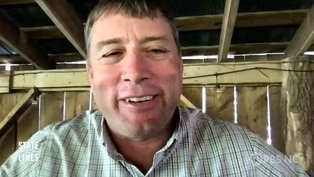
Jamie Ager, Democratic Candidate for NC’s 11th Congressional District
Video has Closed Captions
An interview with Jamie Ager, Democratic candidate for NC’s 11th Congressional District (2026). (14m)
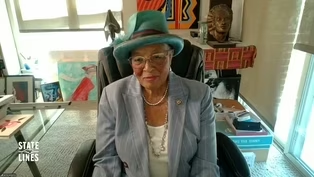
Alma Adams, Democratic Candidate for NC’s 12th Congressional District
Video has Closed Captions
An interview with Alma Adams, Democratic candidate for NC’s 12th Congressional District (2026). (15m 19s)
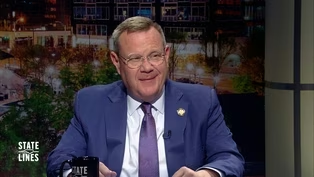
Tim Moore, Republican Candidate for NC’s 14th Congressional District
Video has Closed Captions
An interview with Tim Moore, Republican candidate for NC’s 14th Congressional District (2026). (14m 46s)
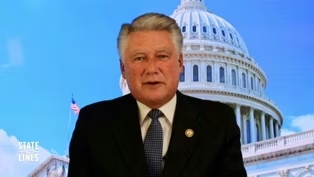
Mark Harris, Republican Candidate for NC’s 8th Congressional District
Video has Closed Captions
An interview with Mark Harris, Republican candidate for NC’s 8th Congressional District (2026). (15m 27s)
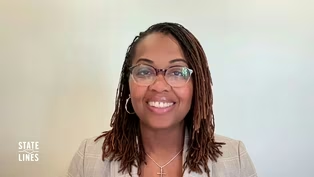
Lakesha Womack, Democratic Candidate for NC’s 14th Congressional District
Video has Closed Captions
An interview with Lakesha Womack, Democratic candidate for NC’s 14th Congressional District (2026). (14m 56s)
Providing Support for PBS.org
Learn Moreabout PBS online sponsorship- We're joined by High Point Mayor Cyril Jefferson, who is the Democratic nominee for Congress in the 6th U.S.
Congressional District of North Carolina.
Mayor Jefferson, thank you for a few moments of your time to discuss your platform.
- Absolutely.
Thank you for having me.
Well, you you're the executive of High Point, North Carolina.
Tell us more about that, your background, and why is this year the right year for you to seek a congressional seat?
- Yeah, so I've enjoyed my time leading in government here in High Point and quite frankly, I think it's the best job in the world, if I can just say that.
The residents of High Point, the visitors who come into our city, they all make it quite a special place.
And in fact, it's not just my feelings, but the numbers tell that too.
High Point is the second fastest growing city in the state of North Carolina.
A couple years ago, we won an All-America City Award during my first year as mayor for the work we were doing for food security and supporting small businesses.
So High Point is a great community and we've been in the midst of revitalization over the past decade or so.
We've got two really strong economic engines in the university and the furniture market.
And so those are all great reasons to support a good community like High Point.
- What makes timing right now to turn your attention possibly towards going to Washington, D.C.?
- Yeah, it's interesting.
I came to this term not expecting to run, if I could just be honest with you.
I made the decision after seeing everything happening in Washington, D.C.
It became incredibly disruptive.
I told you about our furniture market.
The tariffs, for example, end up crippling what happens with that event.
Largest economic event in the state of North Carolina and already the impact on it we've been we felt over the past 18 months.
It's not just that, but we had roughly 19 million dollars taken from our city.
That was to go towards infrastructure and housing and all of that got rerouted towards the border and towards ICE.
Not because High Point had some frivolous or DEI project.
These were real meaningful projects and the representation that we have simply said he was just going to line up with Trump.
- Tell me about these tariffs.
I'm from North Carolina and I was always told, learned, read in the newspapers around these parts that when they went to free trade and NAFTA destroyed the furniture market in North Carolina.
You said the tariffs have destroyed the furniture market in North Carolina.
What does the furniture market need?
- Yeah, well both things can be true in that in the 90s when we became a free trade sort of global economy that that impacted High Point in a major way.
And if we are going to think about onshoring, we've got to do it and be more strategic about it.
I think you could agree that much of what we've seen with the tariff policy hasn't been strategic.
It's been on a whim.
In fact, much of what the president says is that he does what he feels in his bones.
And so my concern is that we don't really have a comprehensive strategy for onshoring.
And in fact, most communities like a High Point have done an incredible job through our economic development efforts to onshore some of that already.
And so the tariffs, if anything, have been prohibitive.
They've not been helpful.
- What would you do to continue to reverse the tariffs you think are harmful?
Apply these tariffs that you think are helpful?
What would you do if you had influence in Congress to make that statement to the president, if anyone else, no one else?
- Yeah, to be clear, I'm not sure what statement you can make to Donald Trump that he would actually hear.
But if we were talking to reasonable people, what we'd say is make the strategy comprehensive and make sure that it is informed by data.
But more importantly, make sure that it's driven by our values.
And right now we've lost all types of allies across the world through our trade wars.
Canada right now is in bed with the European Union and we never thought we'd see that.
- Let's talk about other parts of your affordability platform.
How are you viewing housing right now?
How is it?
If it's a growing city, I imagine the market's pretty strong there for housing.
It seems to be softening a bit.
Mortgage rate's over 7% as we record this interview.
You know, so growing unsolved supply, prices dropping, but mortgage rates high.
I could go on and on.
What's your analysis?
- Well, I agree with you.
It's an issue of supply and demand.
We've got a growing population, which means there's all types of pressure on our housing market.
We have to have a supply that meets that.
Following the '07-'08 financial crisis, building in this country dropped off and that deficit over that time had a significant impact on what you see in terms of housing stock.
And so we've been committed to that work, making sure that through public-private partnerships we provide the kind of housing stock that supports a growing population.
We've also looked at the way that government can be a better partner in the way that we do permitting, the way that we allow for certain zoning to increase density.
And I think that we've taken a strategy that gives us the housing development at a speed that can accommodate our population growth, that can be as affordable as possible, but also represents the fabric and character of our unique community.
- Should the federal government use subsidies, grants, credits, or any other mechanism to put cash back in homebuyers' pockets to then pay for a house on the private market?
Or is there some other plan?
- Yeah, some of that exists already.
There are current federal programs that support home ownership, and we engage in that too, much like many municipalities around the country.
- Protect Medicaid and Medicare for us.
You say it needs protecting as part of your website and your campaign platform.
It's trudging along.
It's survived what we're 60 years in on this experiment so far.
Where do we go the next two if you're in office?
- Yeah, what I'm most concerned about is that we didn't extend the ACA subsidies like we should have.
And my opponent in this race voted against extending those ACA subsidies in a district where 30 percent of the population is on Medicaid.
And that's not surprising.
Addison McDowell was a lobbyist for Blue Cross Blue Shield, and so you probably see where his allegiances are.
But what we believe is that ultimately going sick shouldn't make you go broke.
In a country like America, there should be opportunities.
And so we believe that if we protect Medicaid and protect Medicare, then what that does is it supports our workforce, and it gives us the best kind of country that we could possibly have.
- What does it mean to protect it?
- Yeah, it's simple.
There's funding in place for that.
And some of the cuts that were made, again, I don't believe it was a strategic decision the way that we chose to reduce the funding.
I think that the president, when he cried wolf on waste, fraud and abuse, really couldn't prove it, but just simply said it's waste, fraud and abuse.
And what I'm concerned is that come January 2027, after this coming election, there's going to be a lot of people who not only see their insurance go up, but find themselves without care.
In the city of High Point government, we've had to increase our budget simply because of the insurance that we have to cover for our employees.
It's gone up significantly.
- You said that you took High Point to 2024 All-American City, and you did it through tackling local hunger.
The term hunger is loaded as if people are starving.
Is there a difference in food insecurity, hunger, and starvation?
Because we're a modern society, I would think.
- Yeah, High Point, roughly a decade ago or so, we had some startling numbers when it came to food insecurity, to food deserts in our city, to food hardship, ultimately.
Folks not knowing where their next meal would come from.
And we've reversed course significantly.
And it's happened through partnership, working with nonprofits, working with private sector, to say that if we can take care of our folks and make sure that they're fed, then again, it just gives us the most productive society possible.
- If you're tackling hunger and starvation or food insecurity at the local level, as a congress member, do you believe in the block grant system where you would, in your way, you would have things directed down so local nonprofits do that work and they have the funding to do it?
Do you think the federal government should have a direct hand on the streets of the locality to fight these social challenges?
- It's been good seeing partnership where federal government supports what local governments are trying to do.
And I've seen that over seven years at the city of High Point that where the federal government does enable for resources to flow to our level, then we're able to do some things with that.
And that didn't stop until this administration where that partnership just hasn't been as strong.
But I agree.
We have to protect SNAP benefits.
Not only does it fuel and feed hungry folks, but it also is good in terms of our farmers and the businesses that they maintain.
- Now, I will say back, what was it, four or five years ago, those SNAP benefits were increased for COVID.
And even the critics who say it's time to roll it back say it was always a temporary deal.
That was the deal Congress made.
It was temporary.
Therefore, it can go away.
It just happens to happen during this campaign or, you know, it'll be at the end of 2026.
What do you say to that?
Did expanding benefits expand, expose the problem that it needs to be made permanent?
Or do we get comfortable in society, if you give me something that I don't have to pay for, I'm going to get comfortable and demand that I keep it when it's time to give it back?
- I get what you're saying philosophically, but some of this is impacted by timing.
It's a heck of a time for us to choose to not continue to support the food benefits that folks need right at the time that because of our federal government, food costs have gone to a height that we wouldn't have imagined.
People are going to grocery stores and they're making really hard decisions about which grocery items they can get, while also thinking about how they're going to pay their medical bills, while also thinking about how they're going to pay their transportation bills and other household obligations.
And so, if you say to me that it was meant to be temporary, well, it would have been great for it to be temporary.
But what we did not foresee was a president, again, who would enact a haphazard tariff strategy that would make costs of food go as high as it is now.
- You are clear in saying you support strong separation of powers at the federal level, and you're going to oppose executive overreach regardless of the situation.
Do you see that as a Trump problem, or do you see that as a Trump problem and potentially any future Democratic or Republican president who looks back and says, "Well, this is what President Trump did"?
- Yeah, the framers of our Constitution always intended for Congress to be a check on the executive branch.
And that's responsibility you have.
That's the oath that you take when you go into office.
And so it is important that you not abdicate that responsibility.
So regardless of who's in power, we would do that.
- What do you think of the judge shopping?
You see these issues, these executive orders on his part, even state issues, you know, if you just don't like a law that's passed, it does seem you find a district with a judge that agrees with you, you know what the outcome is going to be.
Does that sort of activity fall into your philosophy of "Let's clean up the legislative, judicial, and executive roles and responsibilities"?
- Oh, I agree wholeheartedly.
I think in our judicial branch, you have to have an enforceable code of ethics.
And we have to think about the reforms there that can ensure that this institution of America can make another 250 years.
Without those reforms, I'm worried that we won't.
- You know, a few of you running for Congress are calling for term limits.
That's bipartisan in certain ways.
- Absolutely.
- Watch out the lobbying moratorium.
Don't retire from it.
And insider trading.
If you become a congressman, there's no question you can make a ton of money by knowing how to make the trades.
Why would you get rid of that?
Because there's even been senators who are in office now who have sued for the constitutional right to stay in office forever.
- There is an issue in our country where people are struggling to trust government.
And the most unpopular institution in said government is Congress because of issues just like this.
People wonder, are you making a vote for your investment portfolio or for the people of your district?
Anytime you have to question the motive and incentive behind decisions that people make, well, then that's where it all begins to crumble.
I don't really care whether it's Democratic or Republicans who are benefiting from it.
The very best thing that we can do is ban stock trading.
If you did insider trading on Wall Street, you would go to jail for it.
Well, on Capitol Hill, it's just another Tuesday.
- How long should someone stay in Congress or in the U.S.
Senate?
President gets eight years.
What do you say about a rep or a senator?
- Yeah, we've looked at scenarios roughly around 12 years that if you were a senator, that gives you two terms.
If you're in the House, that gives you six terms.
But quite frankly, I think let's start with a number as a starting place and then let's debate it.
Let's be deliberative as we need to be, like all good governance needs to be.
But let's land somewhere.
Forever, politicians, I think, have gotten us in trouble.
I mean, there's a senator right now who spent months not casting votes.
And we all saw the viral clips go across social media.
We're not even quite sure if he's all the way there.
However, what I also see is the great senator from the state of North Carolina, Thom Tillis.
The moment he made the decision that he wasn't going to run for re-election, you saw something change in him.
He had a bit more clarity and a bit more courage to say the things they needed to say and to take the votes they needed to take.
I'm of the firm opinion that if you don't have forever politicians, people's conscience becomes a lot more clear.
And therefore, again, the motives and incentives that we have for decisions that we make, we can trust them more.
- A lot of people out there want to know more about you.
As mayor, as a congressional candidate, what's the best way outside of this interview for someone to get on the phone or on the tablet computer and learn more about Mayor Cyril Jefferson?
- Yeah, we encourage them to visit us at our campaign website, cyrilforcongress.com.
There's all types of things you can google out there on the worldwide web to learn more about what we're doing and connect on social media.
- All right, that's it.
Cyril Jefferson, the Democratic mayor of High Point, North Carolina, running against Addison McDowell, that sixth U.S.
congressional district of North Carolina.
I want to get all that out there because this is a worldwide interview in its own little way.
Mayor, thank you for taking the time, making the trip to meet with us and speaking to the voters directly.
- Thank you.
♪
 New Episode
- News and Public Affairs

Top journalists deliver compelling original analysis of the hour's headlines.
 New Episode
- News and Public Affairs

Today's top journalists discuss Washington's current political events and public affairs.
 New Episode
 New Episode
 New Episode
 New Episode
 New Episode


 New Episode
 New Episode

Support for PBS provided by:
State Lines is a local public television program presented by PBS NC